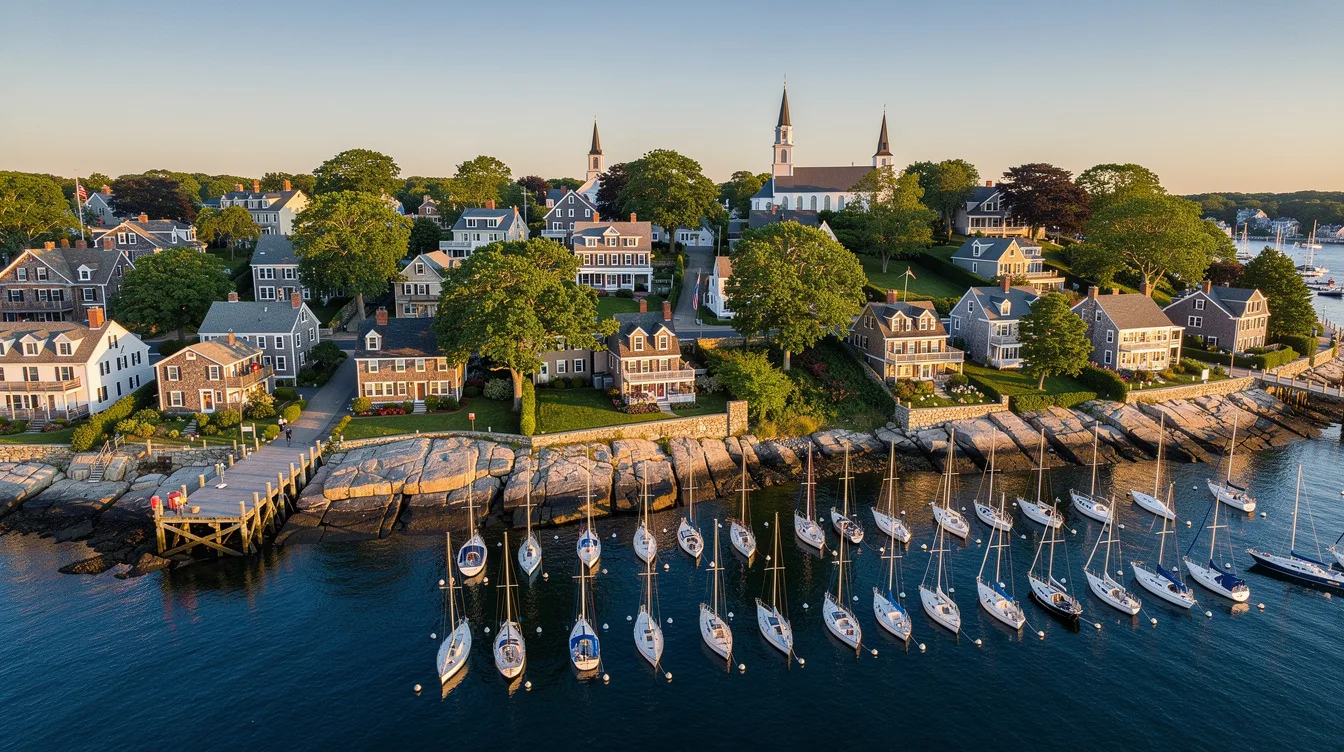
Marblehead sits about 18 miles northeast of Boston, but it feels farther once the narrow lanes begin to twist toward the harbor. This North Shore town claims the title “birthplace of the American Navy,” a legacy tied to its sailors during the American Revolution.
That claim gives the place more weight than a quick coastal stop. And in summer, when sails fill the protected harbor, you can see why water still shapes the town’s identity.
A Navy legacy written into the harbor
Marblehead’s maritime story goes beyond old anchors and souvenir-shop lore. Its seafaring role during the Revolution is why the town makes its Navy claim, and Marblehead sailors were associated with the regiment that helped ferry Washington’s army across the Delaware.
But this isn’t a military museum town with a single grand avenue. You encounter the history in the tight streets, weathered facades, and harbor edges where working boats and pleasure craft share the same view.
The town was settled in 1629 and incorporated in 1649. That age explains the 17th- and 18th-century buildings in Old Town, though it also means you should expect uneven sidewalks and lanes that reward wandering more than efficient sightseeing.
Old Town is where you should slow down
Old Town, within the Marblehead Historic District, is the reason to put your phone away for a while. The streets bend without much logic, so each turn can bring a clapboard house, a small harbor glimpse, or a patch of salt air.
And you don’t need a checklist here. Walk slowly, look uphill, then follow the lanes back toward the water. It’s touristy in summer, but the town’s residential rhythm keeps it from feeling like a stage set.
If you want a more formal stop, the Jeremiah Lee Mansion and Abbot Hall offer two different routes into Marblehead’s past. Abbot Hall holds the Civil War painting The Spirit of ’76, a reminder that the town’s historical pull extends beyond the Revolution.
Marblehead Neck gives the day its horizon
Head out to Marblehead Light and Chandler Hovey Park at the end of Marblehead Neck. The open coastal view is the payoff after Old Town’s close-packed streets, with wind, bright water, and boats moving across Massachusetts Bay.
But the point is less about checking off a lighthouse than lingering at the edge of town. You’ll feel the peninsula’s geography here, set between Massachusetts Bay and Salem Harbor, and the harbor suddenly makes more sense.
Fort Sewall is another waterfront stop worth your time. Its setting looks over Marblehead Harbor, and its historic fortification gives the town’s naval story a physical frame rather than leaving it as a slogan.
Summer sailing is the real show
Marblehead is a major summer sailing destination because its harbor is protected and its coastal culture is still active. You don’t need to sail to enjoy it, though watching the masts and hulls shift against the water is reason enough to stay awhile.
And if you do come in summer, build your day around the waterfront rather than rushing through it. The air carries salt, rigging taps in the breeze, and the town feels lively without becoming loud.
For a simpler shore break, Devereux Beach sits on Ocean Avenue. It’s a town beach, not a wild escape, but that’s part of Marblehead’s appeal: history, harbor, and sand all sit close together.
Getting there takes patience, then rewards it
From downtown Boston, the drive is usually 30-45 minutes, depending on traffic. Because the town is close enough for a day trip, weekends can feel compressed, so an earlier start gives you more room on the streets and waterfront.
You can also take the MBTA Newburyport/Rockport Line to Salem, then use a rideshare or local connection for the roughly 10-minute trip into Marblehead. That route is practical, though it asks you to plan around the final connection.
Come for the Navy claim, but stay until the harbor settles into evening. By then, the lanes are quieter, the boats rock against their lines, and Marblehead feels less like Boston’s nearby coast than a town with its own tide.