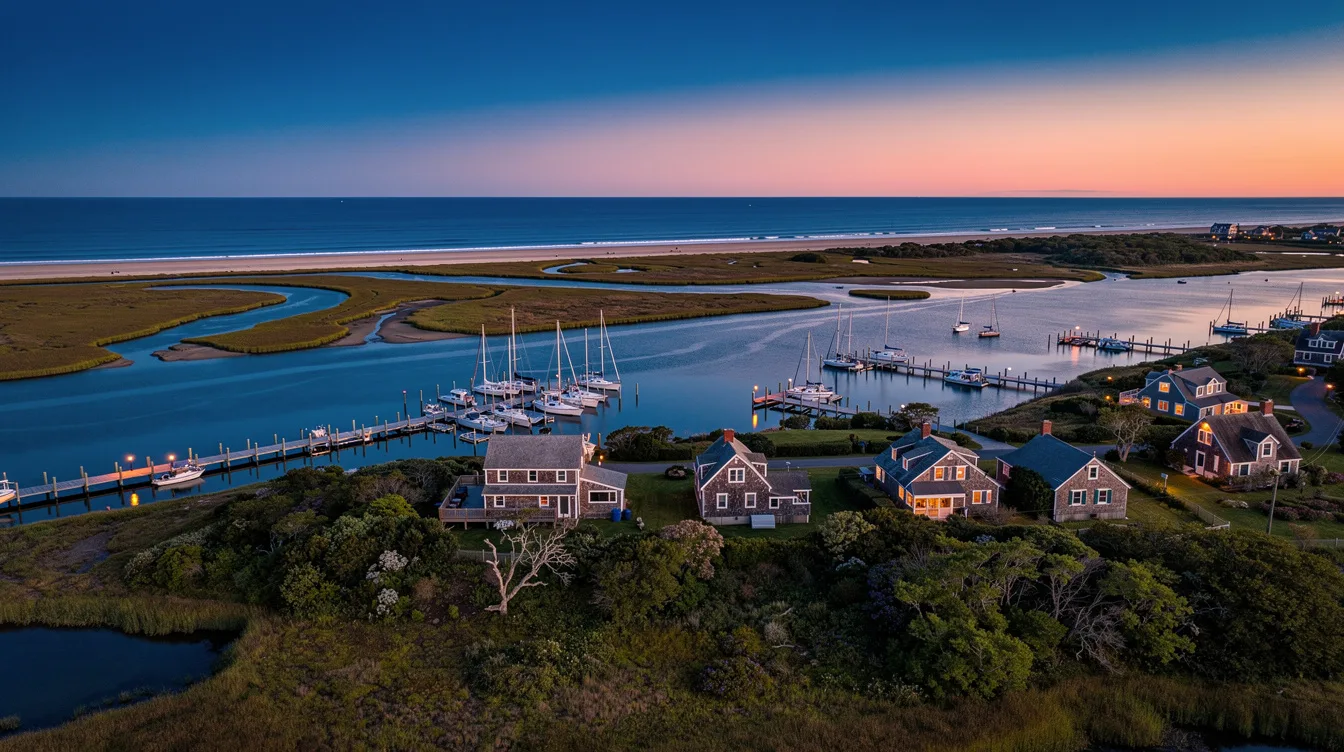
Chatham has about 6,594 year-round residents, then climbs to roughly 20,000 to 25,000 people in peak summer. That jump explains the town’s particular July and August tension: a small Cape Cod community suddenly carries the appetite of a much larger resort.
It happens because Chatham sits at Cape Cod’s southeastern elbow, with the Atlantic on one side and Nantucket Sound on the other. You come for water, certainly, but the appeal is more specific than a generic beach escape: this is polished New England with a working fish pier still in the middle of the picture.
From 6,594 residents to 25,000 people
The summer swell is the story here, because Chatham has beaches, boating, restaurants, galleries, and a walkable Main Street packed into a place built for far fewer permanent neighbors. You’ll feel that contrast most clearly when the sidewalks fill after a beach day and dinner tables become harder to claim.
And the town’s setting makes the influx easy to understand. Atlantic-facing Chatham Lighthouse Beach has broad ocean views, while the Nantucket Sound side offers other choices, so visitors aren’t arriving for one single strip of sand.
Chatham Lighthouse Beach is the dramatic pick, but it asks for attention. Strong currents can shape the day there, so you should heed posted warnings rather than treating the lighthouse view as a reason to ignore the water.
But Chatham isn’t only a place for a beach chair. Harding’s Beach, Cockle Cove, Ridgevale, and Oyster Pond give you different exposures and surf conditions, which is why families and more ocean-focused visitors can make very different plans without leaving town.
Main Street gives summer crowds somewhere to go
Main Street absorbs much of Chatham’s seasonal energy because boutiques, cafés, ice cream shops, and galleries sit within an easy walk. You can spend an hour here between beach stops, though July crowds make it feel more like a resort center than a sleepy village.
And that busier mood has a payoff. The town feels social without needing a loud nightlife pitch, because people are out walking, browsing, and lingering over a meal rather than disappearing behind hotel gates.
For a sharper sense of place, head to the Chatham Fish Pier. Commercial fishing gives the waterfront some grit beneath the polished storefronts, and you may spot seals offshore while boats and dock activity pull your attention away from souvenir-window browsing.
That maritime edge matters because it keeps Chatham from feeling entirely staged. You’ll still find an affluent resort town, but the harbor activity gives the place a working rhythm, especially when the salt air and engine noise cut through a warm afternoon.
The price of a Cape Cod summer
Chatham is most expensive and crowded in July and August, which is the honest reason some travelers should skip those months. You’ll get the fullest version of the town, but you’ll also share its beaches, streets, and restaurants with the seasonal population surge.
Late May through June, or September through October, changes the equation. Fewer people and typically lower costs make those periods a better fit if you want the town’s coastal character without its peak-season pressure.
But don’t mistake quieter for empty. Chatham’s appeal comes from its beaches and town center as much as its summer buzz, so you can still build a full day around the water, Main Street, and the fish pier when the seasonal tide has eased.
The trade-off is straightforward: summer delivers maximum activity, while the shoulder periods deliver breathing room. I’d choose September if the goal is to actually hear the harbor instead of just navigating the crowd around it.
Getting to Chatham without pretending Cape traffic doesn’t exist
Chatham is about 1.5 hours from Boston by car outside heavy Cape traffic. That qualifier matters, because the same route can feel less convenient when the summer population is already streaming toward the shore.
You can also fly into the small municipal airport, CQX. But for many visitors, the drive makes more sense because it lets you arrive with beach gear and leave on your own schedule, even if traffic demands patience.
The town’s roots run deeper than its resort reputation. English colonists settled Chatham in 1664, and it was incorporated in 1712, so the Cape Cod architecture and maritime identity aren’t decorative themes added for visitors.
Go when the crowds suit you, then let the day end near the pier. By evening, the harbor air turns cooler, boats sit against the water, and Chatham feels briefly sized for the people who live there.