
Shower ledge shelf ideas work because a long, low shelf gives you storage without eating into the shower, and that single move can make even a 36×36 in stall look calmer. I learned that the hard way after tiling a shower niche too high and too small for the bottles we used every day. It looked fine on paper. Then real life showed up! The wall felt busy instead of polished.
- ✓ Run a full-width ledge across the back wall
- ✓ Wrap penny tile over the shelf face
- ✓ Float a slim quartz slab under brass fixtures
- Run a full-width ledge across the back wall
- Wrap penny tile over the shelf face
- Float a slim quartz slab under brass fixtures
- Carve a corner ledge into stacked tile
- Frame the ledge with contrasting grout lines
- Extend the shower ledge into a drying niche
- Cap a tiled wall ledge with warm travertine
- Set amber bottles along a recessed stone shelf
- Align the ledge with the shower valve
- Layer two narrow ledges on one wall
- Highlight the shelf with a vertical tile stripe
- Choose a floating ledge with a softened edge
- Pair the ledge with a low-profile shower bench
- Repeat one metal finish from valve to bottle
- Leave one quiet stretch beside the products
- What should a long shower ledge actually hold?
- Choose open storage instead of a deep niche
1Run a full-width ledge across the back wall
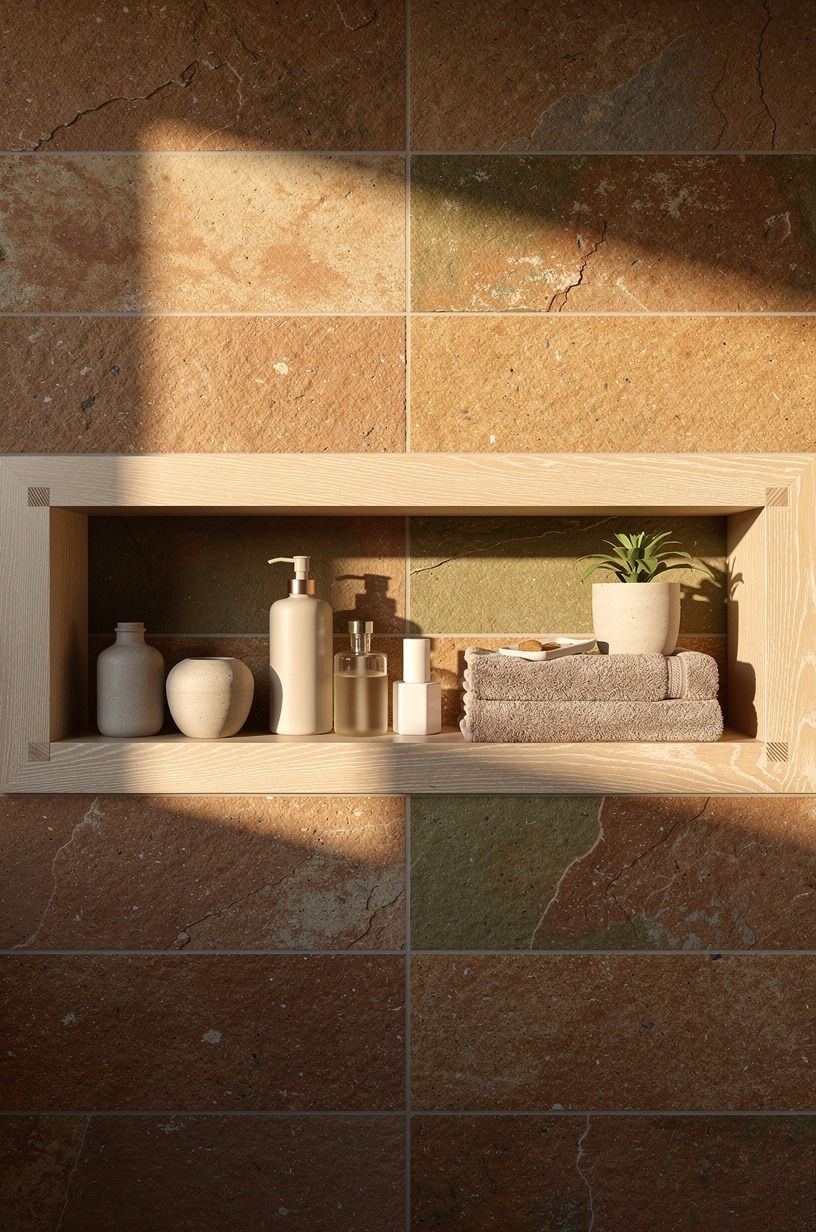
A full-width shower ledge works best when you treat it like architecture, not like an add-on tray. If your shower wall already has terracotta stone tile, olive accents, and that soft cerused finish on nearby wood, running the shelf from side to side makes the whole back wall read as one clean plane. You get the visual width for free, which matters a lot when your shower is only the comfortable minimum of 36×36 in.
And yes, you’ll notice the room feels wider the second your eye stops tripping over a tiny centered niche.
I like this move most when the bathroom is symmetrical, because you can center your bottles, soap, and a small scrub brush without making the ledge look crowded. One or two amber glass bottles. A slim olive ceramic dish.
Maybe a folded Belgian flax linen washcloth at one end if your bathroom styling leans warm and collected. If you’re still deciding between a ledge and a niche, this guide to recessed shower niche shelf ideas for built in clutter free helps you weigh what fits your wall better.
But here’s the part I’d push you on: keep the shelf low, around hand level when you’re standing under the spray, not floating awkwardly near shoulder height. I made that mistake once, and every shower felt like a reach.
If you want more built-in storage logic before you tile, read this recessed shelf comparison before the wall is closed. A long, low shelf should feel inevitable, like it was always meant to live there.
2Wrap penny tile over the shelf face
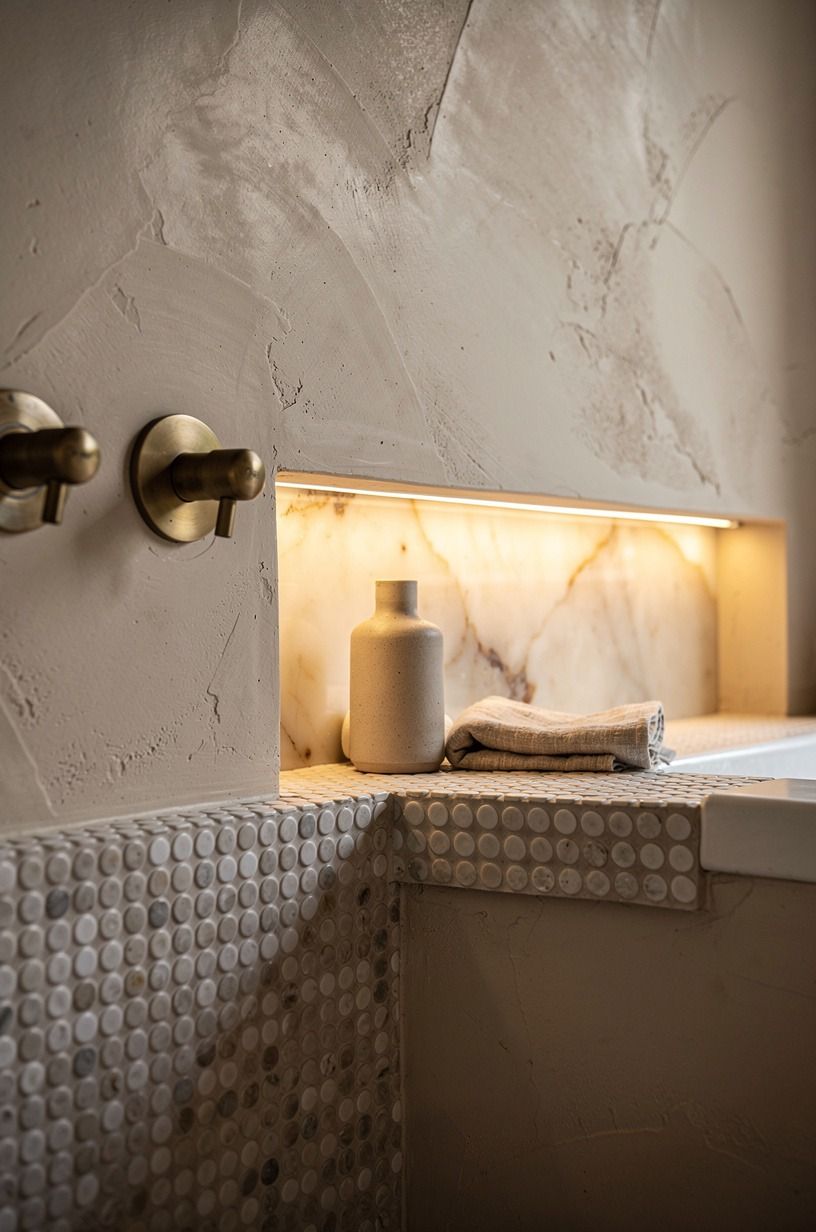
Wrapping penny tile over the shelf face is how you make a tile shower ledge look finished from every angle, especially when you see it first-person as you step into the room. The tiny round texture softens the hard line of the ledge, which is why it works so well with clay and linen tones. If your fittings are aged brass and the room gets a warm backlit glow, the penny tile catches that light in a way flat field tile never does.
You don’t need a loud color shift here. I’d stay close to the wall palette and let the shape do the talking.
Think hand-glazed penny tile in pale clay, cream grout, and a face wrap that looks continuous instead of outlined. The detail feels expensive because the labor shows, not because the material has to cost a fortune.
Typical subway tile runs about $2-$10 per sq ft, while zellige tile lands closer to $15-$35 per sq ft, so penny tile usually sits in that middle zone where you get texture without committing to a full slab moment. If you’re comparing open ledges to inset storage, bookmark recessed shower niche shelf ideas before you call the tile installer.
And if you’re styling the ledge afterward, go quieter than you think. Two matching bottles. One razor.
No rainbow labels. The wrap detail is already doing enough for your modern shower ledge.
The same editing mindset shows up in a calmer body-oil routine, and it applies here too.
3Float a slim quartz slab under brass fixtures
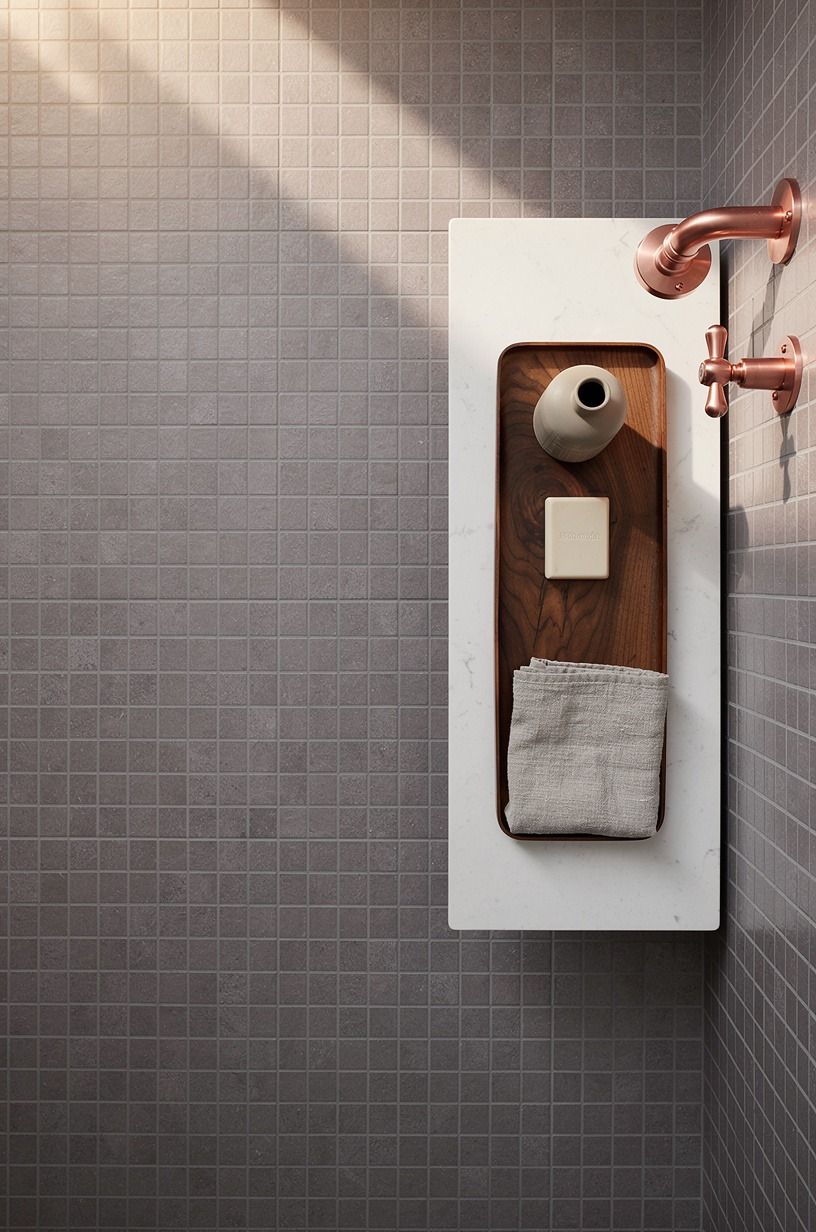
A slim quartz slab under brass fixtures gives you the cleanest version of a bathroom shower ledge, especially if your shower already leans plum gray and soft stone.
4Carve a corner ledge into stacked tile
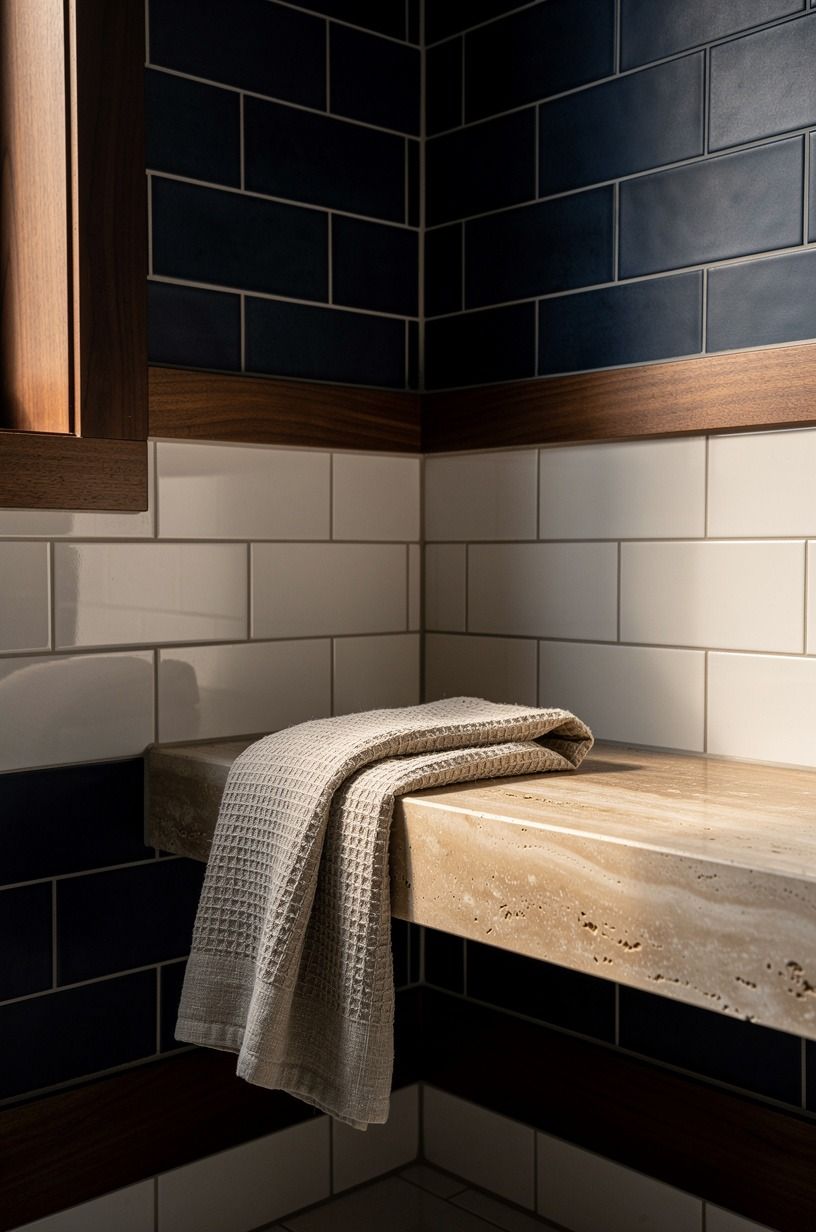
Carving a corner ledge into stacked tile is what I reach for when you want the storage to disappear into the wall but still feel longer and lower than a standard cubby. In a neutral bathroom with sandy stacked tile, the shelf can wrap the corner and keep moving, which makes the shower feel planned instead of patched. Why waste a corner on a tiny triangle shelf when the wall can do more for you?
The key is keeping the cut crisp and the tile rhythm uninterrupted. Let the stacked porcelain tile run long, let the ledge notch in cleanly, and keep the shelf depth useful without going bulky.
Around 3 to 4 inches deep is usually enough for daily products, and it won’t jut into your elbow room. I love this with Sherwin-Williams Sea Salt SW 6204 on the painted walls outside the shower because that muted green softens the tile geometry without stealing focus.
If you want the corner wrap to feel warm instead of clinical, bring in a single natural note nearby. A white oak bath stool with a cerused finish. A 600gsm Turkish cotton towel in oatmeal.
One stone resin bottle instead of plastic. And if you already know clutter gets away from you, pairing a corner ledge with ideas from built-in shower storage can keep the rest of the wall quieter. I also like how a simpler shower routine pushes you to edit what really belongs in reach.
5Frame the ledge with contrasting grout lines
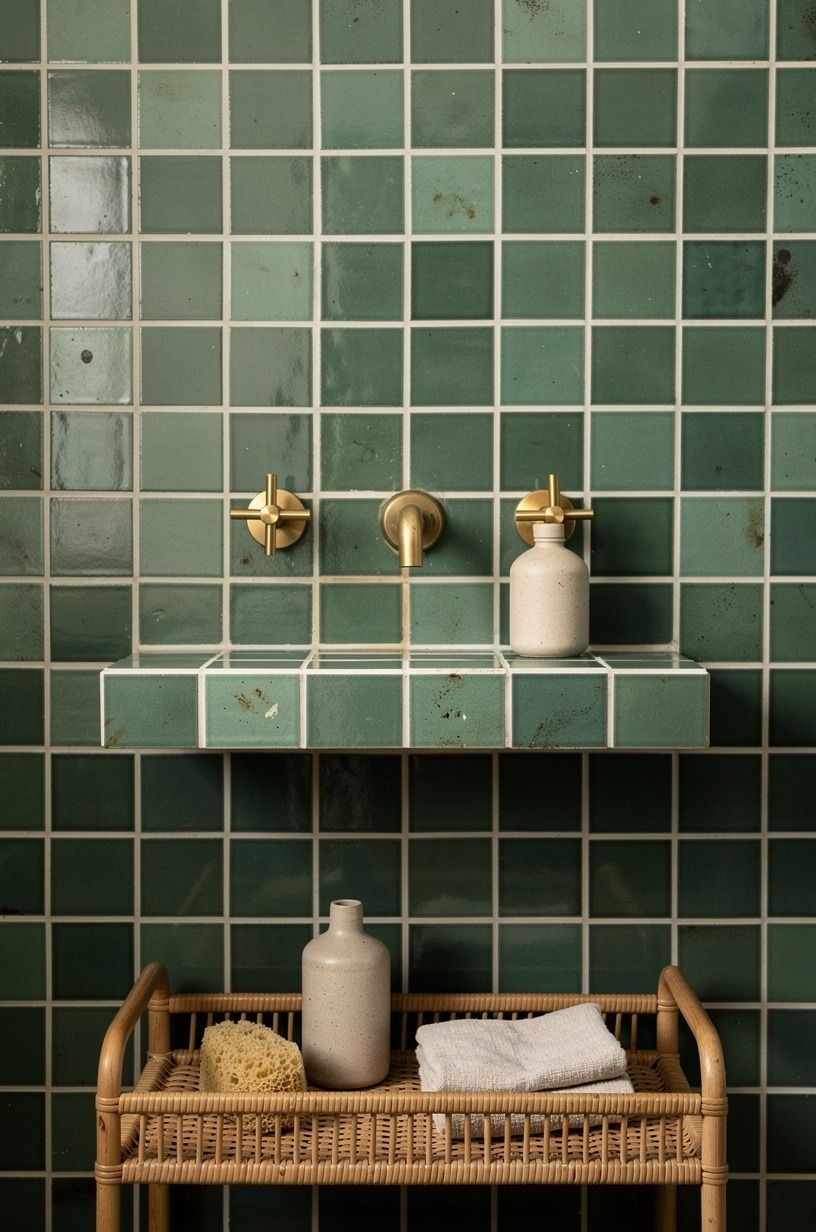
Contrasting grout lines make a shower wall ledge feel intentional fast. On an emerald tile grid with cream grout, the shelf stops being a flat seam and starts reading like a framed detail. That’s what gives you that calm, frontal, almost tailored look in a symmetrical bathroom.
You aren’t adding more objects. You’re letting the lines do the styling.
I especially like this when the hardware is warm gold and the room already has a gentle vintage pull. Emerald ceramic tile with cream grout feels richer than plain white, and the contrast gives you definition even from across the room. But I’d skip bright white grout unless you love maintenance, because shower buildup shows faster there and the whole point of this look is polish.
Benjamin Moore Chestertown Buff HC-9 on the non-wet walls can bridge that green and cream palette beautifully if you want the bathroom to feel softer outside the shower too.
But keep the products on the ledge simple. One glass pump bottle.
One natural sea sponge. Maybe a brass drain cover below to echo the metal above.
The grout pattern is busy enough that you don’t need decorative chaos layered on top. If your room is dim, the lighting geometry notes in floor-lamp placement for darker rooms can help you think about glow placement outside the shower too.
6Extend the shower ledge into a drying niche
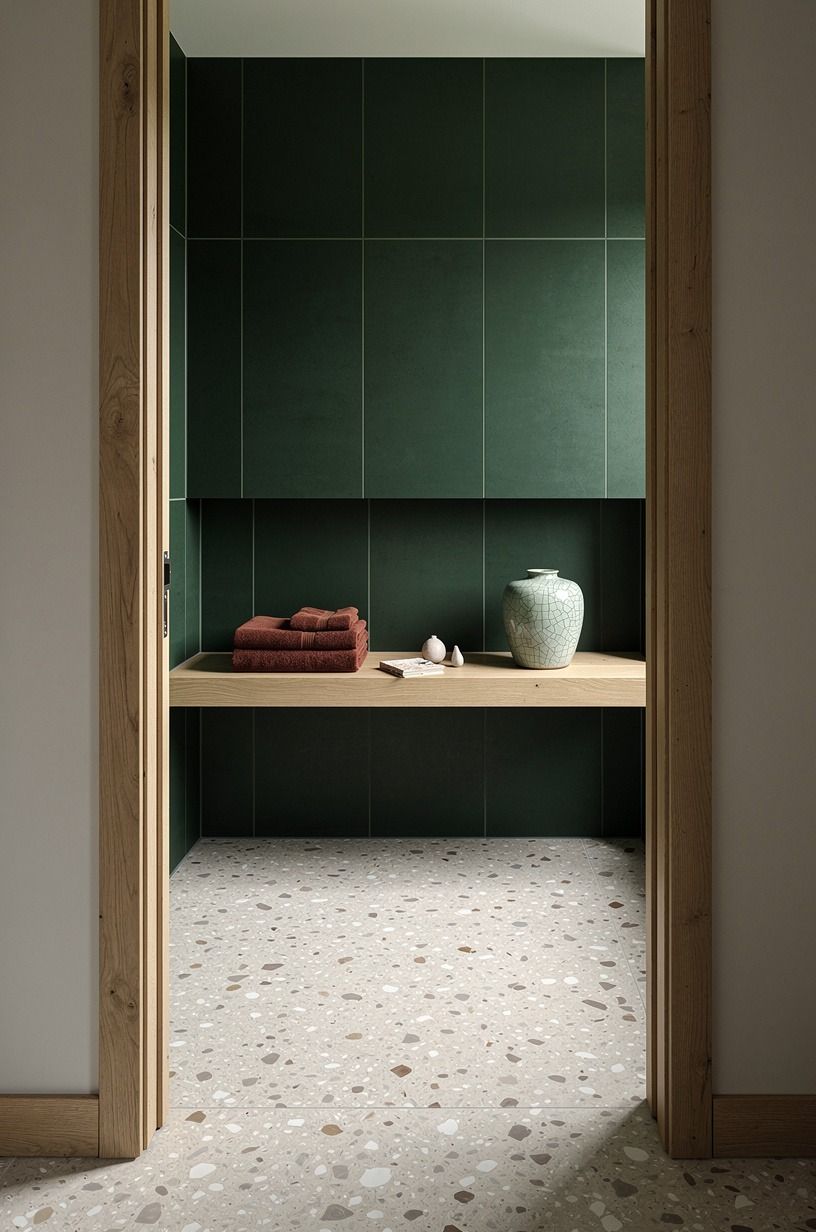
Extending the ledge into a drying niche is one of those moves that makes a bathroom look custom because it solves two problems with one line. From the doorway, you see the long shelf first, then the tucked niche continuing off it, and the whole shower feels larger than it is. If your tile is forest green and your towels run rust, that horizontal pull keeps the palette grounded instead of choppy.
I’d do this when you want a place for products plus a perch for the items you don’t want sitting in direct spray. A forest green wall tile ledge can hold shampoo and body wash, while the niche extension protects a cedar bath brush, a razor, or the bottle you’re not using daily.
Natural oak trim outside the wet zone helps tie the green and rust together. For the storage-curious among us, it also borrows the logic of a built-in without forcing you into a boxy niche centered at eye level.
And yes, this works especially well if you already keep a post-shower routine nearby. I keep body oil outside the spray because waterlogged labels drive me nuts, and if you’re rethinking that zone too, a low-clutter body-oil routine is a useful read.
You can pair that with recessed wet-zone storage if you want the wet-zone and dry-zone storage to feel like one plan. The layout matters more than people think.
7Cap a tiled wall ledge with warm travertine
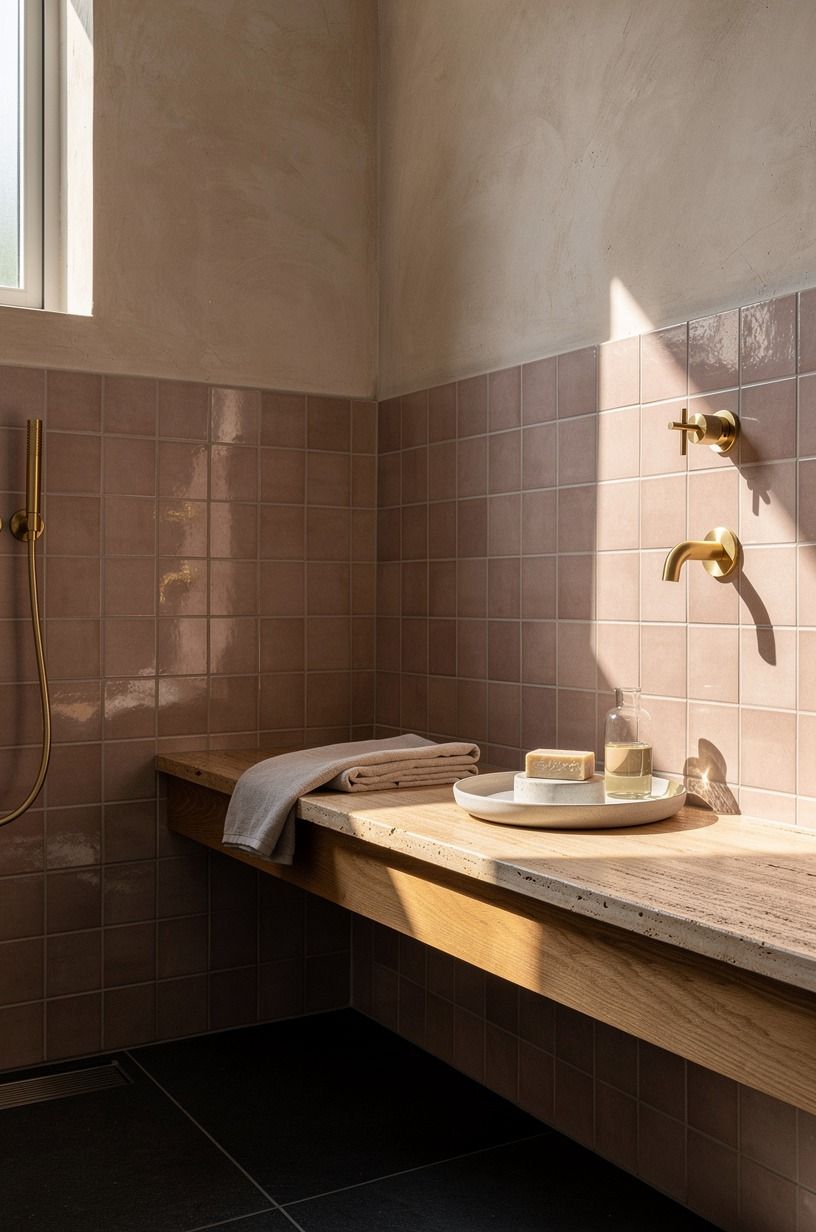
Capping a tiled wall ledge with warm travertine is the fastest way to make a modern shower ledge feel older, softer, and more grounded. I love it when the shelf runs corner to corner but sits slightly off-center in the room, because that tiny asymmetry keeps the bathroom from feeling staged.
Travertine has movement. Tiny pits. A chalky warmth.
That’s why it pairs so well with warm whites, brushed metal, and low-contrast tile.
If you’re choosing between stone looks, I’d take travertine over cool gray marble here every time. Honed travertine doesn’t glare under bathroom lighting, and it doesn’t feel as slick or formal as polished marble.
Typical marble top pricing runs about $50-$100 per sq ft, and while travertine varies by source, the point is value perception: the cap looks custom because it changes material right where your hand goes. That sensory shift matters.
Style it lightly. A single amber apothecary bottle.
A pale limestone soap dish. A folded waffle cotton cloth.
If your room is leaning too crisp, this is the move that pulls it back toward warm. And if you need more proof that fewer products usually look better, a pared-back shower routine makes that case pretty well.
8Set amber bottles along a recessed stone shelf
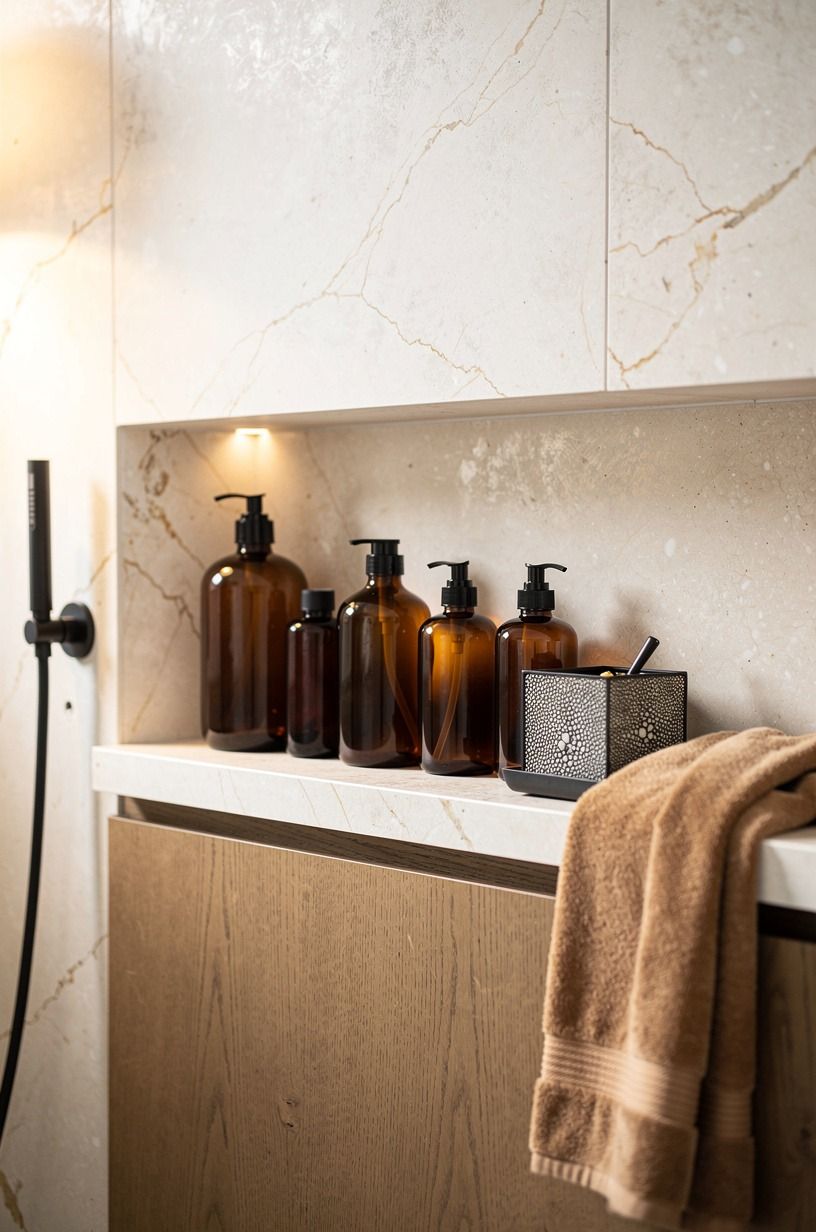
Setting amber bottles along a recessed stone shelf sounds simple, but the styling is what makes this shower ledge shelf idea read editorial instead of random.
9Align the ledge with the shower valve
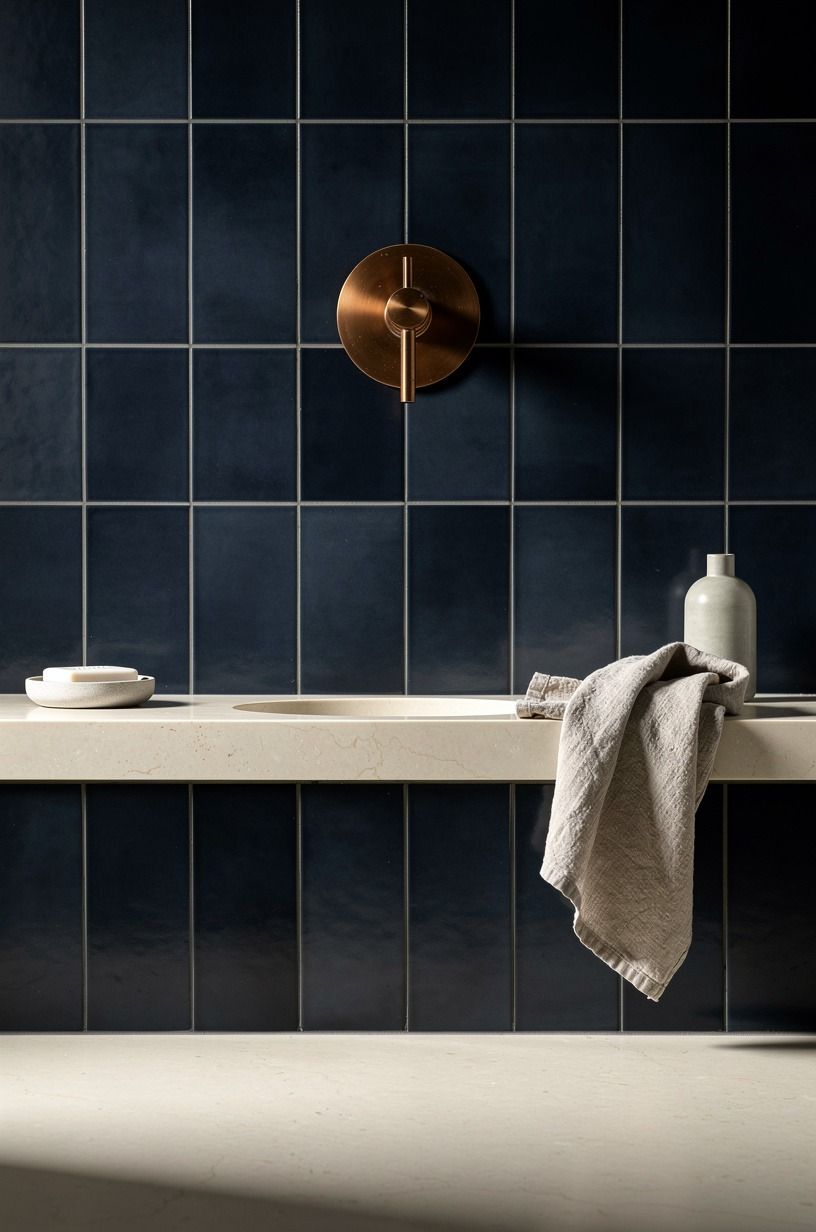
Aligning the ledge with the shower valve is the most disciplined move in the whole group, and it pays off every single time! In a midnight blue tile shower with an ivory floor, that straight horizontal line meeting the valve center makes the wall feel resolved.
The symmetry is what your eye trusts. Even if you can’t explain why the bathroom looks calmer, you’ll feel it.
This is the ledge strategy I’d use in a small bathroom where every visual mistake gets louder. Set the shelf so its top or center line hits the valve trim exactly, then repeat that logic with your grout joints if you can.
Farrow & Ball Hague Blue No. 30 nearby on cabinetry or trim would be gorgeous with this palette if you want to deepen the whole room. And if your family takes cold showers on purpose, fine, but if not, skip the sensational detour and keep the room focused on a calm, practical ritual.
I wouldn’t offset the shelf just to dodge a plumbing line unless the alternative is terrible construction work. The alignment is the reason the wall feels expensive.
Break that, and the magic goes with it. And if you’re still torn between a ledge and an inset detail, compare recessed and open storage before demo starts.
10Layer two narrow ledges on one wall
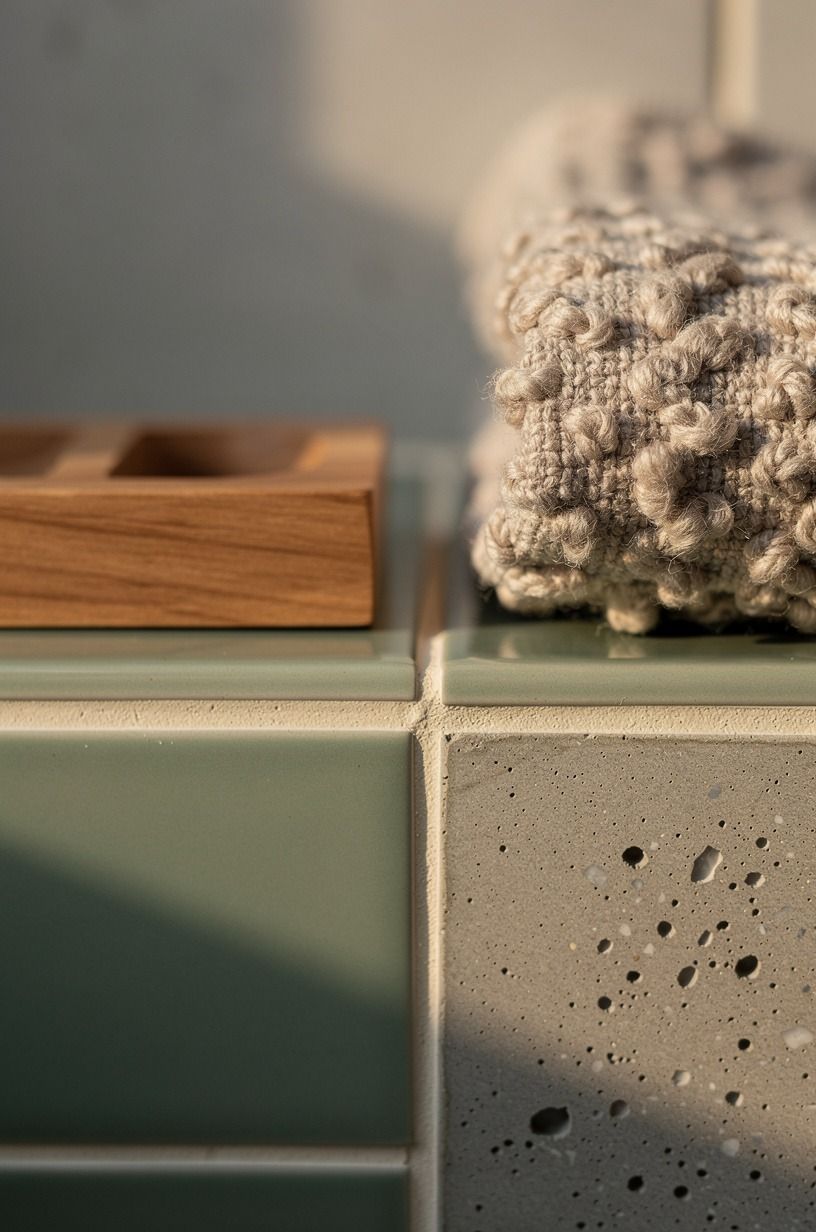
Layering two narrow ledges on one wall works when one long shelf won’t quite hold what you need, but you still want the room to feel low and linear.
11Highlight the shelf with a vertical tile stripe
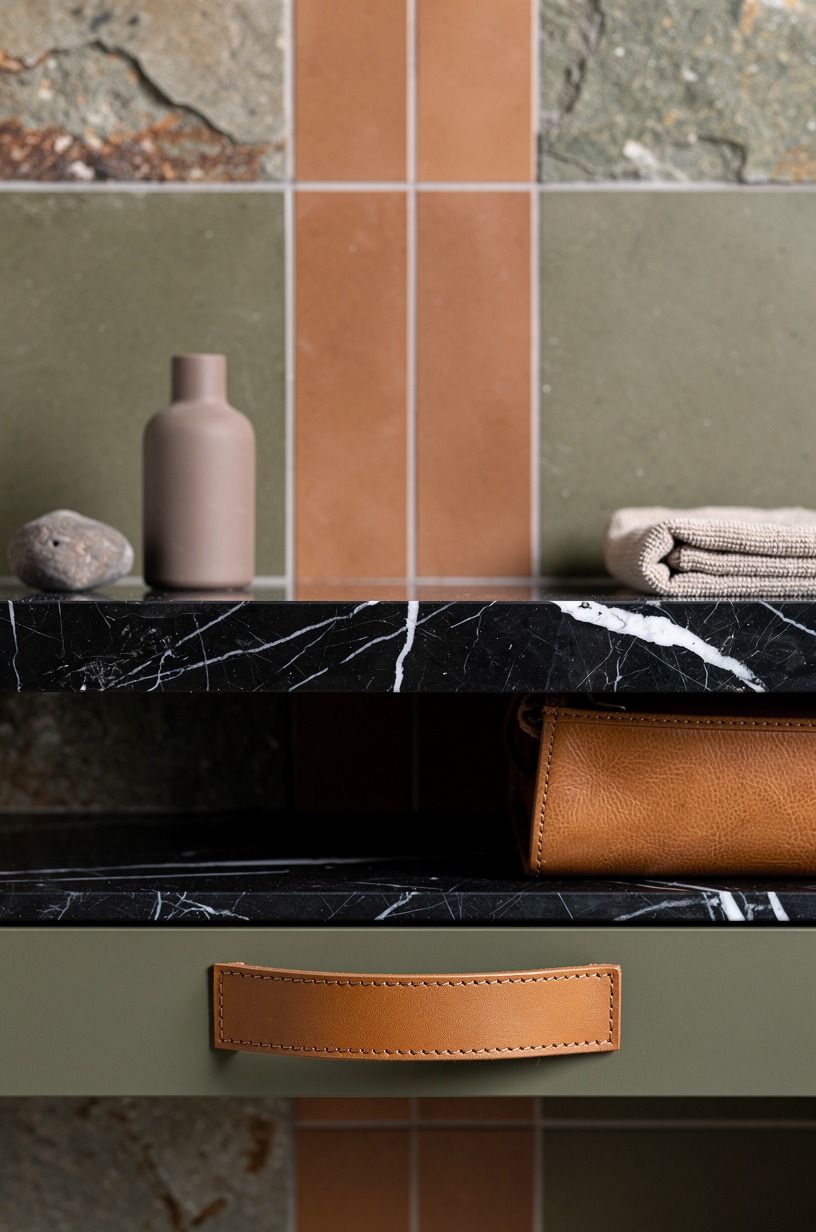
Highlighting the shelf with a vertical tile stripe gives a long, low shelf one strong moment of emphasis without losing the calm. I love this in terracotta, where the stripe rises from the ledge and pulls your eye upward while the shelf keeps the room grounded. You get height and width in the same move, and that’s rare in a bathroom that may only have a 32-36 in vanity and a standard 60×30 in tub nearby competing for attention.
The best version uses one stripe only. Not two. Not a full feature wall.
A single terracotta tile strip crossing a warm plaster-look field tile makes the ledge feel placed with purpose. Add a brushed brass shower set, a small cream stone bowl, and maybe a natural oak frame outside the shower to repeat the earthy warmth. This is the kind of move that looks bold in a photo but surprisingly livable once you’re brushing your teeth in front of it every day.
But be honest about your room. If the bathroom already has a loud patterned floor, skip the stripe and let the ledge stay quiet.
A stripe should sharpen the wall, not start an argument with it. If you’re refining the whole ritual at the same time, a calmer shower routine pairs nicely with this calmer setup.
12Choose a floating ledge with a softened edge
A softened edge takes the hard, rectangular feeling out of a floating ledge without making the construction fussy. You can round the outside corner slightly, ease the stone edge, or choose a tile trim with a quieter profile. If your bathroom has cool porcelain and sharp black fittings, that small change keeps the shower from feeling like a showroom display.
I’d choose a honed quartzite edge over a glossy bullnose when the rest of the room already has plenty of shine. You get a velvety touch under your palm and a line that disappears into the wall from a distance.
If you’re planning the wall from scratch, ask for a 1/8-inch eased edge and a waterproofing detail your installer can explain clearly. You should understand where the water goes before the pretty stone arrives.
13Pair the ledge with a low-profile shower bench
Pairing the shelf with a low-profile bench makes sense when the bathroom has enough floor area for both pieces to breathe.
14Repeat one metal finish from valve to bottle
Repeating one metal finish from the valve to the bottle pump is a quiet way to make separate shower details feel related. You don’t need every accessory in the same finish, but one repeated note gives your eye a path to follow from the wall, across the ledge, and back to the hardware.
Unlacquered brass works when you want the room to soften with age. It will change.
That’s the charm, as long as you’re comfortable with a living finish and occasional water spots. If you want a steadier look, West Elm brushed brass accessories or a simple matte-black pump can hold the line without requiring a perfect match.
I’d skip mixing three warm metals in one compact shower, because the little room can’t absorb that much competition.
15Leave one quiet stretch beside the products
Leaving one quiet stretch beside the products is the simplest styling move here, and it may be the one that saves the whole wall. Give the bottles a group, then leave enough bare ledge that your eye can rest. You need that empty space for the shelf to look useful rather than stuffed.
My rule is three daily-use items, then stop. Amber glass, a cream ceramic dish, and one small natural sponge are enough for most people. If you’ve got a large family, hide the overflow elsewhere instead of turning the long ledge into a lineup.
You’ll clean it faster, reach everything without shuffling bottles, and still see the material you paid for. That last part matters!
16What should a long shower ledge actually hold?
A long ledge should hold the things you reach for every day, with enough open space around them that the shower still feels serene.
17Choose open storage instead of a deep niche
Choose open storage instead of a deep niche when you want the shower to feel airy and easy to clean. A shallow ledge lets you see every bottle from the doorway, and you won’t have to reach into a dark pocket for the conditioner. That’s a small daily win, but daily wins are where a bathroom earns its keep.
I’d choose the open ledge for a family bathroom, especially if different people use different products. A deep niche can swallow labels and create a damp little corner that you’ll resent later.
Keep the shelf around 3 to 4 inches deep, slope the top very slightly toward the shower, and leave enough lip that your bottles won’t slide. The cleaner sightline is worth the trade.
Why Does the IKEA Storage Rule Keep a Ledge Clean?
The IKEA RÅSKOG storage rule is simple: the ledge holds daily-use products, while overflow moves somewhere you can reach without crowding the wall. A slim rolling cart outside the spray or a KALLAX birch-effect cube near the vanity can carry backups, cleaning supplies, and the products you use once a week. The shower itself should stay soothing.
You don’t need to buy a matching set. I prefer one warm bottle, one low dish, and a single textured cloth, then I hide the rest.
If your bathroom is small, choose a cart with a 15-inch footprint and keep it outside the wet zone. That leaves the long shelf visually quiet while your actual routine stays workable.
A welcoming bathroom isn’t empty; it’s edited enough that you can move through it without negotiation.
What It Usually Costs to Get the Look
If you’re wondering whether a shower ledge shelf upgrade belongs in a light refresh or a real renovation, the short answer is both. The shelf itself isn’t always the budget breaker. Tile scope, plumbing access, and how much of the wall you’re redoing usually decide that.
For the shelf materials themselves, a lot depends on what you’re capping or wrapping it with. Zellige tile tends to run $15-$35 per sq ft.
Subway tile is usually $2-$10 per sq ft. A marble top often lands around $50-$100 per sq ft.
And a brushed brass faucet often falls in the $120-$450 range. That’s why I usually tell people to spend on the surface your hand touches and go simpler on the rest.
Why This Low Shelf Trend Keeps Winning in Real Bathrooms
I’ve gone back and forth on shower niches, floating shelves, and wall caddies, and the long ledge keeps winning because it respects the way you move. You reach sideways, not up.
You clean a straight line faster than a deep box. You see fewer interruptions across the wall.
In a bathroom, those tiny frictions add up.
The other reason is visual. A long, low ledge gives the wall a horizon line, and rooms with a strong horizon almost always feel more settled. That’s true whether your taste runs terracotta and olive, midnight blue and ivory, or warm stone with amber glass.
The shelf isn’t loud. It’s just smart. And if you want a built-in cousin to compare it to, the tucked-away storage version shows the more hidden approach.
The Shelf Detail I Wouldn’t Skip
If you’re planning a shower from scratch or retiling one that never felt right, I’d make the case for the long, low ledge before almost anything else. Not because it’s trendy.
Trends are cheap, and bathrooms are not. I’d do it because this one detail changes how the room works every single day, and those daily-use upgrades are the ones that keep paying you back long after the project dust is gone.
I learned that after living with a pretty but annoying shower for longer than I should have. The niche looked balanced in elevation drawings, but once the tile was up, the bottles were shoulder high, the razor had no natural resting spot, and the wall had too many little interruptions.
Nothing was disastrous. That was almost worse.
The room never failed hard enough to force a fix, so I had to feel mildly irritated every morning until I finally admitted the design was wrong.
What a long ledge does is remove negotiation. You don’t ask where the shampoo goes.
You don’t hover with a wet bottle trying to make it line up with a cubby that’s too shallow. You don’t break the wall into puzzle pieces.
You get one clean line, one easy reach, and a surface that can hold the real mix people use: pump bottle, bar soap, scrub mitt, maybe a candle outside the wet zone if the bathroom is that kind of room.
And I’d argue that’s why the detail reads more expensive too. Luxury isn’t always more material. Sometimes it’s less decision-making.
A ledge that runs full width, wraps a corner, aligns with the valve, or picks up a vertical stripe tells your eye that somebody thought the room through from edge to edge. That’s the feeling people call polished.
It’s not magic. It’s planning.
So if you’re torn between adding more features or refining the wall you’ve got, refine the wall. Keep the materials warm.
Let the bottles be part of the composition. Spend money where your hand lands.
And if one choice feels too fussy to clean, too high to reach, or too busy once labels hit the shelf, trust that instinct. Bathrooms tell on bad decisions fast.
The Questions I Get Asked Most
What is the best Shower Ledge Shelf Ideas: The Long, Low Shelf Everyone’s Adding for a small bathroom?
A full-width back-wall ledge is the best pick for a small bathroom because it keeps the wall quiet and gives you more usable storage without extra bulk. If you want a second option, a corner-wrapped ledge works well too. I’d keep the bottles low and the shelf line uninterrupted.
Where can I buy Shower Ledge Shelf Ideas: The Long, Low Shelf Everyone’s Adding pieces on a budget?
Start with IKEA, Target, and Wayfair for bottles, stools, towels, and simple brass-look accessories. Facebook Marketplace is great for a small oak stool or mirror if you’ve got patience. You don’t need luxury sources to make the ledge look thoughtful, just fewer mismatched pieces.
How much does a Shower Ledge Shelf Ideas: The Long, Low Shelf Everyone’s Adding makeover cost?
About $200 to $1,200 for a light bathroom refresh, and much more if tile or plumbing moves are involved. The free upgrade is editing what sits on the shelf. Pull off the loud labels, decant what you use daily, and clear the extras first.
Can I create a Shower Ledge Shelf Ideas: The Long, Low Shelf Everyone’s Adding on a budget?
Yes, and the cheapest version is often the smartest. Focus on paint, bottle editing, and one warm material swap first. A clay-toned bottle set, a better towel, and a cleaner ledge line can change the room before you touch major tile.
Is a Shower Ledge Shelf Ideas: The Long, Low Shelf Everyone’s Adding worth it in a small space?
Yes, especially in a small space, because the long line makes the shower feel wider and calmer. That’s the value move here. Keep the ledge low, align it with the valve if you can, and don’t crowd it with products you never reach for.
If you need more hidden storage after that, recessed shower storage is the next place I’d look.
Is Shower Ledge Shelf Ideas: The Long, Low Shelf Everyone’s Adding a good idea for a rental?
Yes, if you translate the look instead of rebuilding the wall. Use removable styling and no-damage storage nearby: amber refill bottles, a teak stool, a tension caddy outside the sightline, and a better towel palette. You can fake the polish even if the tile stays put.
Where I’d Start First
If I had to pick one, I’d start with the full-width back-wall ledge. It fixes storage and sightlines at the same time, which is why it beats fussier upgrades. Pin that idea for later and start by clearing half the bottles off your current shelf tonight.
{ “title”: “11 Shower Ledge Shelf Ideas That Make Any Bathroom Feel Twice as Polished”,