
Hidden mirror door ideas with a full-length mirror that opens work best when you plan the wall first, not the mirror last. I learned that after trying to force a tall mirror onto a bad swing path in my own living room, and the door clipped the rug every single time. Fix the wall. Then the door. Everything reads calmer after that.
Don’t overthink: Anchor the mirror door beside built-ins.
- Start with a smoked mirror wall panel
- Anchor the mirror door beside built-ins
- Layer molding across the mirrored seam
- Hang sconces directly on the mirror frame
- Build a Murphy-style wall behind antique glass
- Conceal storage behind a paneled mirror
- Frame the opening with slim black trim
- Float a console below the detail mirror
- Repeat living room millwork over the door
- Install push hardware behind a brass rosette
- Finish with lounge storage beyond the mirror
- Test the swing path before you commit to glass
- Why does the hinge action matter as much as the mirror itself?
- Hide the threshold with a continuous floor line
- Use full-height pulls in aged brass or blackened steel
- Should you add anti-glare film if the door faces a window?
- What if the door leads to a closet, not a wall?
- Plan the back panel like a real room, not leftover space
1Start with a smoked mirror wall panel
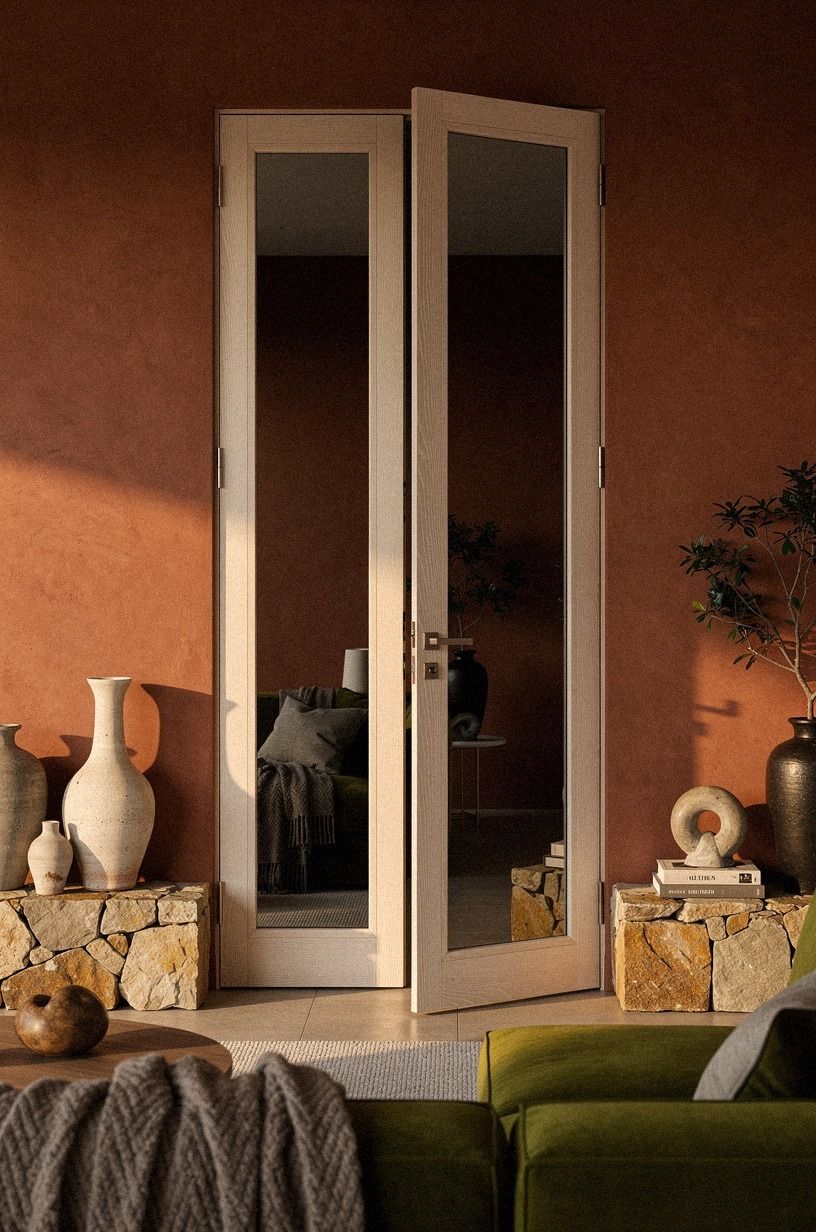
Begin with the largest visual move first: the mirror tone. A smoked panel gives you depth without the hard glare you get from bright silver glass, and if your room already leans terracotta, stone, and olive, you’ll see why it works the second the light hits it. I like smoked mirror glass here because you still get reflection, but you don’t get that dressing-room flash that can make a living room feel cold.
Before you size anything, stand where you normally enter the room and look at the whole wall. You want the panel to read like part of the architecture, not a lonely slab pasted on top.
In a space with terracotta upholstery and honed stone, I’d skip a shiny bevel because it pulls too formal. A flat edge looks richer.
If you’re collecting concealed-door references, the proportions in this mirror door bar setup show the same calm, built-in look you want.
And measure the walking path before you order. If a rug sits in front, leave the door clear enough that you can open it without kicking the pile sideways. Small move.
Big difference!
2Anchor the mirror door beside built-ins
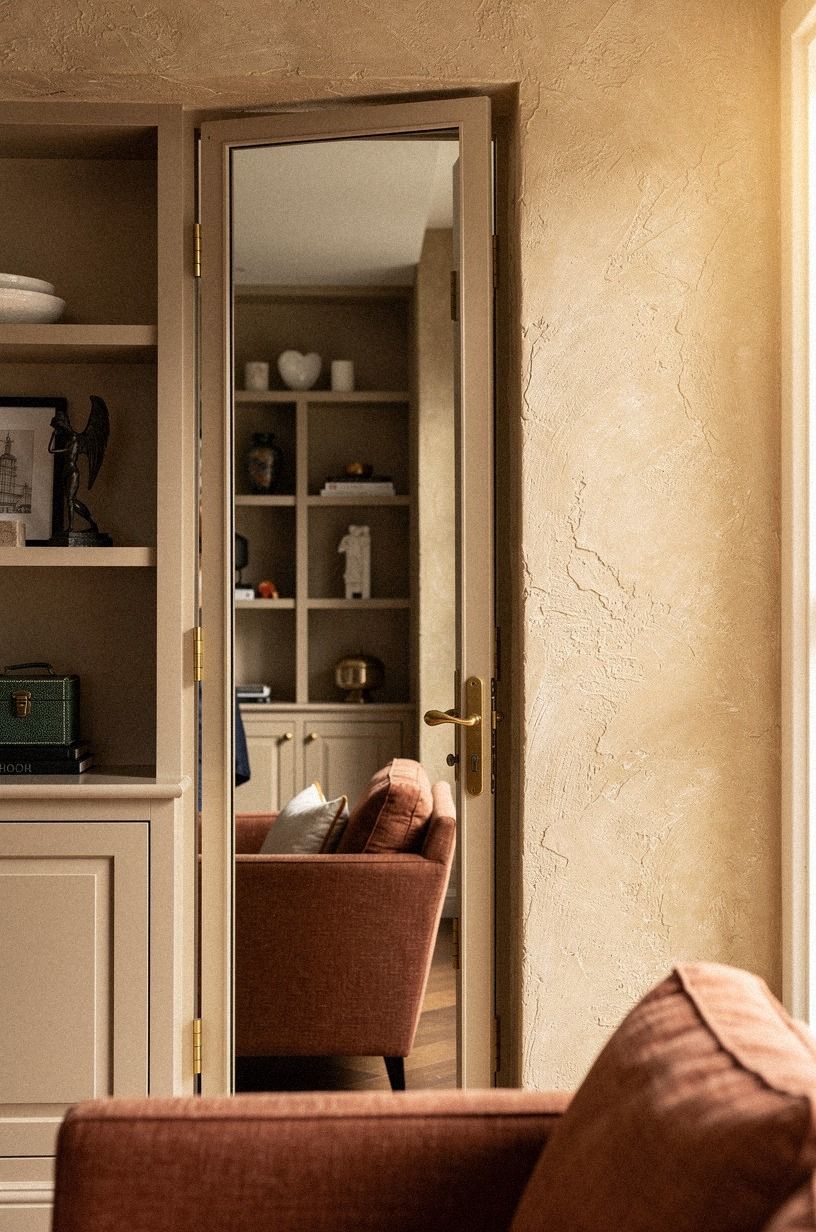
Next, give the mirror a reason to exist by parking it beside cabinetry or shelving. A full-length mirror floating by itself can feel random, but once you anchor it next to white oak built-ins, your eye reads it as part of a larger storage wall. That’s what makes the hidden storage door idea feel expensive and grounded.
I use a simple test here: if you can imagine swapping the mirror for a bookcase and the wall still makes sense, you’re in the right zone. If not, shift it closer to the millwork.
In first-person view, the opening should feel a little off-center, with enough negative space that you can step toward it naturally. I’d rather trim a shelf bay than center the mirror on an empty wall.
Empty symmetry is the losing option.
And don’t chase a perfect centerline if your shelves are off. Most living rooms have a door, a window, or a heat register that pulls the eye one direction, and your mirror door reads better when it leans slightly toward the heavier mass. If your room needs more disguised-entry ideas, this hidden door roundup is useful for layout thinking, even if you keep your finish softer and more living-room friendly.
3Layer molding across the mirrored seam
This is where most blind door plans either pass or fall apart. If the seam stops dead, people spot the opening.
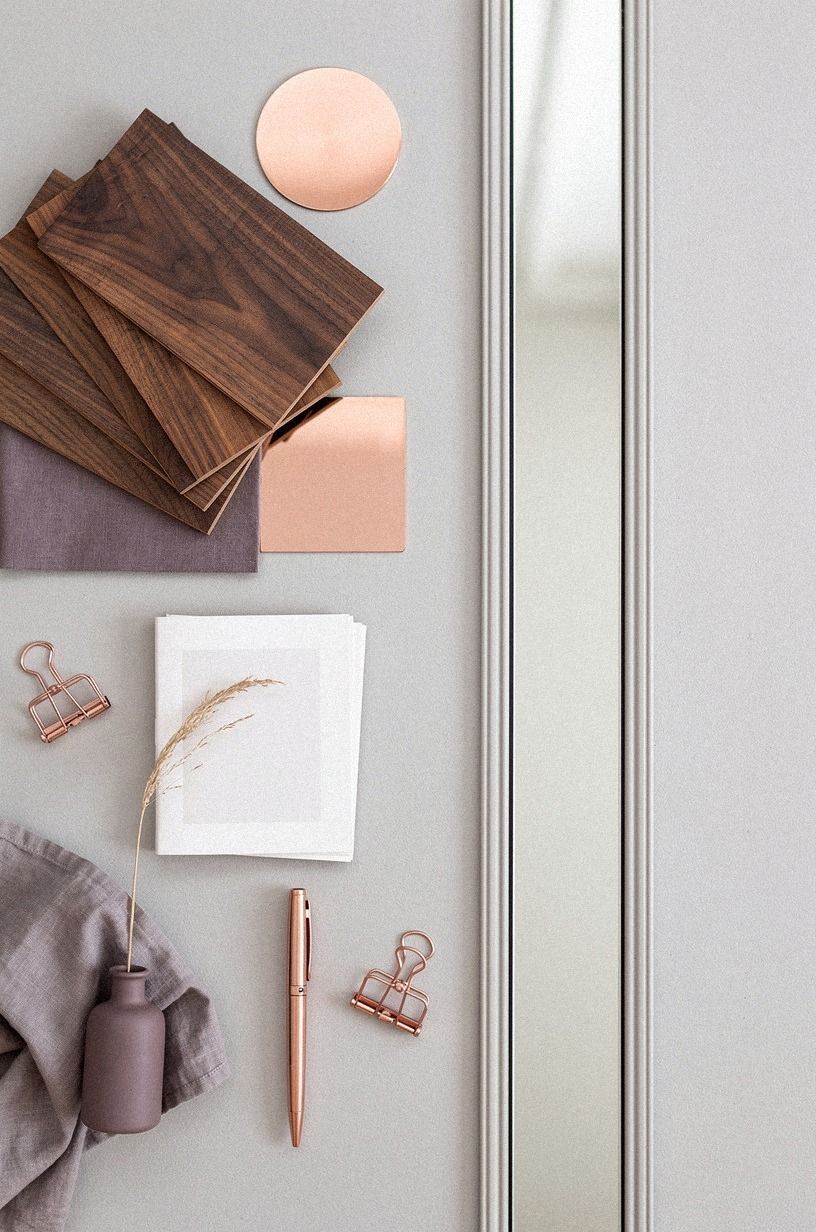
If the seam gets too busy, people spot it for a different reason. The fix is slim, repeated trim that carries straight across the joint, and I mean straight. Use applied molding strips that match the rest of the wall profile so the eye keeps moving instead of freezing at the crack.
I made the mistake once of using chunky trim on a mirror seam because I thought more relief would hide more. It didn’t. It created a shadow line that screamed door.
You’ll want the molding shallow, crisp, and repeated at the same interval as the surrounding wall. In an overhead planning view, mark the seam, then lay painter’s tape for each molding run before anything gets glued.
You can catch a bad rhythm in five minutes that would cost a full repaint later.
But don’t let the molding land too close to the edge pull. Leave enough breathing room for your fingers, your push point, or your hardware detail if you’re using one.
That’s the whole Two-Line Seam Rule I keep coming back to: one line to hide the cut, one line to keep it usable. The discipline in this concealed door trim guide walks through the same logic with a few more picture references.
4Hang sconces directly on the mirror frame
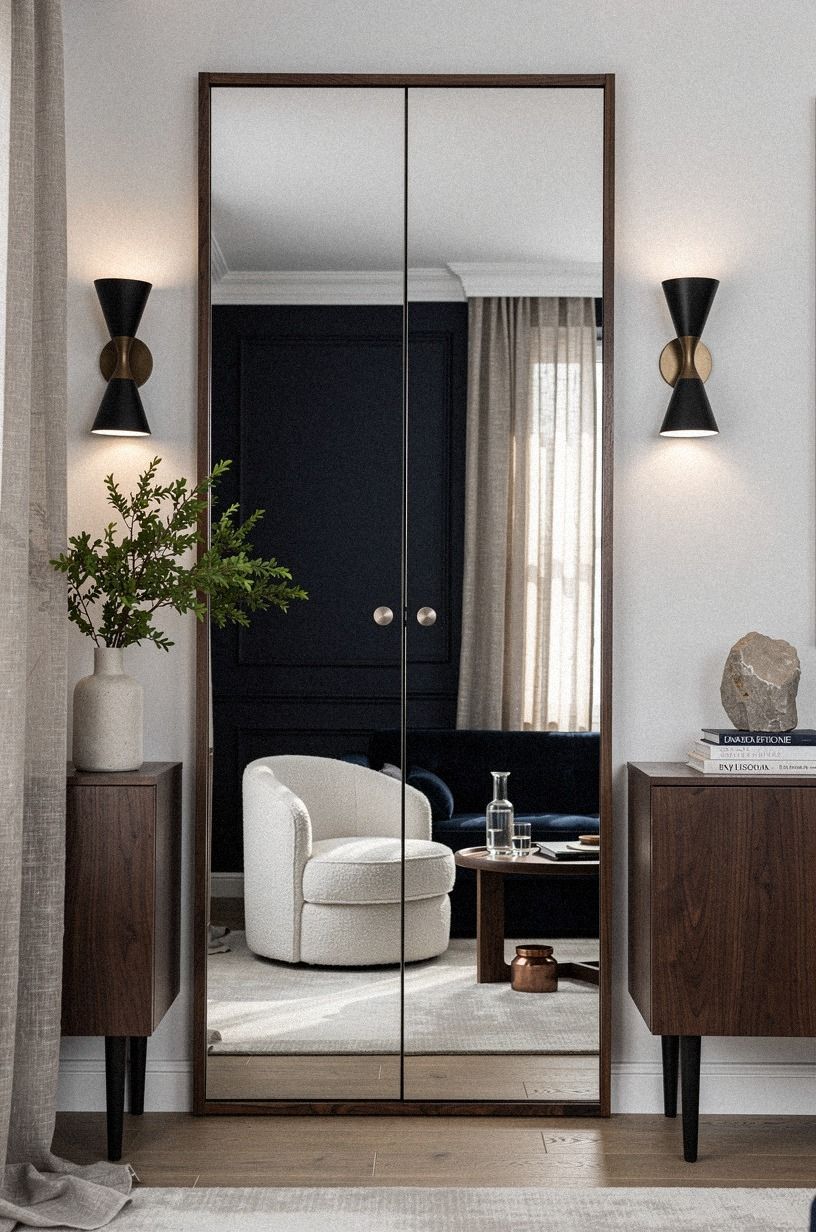
Now for the bold move. If your mirror door sits in a navy, white, and walnut room, you can mount sconces right on the frame and make the door feel even more intentional. The key is using a frame that can visually hold the light.
A skinny frame with big fixtures looks nervous. A slightly wider rail in walnut veneer or painted wood looks planted and warm.
Would I do this with oversized lantern sconces? No, and that’s where a lot of plans go wrong. You want compact fixtures with a clean backplate, something in aged brass or blackened metal that keeps the mirror readable.
In a room painted Farrow & Ball Hague Blue No. 30, the brass glow against a darker wall looks hushed and warm at night, and you don’t lose the mirror’s shape from across the room.
Keep the bulbs soft and low glare. Stay between 2200K and 2400K if you’re using LEDs, and dim them down to about 30 percent in the evening.
Anything brighter reads like a hallway. And if you need more hidden-door inspiration with mood lighting, the layered glow in this bar behind a bookcase example gets the vibe right without turning the wall into theater.
5Build a Murphy-style wall behind antique glass
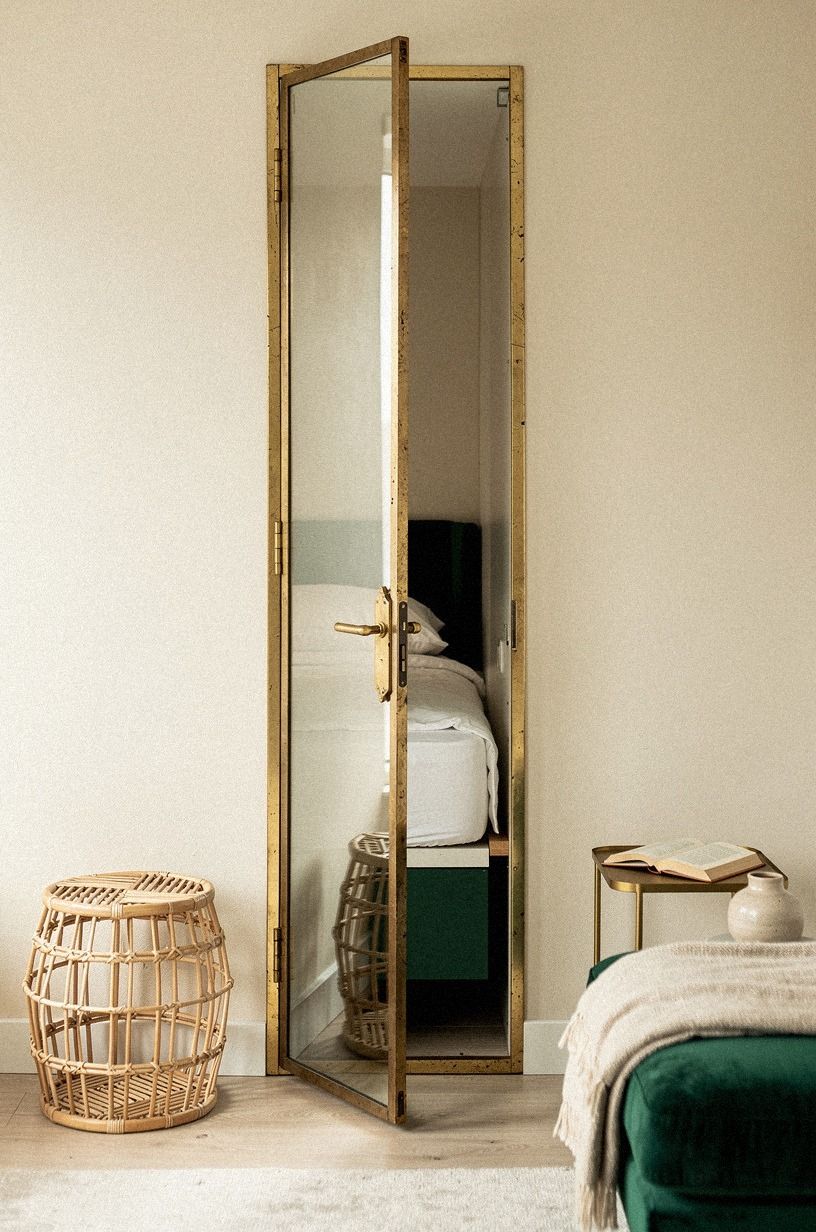
If you want the opening to feel hushed and a little dramatic, antique mirror is the move.
6Conceal storage behind a paneled mirror
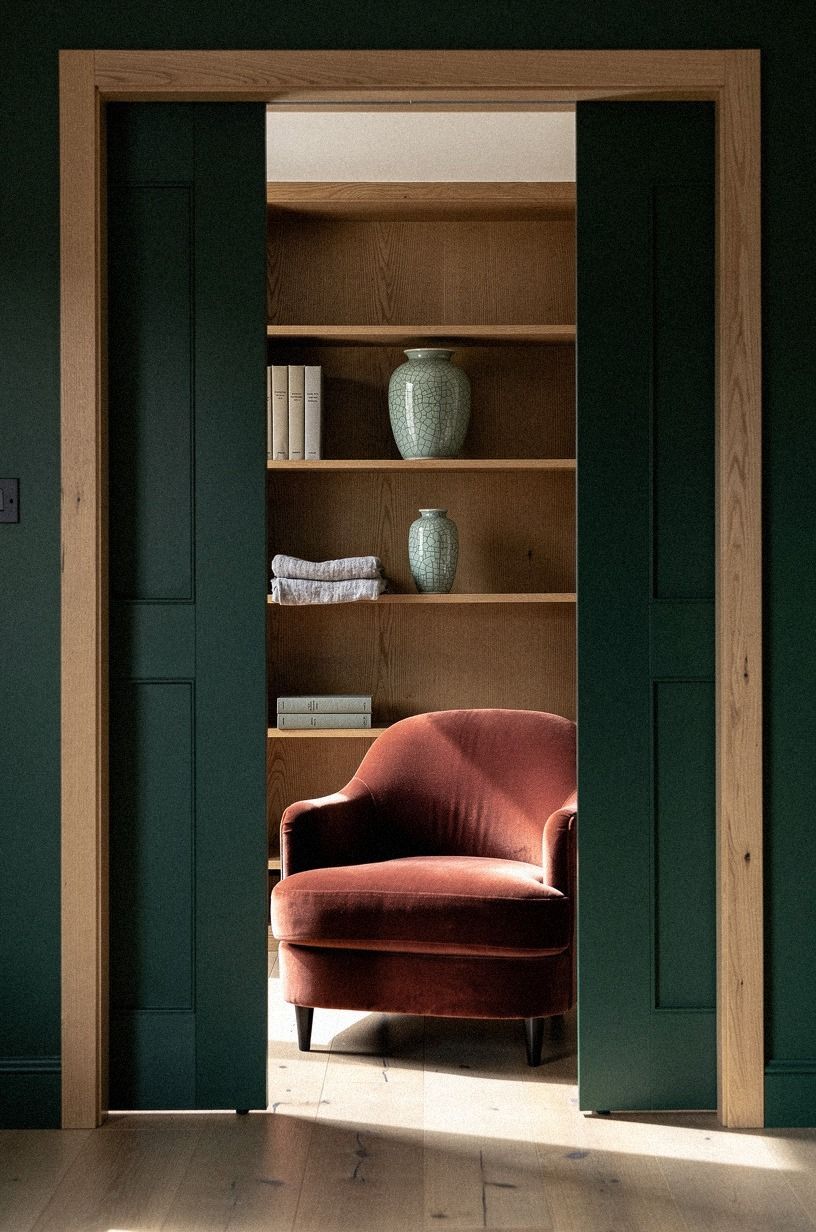
A paneled mirror is your friend when you need the door to disappear from a doorway view. In that layered forest green room, the paneling breaks up the reflection so you don’t get one giant vertical shine. That’s why paneled mirror sections usually beat a single sheet in lived-in spaces, where one tall reflection can feel like a gym wall.
When you’re planning this from the hall or the adjoining room, think about what the first frame of view gives away. You don’t need the entire door hidden.
You need the first glance hidden. Repeat the wall color, repeat the panel size, and keep the seams consistent with the rest of the room. If the surrounding millwork is painted Sherwin-Williams Evergreen Fog SW 9130, carry that same tone onto the trim around the mirror so the reflective field sits inside something familiar.
And give the storage behind it a job. Media accessories.
Candles. Board games. A folded Belgian flax linen throw.
If the hidden storage door doesn’t solve a daily mess, you’ll stop using it, and then you’ve only built a complicated mirror. For a deeper dive into panelled proportions, this paneled concealed door layout does the same exercise on a different wall and helps you sanity-check panel sizes.
7Frame the opening with slim black trim
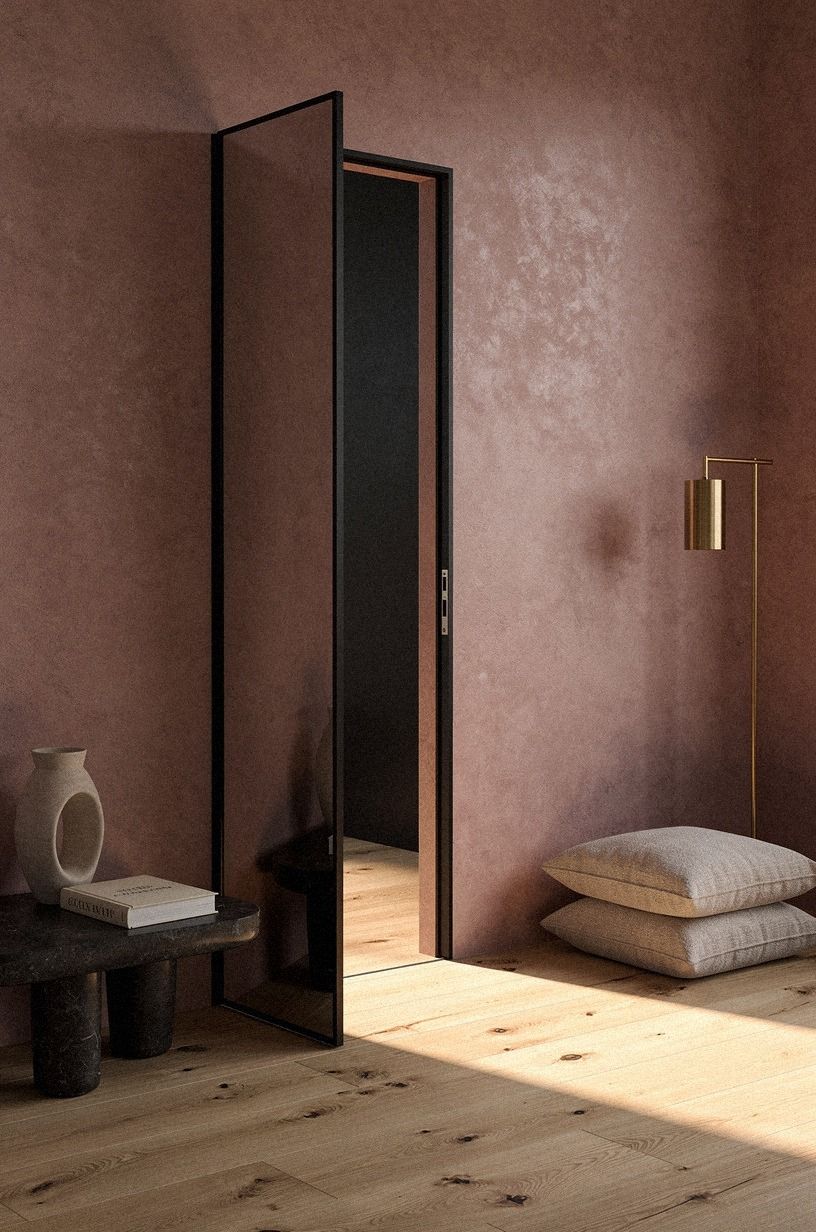
Sometimes you don’t want the door gone. You want it legible, but quiet. In a dusty rose, charcoal, and brass living room, slim black trim does that cleanly because it gives the mirror a graphic edge without adding weight.
I like matte black steel-look trim here, especially when the room already has charcoal or iron notes elsewhere.
Here’s the contrast call I’d make: black trim over brass trim, at least on the opening itself. Brass around a mirrored seam can blur into decoration, and decoration is what makes a concealed door feel fussy.
Black reads like architecture. It gives you a clean outline from a wide corner view, and it helps the door feel deliberate instead of improvised. The fine line is depth, and I’d keep the trim around 3/8 inch proud so the shadow stays sharp.
If you want another angle on strong framed openings, this hidden entry inspiration is worth a look for proportion, even if your palette stays softer than the dramatic examples there. And if you’re styling the whole wall after the trim goes up, this living room styling around a focal wall pairs well, because a panel this deliberate needs calm companions rather than more loud decor.
8Float a console below the detail mirror
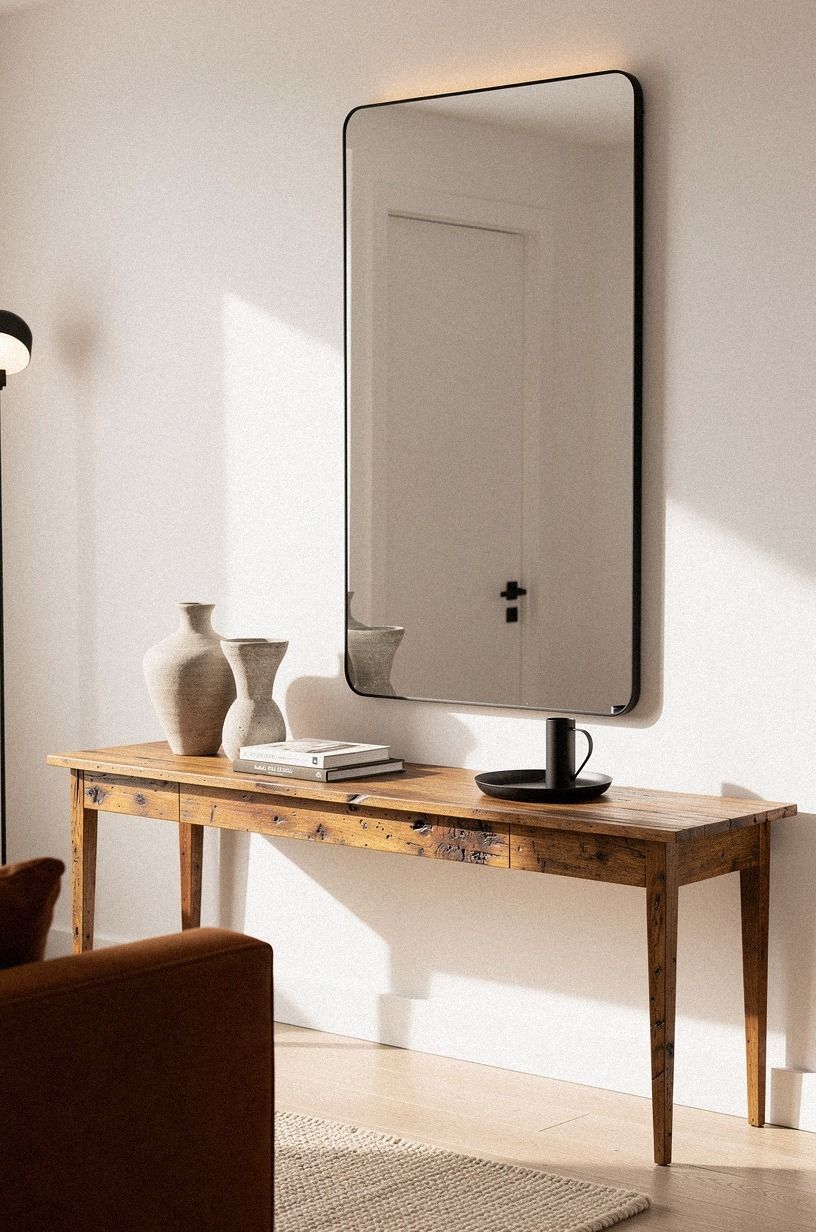
The wall gets much easier to style once you stop leaving the mirror door alone. A slim console underneath gives you a base line, a landing zone, and a visual excuse for the mirror above it. In a warm white and camel room, I’d use CB2 Primitivo travertine-look console proportions as the benchmark: narrow, leggy, and long enough to ground the opening without blocking the swing.
Keep the depth modest so you don’t create traffic trouble. Most living rooms handle a console better when it stays visually light, and if you need a reference point, think the discipline you’d use with a coffee table at 16 to 18 inches high and about two-thirds the sofa length.
Same idea. You want support, not bulk. I also like one lamp, one bowl, and one stack of books here.
That’s enough. More than that, and the mirror starts reading like a vanity.
But make sure the door clears the styling. Test it with cardboard before you buy the table.
It isn’t glamorous, but it saves you from returning furniture later. Less guesswork, fewer returns!
9Repeat living room millwork over the door
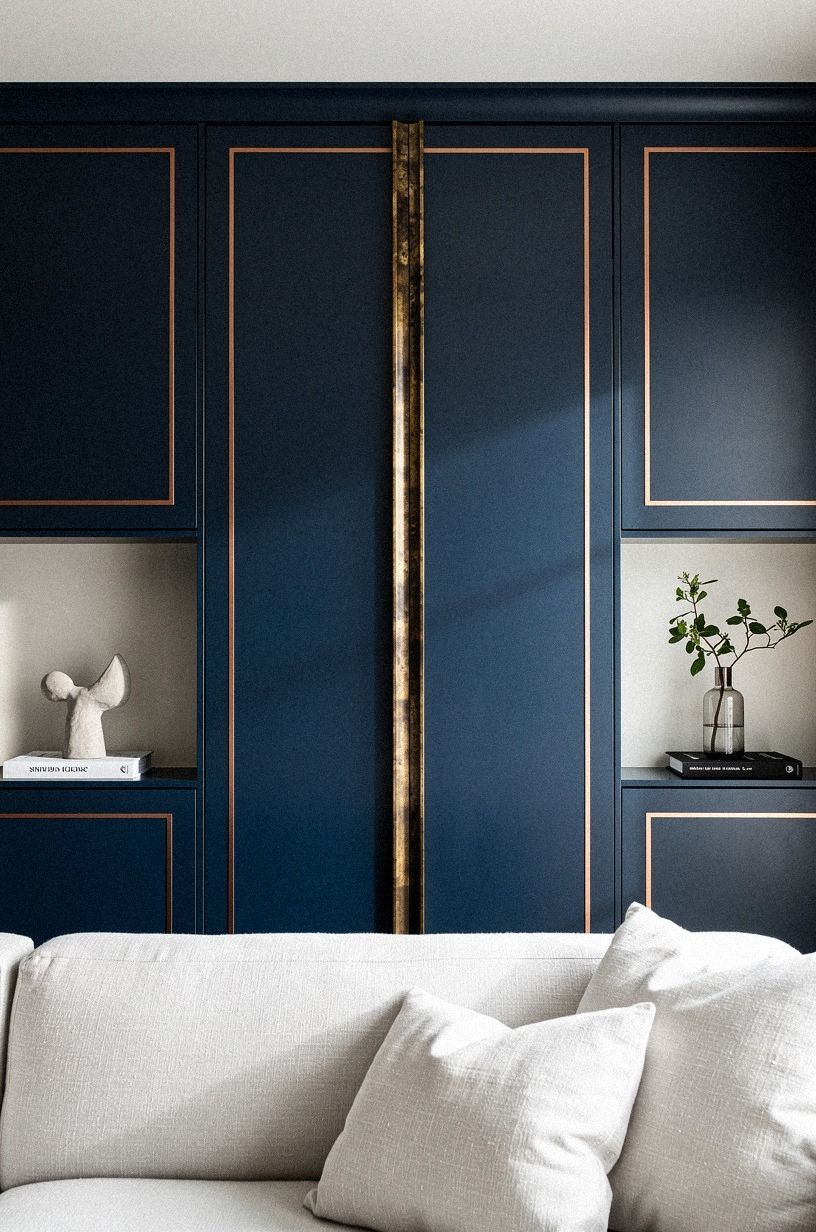
This is the move that makes people miss the door completely. When the wall has midnight blue millwork, copper accents, and strong vertical rhythm, repeat every one of those cues across the door face.
Same rails. Same stiles. Same reveal depth.
The mirror becomes one component inside the composition instead of the headline. That’s the Millwork Echo Method, and it works because your eye trusts repetition.
I’d go all in here with midnight blue painted millwork, especially if you have a low perspective into the room and want the wall to feel taller. A color like Benjamin Moore Revere Pewter HC-172 would be too soft for this dramatic setup.
It would flatten the contrast you need. Deep color gives the copper something to push against, and it hides little line shifts better than pale paint does.
And if you love doors that vanish into paneling, the old-library feeling in this bookshelf-door article can help you think through repetition, even if you swap books for mirror glass. The trick is treating your mirror panel as one more bay in the same composition, never as a separate object living on top of the wall.
10Install push hardware behind a brass rosette
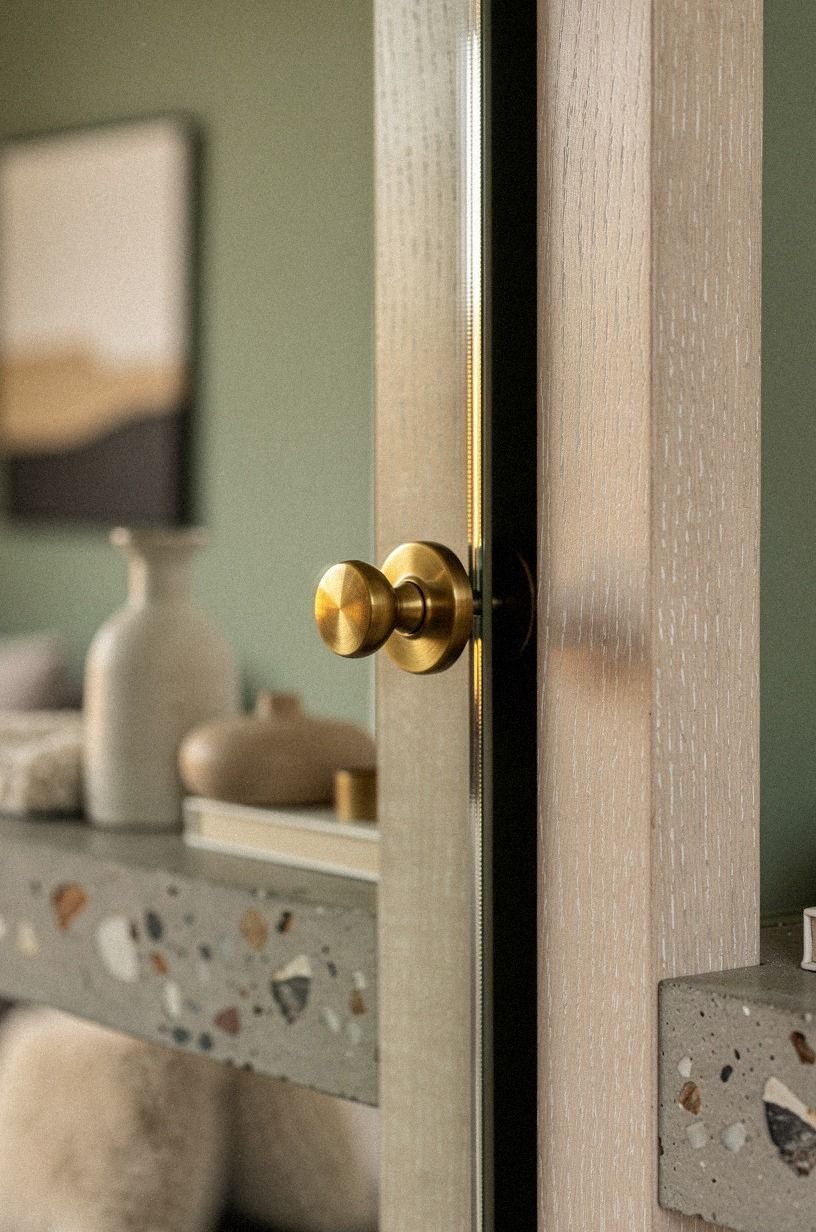
Hardware is where you decide whether the door feels custom or improvised.
11Finish with lounge storage beyond the mirror
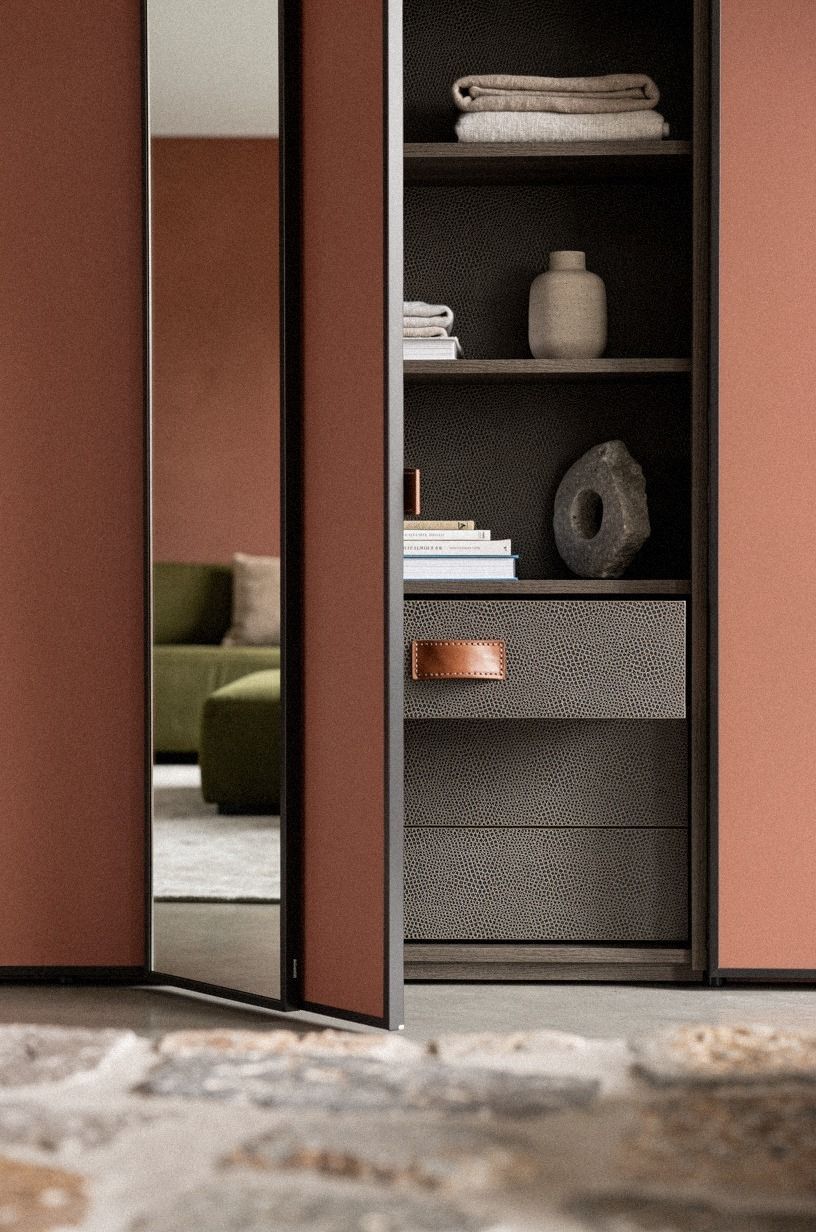
The door only feels worth building if what’s behind it makes your room run better. So finish by planning the reveal as lounge storage, not as leftover closet space.
In that terracotta, stone, and olive setting, I want the inside to feel like the next sentence of the room: same palette, same softness, same materials. That’s why olive-painted shelving beats plain white melamine every time.
Give yourself zones you can remember without looking. Upper shelf for spare candles and matches.
Middle shelf for remotes, chargers, and the thing you never want on the coffee table. Lower shelf for baskets or folded throws in Turkish cotton or wool.
You don’t need a huge cavity. You need the right one.
Even 35 to 40 inches of usable shelf width can change how clean the room stays when guests drop in.
But don’t end on storage alone. Step back and check the open-door view from ground level.
If the inside looks cheaper than the living room, repaint it, line it, or restyle it before you call the job done. The reveal is the payoff!
And for inspiration on styling what guests actually see when the door swings open, this lounge storage reveal walks through a few honest “before and after” reveals that don’t read styled for a photoshoot.
12Test the swing path before you commit to glass
Here’s the unglamorous part that saves you money. Before you order a single pane, mock up the door swing with painter’s tape on the floor. I mean a full rectangle, not a sketch on paper.
The biggest mistake I see in hidden mirror door plans is people believing a 24-inch panel will swing clean when their console, basket, or bench eats three of those inches every morning. You don’t need imagination.
You need floor tape and a Saturday.
Mark the arc with a string tied to the hinge point, then walk the room like it’s 6am and you’re half-awake. Does the panel clear the rug edge?
Does the door clear the lamp cord? Can a guest open it without bumping into the sofa? If any of those answers is “no,” you’re not done planning, you’re done hoping.
Adjust the panel width, shift the hinge set, or trim the console before you spend anything else.
13Why does the hinge action matter as much as the mirror itself?
Because a beautiful mirror on a bad hinge feels cheap every single day.
14Hide the threshold with a continuous floor line
People underestimate the floor. When the door is closed, your eye reads the threshold before it reads the trim, and any visible break announces an opening. The cleanest fix is running the same hardwood or porcelain straight through the seam, with a hairline gap that reads as a normal floorboard joint.
In a soft-toned living room with wide-plank white oak, this looks effortless. In tile, plan the layout so the door falls on a grout line, never on a full tile.
If you’re working with a slab-on-grade house and the door sits on top of tile, you can build a flush saddle in matching material that goes from living-room flooring into the closet cavity without a visible break. The trick is to keep the saddle depth under an inch and the transition strip flush, never proud. Anything that catches a sock or a stockinged foot reads as a threshold, and a hidden mirror door that trips people doesn’t stay hidden for long.
15Use full-height pulls in aged brass or blackened steel
Pulls are a small thing that does a lot of work. On a hidden mirror door, I’d skip knobs entirely and go with full-height edge pulls set into the mirror edge itself.
They read as part of the frame, give you a confident grip, and never interrupt the flat reflective face. In a room with unlacquered brass lighting and warm woods, the patina will develop naturally over a year and start to feel quietly expensive.
If your palette is darker, do the same pull in blackened steel with a brushed finish. Skip polished chrome, because it pulls attention away from the mirror tone.
And never use two pulls side by side on a single panel. One pull. That’s the discipline, because the second pull implies a double door, and a hidden single reads calmer.
16Should you add anti-glare film if the door faces a window?
If your mirror door catches direct afternoon sun, yes. A low-iron anti-glare film softens the harsh reflection without dulling the depth, and it prevents the panel from turning into a beacon for the rest of the room.
In north-facing rooms, you can usually skip it. The light is already diffuse, and a film would just flatten the smoky tone you picked the panel for in the first place.
For west-facing panels, I’d go a step further and spec UV-filtering film so the door’s not bleaching out your sofa or your rug over a couple of summers. It’s a thirty-dollar upgrade that protects a few thousand dollars of upholstery, which is a trade I’d take every single time. Test the film on a corner first, because some anti-glare films pick up a slight green cast, and that green will show up against your wall color.
17What if the door leads to a closet, not a wall?
This is the version I get asked about most. The honest answer is that a closet-backed mirror door is actually easier to pull off than a wall-backed one, because you don’t need to fake millwork on the inside.
You only need to fake it on the outside, where the eye is actually looking. Treat the closet side like a normal small closet: hanging rod, shelf above, basket below.
Don’t try to dress it up.
The mistake people make is putting nice wallpaper or paneling inside the closet to “match the reveal,” and that almost always blows the disguise. A bespoke closet reads as a hidden room worth investigating.
A simple closet reads as the kind of thing nobody thinks twice about. For more on building a hidden closet door that disappears, this murphy door behind a mirror setup shows a sister version where the closet is part storage, part bar.
18Plan the back panel like a real room, not leftover space
Last step, and the one most people forget: paint and light the back of the door like a small room, not a leftover closet wall. That means the same color temperature you used in the living room, ideally a continuous tone so the open door reads as an extension of the space instead of a peek into a different world. I’d default to a soft warm white at 2700K so the doorway doesn’t feel like a refrigerator opening.
And if the back of the door ever faces guests when it’s open, hang a single piece of soft art or a small shelf with one object on it. Not a styled moment.
Just one calm thing that gives the eye a place to land. That’s how you take a hidden mirror door from “door that doesn’t shout” to “wall that earns the room.”
What I’d actually spend the money on first
Here’s the part nobody tells you about hidden mirror doors. Most of the cost goes into the parts nobody looks at twice: the hinges, the cleats, the floor continuity, the lighting at 30 percent. People who haven’t done this before spend the budget on the mirror itself and then bargain-shop the structure, and that’s why their hidden door feels a little cheaper than the rest of the room every single day.
I learned this the hard way after watching a friend install a beautiful antique mirror on builder-grade hinges. The mirror looked gorgeous for three weeks.
Then the door started drifting open on its own, then the panel started to sag, then the trim started to gap. We pulled the whole thing out, replaced the hardware with soft-close concealed hinges rated for solid-core, and the door finally worked the way it looked.
The mirror cost three times the hinges. The hinges mattered ten times more.
So if I’m setting a budget, I split it into thirds. One third on the glass and frame, where aesthetics live. One third on the structure and hardware, where the door either works or embarrasses you.
One third on the lighting and trim around the door, where the room decides whether the project looks intentional. If you cut one of those thirds, you’ll usually cut the wrong one.
People cut the hardware because it’s invisible, and they regret it the moment a guest opens the door the wrong way.
And there’s a bigger design point that goes beyond this one project. The market is full of beautiful mirrors that don’t work as doors, and full of working doors that don’t work as architecture. The hidden mirror door idea only earns its keep when the two halves meet, when the craftsmanship is good enough that the cleats vanish, the hinges disappear, and the mirror reads as a wall that happens to open. That’s not a material choice.
That’s an installation discipline choice. Buy the cleaner mirror.
Hire the better carpenter. Be patient about the trim.
The room will thank you for it.
Real talk too: I’ve watched enough of these projects come in over budget to know that the homes that did it best treated the hidden mirror door as part of a longer room plan, not a weekend prank. They picked palettes that already supported the mirror tone.
They added storage zones that made the inside worth opening. They let the rest of the living room stay quiet so the door never had to compete.
That kind of restraint is harder than picking the right glass, but it’s what turns a clever idea into a room that actually feels calm. If you want another example of restraint at work, the same logic shows up in this living room styling around a focal wall, where the wall carries the room instead of the accessories carrying the wall.
What People Always Want to Know
What is the best hidden mirror door layout for a small living room?
A smoked panel beside shelving is usually the best call. It gives you storage without bulk, and the built-ins help the mirror feel intentional instead of random. I’d start with a narrow cabinet run or an IKEA HEMNES side unit nearby so the wall has context.
Where can I buy hidden mirror door pieces on a budget?
Start with IKEA, Target Threshold, and Wayfair for consoles, baskets, and lighting that help the wall look finished. For the mirror itself, I also check local glass shops and Facebook Marketplace.
That’s where you can save money, especially if you find a frame worth repainting. For the hardware, I’ve had good luck with Sugatsune touch latches, which run quieter than typical big-box catches and last longer on heavier antique panels.
How much does a hidden mirror door makeover cost?
Most living room versions land somewhere between about $300 and $8,000, depending on whether you’re just styling around a door or rebuilding millwork. A smoked mirror panel with new trim and a slim console runs about $400 to $1,200. A custom antique mirror with concealed soft-close hinges and floor continuity lands in the $2,500 to $6,000 band.
For more on the math of these installs, this concealed door budget breakdown lays out a similar project line by line.
Can I create a hidden mirror door on a budget?
Yes, and you can get a lot done cheap. Focus on paint, trim rhythm, and smarter styling first.
A secondhand mirror, a removable sconce option, and baskets you already own can carry the look farther than one expensive custom detail. Spend the budget on a soft-close touch latch and good painter’s tape for mockups, then live with the layout for a week before committing to anything you can’t return.
Is a hidden mirror door worth it in a small space?
Yes, more than in a big room sometimes. You get reflection plus concealed storage in the same footprint, and that dual job matters when every wall has to work.
Keep the swing clear, keep the console slim, and let the mirror bounce the best light in the room. In tight apartments, I’d avoid going taller than the doorframe, because a too-tall mirror starts to shout.
Is a hidden mirror door a good idea for a rental?
Yes, if you keep the build reversible. Use freestanding pieces and removable styling layers around an existing mirrored panel, or mimic the look with a leaning mirror near a disguised storage zone.
I’d skip invasive trim work if you know you’ll move soon. Most landlords read a full-height mirror door as a built-in, and that’s a conversation I’d rather avoid.
What height should a hidden mirror door be?
I’d set the panel so its top edge lands between 78 and 84 inches in most living rooms, just above a typical console height. Anything taller usually requires a soffit or a custom ceiling transition.
Anything shorter and the mirror stops reading as full-length, which is half the brief. Let the bottom edge float about 3 inches off the floor so the panel doesn’t look like it’s trying to grow legs.
How do you keep a hidden mirror door from drifting open?
Spend the money on the hardware. A good soft-close concealed hinge with a quality touch-latch roller catch will keep the door closed for years.
Cheap hardware sags. I’ve replaced three in the last decade, and the only ones still holding tight are the rated-for-solid-core ones.
Don’t cheap the latch.
Where I’d Start First, the Smoked-Glass Rule
If I had to pick one step, I’d start with the smoked mirror wall panel. Get the tone wrong and every hinge, trim line, and sconce has to fight it. Get that surface right first, and the rest of the plan starts behaving.
Lock the sample to the wall with painter’s tape for a full day, look at it under morning and evening light, and only order the glass once you’ve lived with the swatch longer than you think you need to. The mistake isn’t picking a bad mirror.
The mistake is picking a mirror you never sat with.