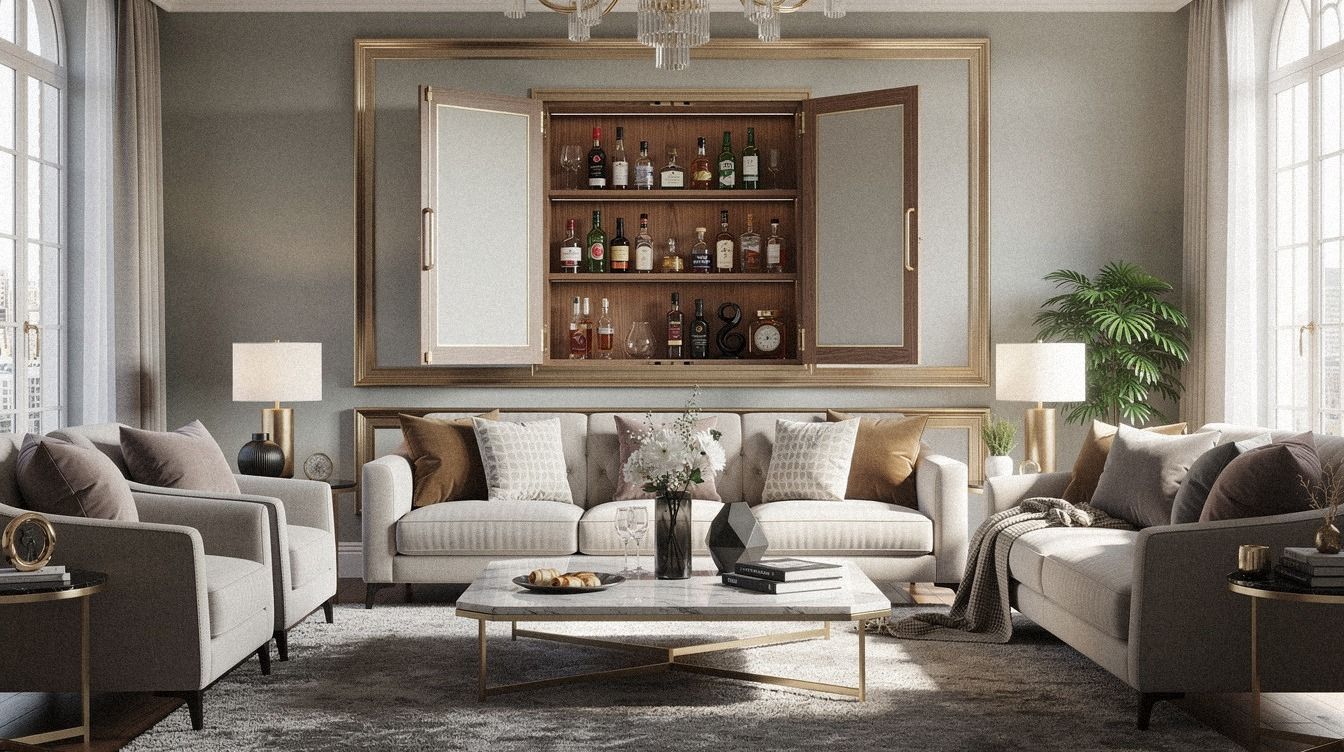
Hidden liquor cabinet ideas work best when the bottles don’t announce themselves from across the room. I learned that after styling one living room around an exposed cart that made every corner feel busy by 5pm. Once the storage disappeared into the architecture, the room felt calmer, richer, and far more grown-up.
- ✓ Build a hidden liquor cabinet behind picture-frame moulding
- ✓ Turn a closed credenza into quiet cocktail storage
- ✓ Why does a shallow art-front cabinet beat a freestanding bar?
- Build a hidden liquor cabinet behind picture-frame moulding
- Turn a closed credenza into quiet cocktail storage
- Why does a shallow art-front cabinet beat a freestanding bar?
- Disguise bottles inside a vintage secretary desk
- Install a tambour door inside your existing built-ins
- Camouflage a bar behind painted panel doors
- Tuck glassware into a skirted console table
- Why line a recessed niche with smoked mirror?
- Hide spirits behind sliding bookcase panels
- Build a foldout shelf under framed art
- Stone bowl over faux books across cabinet doors
- Add reeded doors to a media unit
- Nest a lockable bar inside the fireplace wall
- What about floating stone shelves with a concealed lower cabinet?
1Build a hidden liquor cabinet behind picture-frame moulding
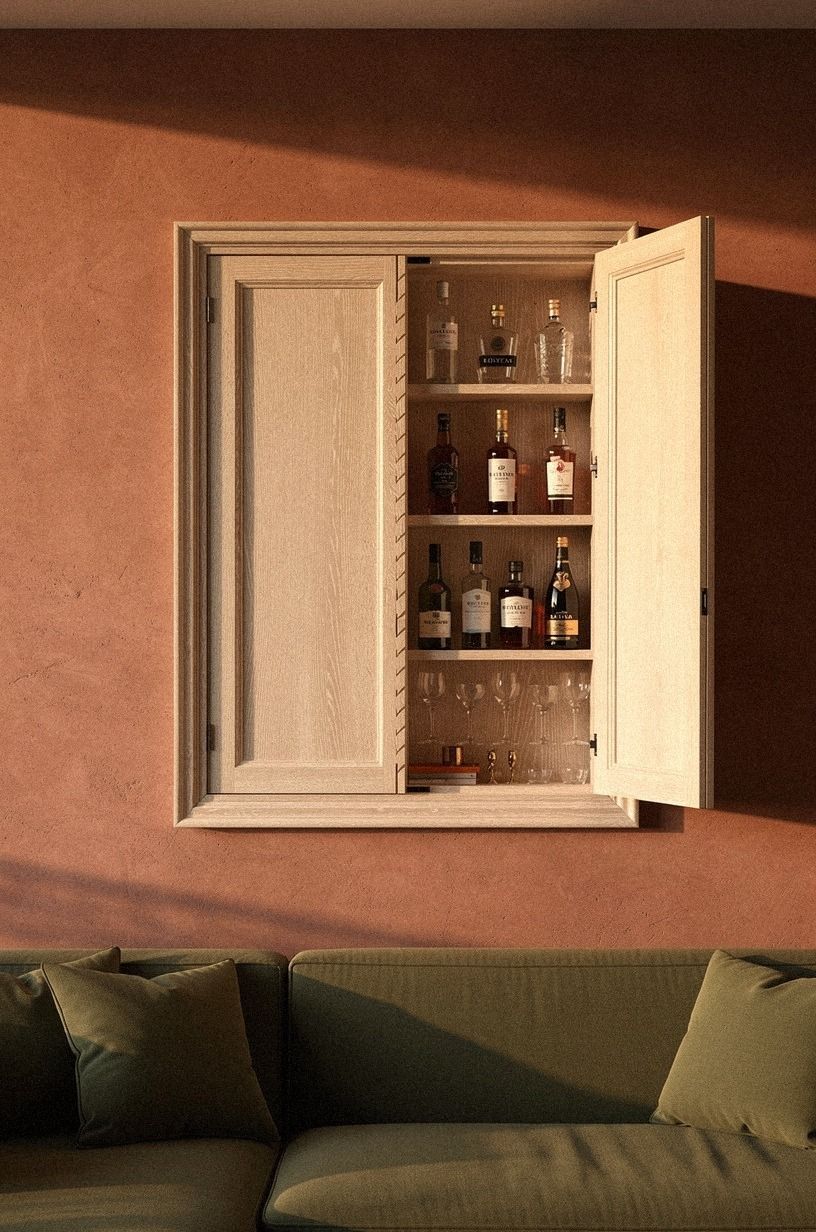
Embed the cabinet into the wall you already treat as a focal point, then let one moulded panel swing open so the reveal feels almost accidental. In a living room with classic trim, a hidden liquor cabinet in wall form works because your eye reads the symmetry first and the storage second. I like this best when the panel is centered between seating, not shoved beside the TV, because you want the whole wall to feel intentional when the door is closed.
Paint the millwork in Benjamin Moore Revere Pewter HC-172 if your room leans warm, then keep the inside finish one note deeper with Farrow & Ball Hague Blue No.30 so bottles and tumblers feel grounded instead of flashy. You should give yourself at least 12 to 14 inches of interior depth for standard bottles, and you should plan shelf spacing before the trim goes on.
One shallow ledge for coupes. One taller zone for whiskey.
One little drawer for openers. Aged bronze hinges and a soft-close catch keep the reveal quiet. If you’re mapping a whole living room around one accent wall, the mantel styling roundup is a smart companion read, and the principles in 19 genius hidden storage ideas translate just as well to a liquor wall.
2Turn a closed credenza into quiet cocktail storage
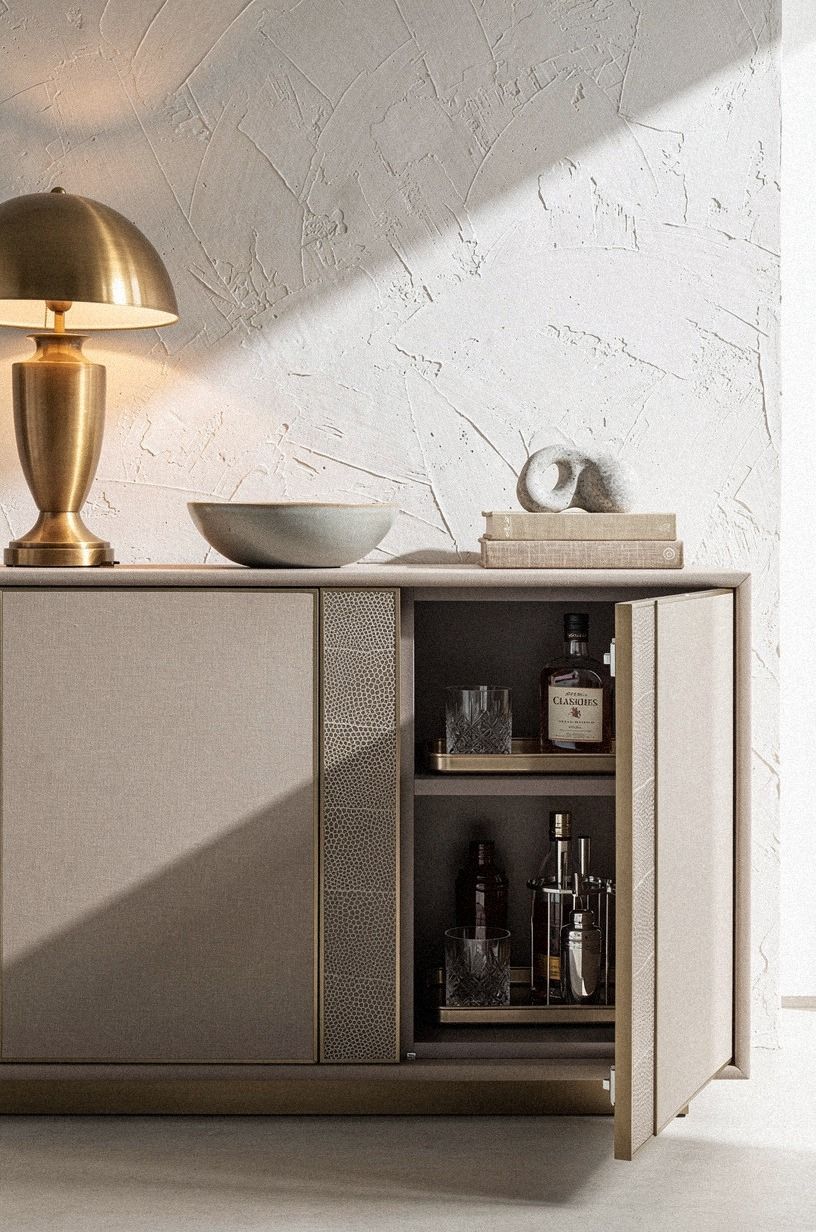
Start with a credenza that already belongs in the room, then make the inside do the hardworking part. A clay linen piece with one door cracked open looks relaxed, not theatrical, and that’s exactly why this liquor cabinet design lands. You can tuck bottles on one side, tumblers on the other, and still leave the top clear enough for a lamp and a stack of books.
And I wouldn’t buy a super shallow unit here. A body depth close to 35 to 40 inches is sofa territory, not credenza territory, but the lesson still holds: you need more breathing room than you think or the cabinet becomes a bottle traffic jam. If you’re styling a family room, you should add a tray so you can pull everything forward in one move.
Aged bronze pulls. Smoked glasses. One folded Belgian flax linen cocktail napkin.
Pair it with the principles in 19 genius hidden storage ideas so the whole room reads cohesive, not crowded. A Target Threshold console in oak or a vintage IKEA BESTÅ modification both fake the look for under $500.
3Why does a shallow art-front cabinet beat a freestanding bar?
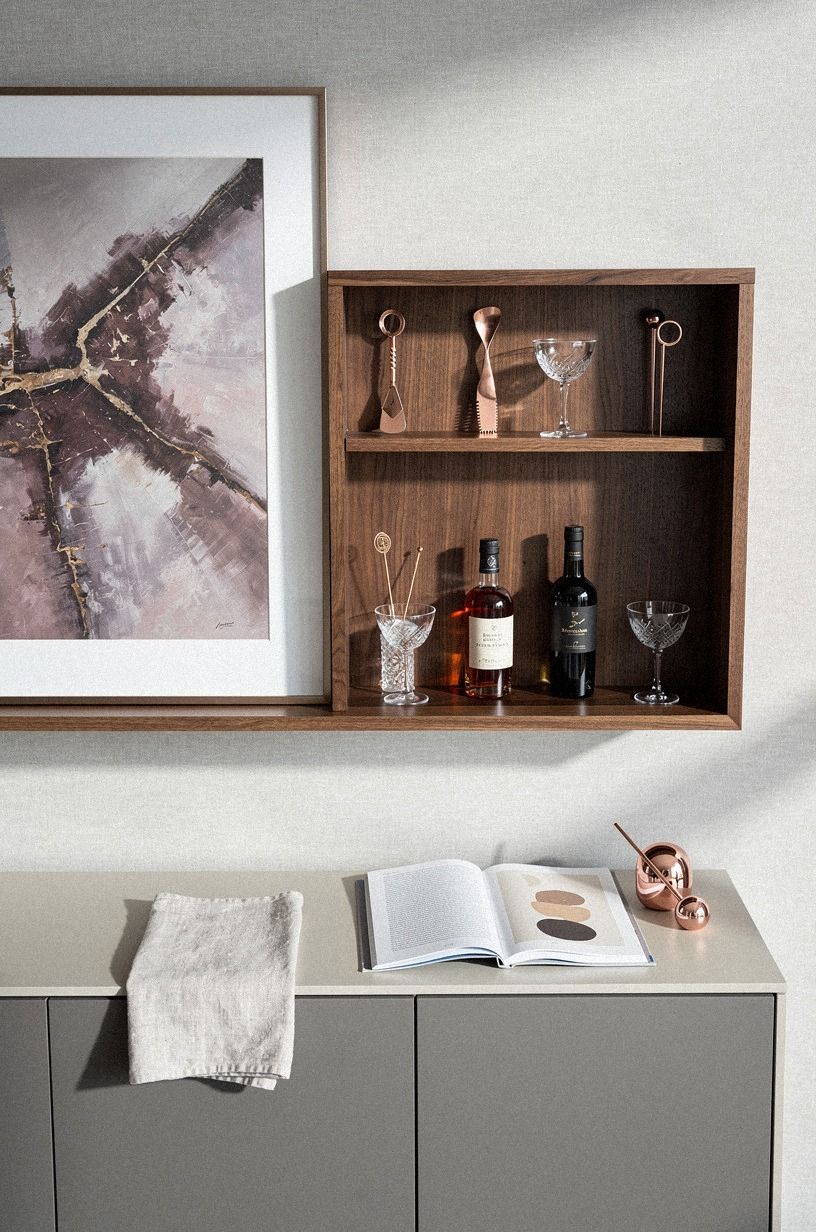
Because it disappears. Slide art over the storage instead of treating the storage as the art, and the cabinet becomes a frame you hang rather than a piece you stage. In a plum grey living room, that little wall section can hide a slim book-matched walnut box with one magnetic catch and a single shelf for bottles, no handles, no fuss.
You want at least 6 inches of interior depth so standard bottles don’t poke past the door. Mount the art on a cleat so it lifts off in one motion when you need a pour, and line the back wall in the same paint color so the eye doesn’t catch the seam.
Unlacquered brass hinges. One smoked glass coupe.
That’s it. The piece should look like a print until someone leans close.
If you’re working with a small living room layout, the 14 cozy studio apartment ideas post walks through the same kind of vertical thinking.
4Disguise bottles inside a vintage secretary desk
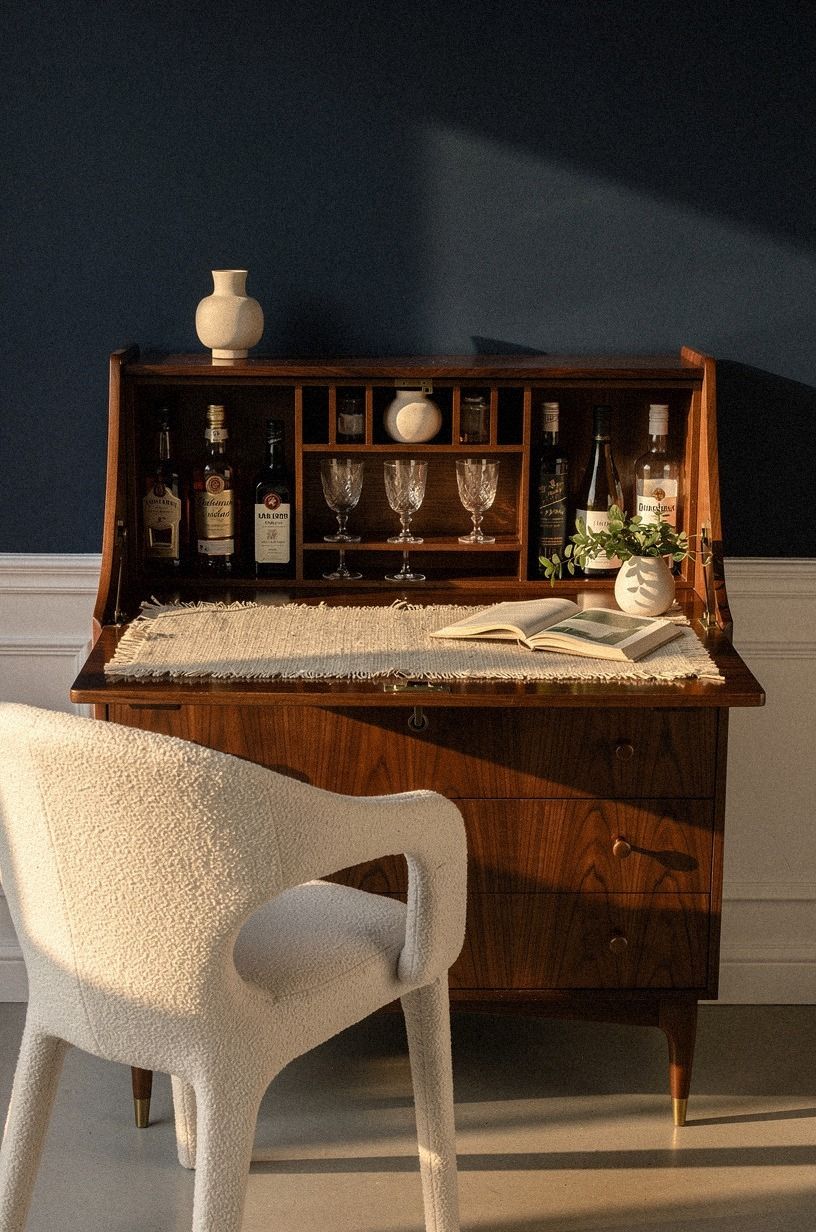
A secretary desk does half the disguising for you because people still read it as paper storage first. In a navy, white, and walnut living room, the drop-front or upper cabinet can hold bottles beautifully as long as you keep the exterior disciplined.
No neon signs. No bar tools scattered on top.
Just the quiet authority of a piece that looks inherited.
I’d choose Farrow & Ball Hague Blue No.30 for the body if the room gets evening light, because it gives dark wood and glass some depth without turning muddy by dinner. Inside, line the back with a warm paper or a smoked mirror insert and let the shelves do less. One rye.
One gin. A little silver bowl for corks.
And yes, this is one of the few hiding spots that still looks right when the cabinet is left open for an hour. Wayfair has a deep drop-front secretary in walnut that reads as inherited without the inherited price.
5Install a tambour door inside your existing built-ins
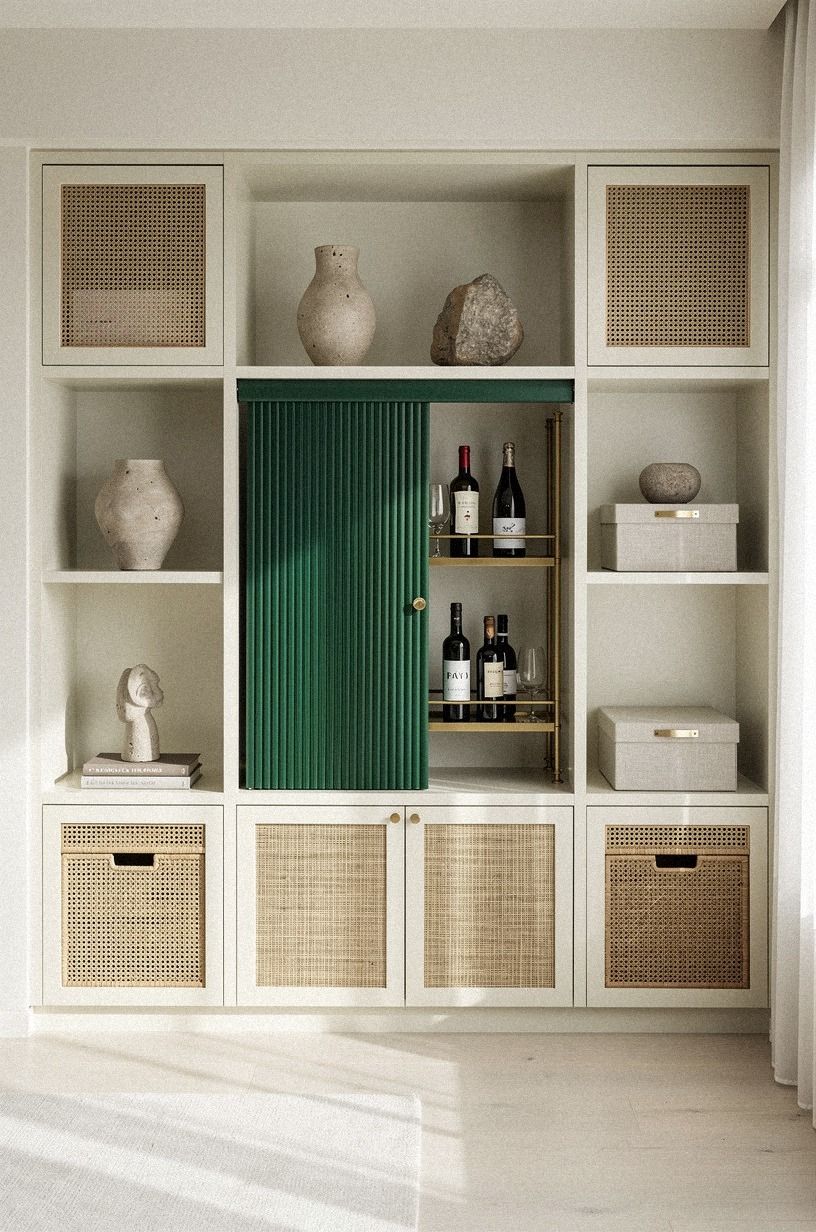
Add the concealment inside the built-ins, not on the outside, and you get a cleaner result. A cream wall of shelving with one emerald tambour section rolling open feels playful in the best way because the architecture stays calm while the motion adds personality. If your shelves already hold books, boxes, and framed photos, a little rolling panel keeps the bar from becoming the loudest thing in the room.
Use Sherwin-Williams Evergreen Fog SW 9130 on the tambour if you want color without a hard stop. You should keep this compartment about 30 to 36 inches wide so the slats don’t feel fussy, and you should store your tallest bottles at the center where your hand reaches most easily.
Why make every guest stare at labels when a soft tambour curve can do the editing for you? A rattan tray.
Two etched coupes. An unlacquered brass opener. That’s all you need for the reveal to feel expensive.
If you’re leaning into the library wall mood, the 25 dream home library ideas post shows how to layer the same kind of warm, paneled rhythm.
6Camouflage a bar behind painted panel doors
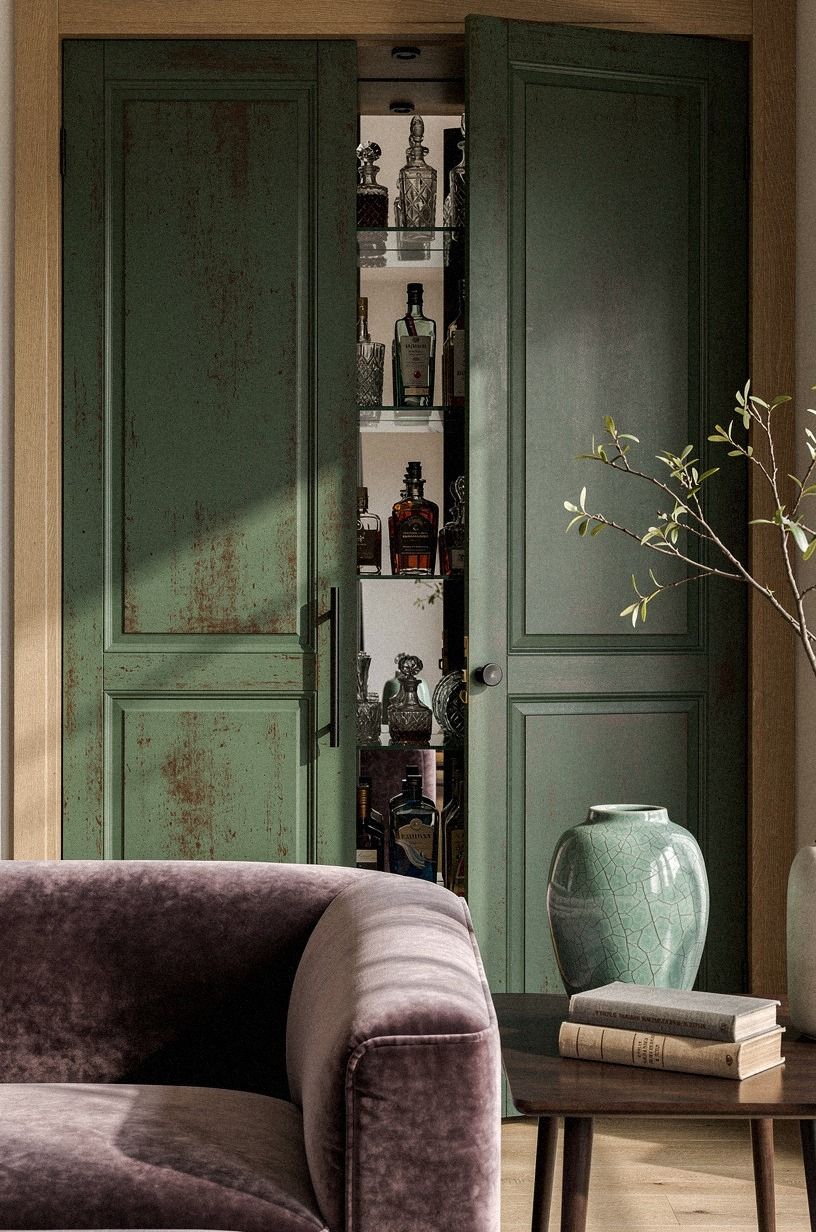
This is the move for anyone who wants a hidden liquor cabinet idea that reads like architecture, not furniture.
7Tuck glassware into a skirted console table
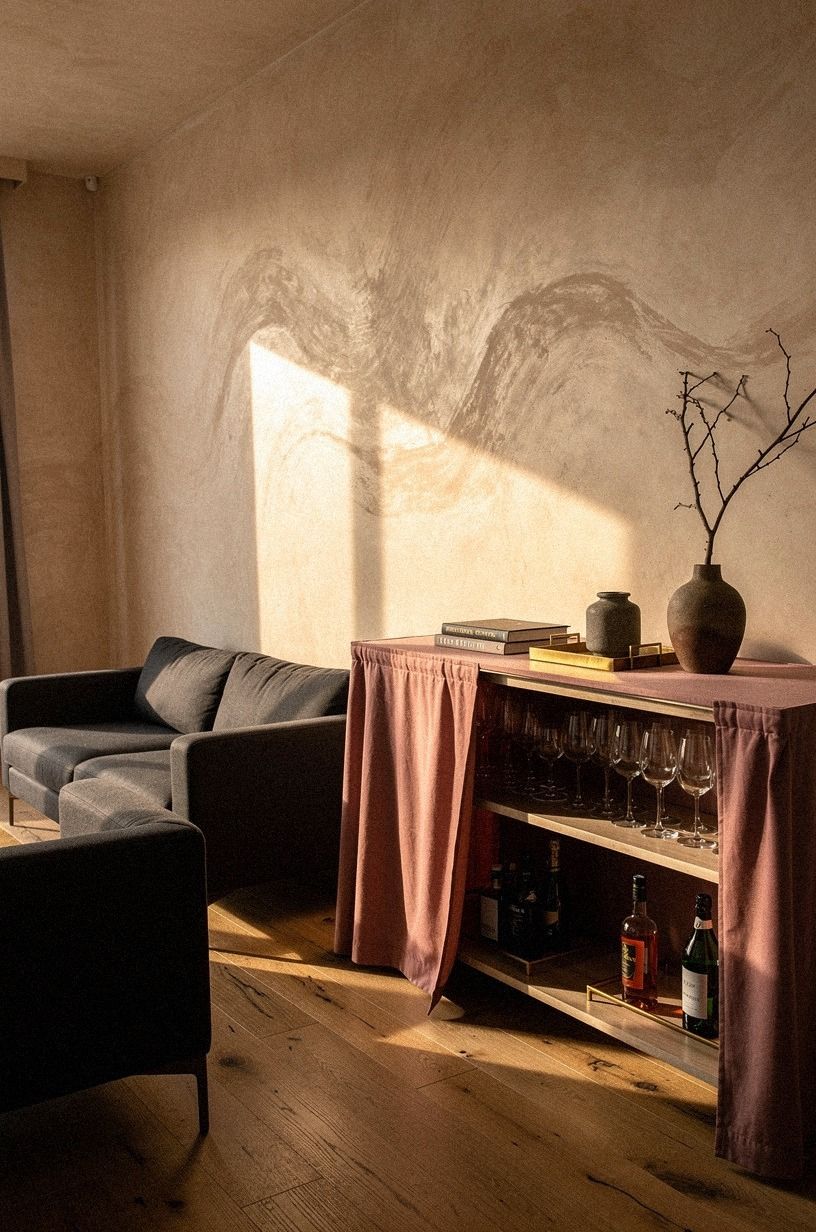
A skirted console is softer than a hard cabinet, which is exactly why it works. In a living room with dusty rose fabric and a relaxed shape, pulling the skirt back to reveal stemware and bottles feels more residential than a polished bar ever does. This is the hidden storage move I’d use in a room that already has linen drapes, warm lamps, and a little bit of collected clutter.
Go for Belgian flax linen if you want the skirt to puddle with some weight instead of clinging like a tablecloth. Underneath, divide the space with low risers so your glassware doesn’t rattle every time you reach in.
You can keep a shaker there too, but I wouldn’t store anything too precious at floor level if kids or pets cut through the room. Soft pleats.
Hidden shelves. One brass ring pull to sweep the fabric aside.
It feels old-money without trying too hard, and that’s rare! If you’re finishing the room around it, the cozy reading nook ideas post walks through how to layer that same softness elsewhere, and the 16 bar tray styling looks roundup shows you what to actually put on the tray once the bottles come out.
8Why line a recessed niche with smoked mirror?
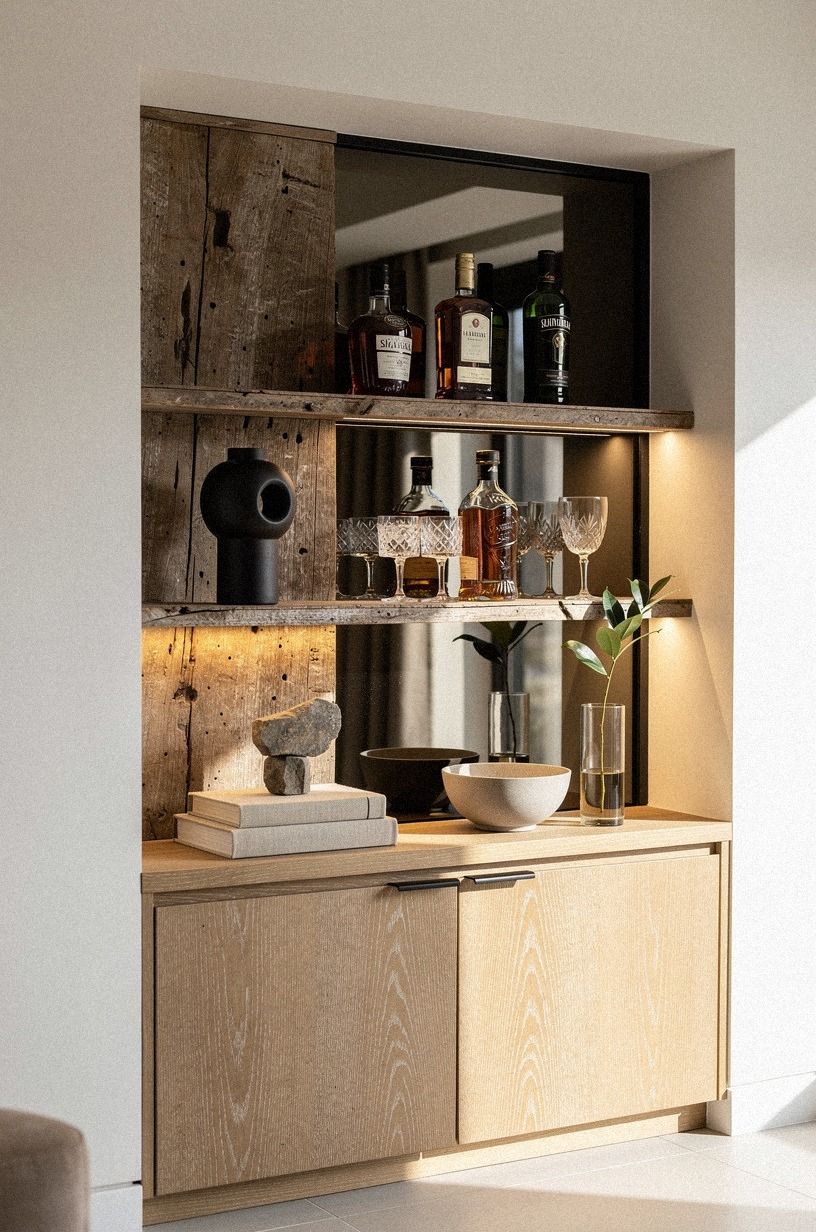
Because the reflection doubles the storage without doubling the footprint.
9Hide spirits behind sliding bookcase panels
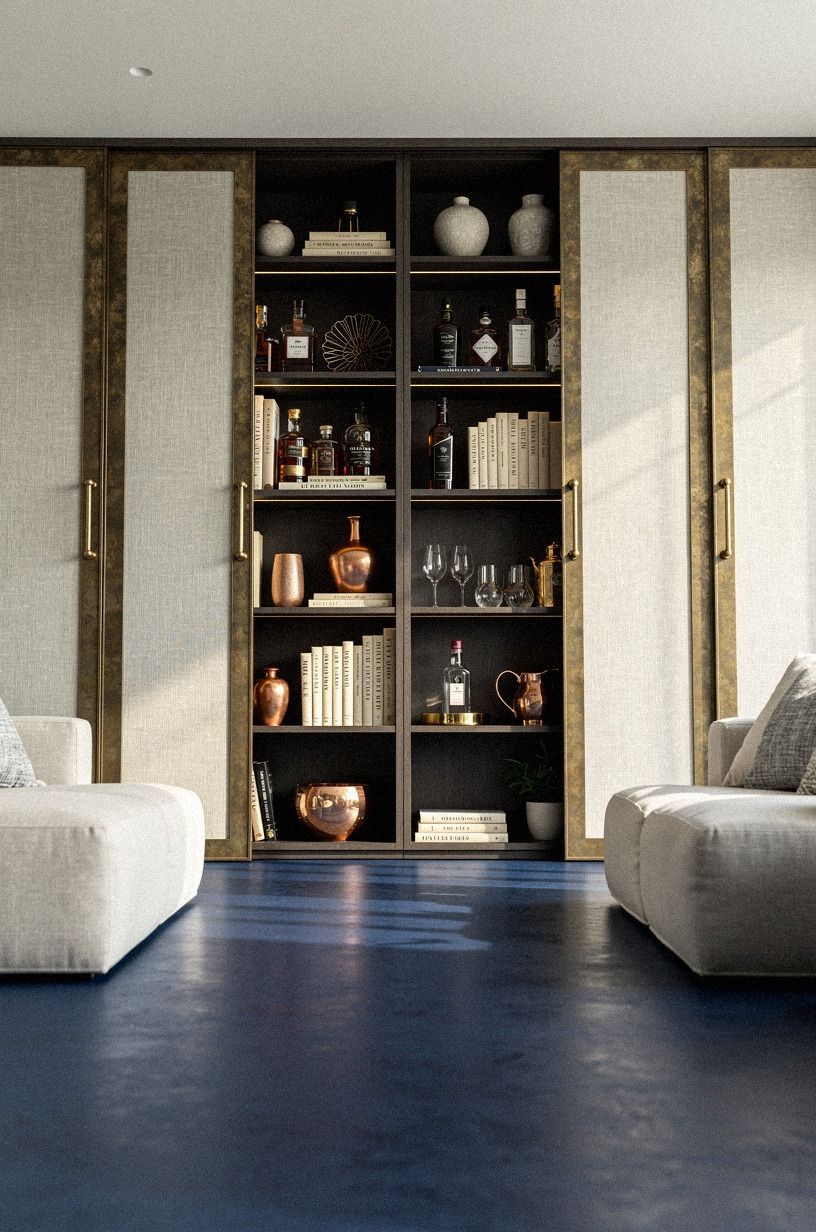
Sliding bookcase panels bring drama, but only when the books still look believable. A midnight blue wall with symmetrical shelves and one panel shifted aside has that old-library tension people love, and it gives you more capacity than a tiny hinge door ever could. If you’re after hidden liquor cabinet ideas that feel cinematic, this is the strongest one in the bunch.
Paint the case in Farrow & Ball Hague Blue No.30 or keep it close to your fireplace color so the movement doesn’t look bolted on later. You should use real books across the visible spans and save the faux volume only for the sliding edge where weight matters.
One lower shelf for bottles. One middle shelf for coupes.
One upper shelf for boxed tools. But make sure the track is smooth, because a sticky panel ruins the magic fast.
Aged bronze track hardware and a Belgian linen pull tab soften the mechanism. If you’re building out a whole library wall, my 25 small home library ideas guide shows how to layer in the same kind of moody depth, and the 25 dream home library ideas post goes deeper on the magazine-spread finish.
10Build a foldout shelf under framed art
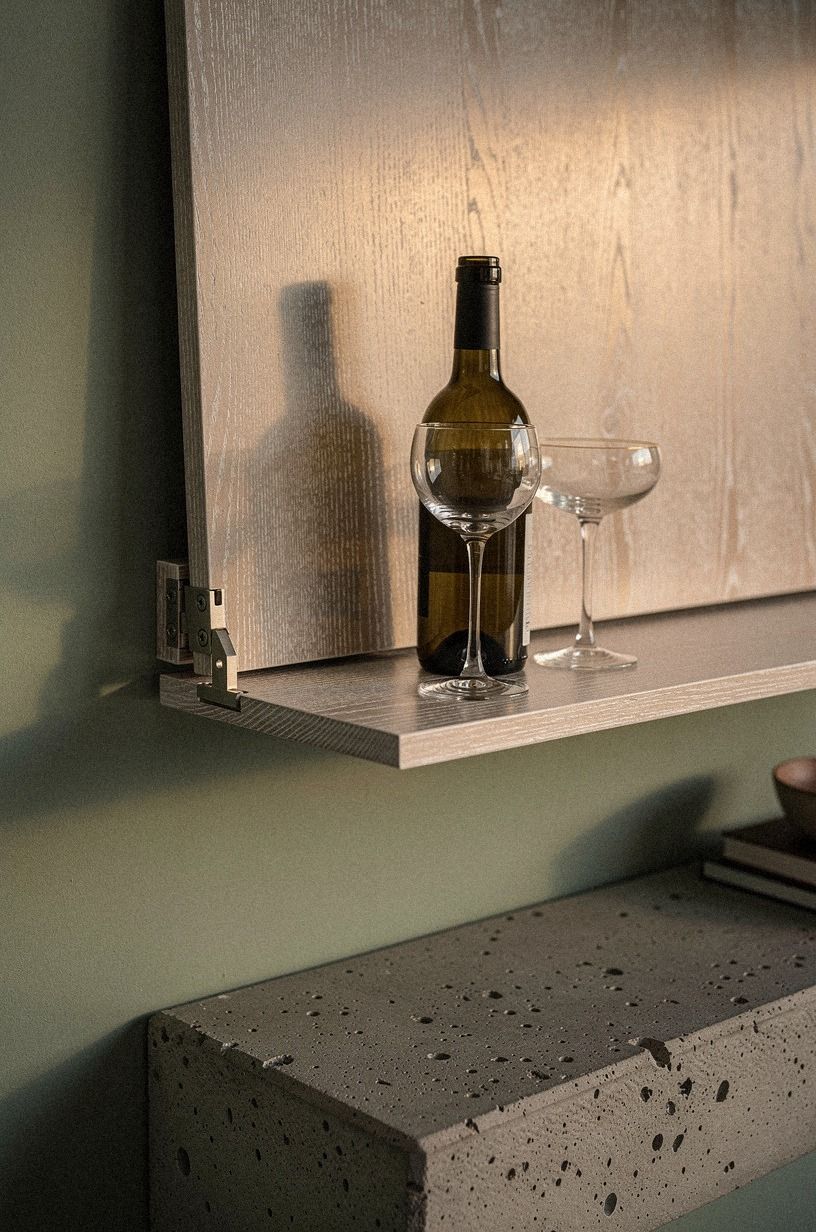
Think tiny but useful. A framed panel that folds down into a shallow serving shelf gives you just enough room to pour a drink without dedicating a whole piece of furniture to the task. In a sage wall moment, that little ledge looks almost like a writing desk at first glance, which is why it works so well in apartments or rooms where every inch has to earn its keep.
Use aged brass stays and hinges so the hardware feels intentional when the panel is open. You should mount the shelf at a height that lets you set down a coupe without hunching, and you should keep the depth honest at around 8 to 10 inches.
Any deeper and the folded face starts to look clunky. I love this for people who only keep a few bottles and want the ritual without the footprint.
Small shelf. Big payoff.
And yes, guests will ask where you found it. Pair the brass with Benjamin Moore Pale Oak OC-20 on the surrounding wall so the panel reads as art, not as a hatch.
11Stone bowl over faux books across cabinet doors
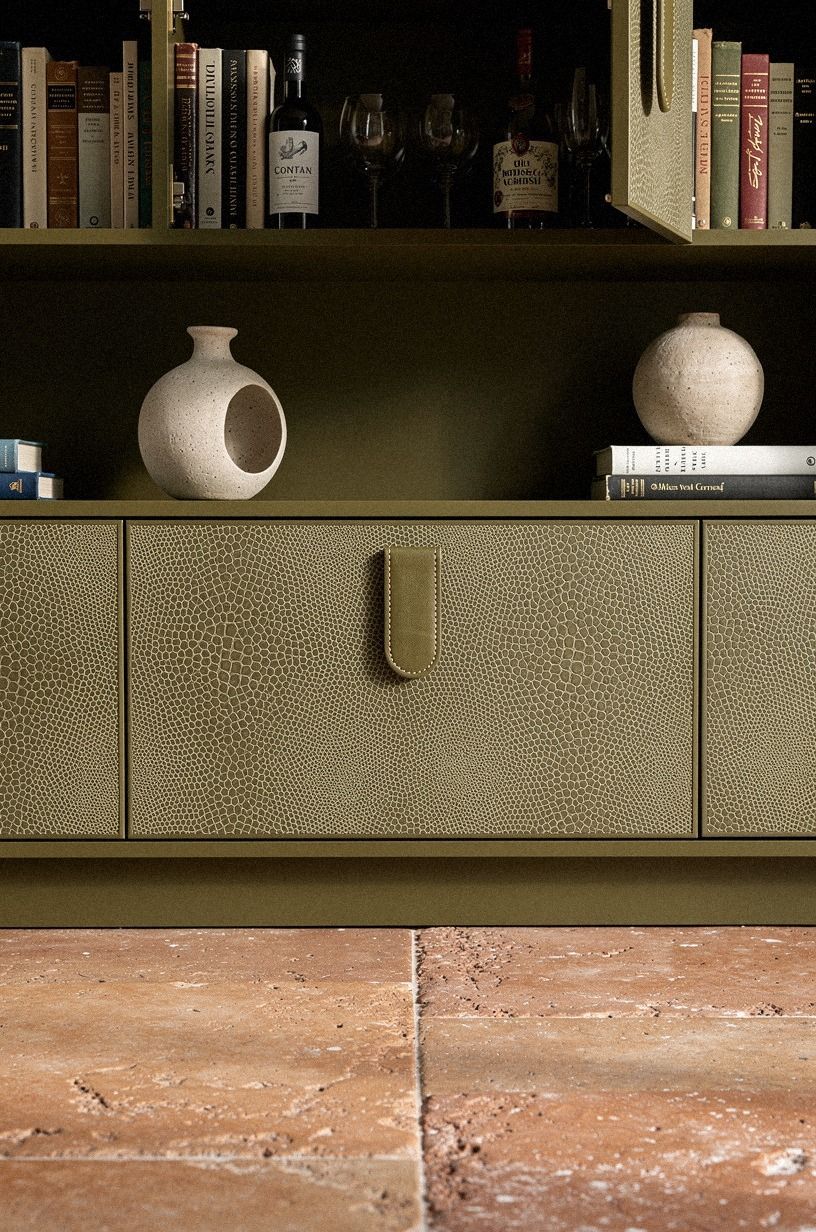
This one can go wrong in a hurry, so restraint matters. Faux book spines across terracotta, stone, and olive cabinetry should read like texture first, joke never.
When one concealed door opens behind those spines, the room gets that collected, slightly eccentric look that feels personal rather than showroom-perfect. That’s the difference.
Choose terracotta clay limewash nearby so the palette has enough weight to support the whimsy, then keep the spine colors dusty instead of candy bright. You should mix in a few real objects around the cabinet so the book detail doesn’t feel too staged.
A stone bowl. A box of matches.
One little picture frame leaning off-center (nothing precious). If you’re tempted to label the sections by spirit, don’t.
The whole point is that the room doesn’t look like a bar until you need it to. Farrow & Ball Dead Salmon No.28 on the back wall reads as terracotta’s quieter cousin if the real thing feels too loud.
12Add reeded doors to a media unit
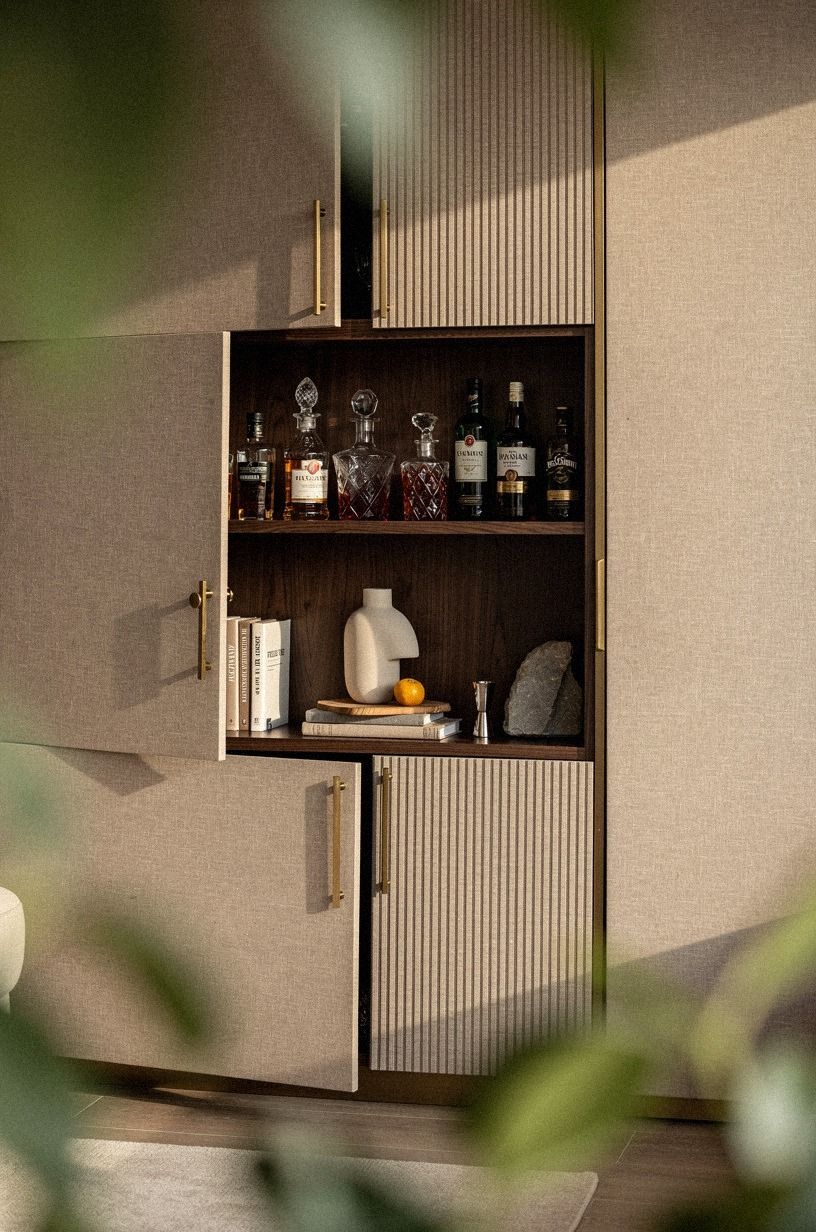
A media unit already carries visual bulk, so it’s the easiest place to hide a bar without adding more furniture. Reeded walnut doors on a clay and linen wall soften whatever sits behind them, and the texture does a lot of work before you ever touch the handles. If your TV wall feels blunt, this is how you make it behave a little better.
Here, cost matters, so keep this rough guide in mind before you start planning millwork or replacements around the living room:
I’d rather upgrade doors than buy a bigger console. You can fit bottles behind one bay, media gear behind the other, and still keep sightlines clean.
Add book-matched walnut if you’re splurging or a good reed-front insert if you’re not. For proportion, think like a living room planner: a coffee table usually sits 16 to 18 inches high and about two-thirds the sofa length, so your media piece shouldn’t sprawl wider than everything else just because it can.
A slim CB2 Project 62 reed cabinet pulls off the look for around $800 if millwork isn’t in the cards this year.
13Nest a lockable bar inside the fireplace wall
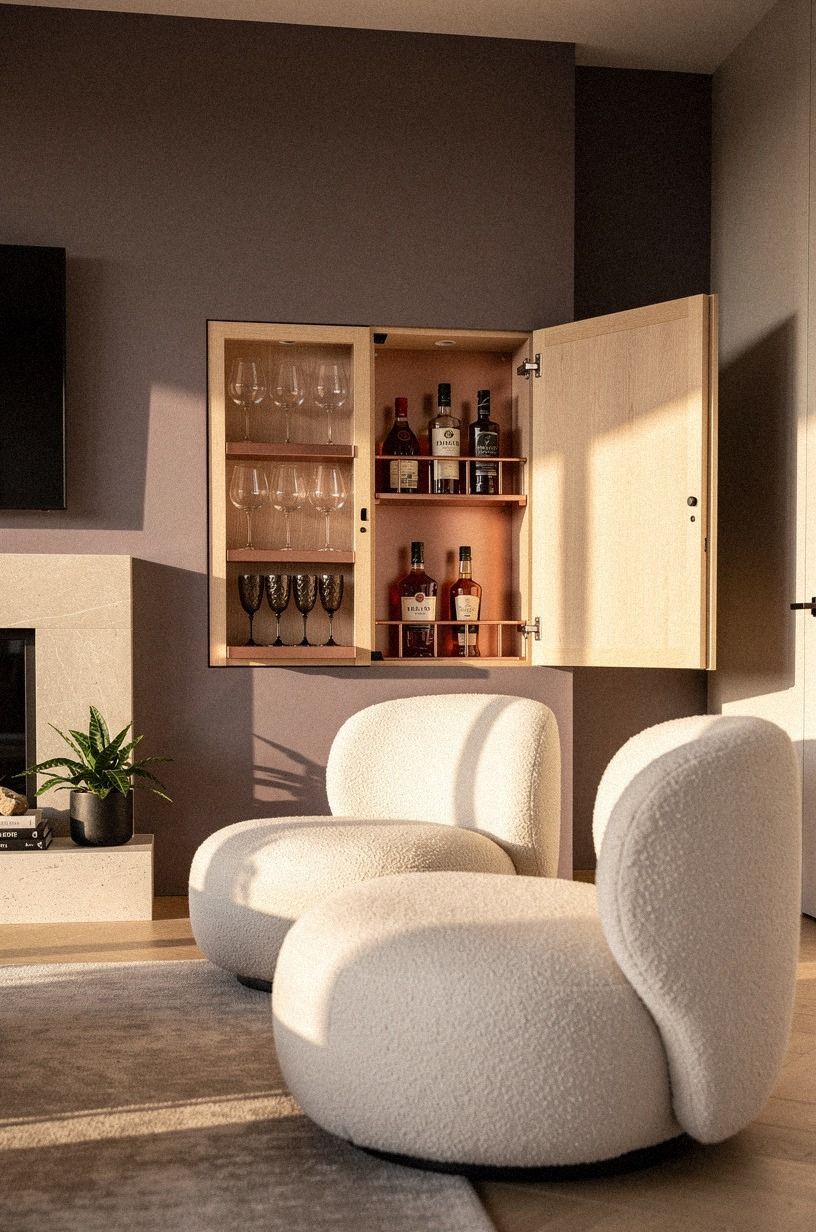
If you have a fireplace wall with extra depth on one side, that dead zone can become the smartest storage in the room. A plum grey wall with an asymmetrical cabinet tucked beside the surround feels built-in and grown-up, especially when the lock disappears into the hardware instead of announcing itself. This is the strongest choice if you want grown-children, rental guests, or just your own peace of mind.
Use Benjamin Moore Revere Pewter HC-172 or another warm grey around the firebox if you want the lockable section to blend rather than read as an add-on. You should size the cabinet around the architecture instead of forcing symmetry where it doesn’t belong. And you should be honest about budget here, because once millwork and stone get involved, the spend moves quickly.
If your rug is 8×10 or 9×12 and the front legs of your seating sit on it already, a side cabinet like this won’t crowd the room the way a freestanding bar would. Unlacquered brass lock hardware picks up the same patina as a fireplace tool set, which is the move.
That practical win is what makes it worth it. If you’re choosing between this and a stone reface, the fire pit vs fireplace comparison is a good sanity check on what kind of focal point your room really needs.
14What about floating stone shelves with a concealed lower cabinet?
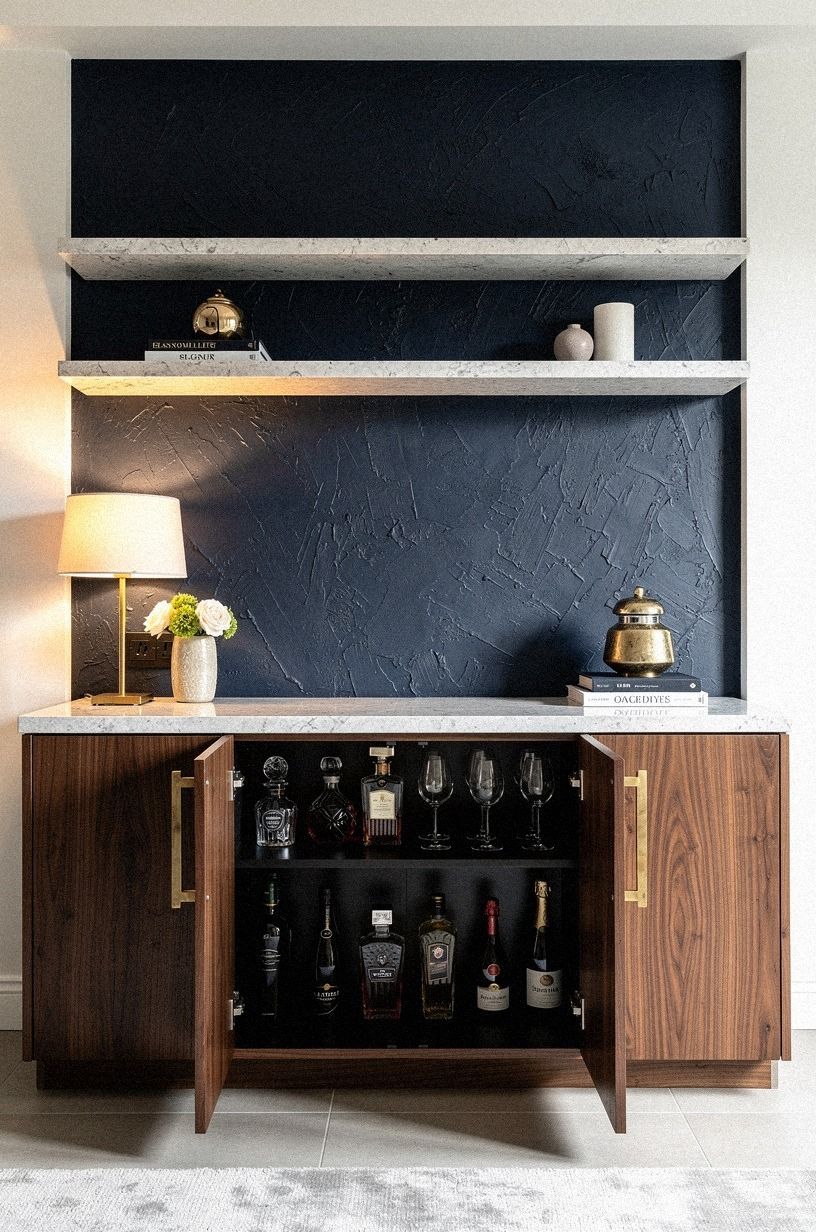
That’s my favorite underdog move, and yes, it works!
The Two-Layer Concealment Rule
The hidden bar ideas that age well all follow the same rule: the room needs one visible layer and one private layer. The visible layer is what the room says about itself when nobody’s entertaining. That’s where your lamp, art, shelves, and wall color do the talking.
The private layer is where the practical stuff lives. Bottles.
Openers. Napkins.
The minute those two layers get mixed, the room starts reading like storage instead of living space.
I’ve made that mistake before. I thought an open cart looked easy and social, but it pulled every conversation toward the cart and away from the room. It also made the living room feel smaller, because your eye kept landing on labels, glass, and chrome instead of on the seating, the fireplace, or the windows.
Once I started hiding the functional parts and letting only the atmosphere show, everything settled down. The room looked finished even when nothing was perfectly styled.
This is also where money gets wasted. People spend on the dramatic piece first, then ignore the envelope around it.
I’d reverse that. Get your wall color right.
Get your lighting layered. Make sure the room proportions already work.
A sofa depth around 35 to 40 inches, a rug large enough that the front legs sit on it, and a TV placed about 1.5 to 2.5 times the screen diagonal away all do more for the room than a flashy bar setup ever will. Then add the hidden storage where it supports the architecture.
And honestly, that’s why these concealed cabinets feel richer than obvious bars. They’re not performing.
They’re editing. A room with a concealed secretary or a panel-front cabinet tells you the owner thought about how the space should feel at noon, at dinner, and at midnight.
Compare the atmosphere each option gives you before you compare the price. The principles behind 19 genius hidden storage ideas translate just as well to linen closets and entryways, and the mantel styling roundup shows how to layer in the same quiet-collected mood once the cabinet is in.
What People Always Want to Know
What is the best Hidden Liquor Cabinet Ideas [Stylish Ways to Stash the Bottles] for a small living room?
A shallow art-front cabinet or a foldout shelf is usually the best pick because it gives you real function without floor bulk. You should look at compact pieces from IKEA first, then copy the idea in a custom finish if you need something more tailored. The cozy reading nook ideas post shows how small-space layering can do the same quiet work.
Where can I buy Hidden Liquor Cabinet Ideas [Stylish Ways to Stash the Bottles] pieces on a budget?
Start with Target Threshold, Wayfair, and IKEA because they all carry credenzas, media units, and skirtable tables that can fake a built-in look. Facebook Marketplace matters too.
Old secretary desks and solid wood consoles show up there for less than new flat-pack pieces. A West Elm console on the resale market can also drop into the $400 to $600 range if you’re patient.
How much does a Hidden Liquor Cabinet Ideas [Stylish Ways to Stash the Bottles] makeover cost?
Most living room versions cost about $100 to $300 if you’re repainting or repurposing furniture, and a custom built-in climbs much faster. The free win is editing what you already own.
Fewer bottles, better trays, smarter shelf spacing. That alone changes the read.
Can I create a Hidden Liquor Cabinet Ideas [Stylish Ways to Stash the Bottles] on a budget?
Yes, and you don’t need millwork to get the effect. The cheapest wins are repurposed furniture, removable fabric, and better styling discipline. Try a closed credenza you already own, a skirted console with tension wire inside, or thrifted art mounted over a slim cabinet.
Pair that with a refresh using Benjamin Moore Revere Pewter HC-172 on the millwork and you’ve moved the room without a big spend.
Is a Hidden Liquor Cabinet Ideas [Stylish Ways to Stash the Bottles] worth it in a small space?
Yes, especially in a small room, because concealed storage keeps the layout from feeling visually noisy. That’s the value.
You should place the cabinet where circulation already pauses, not along your tightest walkway, so the room still breathes when the doors are open. If you need more small-space tactics, the 14 cozy studio apartment ideas guide is full of similar moves, and a slim IKEA KALLAX with a Farrow & Ball Studio Green back panel can become a hidden bar in under an hour.
Is Hidden Liquor Cabinet Ideas [Stylish Ways to Stash the Bottles] a good idea for a rental?
Yes, as long as you stay with no-damage layers and movable pieces. Use a closed media unit, a secretary desk, a skirted console, or art that covers a freestanding slim cabinet.
Removable puck lights and tension-mounted dividers help without risking your deposit. The murphy bed in a closet post walks through the same renter-friendly thinking if you want another example.
Where I’d Start First
If I had to pick one, I’d start with the closed credenza. It hides the messiest part fast, costs less than millwork, and doesn’t lock you into one layout.
Pin the credenza idea for later, then measure the door swing before you buy. You’ll avoid the most annoying mistake!