
The best hidden bars in the bedroom aren’t really bars. They’re pieces of furniture that happen to hold a bottle, a glass, and the quiet ritual of ending your day somewhere that isn’t the kitchen. I’ve set up a few over the years, and the ones that felt right all started from the same place: the bedroom’s existing architecture. A wardrobe door. A headboard niche. The foot of the bed. The move is letting the room do the work and using the bar as the excuse to commit to a finish you already wanted. These 14 ideas keep the bottles close, keep the bedroom calm, and make the nightcap feel like part of the bedroom instead of a guest who won’t leave.
Quick Answer
A bedroom nightcap station works best when you build it into furniture you already use: a mirrored armoire, a headboard niche with folding doors, a wardrobe pull-out, or a closet alcove lined with brass rails. Skip anything mirrored and neon if you want a room that still feels like sleep.
Pick one architectural moment, give it warm lighting from sconces or a low table lamp, and edit hard. Two glasses, one bottle you actually drink, one weighted tray.
The bar should disappear by morning and reveal slowly at night, never the other way around. If you want a sibling palette story for the alcove, this green speakeasy decor roundup treats brass rails the same way in a richer palette.
- Conceal a minibar inside a mirrored armoire
- Slide nightstand panels over bottle storage
- Build a headboard niche with folding doors
- Hide a cocktail tray inside the wardrobe
- Install a tambour door beside the dresser
- Fluted fronts versus mirrored ones for glassware
- Turn a vanity drawer into bar storage
- Mount a fold-down shelf under artwork
- Tuck a mini fridge behind linen panels
- Paint the reveal in glossy midnight blue
- Frame a tucked-away bar with bedside sconces
- Disguise bottles inside a blanket chest
- Line a closet alcove with brass rails
- Style closed doors with books and perfume
1Conceal a minibar inside a mirrored armoire
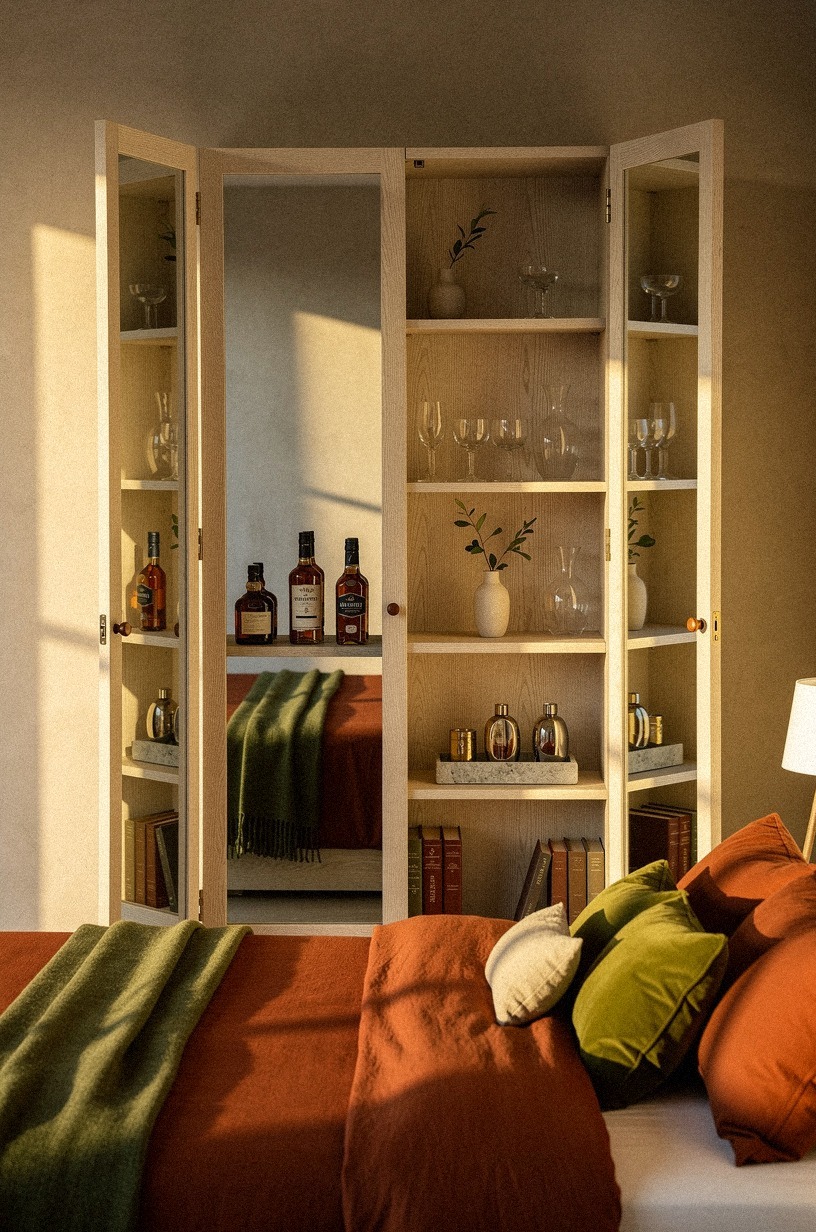
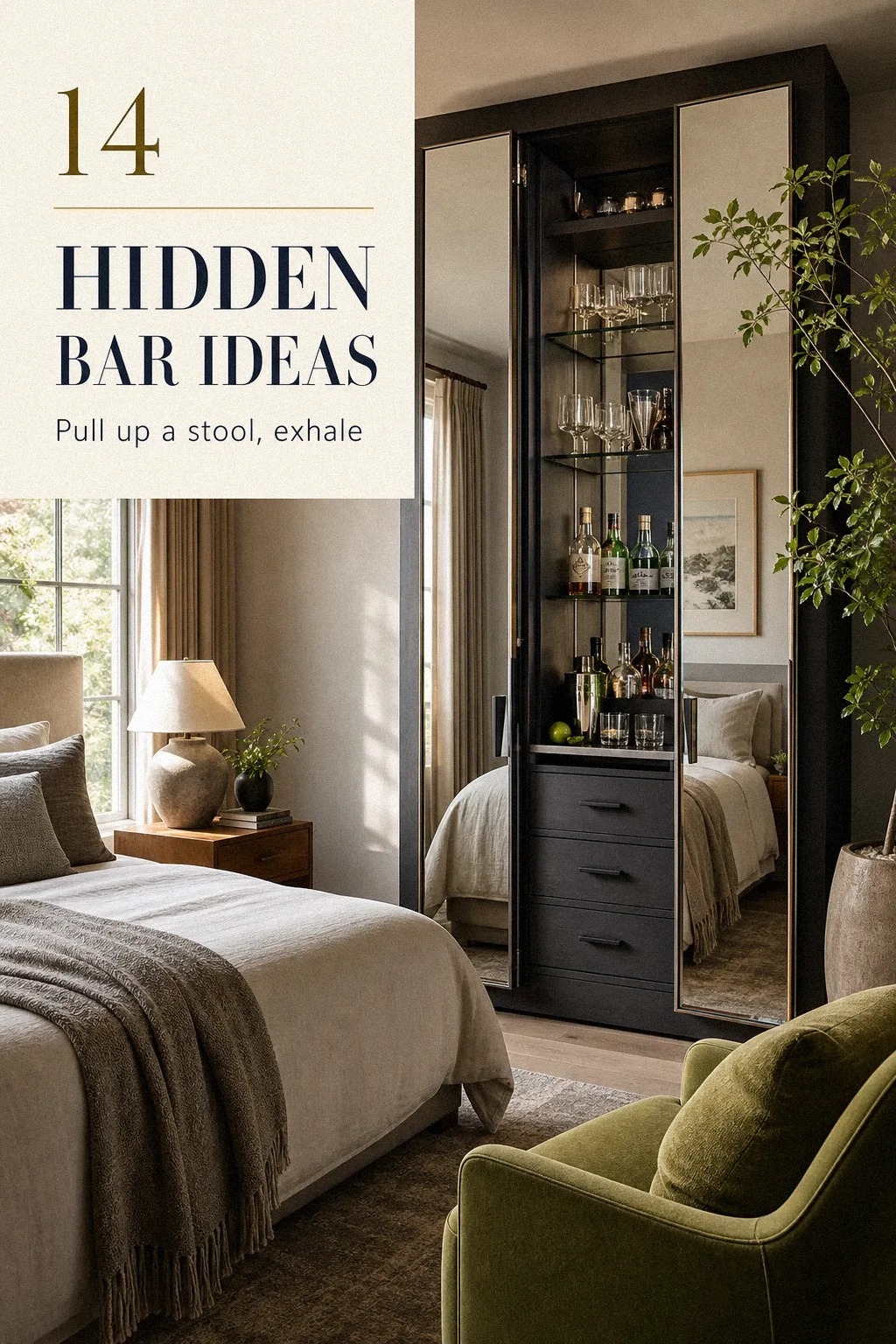
Start with a mirrored armoire if your bedroom already needs light bounced back into the room. The double doors do two jobs at once: they make a queen bed at 60×80 inches feel less boxed in, and they hide your bottles until you want the room to shift from sleep mode to nightcap mode. I’d choose this over an exposed cart every time because you keep the soft bedroom mood rather than constant bar display.
Inside, give yourself real zones so the reveal feels intentional. Bottle cubbies on one side.
Stemware up top. A small stone tray in the center for the pour.
If your walls are painted Benjamin Moore Pale Oak OC-20, the mirror and pale backdrop keep the whole thing from getting heavy. And if you’re already planning other tucked-away storage, this hidden mini bar layout for small spaces shows the same restraint in a tighter footprint. You don’t need much, but you do need order.
2Slide nightstand panels over bottle storage
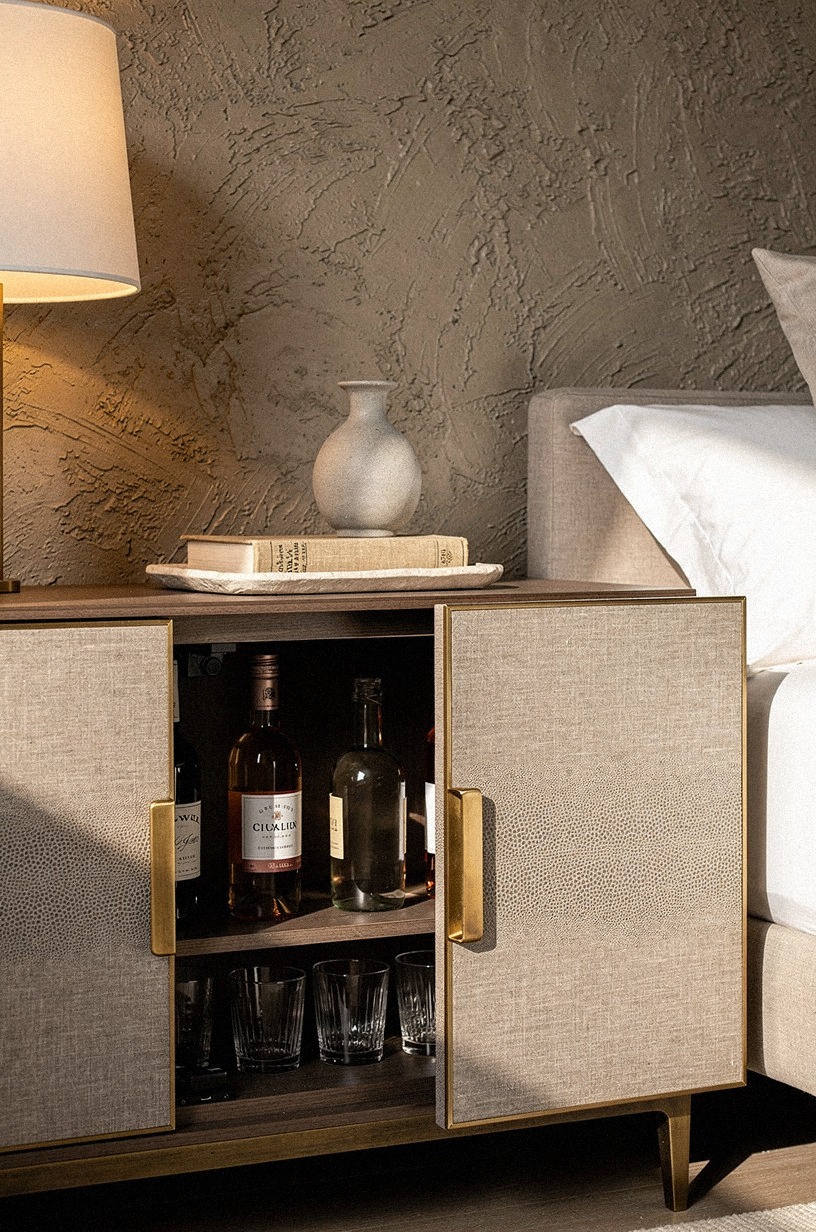
This is the move I’d reach for in any narrow bedroom where every inch beside the bed matters, and it’s the one I wish I’d done years ago. Take a standard nightstand depth and add a sliding panel on the side that faces the bed.
Behind the panel: a shallow bay sized for two short tumblers and one bottle. Nothing taller than ten inches, nothing wider than the nightstand itself.
When you want the bar, you slide the panel back with one finger. When you don’t, the side reads as solid panelry and the room stays calm.
I’d build the panel from shagreen-wrapped MDF with a slim unlacquered brass finger pull. The shagreen picks up lamplight without competing with the bedding, and brass ages into something warmer instead of looking like a finish you have to defend.
A 12-inch-wide reveal is plenty. Two tumblers.
One bottle of something brown. A linen square folded on the bottom shelf so nothing rattles when you open the panel at midnight. Total added cost over a regular nightstand: about $180 to $320 depending on what you already own.
Want a similar sliding-panel logic elsewhere in the house? This mirror-door hidden bar idea carries the same move into a bigger footprint.
3Build a headboard niche with folding doors
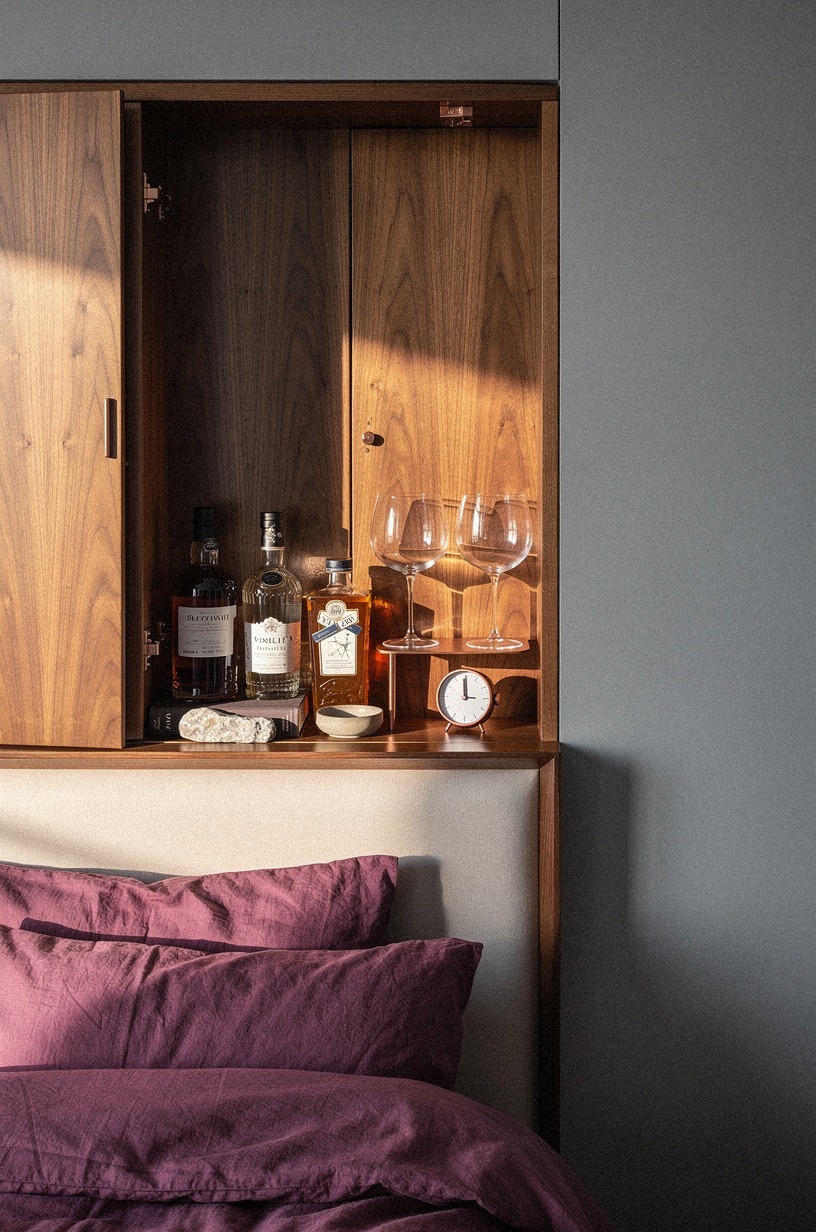
If you’ve got the width for it, a headboard niche turns the bar bedroom concept into architecture. I love it most behind a bed in cerused white oak or book-matched walnut because the grain does the decorating for you before a single bottle goes in. Instead of adding another cabinet across the room, you tuck the function right where the visual weight already lives.
Give the niche enough horizontal breathing room to sit wider than the bed, especially if you’re styling a king at 76×80 inches. Folding doors matter here because swing doors can smack lamps or block the path.
Inside, I wouldn’t crowd it. Two decanters.
A stack of napkins. Low amber glass. That’s it.
Want a sibling look in another zone of the house? This hidden bar idea for the living room proves the same built-in approach works without feeling theme-y.
Why force a separate cabinet when the headboard can do the hard work for you?
4Hide a cocktail tray inside the wardrobe
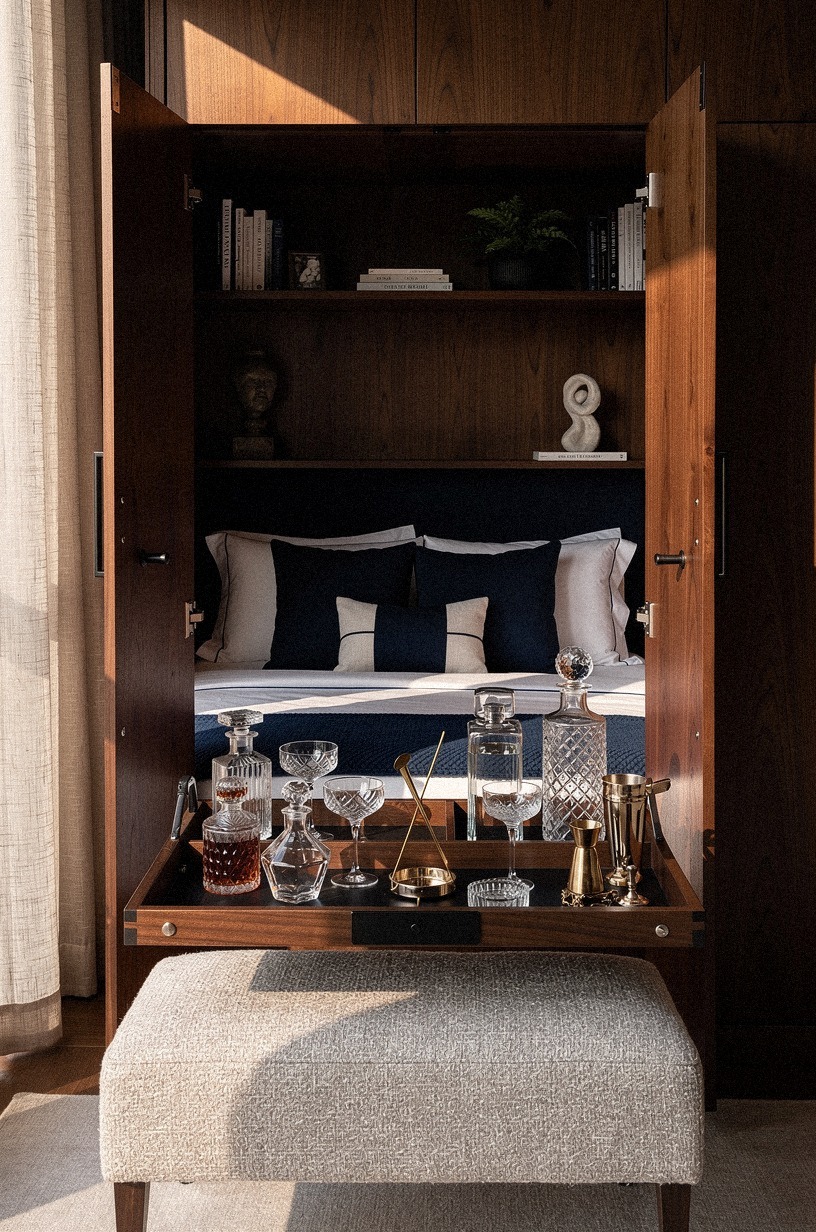
A pull-out tray inside the wardrobe is the move I’d recommend for anyone renting or anyone who refuses to commit to a built-in. The wardrobe is already a piece of architecture you didn’t have to install. You just give it one job it didn’t know it had.
Take a walnut tray at roughly 14 by 18 inches, fit it with low brass rails along two edges so the bottle can’t slide, and mount it on soft-close full-extension drawer slides rated to 75 pounds. The slides matter because cheap ones rattle every time you open the door, and that single rattle is what kills the calm.
Store two glasses upside down on a small velvet-lined shelf above the tray, and tuck a folded linen napkin underneath. The whole reveal takes maybe three seconds and disappears again.
Cost: $140 to $260 for the hardware if you’re doing it yourself, more if a cabinetmaker handles the install. For a similar wardrobe-as-bar logic with a tighter footprint, this small-space hidden mini bar article is worth bookmarking.
5Install a tambour door beside the dresser
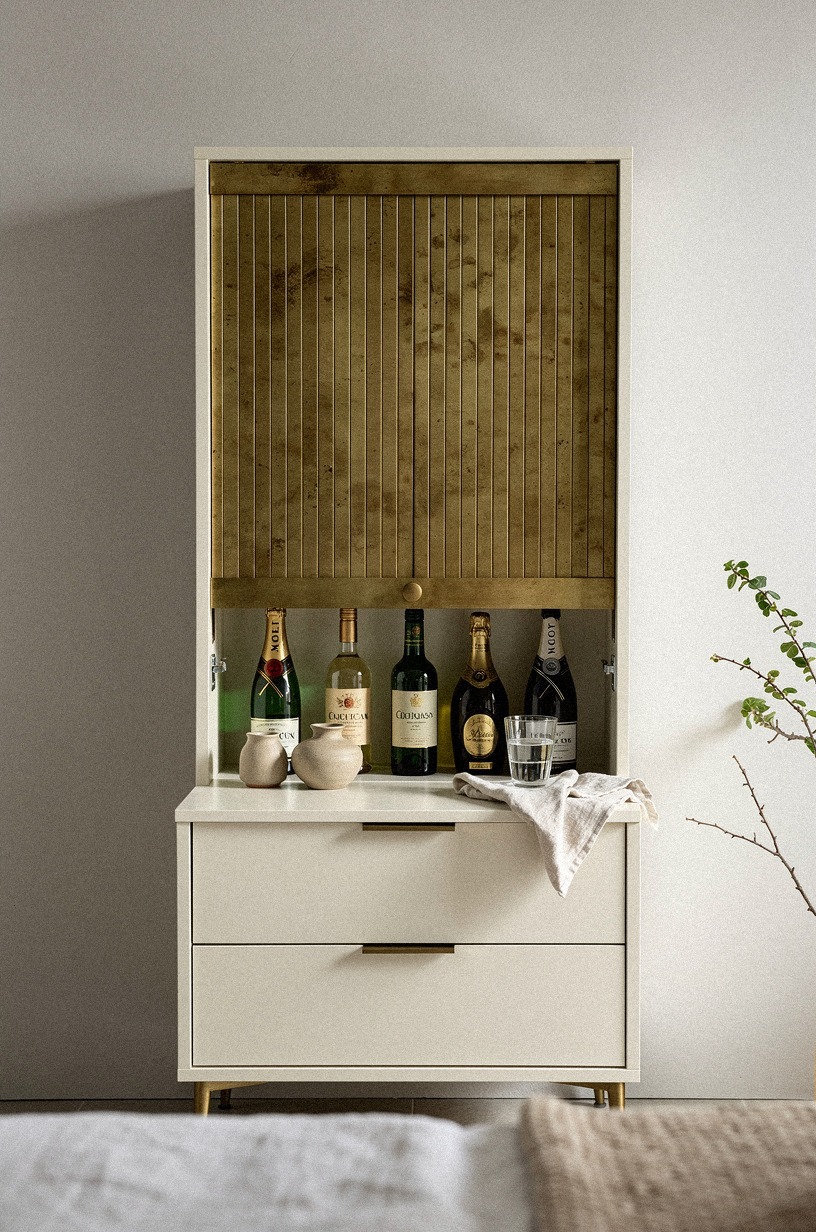
A tambour door gives you movement without the visual bulk of a regular cabinet door, and that’s exactly why it works in a bedroom. Next to a dresser, it feels tailored.
The rounded slats, the little brass lift, the way the panel disappears upward instead of out into the room. I’d rather do this than a hinged mini cabinet every single time.
Keep the bay narrow so the reveal feels jewel-box small. A cream dresser with a brass tambour insert looks especially good against Sherwin-Williams Accessible Beige SW 7036, because the warm neutral keeps the metal from getting too sharp.
Your storage can stay simple: one bottle shelf, hanging rack for two glasses, linen cocktail napkins below. If you like hidden storage that still reads custom, this closet-to-speakeasy conversion guide treats sliding panels with even more restraint.
But I’d skip mirrored tambour here. Too busy for a bedroom.
6Fluted fronts versus mirrored ones for glassware
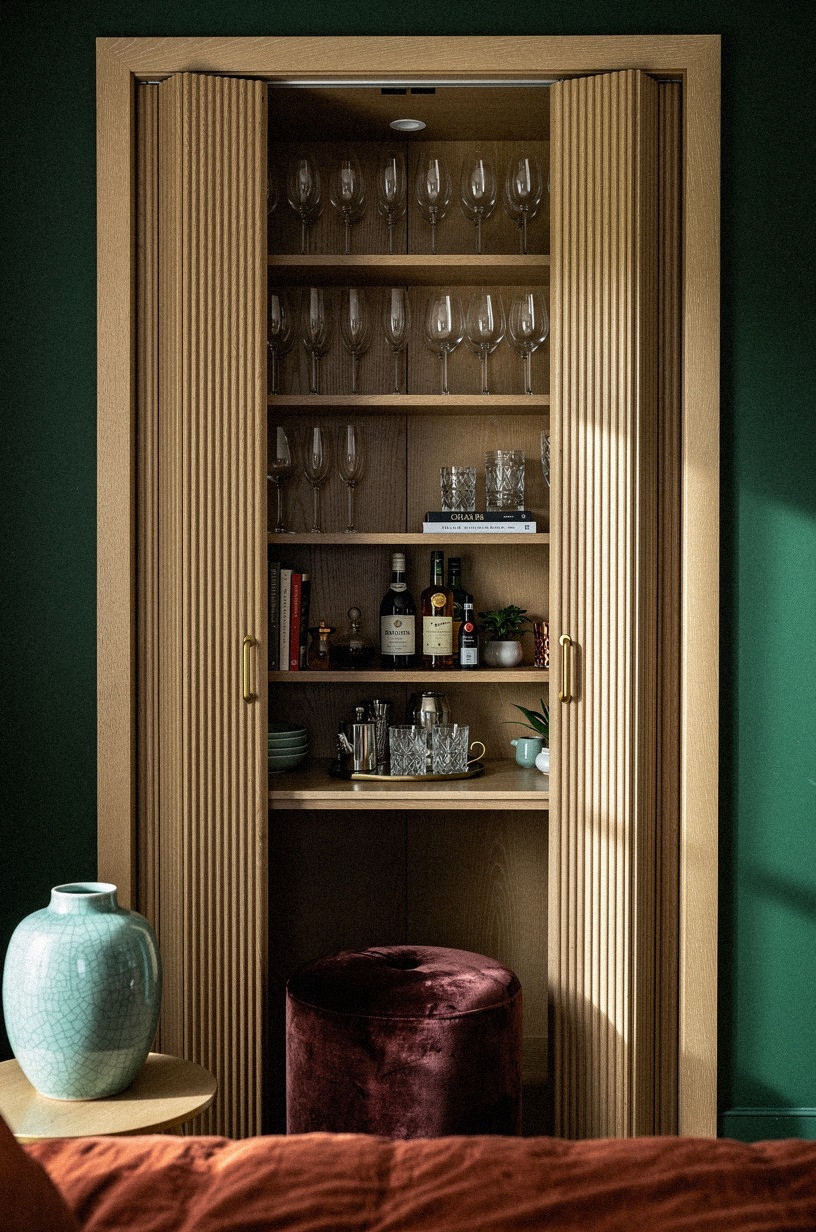
Fluted glass fronts are doing a lot right now in kitchens and baths, and they’re having a quiet moment in bedrooms too, mostly because the vertical ridges catch lamplight the way a pleated shade does. The question is whether fluted or mirrored is the right call behind closed doors, and the honest answer is that fluted wins for almost every bedroom.
Here’s why. A mirrored front doubles everything in the room: the bedding, the lamps, the windows, whatever you don’t want to look at twice. A fluted front in reeded glass or fluted acrylic does the opposite.
It softens what’s behind it. You see the suggestion of bottles without the count.
The bedside lamp throws light across the ridges in a way that reads like architectural detail, not bar display. If you already have a fluted island or a fluted vanity in an adjacent bath, repeat the texture here so the bedroom reads as part of the same house.
For a related reeded-glass moment in a different room, this speakeasy curtain and drapery guide handles the same light-play in fabric instead of glass. I’d reserve mirrored fronts for the room where you actually want the room to feel bigger, not the room where you’re trying to sleep.
7Turn a vanity drawer into bar storage
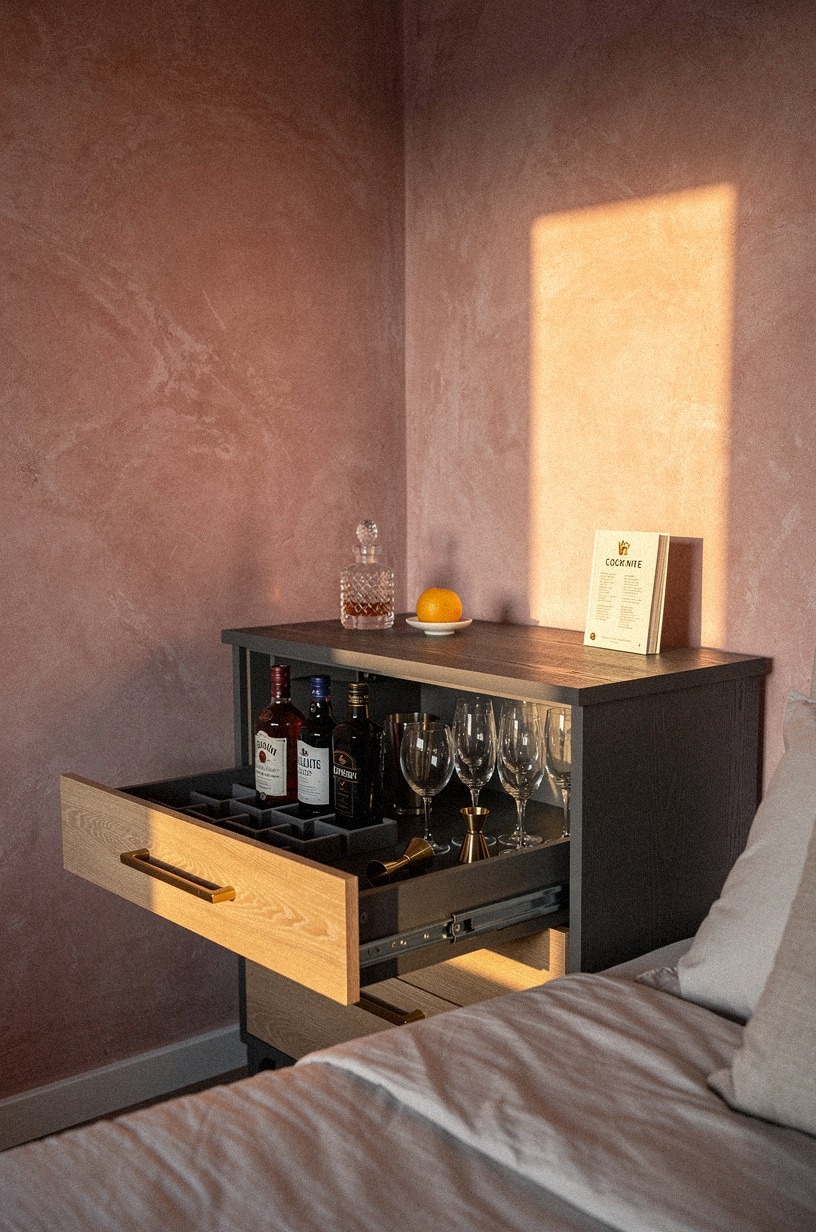
This is such a smart renter-friendly move because the vanity already wants compartments. Instead of filling every drawer with backup cords and random samples, dedicate one deep drawer to the nightcap station.
Bottle slots. Two glasses.
A jigger. A linen square.
That’s enough to make the drawer feel finished instead of improvised.
I like using fitted inserts in unlacquered brass or walnut so the bottles don’t clack around every time you open the drawer. If the vanity sits near a window, a wash of morning light on the metal makes the whole setup feel custom, even when it started as basic furniture.
But keep scale honest. A small drawer should hold a small ritual.
For more ideas that hide the function until you need it, this living room hidden bar guide gets the furniture logic right. You don’t need a full backbar to feel spoiled.
If you want a deeper paint story for the vanity surround, try Benjamin Moore White Dove OC-17 and let the metal do the talking.
8Mount a fold-down shelf under artwork
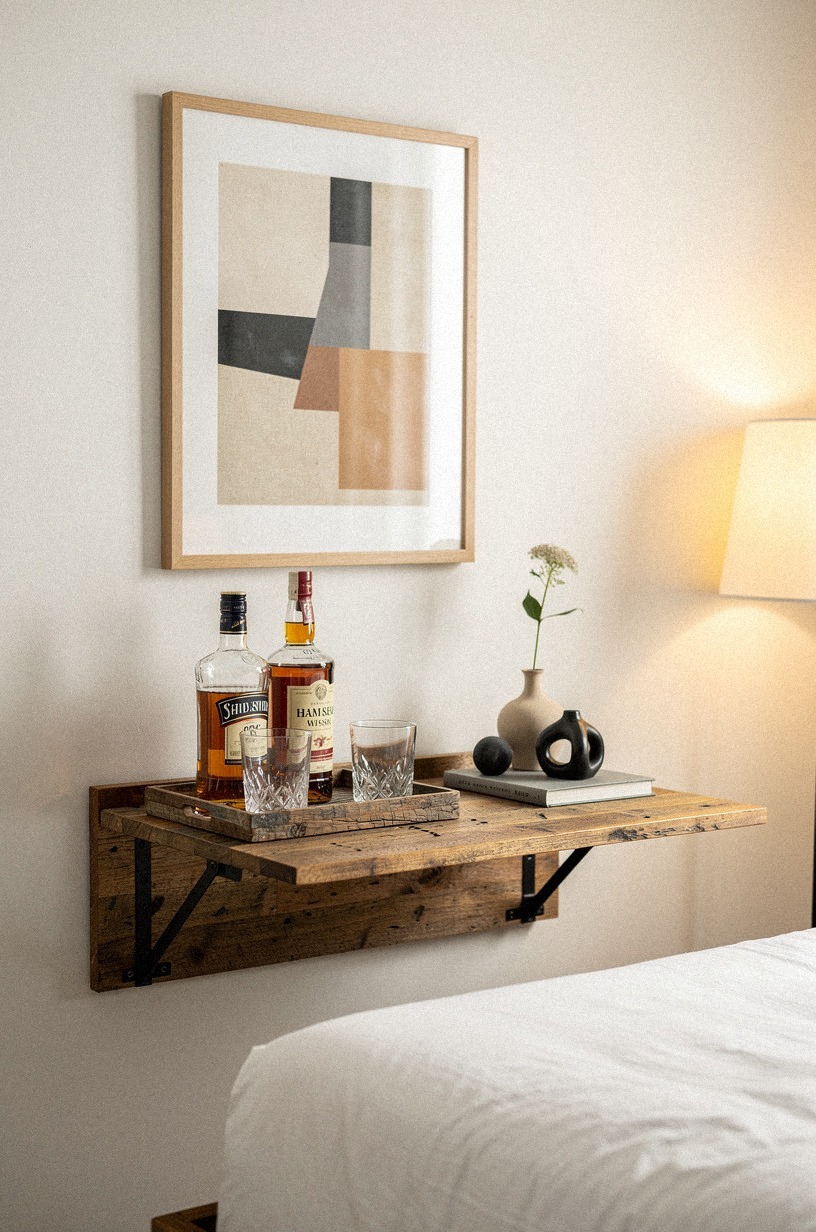
A fold-down shelf under art is one of those ideas that sounds gimmicky until you see it done well. The hinge is the whole reason.
A brass pivot hinge mounted into the wall framing lets a slim walnut shelf drop down to bar height and fold back up flush with the wall when you’re done. No visible hardware, no cantilever sag, no clunky bracket.
The shelf itself should be at most 10 inches deep and 24 inches wide, sized for one bottle, two glasses, and a small tray. Mount it 36 to 40 inches off the floor so the elbow has somewhere to land while you pour. Above the shelf, hang a single piece of art at standard eye level so the eye reads shelf-as-furniture, not shelf-as-bar.
The artwork is what sells the camouflage. For the same hide-until-needed logic in a bigger piece, this small-space hidden mini bar article has a few sister moves.
Total cost with the brass hinge and a piece of walnut: $90 to $160, and the room doesn’t know it’s there until you drop the shelf.
9Tuck a mini fridge behind linen panels
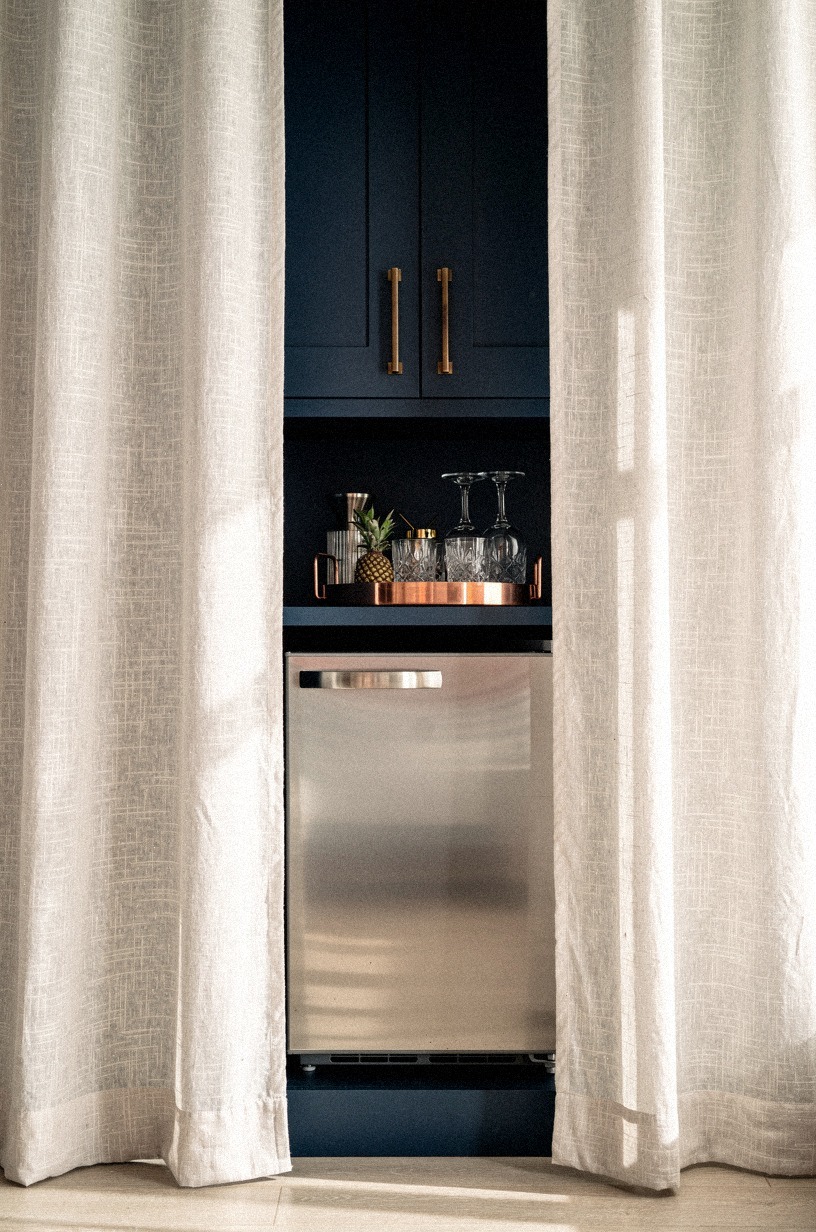
If you like cold sparkling water or chilled glasses at night, this is the splurge that changes how the whole room functions. A mini fridge behind linen panels lets the bedroom keep its softness while still doing real work.
I wouldn’t put exposed stainless in a sleeping space. Never.
But wrap the reveal with Belgian linen panels in ivory and suddenly the appliance disappears.
The fridge itself should be a 24-inch undercounter model with a solid door, not glass. Glass looks like a bar fridge and reads as bar fridge.
A solid panel-ready door, painted or wrapped to match the bedroom millwork, is what makes this work. Ventilation is the part everyone skips, and it’s the part that keeps the whole thing from turning annoying fast: leave at least two inches behind the unit and cut a low vent in the toe kick so the compressor can breathe.
If you’re already reworking a storage wall, the fridge can piggyback on that project without feeling random. A West Elm Belgian Linen Panel runs about $129 to $189 per panel and looks instantly custom.
For more examples of hidden service zones that stay visually quiet, this hidden wet bar inspiration treats appliance concealment with the same restraint.
10Paint the reveal in glossy midnight blue
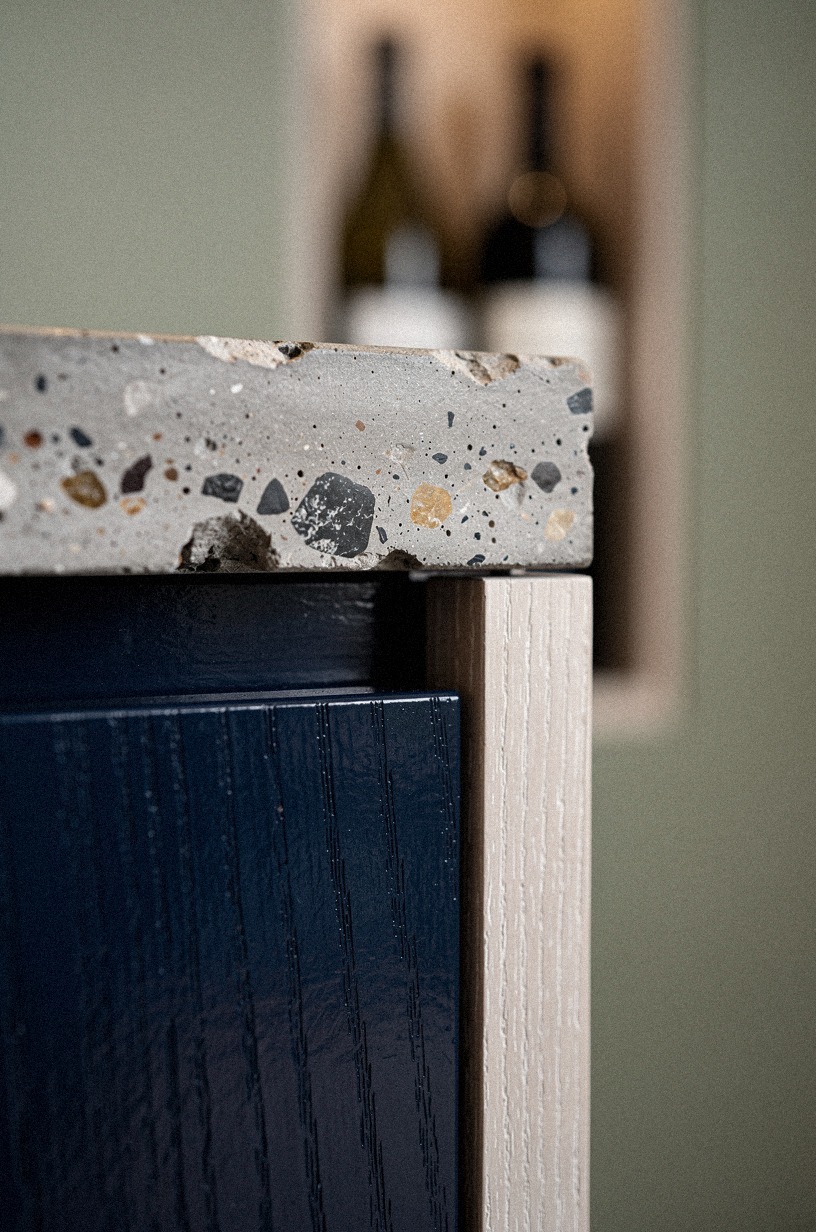
Sometimes the smartest move isn’t more cabinetry. It’s contrast. A glossy reveal edge in midnight blue makes the hidden bar feel deeper the second the door opens, especially against cerused white oak and a poured-concrete ledge.
You don’t need much paint either, which is why this works even when the rest of the room stays pale.
I’d keep the outer bedroom envelope soft with Benjamin Moore Pale Oak OC-20, then hit only the inner bar reveal with a lacquer-like dark blue so the moment feels deliberate. The sheen matters as much as the color because light skims the edge and makes the opening feel sharper.
And if the room already has too many midtones, this is the fix. The single can of Farrow & Ball Hague Blue No. 30 in Dead Flat sells for about $120 and covers a full reveal twice, which is the entire budget here.
Pair it with a Benjamin Moore White Dove OC-17 outer wall and the contrast does all the work. For a tucked-away palette story, this speakeasy paint color guide goes deeper on the dark reveal logic.
11Frame a tucked-away bar with bedside sconces
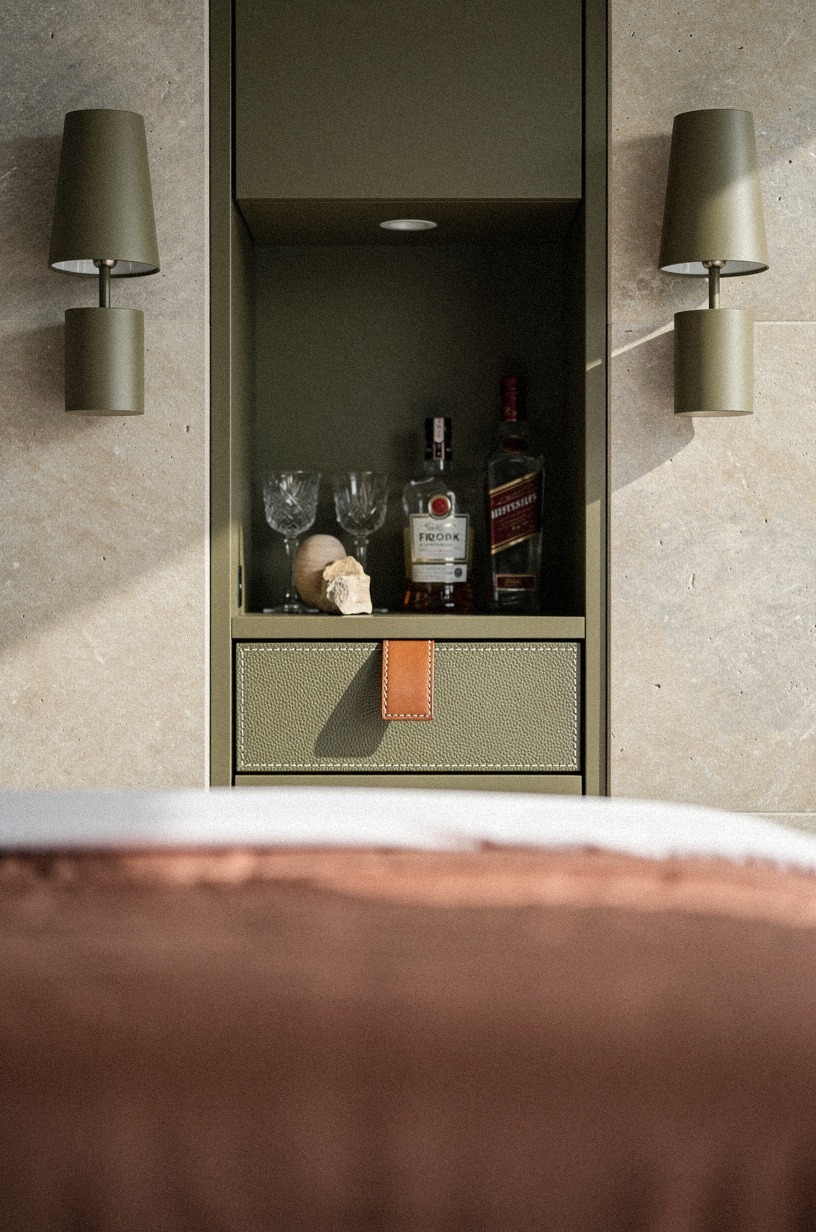
Light is what makes the reveal feel expensive. Not the bottles.
Not the shelves. Two bedside sconces flanking a centered niche create that hotel-like balance you notice before you even clock the bar.
I’d do warm bulbs only, and I’d keep the spread low so the glow stops around the niche instead of washing the whole wall flat.
If your nightstands already sit near mattress height, the sconces help anchor the whole line so the hidden compartment feels built in. A pair in aged brass looks great against Farrow & Ball Setting Plaster No. 231, especially if the niche itself is trimmed in walnut.
And when you’re comparing other tucked-away bar zones, this speakeasy lighting guide covers the bulb-temp logic in more detail. But skip cool LEDs.
They kill the mood instantly. For a sconce that punches above its price, the Schoolhouse Electric Owens Sconce in aged brass lands around $189 and looks twice as grown-up.
12Disguise bottles inside a blanket chest
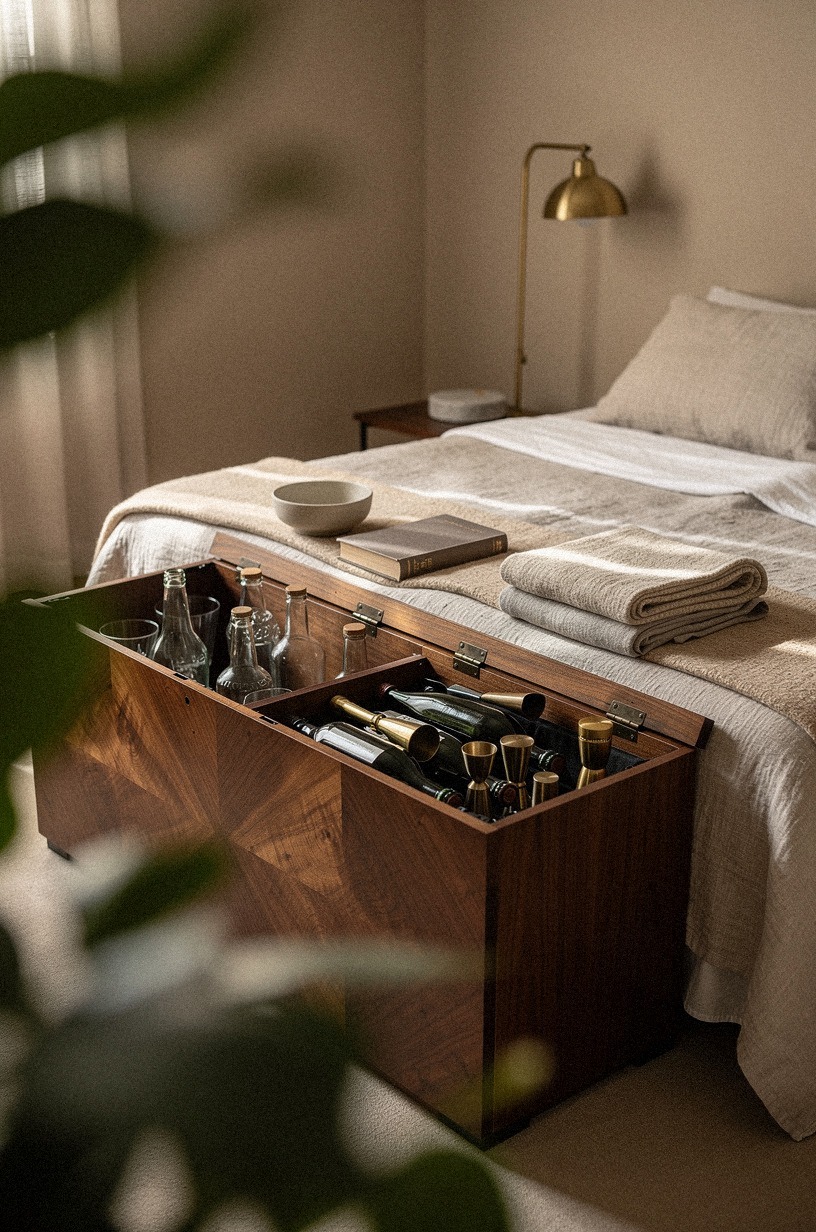
A blanket chest at the foot of the bed is one of the oldest storage moves around, and it’s exactly why it still works in a bedroom that needs to hide a bar without looking like one. The chest reads as furniture first.
The bottles read as afterthought. That’s the whole camouflage.
Pick a chest with a deep enough cavity to hold two bottles lying flat, two tumblers wrapped in linen, and a small tray. Cedar-lined chests are best because the wood absorbs any smell transfer, so the bottle you keep open doesn’t end up scenting your wool throw.
I’d skip chests with visible hardware on the lid. A simple iron strap hinge in matte black or unlacquered brass keeps the lid quiet and the proportions honest.
Style the top with one folded throw and one small object, the same way you’d style a bench. For a richer palette moment at the foot of the bed, this dining-room speakeasy guide treats the bench-and-chest logic with more dressed-up materials.
A vintage blanket chest runs $400 to $1,200 depending on age and condition, and it’ll outlive every other piece in the room.
13Line a closet alcove with brass rails
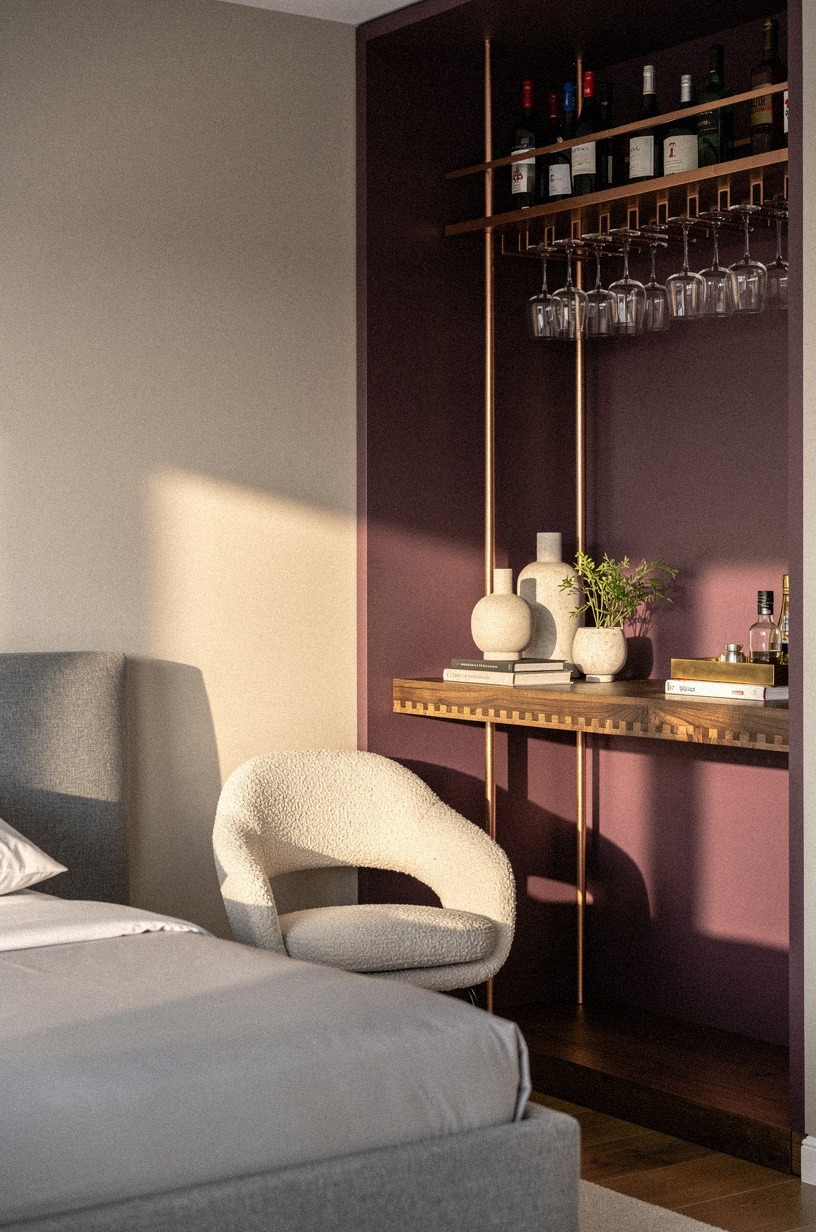
This is the dressiest option of the bunch, and yes, it can go wrong fast if you over-style it. But a plum-toned alcove with brass rails, hanging stemware, and one polished shelf can look incredible when the rest of the bedroom stays grounded. I think of it as the hotel-hush alcove: rich color inside, calm room outside, one little flash of metal when the doors open.
Try painting the alcove itself, not the whole room. A soft shell around it in Sherwin-Williams Accessible Beige SW 7036 keeps the bedroom relaxed, while the inner niche can go moodier without taking over.
One rail for glasses. One ledge for bottles.
One tray for the pour. That’s plenty. And if you want more examples of niche planning that stays tucked away, this hidden bar living room article is helpful because the proportions translate well.
Too many rails and it starts looking like retail. For a deeper speakeasy color story with the same brass logic, this speakeasy wall art roundup goes even richer on the plum-and-brass combination.
14Style closed doors with books and perfume
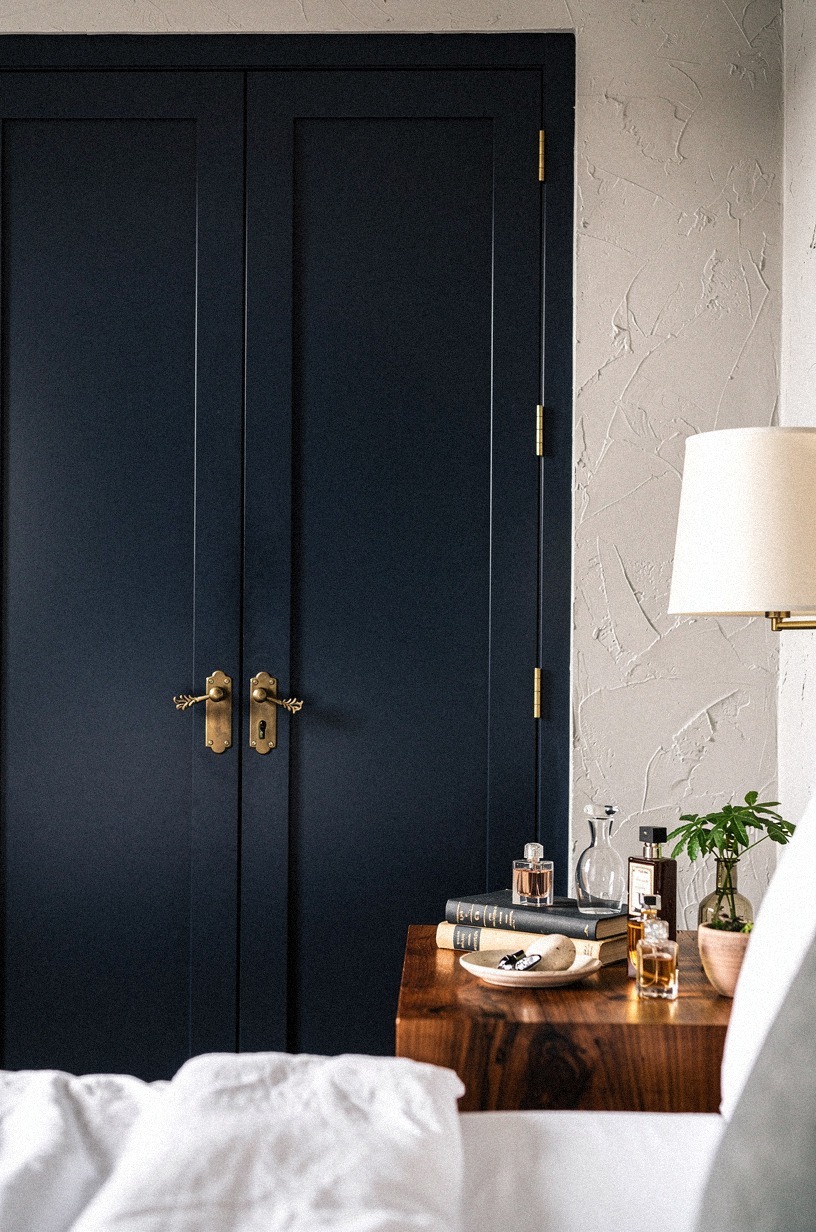
Closed doors matter just as much as the reveal because that’s what you live with all day. A mirrored or paneled door that closes off your bar is going to be the largest single surface in the eye-line of the bedroom, and if you leave it bare, it reads as a blank wall pretending to be furniture.
Style the outside of the door the way you’d style a tall bookshelf end. A brass picture light mounted above at art-gallery height, washing a single framed print or a small object.
A scent moment: a slim cedar diffuser on a small acrylic shelf mounted to the door itself, which means the room smells like the bar before you open it. A folded throw tossed over a hook at handle height, the same linen family as your bedding.
None of it is the bar. All of it announces the bar’s existence without showing a single bottle.
For a sister take on the same logic with a louder palette, this speakeasy gold and brass accent guide runs the same door-as-canvas idea in a more dressed-up register.
Why a Bedroom Nightcap Station Works Now
I think a bedroom nightcap station is having a moment because people want privacy again, not just openness. For a while, every entertaining idea got pushed into the kitchen or living room, and a lot of that looked good in photos but felt noisy in real life. A bedroom bar flips the mood.
It’s slower. More contained.
More about ritual than performance.
I’ve also noticed that the best versions don’t chase novelty. They borrow from old hotel suites, dressing rooms, and built-ins that were always about ease.
You open one door, pour one drink, shut the room back down. That’s it.
No spectacle. The difference is scale.
In 2026, you can get that feeling without a full renovation if you choose the right surface, the right pocket of storage, and one material that feels a little better than strictly necessary.
What I’d warn you against is the opposite version: a bedroom that’s been turned into a nightclub corner with mirrored everything, neon, and too many bottles out. That bar will be the loudest thing in the room by Tuesday, and you’ll start hiding it again.
The whole point of a nightcap station is that it disappears into the room until you need it. Keep the reveal slow, keep the lighting warm, and let the bedroom do the heavy lifting.
That’s what makes the difference.
My rule for making a hidden bedroom bar feel grown-up
I’ve seen people miss this in expensive rooms and cheap rooms alike: the hidden bar can’t feel more excited than the bed. If the storage is glossy, mirrored, brassy, and packed with accessories while the bed is plain, the room splits in half.
You feel it immediately, even if you can’t explain it. The part nobody respects enough is hierarchy.
What works is balance. If you want mirrored doors, keep the bedding matte.
If you want a glossy midnight-blue reveal, let the walls stay soft in Benjamin Moore Pale Oak OC-20 or Sherwin-Williams Accessible Beige SW 7036. If you want walnut and brass inside the compartment, repeat that warmth somewhere else, maybe in the lamp base or picture frame, so the reveal doesn’t look imported from another house.
I made the mistake once of doing a very dressed-up storage niche in a room with washed-linen bedding and a plain painted bed, and the bar looked like it belonged to a different person.
You also don’t need many ingredients for the setup to feel complete. That’s the freeing part.
One good bottle you really drink. Two glasses you like touching.
A tray with enough weight that it doesn’t skate around. Maybe a linen square or tiny dish for citrus if you’re the type who keeps a real ritual.
But that’s it. More stuff doesn’t make it feel luxe. Usually the opposite.
And honestly, the bedroom is where editing pays off hardest because you’re looking for exhale, not entertainment. A hidden bar should make your evening easier, quieter, and a little more handsome.
It shouldn’t ask for attention all day. If you can close the doors and the room still feels serene, you got it right.
If you can open them and the reveal feels a bit thrilling, even better.
How much does it cost to build a hidden bar into a bedroom?
Real numbers, no fluff. A renter version using a single IKEA HEMNES nightstand with a shagreen panel run lands around $220 to $380 if you already own the bottles and glasses.
A mid-range headboard niche with custom folding doors in cerused white oak runs $2,200 to $4,500 installed, plus the interior fittings. A full built-in alcove with brass rails, walnut shelves, and a midnight-blue reveal lives in the $6,500 to $14,000 zone, depending on your zip code.
The cheapest upgrade that moves the needle? A single can of Farrow & Ball Setting Plaster No. 231 on the closet front and a slim 12-inch fold-down shelf under existing art.
That’s about $180 total and it changes how the room reads.
A Few Things Worth Answering
Where should I put a hidden bar in a small bedroom?
Beside the bed, not across from it. A sliding nightstand panel or a wardrobe pull-out tray uses space you already need without claiming floor space you don’t have.
Keep the depth under 14 inches and stick to two glasses, one bottle, and a slim tray. The hidden mini bar guide for small apartments has tighter-footprint versions of the same moves if you want to compare layouts.
Can I build this into a rental without losing my deposit?
Yes, and the whole point of a nightcap station is that nothing has to be permanent. Skip the built-ins.
Use furniture-based concealment: a tray in the wardrobe, a fold-down shelf mounted into a single stud with a removable anchor, removable puck lights behind a panel, and a velvet-lined drawer insert you take with you on move day. The mirror-door hidden bar article has more renter-friendly ideas worth saving.
What’s the most expensive part of a bedroom bar project?
The millwork, almost every time. If you’re going custom, the cabinet doors, hinges, and soft-close hardware run more than the bottles, the glasses, and the lighting combined.
The cheaper path is to start with furniture you already own and add one piece at a time. The slimmer, slower build often looks more deliberate than the full renovation anyway.
What paint colors make a bedroom bar reveal feel intentional?
Glossy dark on the inside, soft warm neutral on the outside. Farrow & Ball Hague Blue No. 30 in Dead Flat or Benjamin Moore Midnight Oil on the inner reveal against Benjamin Moore Pale Oak OC-20 or Sherwin-Williams Accessible Beige SW 7036 on the bedroom walls. The two-value contrast is what makes the moment read as a designed reveal instead of a painted box.
The speakeasy paint palette guide goes deeper on the dark-on-light logic.
How many bottles and glasses do I actually need?
One bottle you really drink. Two glasses.
One tray. That’s the grown-up number. More bottles invite clutter, more glasses invite “I’ll get to those later,” and both of those turn the nightcap station into a storage problem with a lightbulb.
Edit hard. You can always add a second bottle when the first one runs out.
Where I’d Start First
If I had to pick one, I’d start with the sliding nightstand panel. You use that spot every single day, and the hidden storage works hardest where your hand already lands. Pin the idea for later and read this hidden bar living room guide if you want the same mood elsewhere.