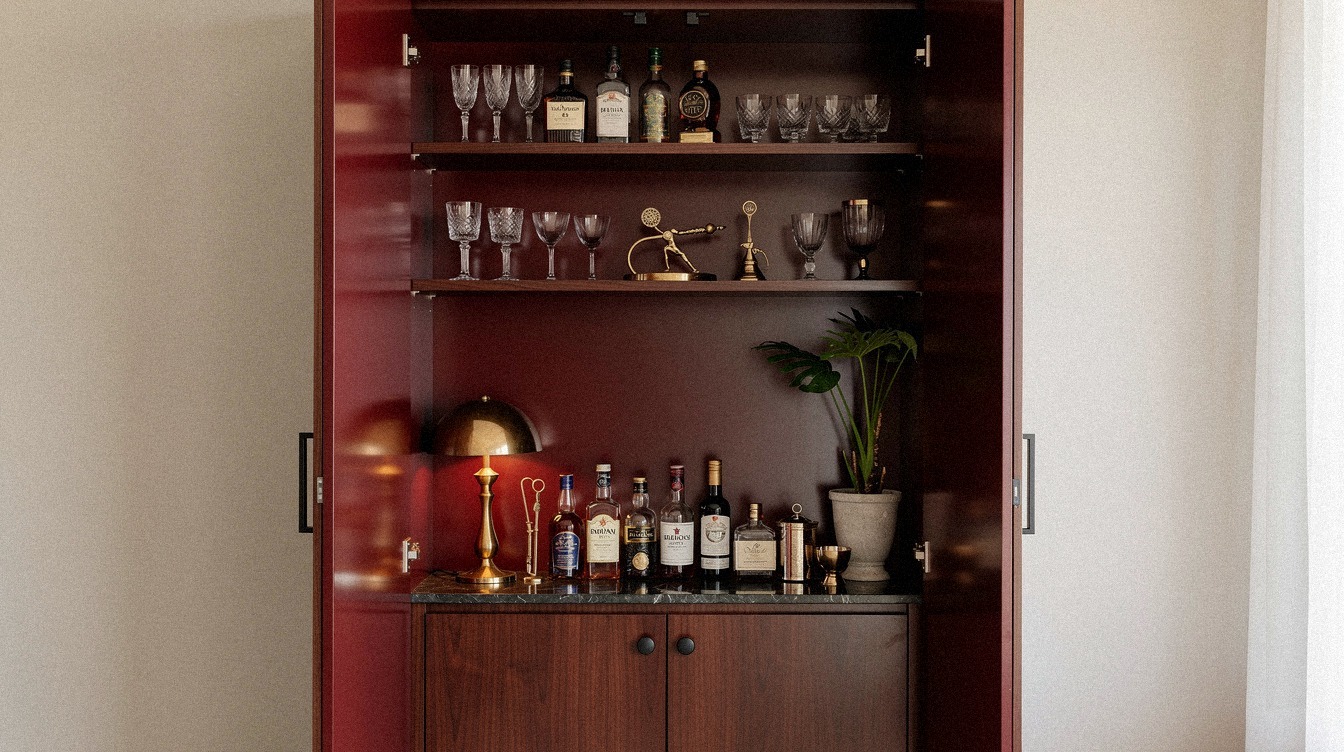
A closet speakeasy bar can feel intimate in as little as 4×4 feet, and a comfortable setup can start around $150 if you reuse the rod, shelves, and doorway you already have. I learned that after overfilling one with bottles, mirrors, and fussy decor that made the whole thing feel smaller. You don’t need more stuff. You need tighter choices, better light, and one mood that holds.
- ✓ Paint the closet walls in oxblood lacquer
- ✓ Install a brass rail across glass shelves
- ✓ Hide bottles behind cane cabinet doors
- Paint the closet walls in oxblood lacquer
- Install a brass rail across glass shelves
- Hide bottles behind cane cabinet doors
- Mount a smoked mirror above the counter
- Convert the rod into stemware storage
- Line the ceiling with tin tiles
- Add a pocket door with velvet panels
- Build a marble ledge for mixing
- Tuck a mini fridge under walnut cabinetry
- Backlight amber bottles with LED strips
- Hang antique sconces inside the doorway
- Wrap shelves in dark grasscloth
- Fit a hinged tasting counter inside
- Style decanters on a mirrored tray
- Frame the entrance with library trim
- Use a rolling ladder for upper bottles
- Layer patterned carpet under the bar
- Conceal tools inside velvet lined drawers
- Cap the nook with a picture light
1Paint the closet walls in oxblood lacquer
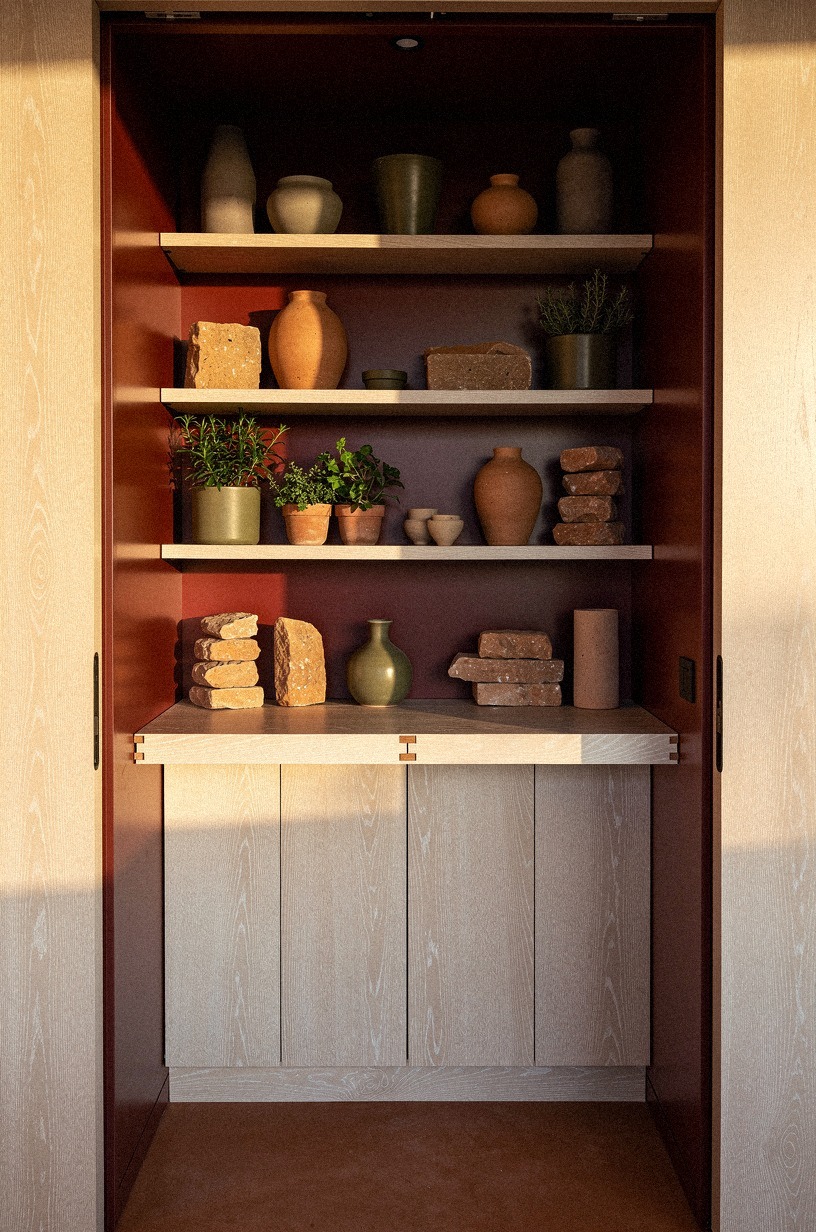
Oxblood lacquer is the fastest way to make a plain closet feel intentional instead of improvised. In a small home speakeasy, deep color pulls the walls inward on purpose, and that controlled darkness is what makes the brass, glass, and bottles look richer. If your closet is at least 6×8 ft, you can take the color across every wall.
If it’s closer to the 4×4 minimum, keep the shelves lighter so your eye still gets a break.
I wouldn’t do this in a flat paint. You want that subtle bounce that lacquer gives, especially against a cerused white oak counter with visible grain.
Think oxblood walls, warm amber bottles, one ivory lampshade, and no random rainbow labels facing out. The part that worked for me was limiting the palette before styling anything else. And yes, it looks expensive!
Pair it with unlacquered brass rails and the room starts to feel old-money without trying. If you want the doorway to sell the hidden mood too, the moody palette work we did in our moody green home office piece hits a similar theatrical register.
What if your closet is under 4×4?
Then the bar should travel vertically, not horizontally. Stack two short shelves above a single narrow ledge, hang stemware from the rod, and skip the fridge entirely. A matte black magnetic knife strip mounted on the side wall holds a slim shaker and jigger without eating an inch of counter.
The whole thing should feel like a wall you happened to lean against, not a room you furnished. Get the proportions right and a 3×6 closet reads bigger than a sloppy 5×7 ever will!
2Install a brass rail across glass shelves
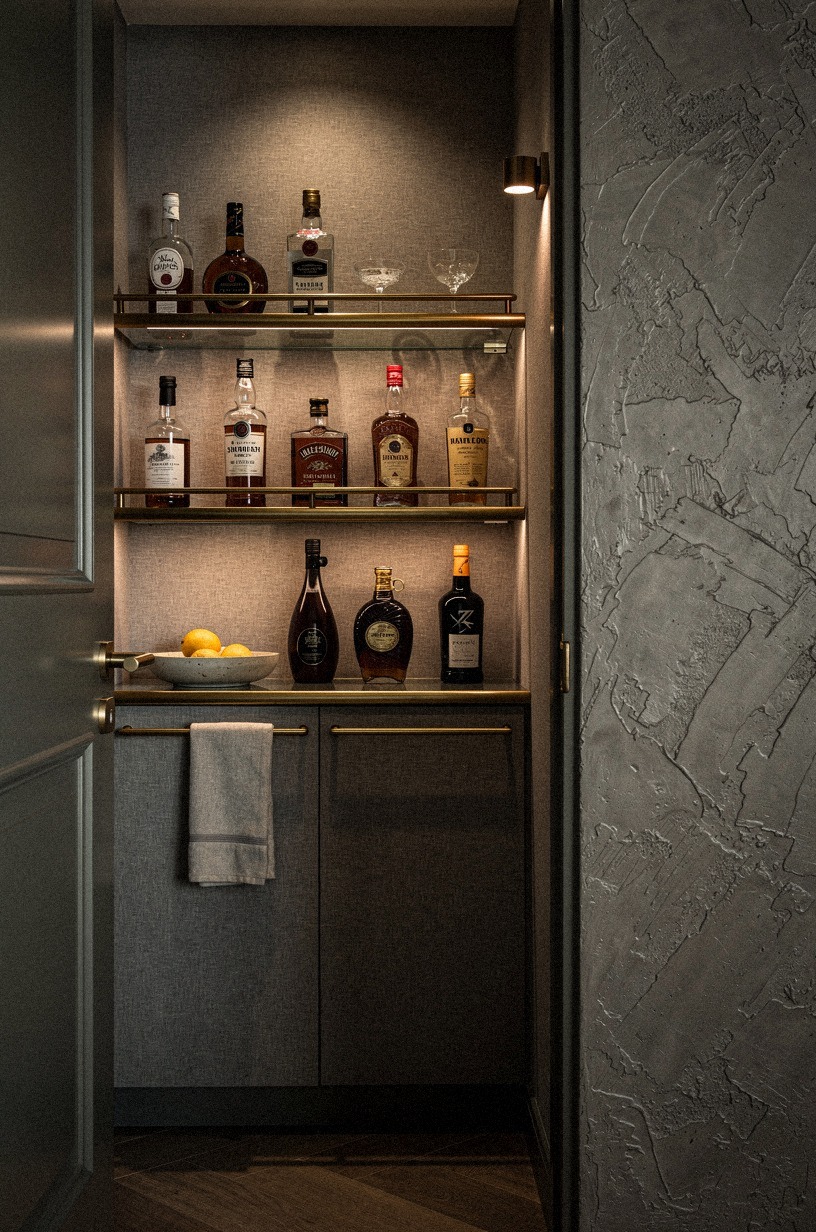
A brass rail does more than keep bottles from sliding. It gives your speakeasy closet that old hotel rhythm your eye reads in one second, especially when the shelves are glass and the rail catches the first bit of light as you step in. If your shelves are the standard 14 in deep, the rail stops the setup from feeling cluttered because the front edge finally has a clean line.
But I would choose unlacquered brass over polished brass every time because fingerprints soften into patina instead of announcing themselves. You can keep coupe glasses on the second shelf, lower bottles on the first, and one small shaker on the counter so you aren’t reaching over crystal every time. But don’t line every shelf with matching bottles.
That showroom look dies fast in real life. A tighter arrangement, three bottle heights and a few open pockets, reads far better when you’re standing in the doorway.
Pair the rail with aged bronze drawer pulls for a richer, lived-in finish. For more quiet-luxury hardware moves, see our parisian bedroom ideas and the trim work we covered there.
3Hide bottles behind cane cabinet doors
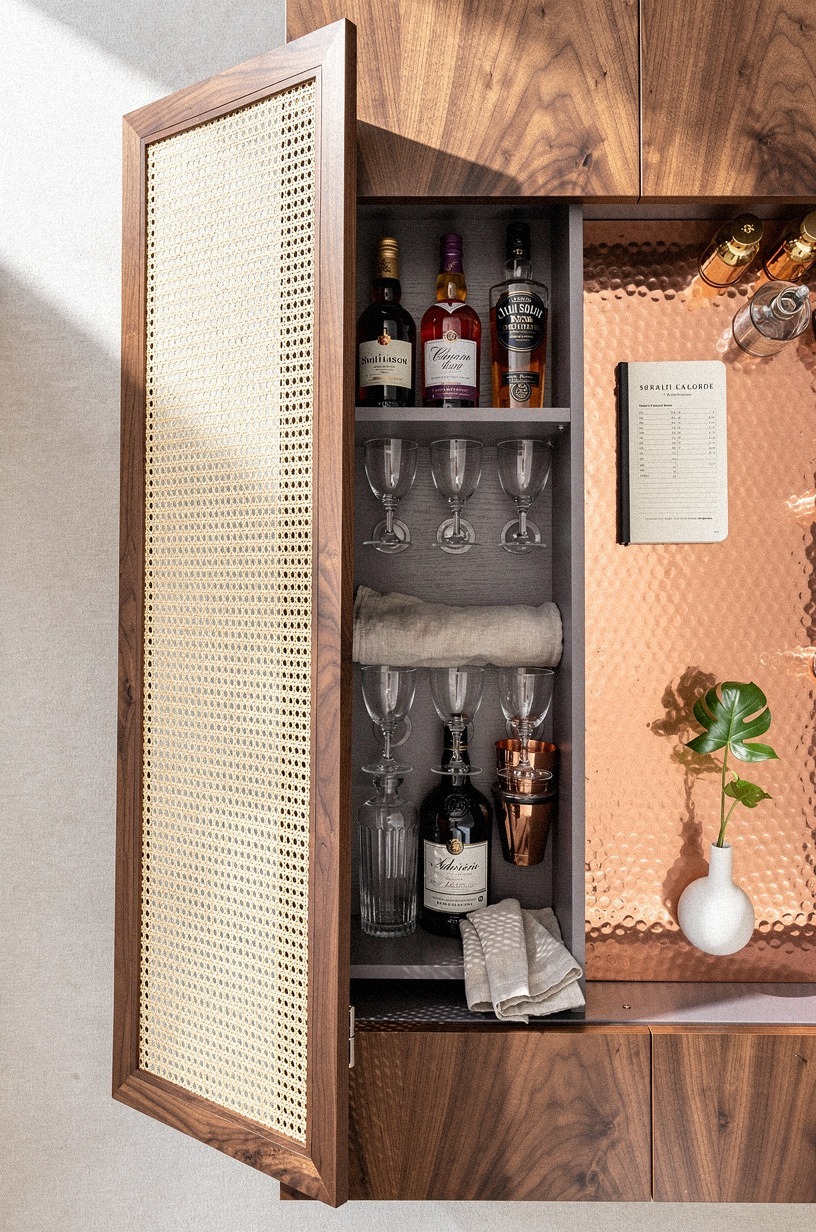
Cane doors are useful when you want the bar to disappear without looking sealed shut.
4Mount a smoked mirror above the counter
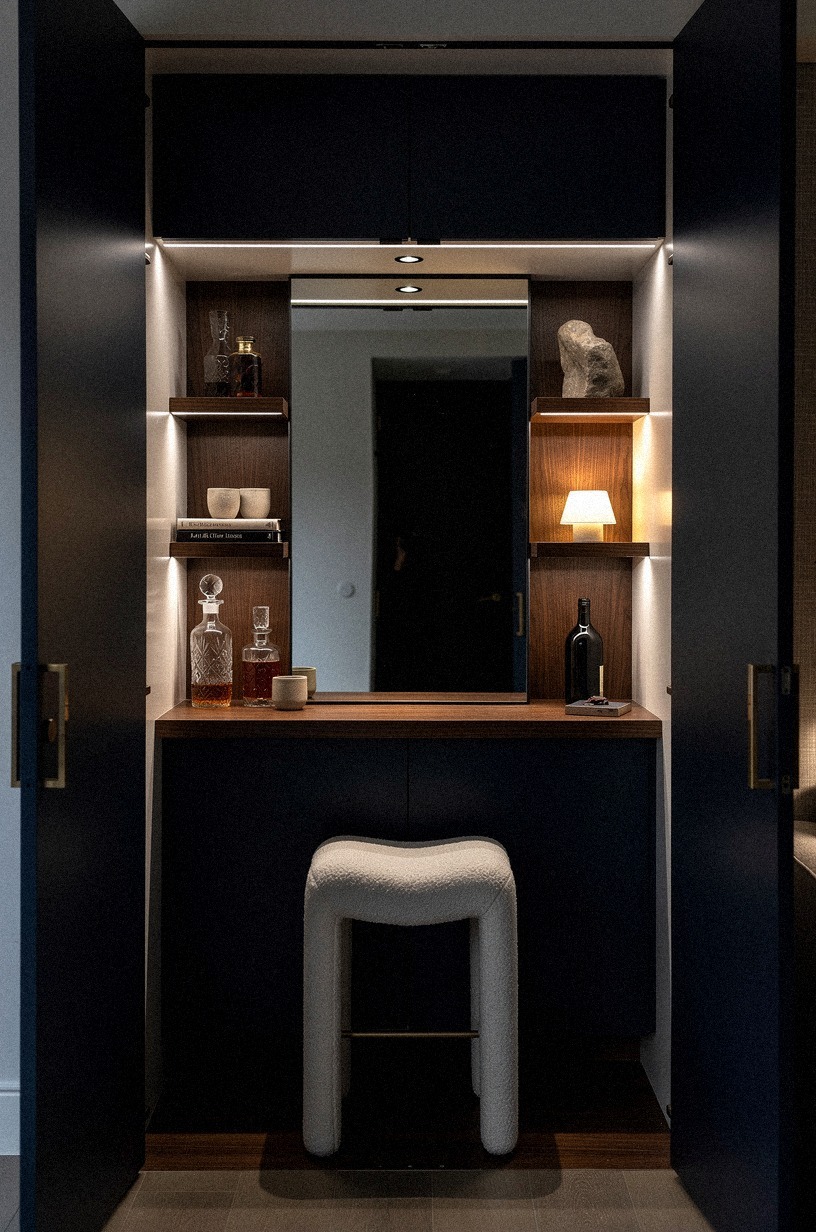
A smoked mirror is one of those upgrades you notice more at night than in daylight. It doubles the bottle glow, stretches the closet visually, and keeps the bar from feeling boxed in. If you already have navy walls, white trim, and walnut below, that mirror gives you one dark reflective plane that ties everything together without shouting for attention.
I would skip a clear mirror here. Clear glass turns every label into a distraction, while smoked mirror lets the room blur just enough.
Mount it above a 3/4-inch solid white oak counter, keep the shelf brackets slim, and let the reflected glasses do the decorative work. Layer in matte black picture rail molding above and the whole wall feels architectural.
For more moody surfaces, this piece on moody vintage bedrooms uses a similar mix.
5Convert the rod into stemware storage
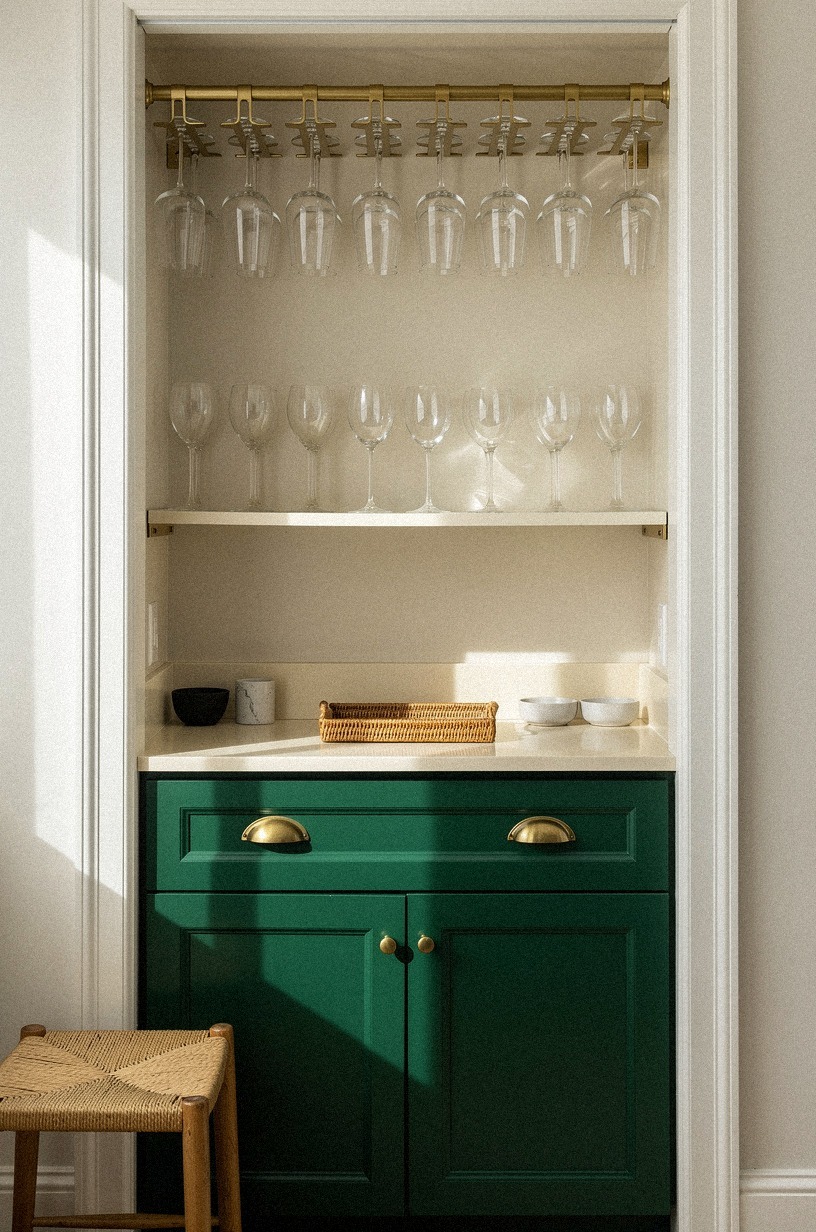
The original closet rod is usually the first thing people rip out. I think that’s a mistake. If the rod is sound and set around the 84 in line, it can become your best storage move once you hang stemware racks from it and leave the counter clear.
In a small speakeasy room, open floor and open counter matter more than squeezing in one more bottle shelf.
Use the rod for coupes and wine stems, then let the cabinetry below carry the weight. Sherwin-Williams Evergreen Fog SW 9130 paint, a cream counter, and a strip of unlacquered brass on the drawer pulls is enough to make the setup feel finished. I made the mistake of keeping too many glasses the first time, and every pour became a careful little traffic pattern.
Don’t do that. Four coupes, four rocks glasses, one shaker, done.
Sculptural sconces at the threshold then frame the moment when someone steps in. The same horizontal-stacked-light rhythm shows up in our cozy reading nook ideas, and the rod-to-stemware conversion is exactly the kind of editorial move we test there.
6Line the ceiling with tin tiles
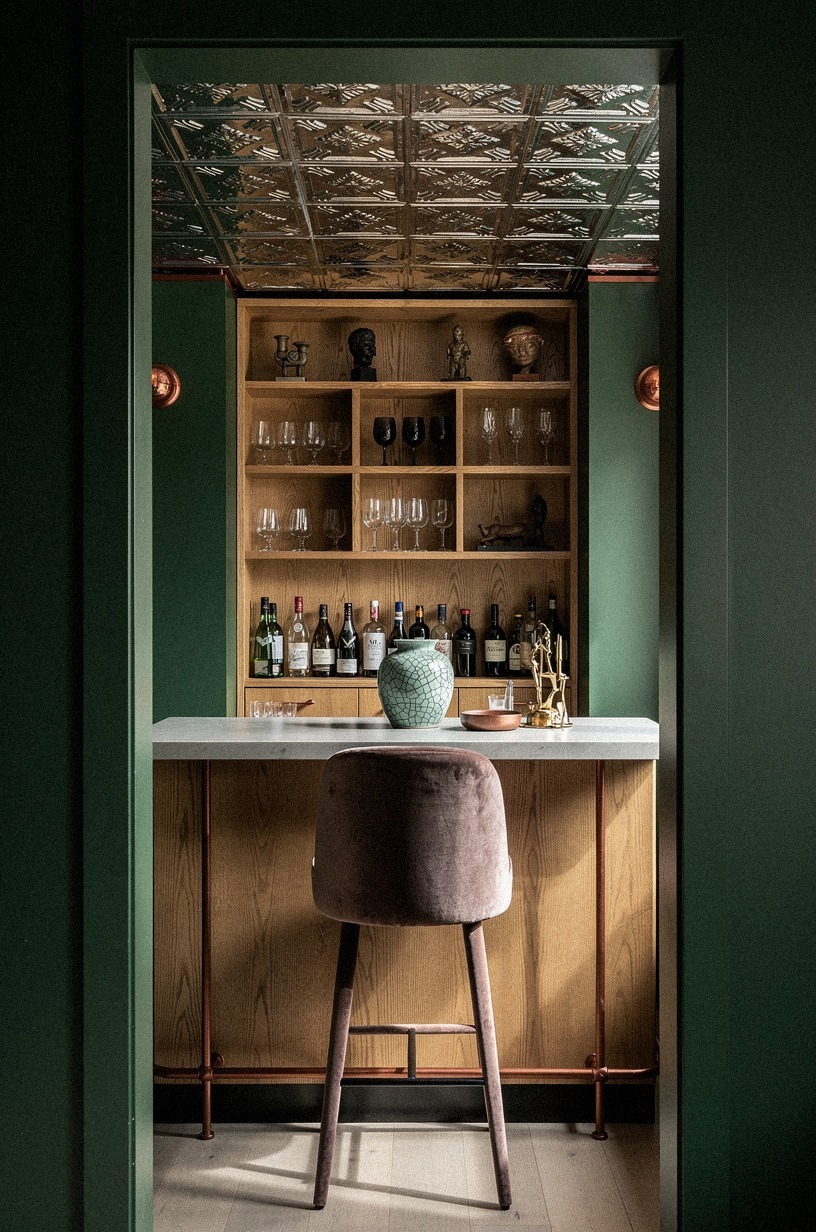
Ceilings matter more in tiny bars because you see the whole volume at once. Tin tiles bounce just enough light to keep forest green walls from going muddy, and they give you a top plane that feels old in the best way. Through the doorway, that reflective ceiling is often what tells your brain this is not just a closet with bottles.
I like aged silver or soft pewter finishes, not bright chrome. Against forest green paint, rust accents, natural oak shelving, and deep charcoal trim, a patterned tin ceiling reads layered without asking for more decor. Once that overhead plane has texture, keep the counter simple. One tray.
One ice bucket. One lamp. That’s enough. Smaller tiles usually work better in a narrow opening because the pattern does not swallow the space.
Pair the tin with unlacquered brass rails below for a warm, sun-baked ceiling-to-counter rhythm. The same move shows up in our rustic chic bedroom ideas.
7Add a pocket door with velvet panels
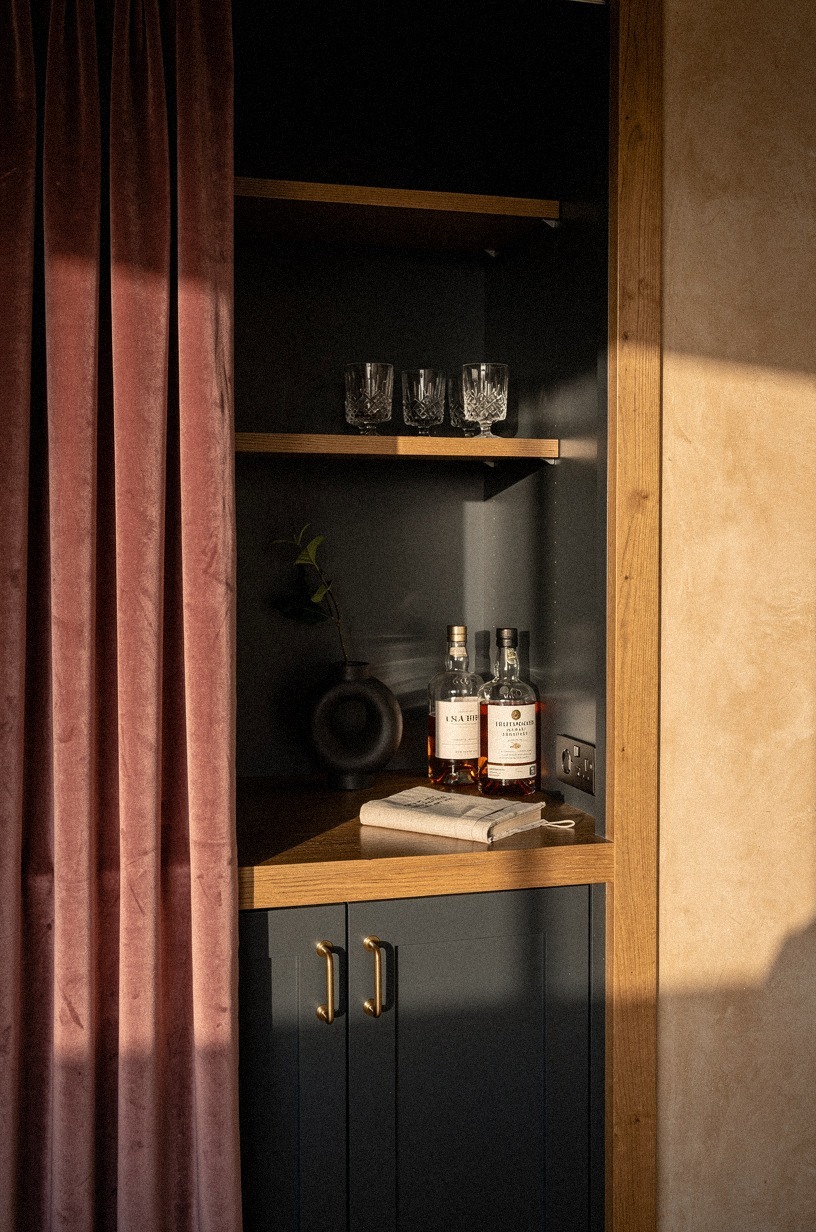
A pocket door solves the swing-space problem and gives you a theatrical reveal at the same time. When the panels are wrapped in velvet, the whole entry feels quieter the second you slide it open. In a speakeasy closet, that matters more than people expect because hard surfaces can make a tiny bar feel sharp instead of intimate.
Dusty rose velvet against charcoal cabinetry and brass hardware is a smart mix because it gives you softness at the threshold and structure inside. I would choose 18 oz cotton velvet over a thin polyester panel because the weight helps the door look architectural, not crafty. Carry a little Venetian plaster inside, keep the shelves darker, and the opening feels like a stage set.
Add antique brass finger pulls and the reveal feels intentional. The same moody tailored entry shows up in our industrial loft bedrooms.
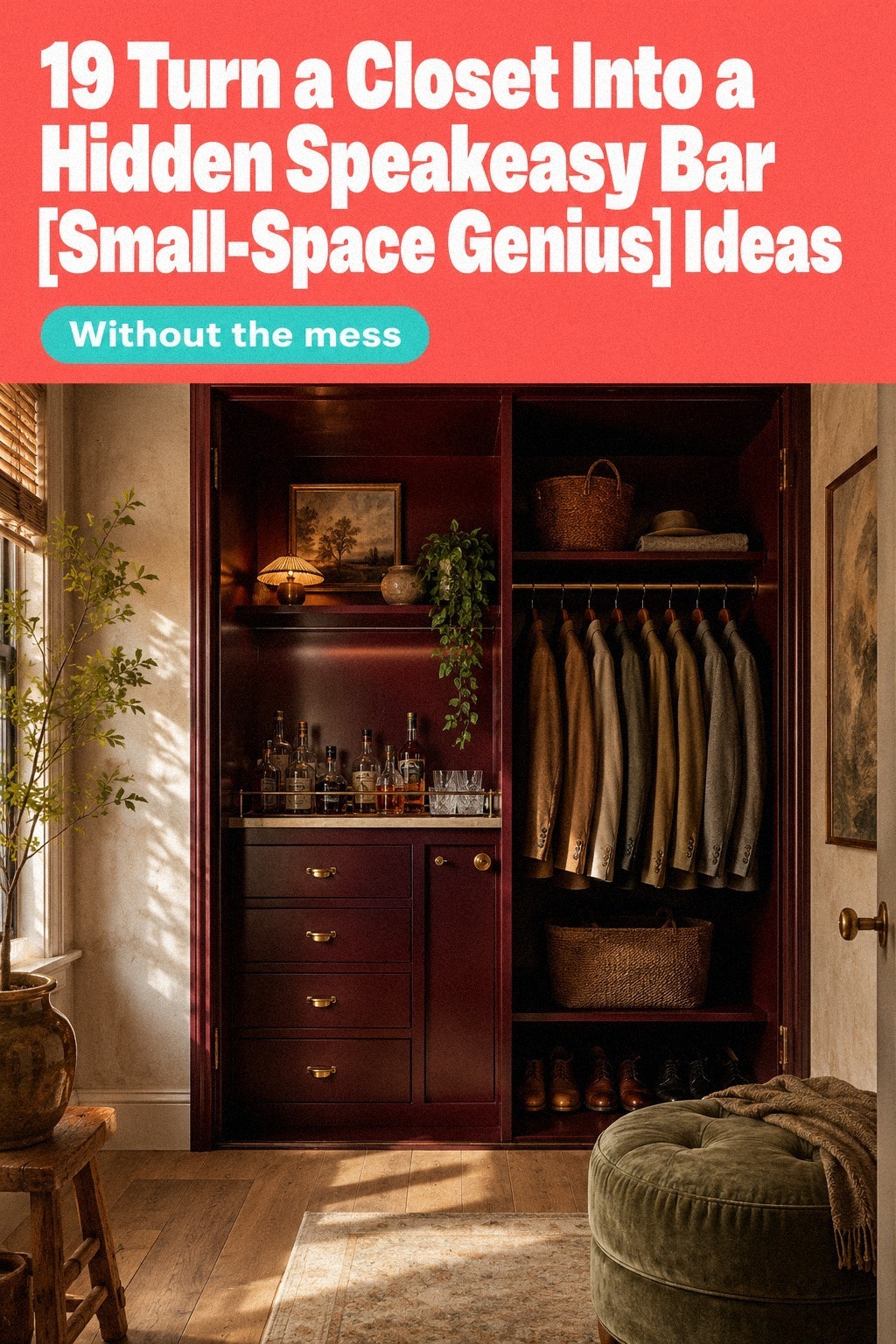
8Build a marble ledge for mixing
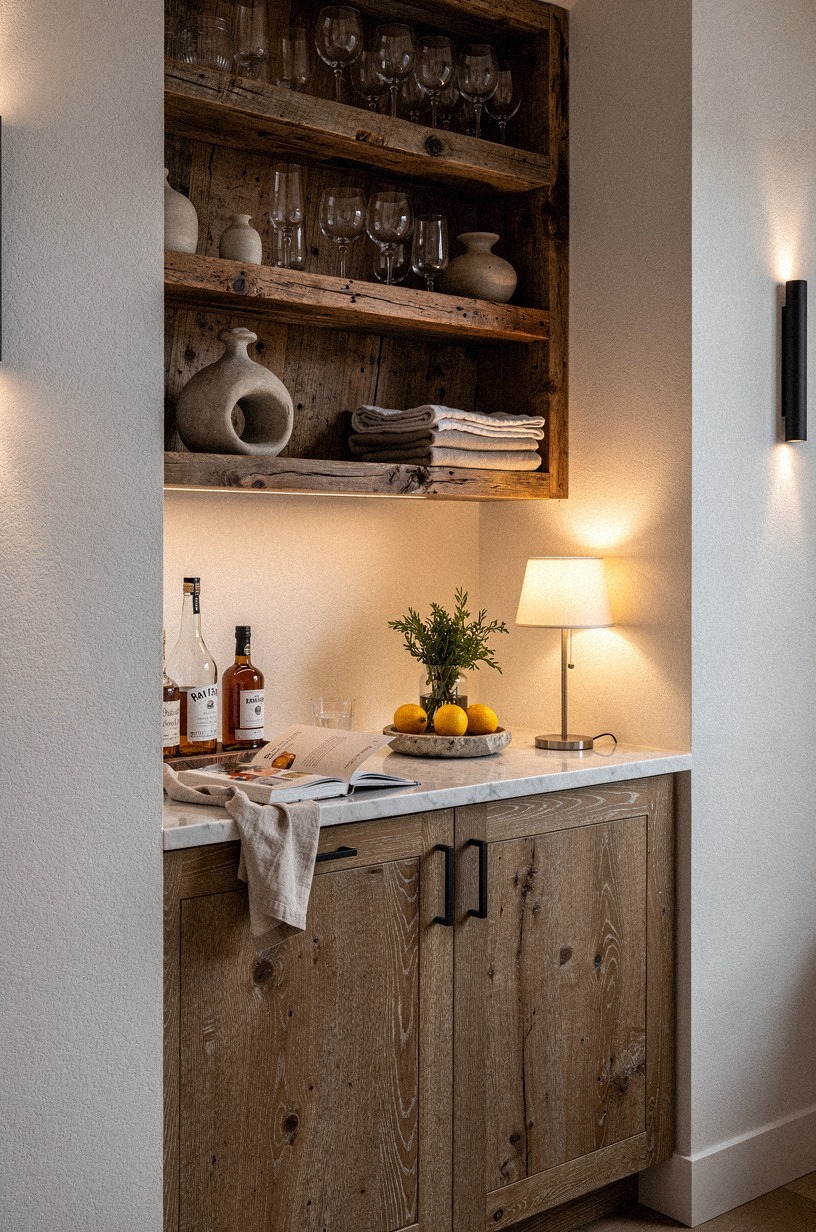
A narrow ledge gives you a mixing station without forcing a full-depth counter into the room. That’s the whole move in a closet bar. You need enough surface for a shaker, a citrus bowl, and one coupe, not a kitchen island.
If the ledge is pushed to one edge, you keep breathing room in front of it, and the bar still feels usable when someone else steps in behind you.
I prefer warm white walls, camel leather details, and a Calacatta Gold marble ledge with amber veining because the stone brings pattern without taking up visual space. Keep the ledge shallow, use matte black metal underneath, and let the remaining wall stay clean. Here’s the honest money side:
For more ways to build a small mixing station without overbuilding, our cozy minimalist bedroom ideas approach to slim surfaces translates almost line-for-line into a tiny bar ledge.
9Tuck a mini fridge under walnut cabinetry
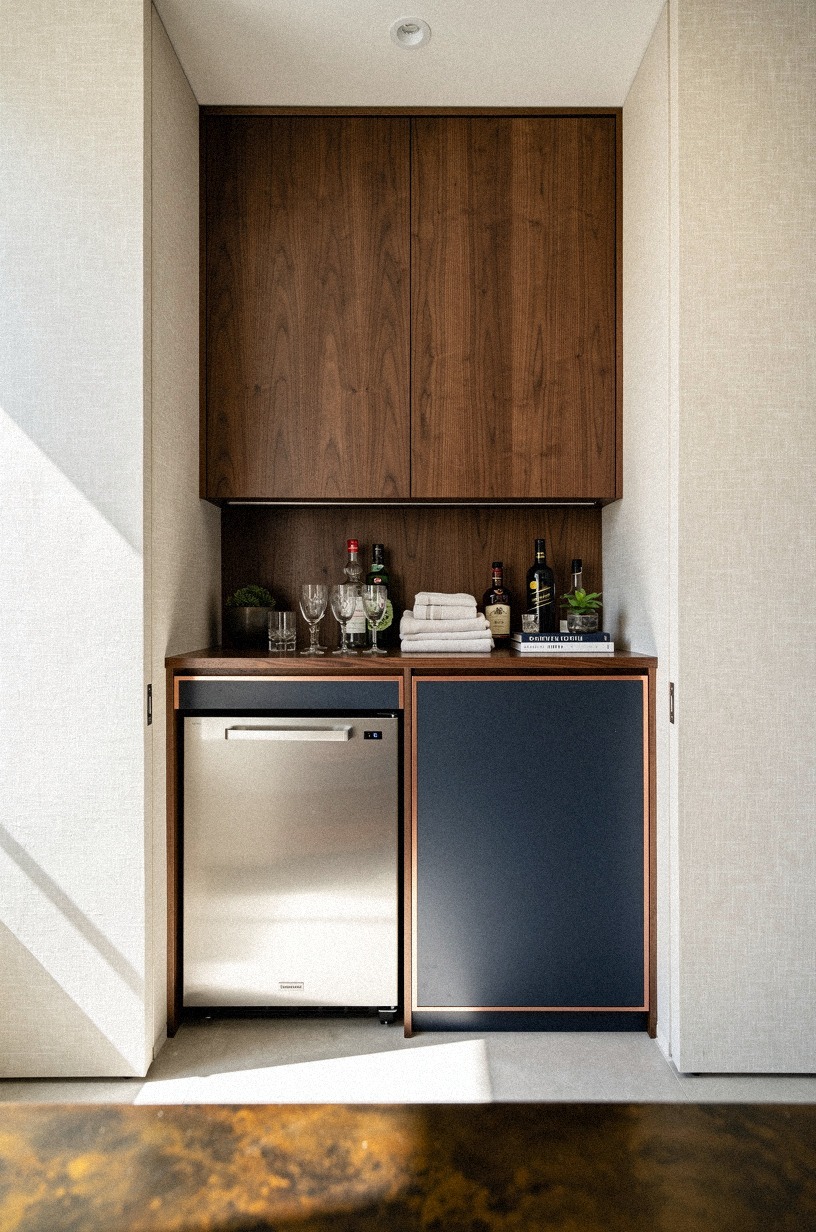
A mini fridge is worth it if you entertain, and not worth it if it steals your legroom. That’s my rule.
In a low, floor-level view, the fridge only looks clean when the walnut cabinetry above it feels continuous and the toe kick is not choppy. Hide the appliance line under one run of panels and the whole bar looks built in.
Choose a panel-front or a matte black unit under walnut cabinetry, then keep the shelves above more edited than you think. You don’t need to refrigerate everything. One bottle of vermouth, a small water carafe, citrus, and maybe one dessert drink, that is usually plenty.
I would not center the fridge either. Off to one side preserves the visual middle for glass, light, and the part people remember.
Layer in Belgian flax linen curtain panels beside it for a quieter, handcrafted finish. The same hide-the-appliance thinking shows up in our modern farmhouse bedrooms.
IKEA KALLAX as your bar base
If you have to start with one piece of furniture, start with an IKEA KALLAX birch-effect turned on its side. Two cubes wide and four cubes tall gives you eight cubbies for bottles, coupes, rocks glasses, and bar tools, with room left for a lamp and one small stack of books. The birch veneer reads warmer than white, which matters when the room is small and every surface is competing for attention.
Add unlacquered brass cup pulls to the cabinet doors so the KALLAX stops looking like flat-pack and starts looking like built-in. Pair it with a 3/4-inch solid white oak counter across the top and you have a full bar surface for under $250. Use the bottom two cubbies for a mini fridge and a recycling bin, and the bar is functionally complete on day one.
The same hack-one-piece-and-build-out approach shows up in our cozy reading nook ideas, where a single piece of furniture does most of the styling work.
10Backlight amber bottles with LED strips
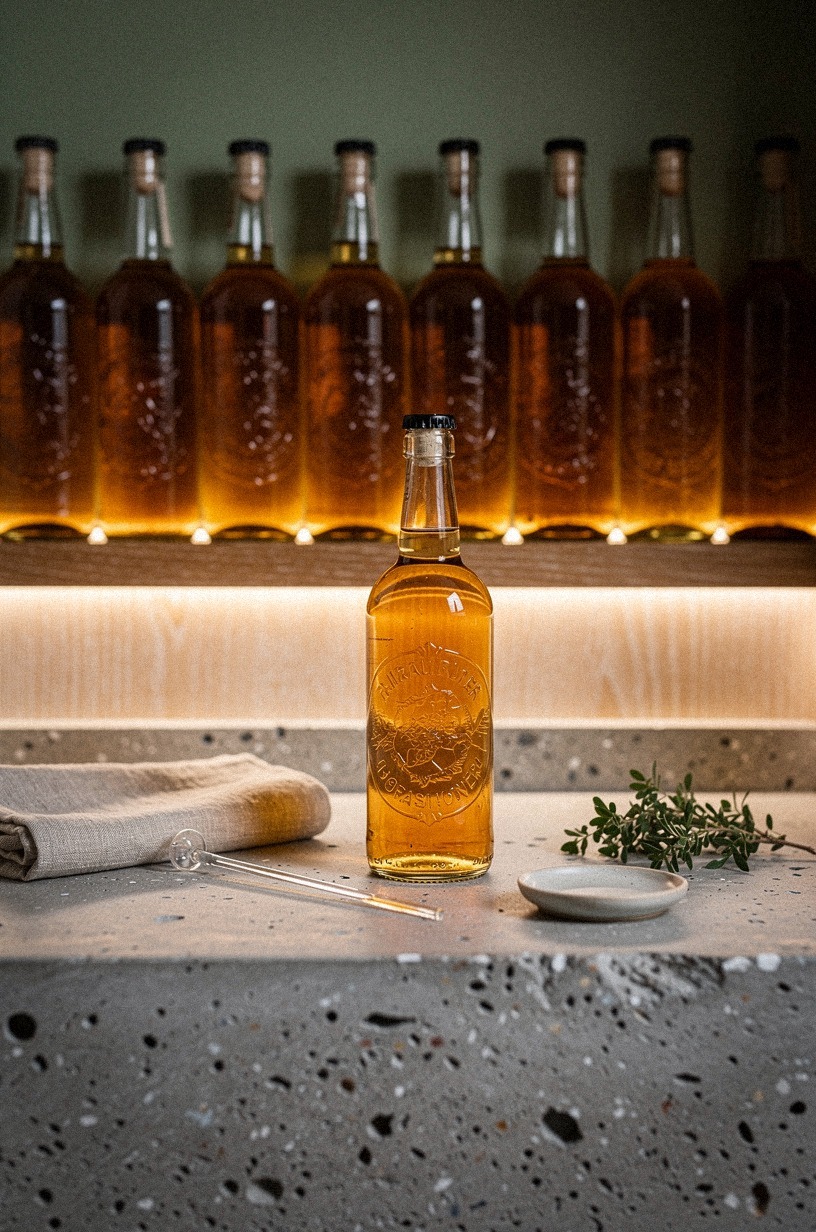
Backlighting is the easiest way to make good bottles look better than they are.
Can you hide the bar entirely when guests come over?
If the closet still has a door, yes, and that is the simplest solution. Slide it shut, drop the rod covers, and the room reads as a coat closet.
If you do not have a door, hang a dusty rose velvet curtain on a ceiling-mounted rod, and pull it across when you want the bar to disappear. Either way, the rule is one motion, no fiddling.
The fastest hide beats the cleverest one every time.
11Hang antique sconces inside the doorway
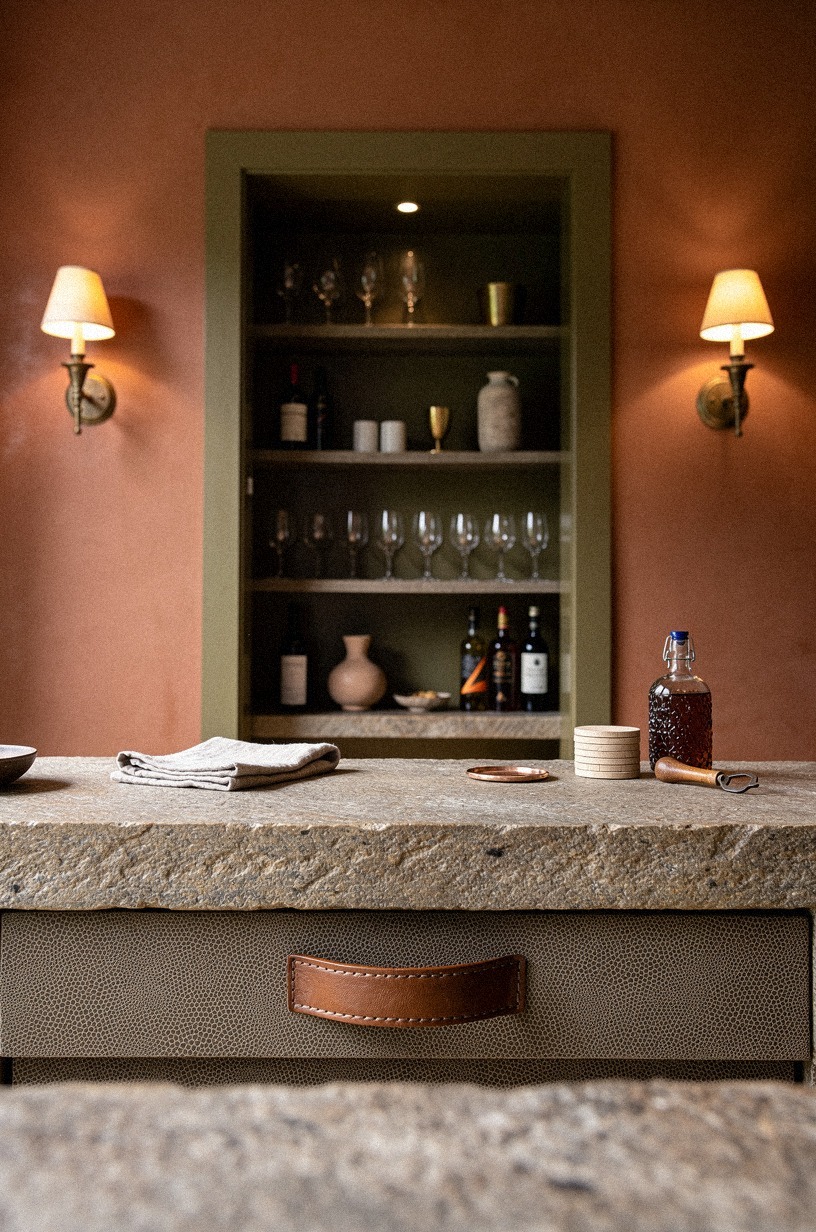
Sconces inside the doorway do something overhead lights can’t. They make the threshold feel intentional before you even step in, and they light the counter from the side so the bottles, tray, and tools pick up shape instead of glare. In a tiny cocktail room in house, that’s a huge difference because you don’t have many inches to waste on bad lighting.
Go for antique-looking sconces with small shades, then pair them with a stone counter, terracotta and olive walls, and one shagreen box for bar tools. I would use aged bronze or old brass here instead of polished nickel.
It feels calmer. The Three-Height Light Stack is what I keep coming back to: picture light above, sconces at eye level, candle or lamp below.
Once you layer light that way, the bar feels settled instead of flat. For more layered lighting moves at human height, our cozy reading nook ideas walks through the same three-source stack in a different room.
12Wrap shelves in dark grasscloth
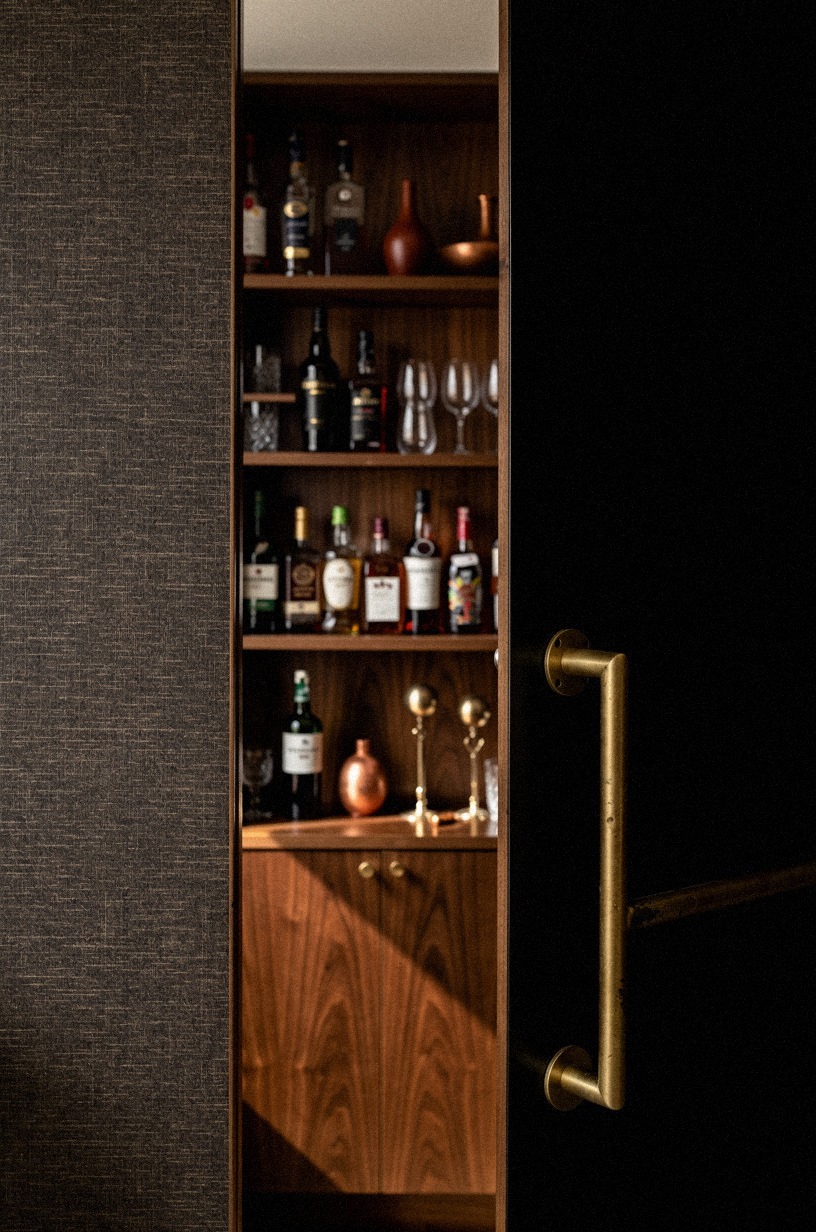
Grasscloth on shelves sounds fussy until you see it in a narrow opening. Then it makes sense.
That woven surface dulls glare, softens bottle reflections, and gives the whole back wall some body, which is helpful when you have book-matched walnut on the frame and lots of glass inside. Without texture, these little bars can feel too shiny, too fast.
Use dark grasscloth in brown-black or deep tobacco, then let book-matched walnut do the warmer work around it. Keep your labels turned partly sideways, leave one shelf only half full, and let the open pockets breathe.
I would not wrap every wall though. One textured zone is stronger than a full envelope of pattern. Add cerused white oak cubby shelves and the contrast does the layered work for you.
The same earthy, tactile shelf moment shows up in our earthy vintage bedroom ideas.
13Fit a hinged tasting counter inside
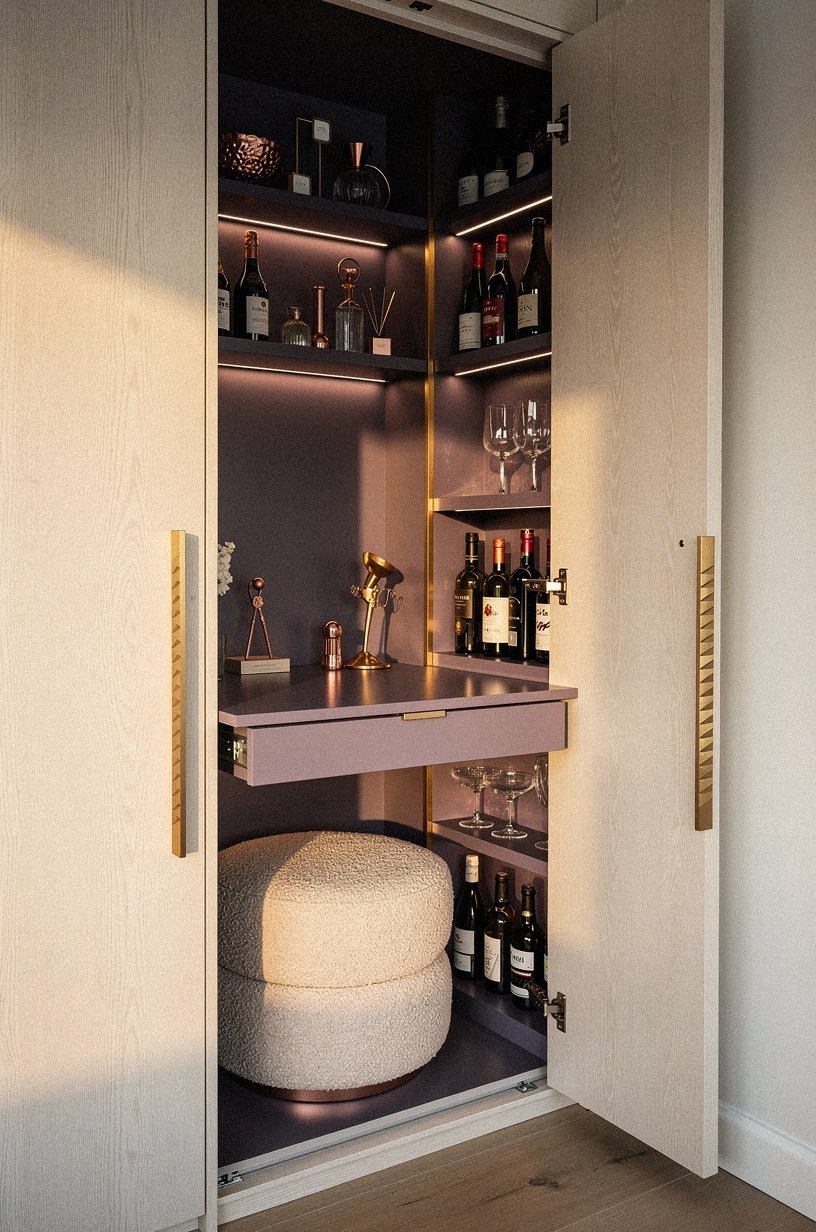
A hinged counter gives you a place to sit without asking the room to be a full-time lounge.
14Style decanters on a mirrored tray
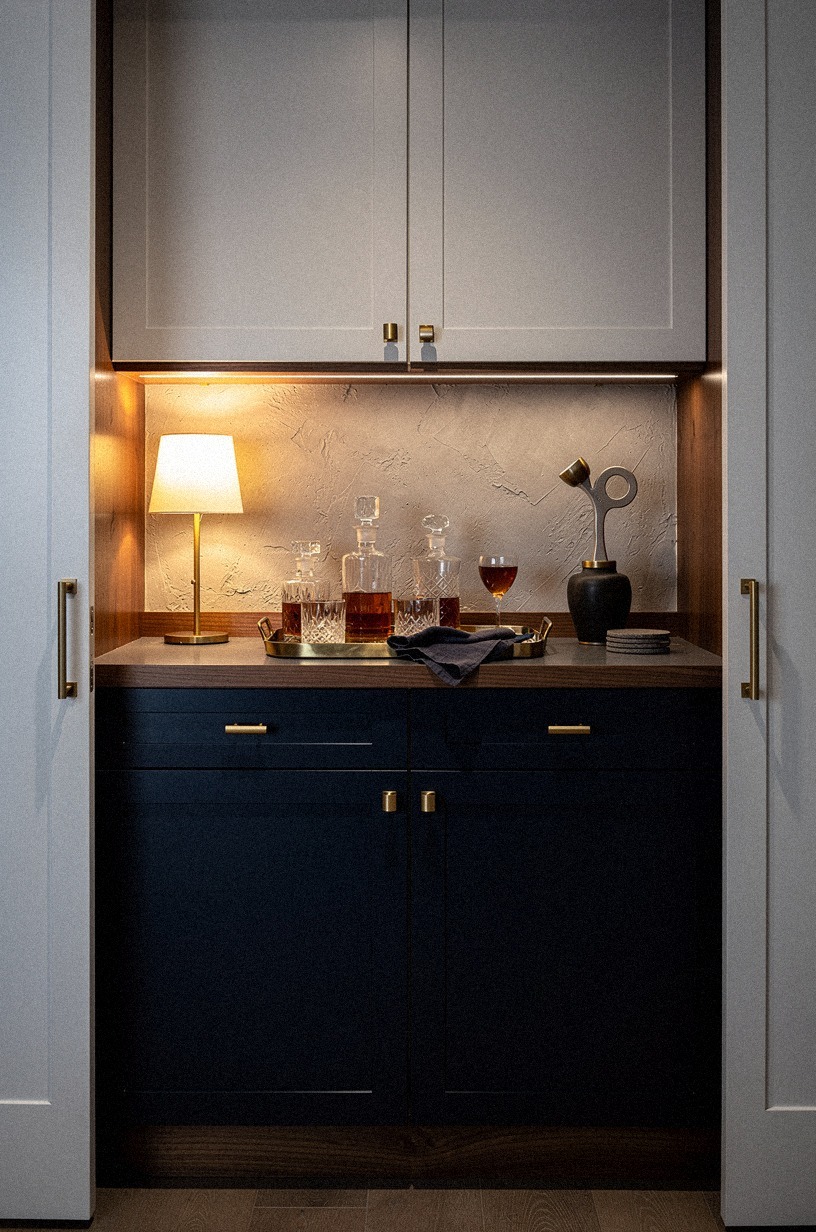
Decanters look better grouped than scattered. A mirrored tray gives them a boundary, catches light from the doorway, and makes a few objects feel deliberate instead of random. When the cabinetry is navy and walnut, that little reflective base becomes the quiet flashy note that tells you the bar was styled, not just stocked.
I would keep it tight: two decanters, one low bowl, one stack of linen coasters, maybe a citrus knife. Too many pieces and the tray becomes a junk drawer in costume.
A mirrored tray with a warm metal edge works best because it reflects glass without feeling cold. Add 18 oz cotton velvet underneath for a quiet, hushed undertone, and a single low cerused white oak trivet if you have room. For more small-surface styling moves, see our french classic bedrooms.
15Frame the entrance with library trim
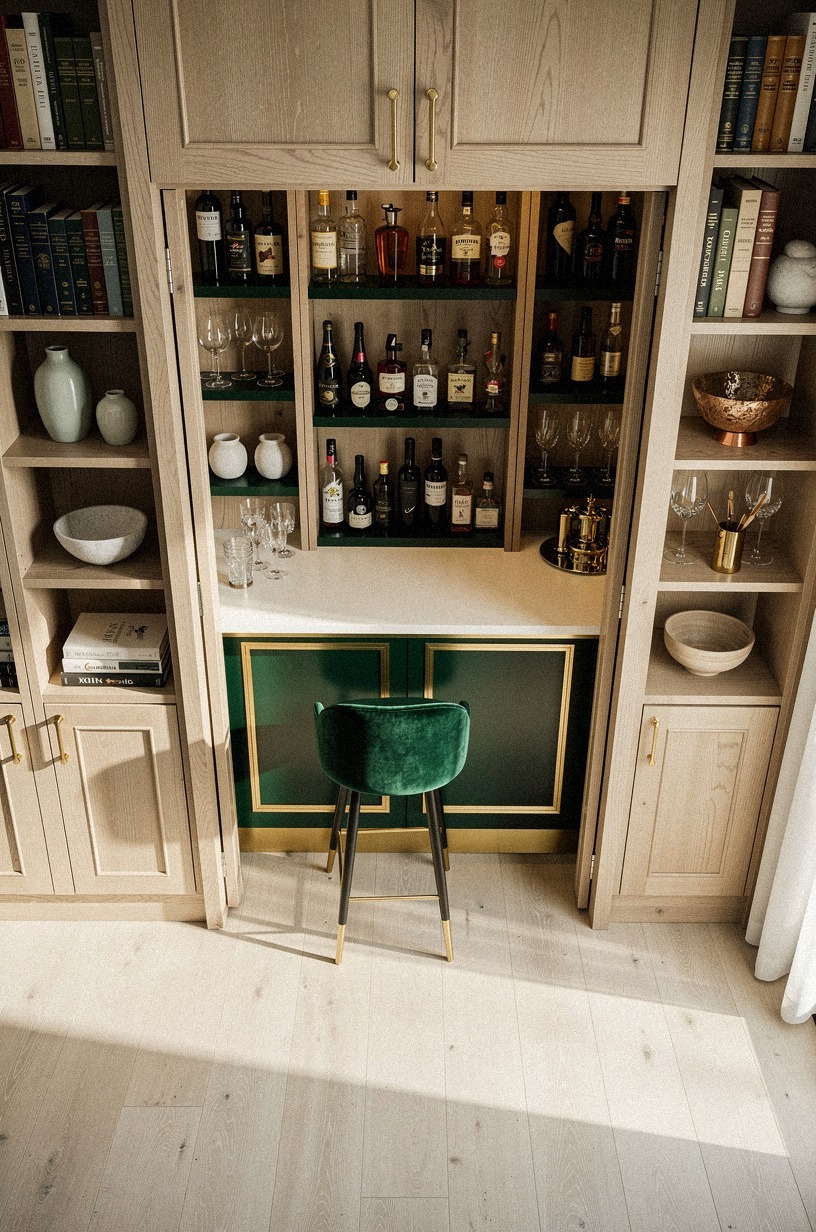
Library trim turns a blank closet opening into architecture. That’s why it works.
When you wrap the entrance in emerald, gold, and cream millwork, the threshold starts to read like a room within a room, which is exactly what you want from a speakeasy closet. You don’t need a giant opening either. Even a narrow door can look important once the casing has depth.
Use applied molding, a deeper header, and a paint match like Sherwin-Williams Alabaster SW 7008 on the outer surround if your hall is already light. Then let the bar interior go darker so the reveal feels intentional. I would rather spend on trim than on extra decor because the frame is what makes the hidden idea believable.
Top it with a slim aged bronze picture light so the trim glows at the threshold. The same millwork-heavy threshold shows up in our french country bedrooms, and the budget-to-splurge split lands the same way.
16Use a rolling ladder for upper bottles
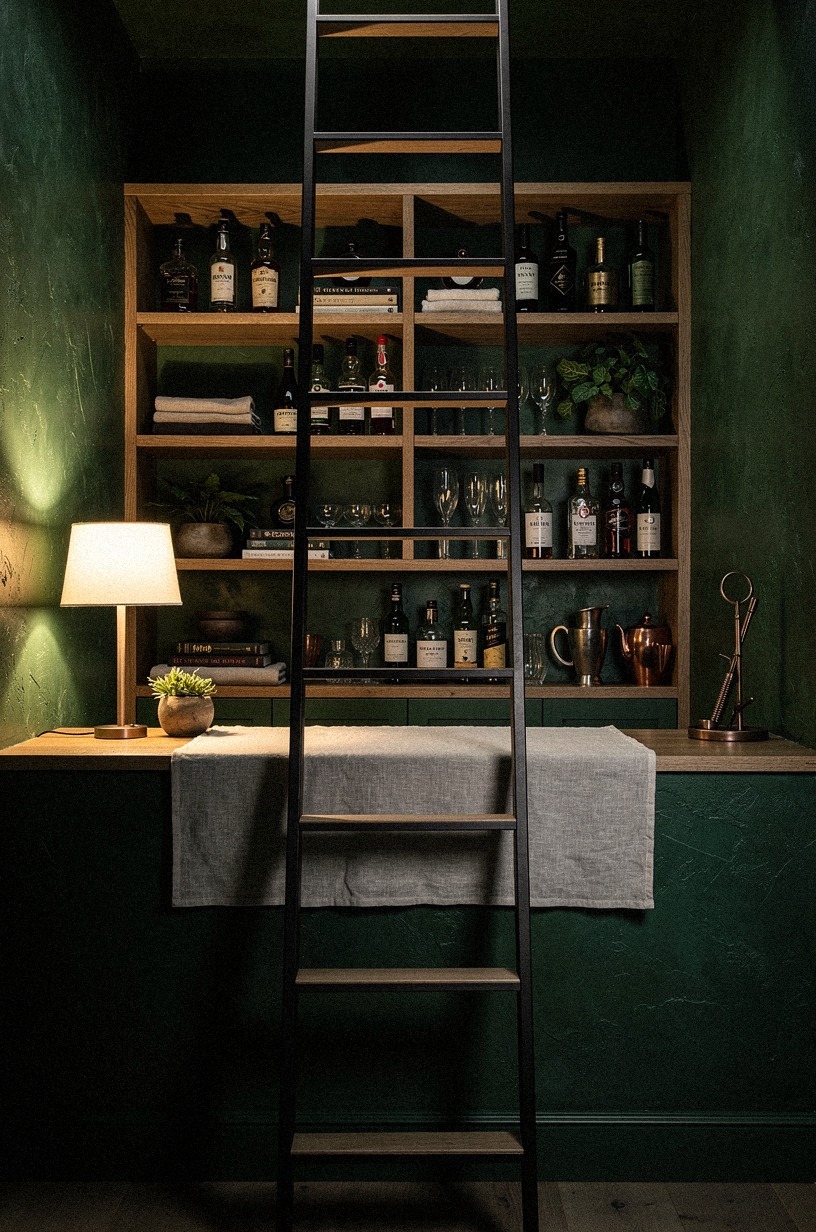
A rolling ladder sounds dramatic, and in the right closet that’s exactly why it works.
17Layer patterned carpet under the bar
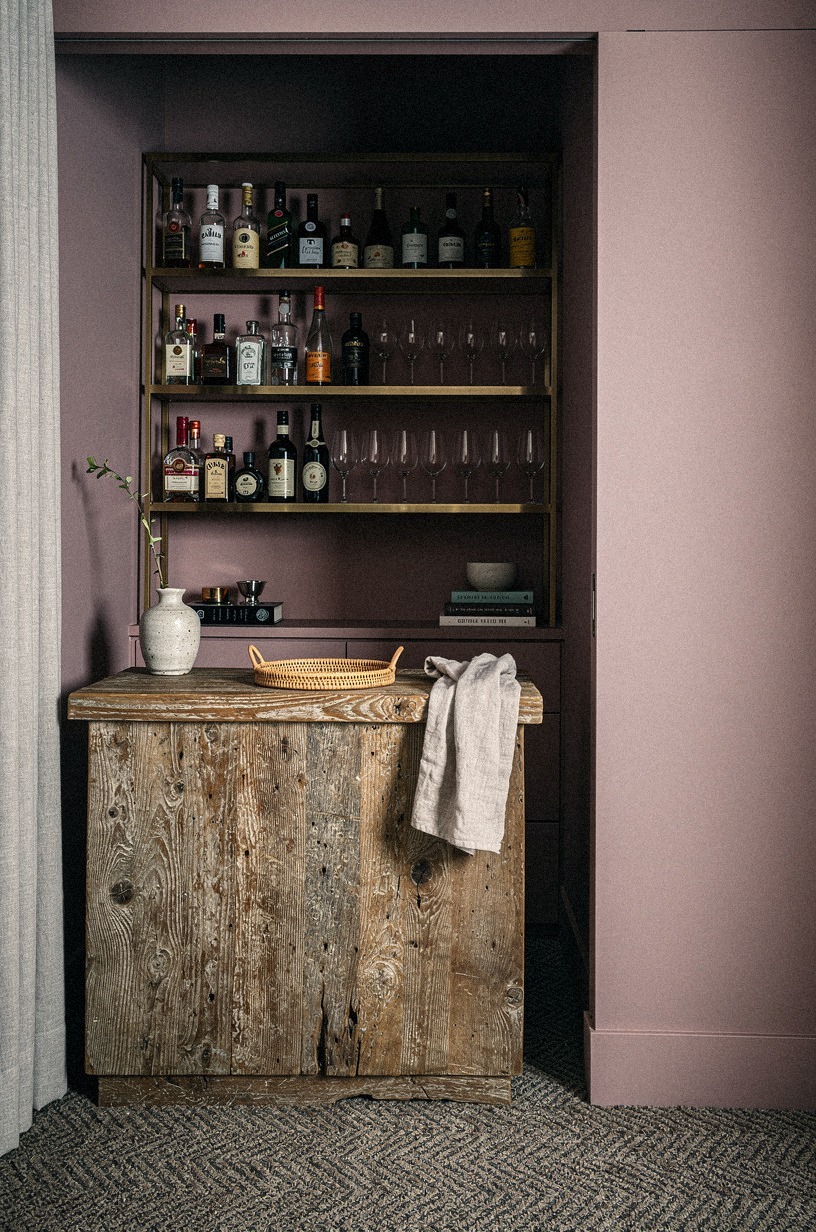
A patterned carpet under the bar quiets footsteps, warms the threshold, and keeps the closet from feeling like a hard little box. In a dusty rose, charcoal, and brass palette, the floor is where you can bring in movement without crowding the shelves. That’s useful if the bar sits slightly off center and you need something to visually anchor the whole vignette.
Choose a low-pile runner or compact rug with enough pattern to hide spills and enough softness to pull you in. I like faded wine, charcoal, and cream under dusty rose velvet because the tones echo the doorway without matching it too literally. But skip a tiny bath-rug scale.
It always looks accidental. You want the carpet to run wider than the counter line so the bar feels placed, not dropped into the closet at the last minute. The same wider-than-the-furniture carpet move shows up in our modern cozy backyard seating guide, and the rule travels.
18Conceal tools inside velvet lined drawers
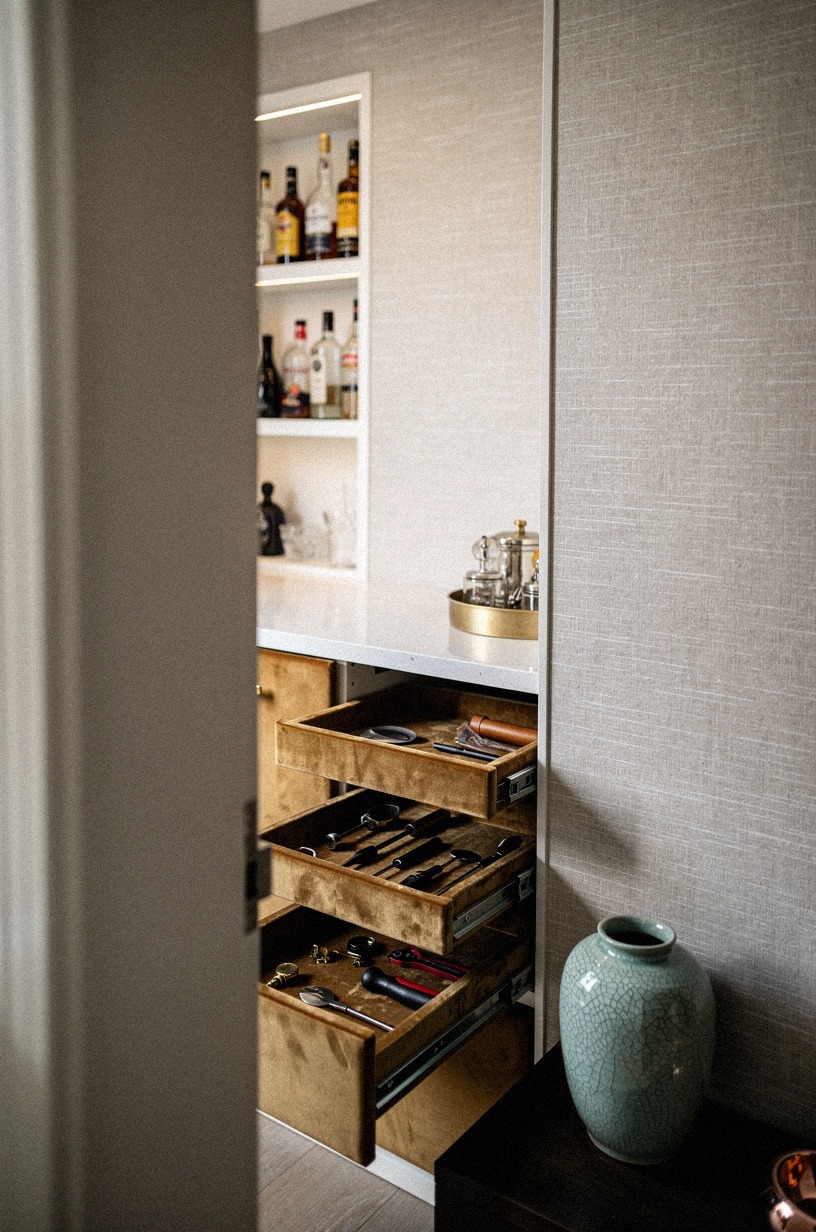
Hidden tools are what separate a pretty bar from a useful one.
19Cap the nook with a picture light
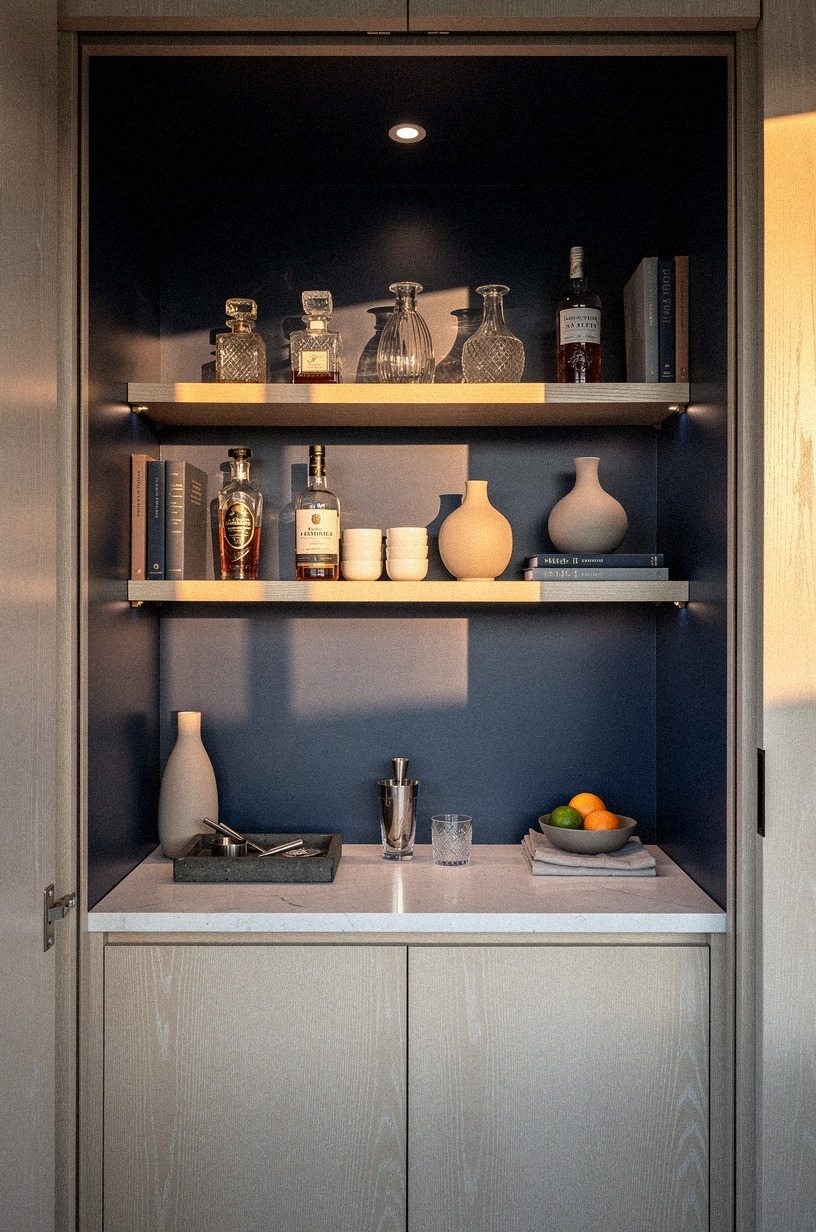
A picture light is the final layer that makes the whole nook feel composed. It washes the back wall, kisses the bottle tops, and gives the closet one strong horizontal line near the top so your eye reads the full height of the space. In midnight blue, copper, and ivory, that line is what keeps the bar from feeling too bottom heavy.
I would choose a slim aged bronze picture light and mount it high enough to light the full width, not just the center shelf. Then keep the rest of the ceiling quiet.
No spotlight circus, no extra puck lights, no visual noise. But here’s the thing: the picture light works because everything under it has already been edited.
Once the palette is tight and the shelves aren’t overcrowded, that last layer of light makes the nook feel finished. Pair it with unlacquered brass shelf brackets below for a quiet, considered top-and-bottom rhythm. See our cozy backyard string lighting guide for the same principle at a different scale.
Why Hidden Bars Feel Bigger Than They Are
I think people get small bars wrong because they start with the fantasy version, not the lived-in one. They picture ten bottles glowing, stacks of coupes, brass everything, maybe a marble slab, maybe a mirror, maybe a little stool.
Then they try to fit all of that into a closet and wonder why it feels cramped. I did that once, and the result looked expensive for exactly one afternoon. After that, it looked like a cabinet that had been asked to perform a costume change.
What changed my mind was realizing a hidden bar is supposed to feel like a controlled interruption in the house, a moment of mood that appears when you open the door and disappears when you close it again. That’s why I care so much about editing. I would rather see four great bottles under a picture light than fourteen labels shouting at me from every shelf.
I would rather see one West Elm tray, one stack of linen coasters, and one lamp than a counter full of little props trying to prove the point. The same calm, considered energy shows up in our french cottage bedrooms and our parisian chic bedroom tour, where restraint does the heavy lifting.
And honestly, this is where money gets misread. People assume the splurge should go to marble or custom doors. Sometimes it should.
But most of the time the better spend is paint, light, and joinery that makes the opening look believable. A cheap bar with a strong mood will beat an expensive bar with no editing every single time.
Paint, a picture light, and a few named pieces will outwork a marble slab every single time!
So my rule is simple: build the atmosphere first, then earn every object you add after that. If a bottle doesn’t look good enough to be seen, hide it.
If a shelf only exists to hold clutter, lose it. The room will tell you when it is done. Usually sooner than you think.
A Few Things Worth Answering
What is the best setup for a small closet bar?
The best setup is a narrow counter, open shelves, and one strong light layer, because open floor space is what keeps the closet usable. If you’re buying one starter piece, an IKEA KALLAX birch-effect insert used low can work surprisingly well for bottles and glass. For more narrow-room furniture moves, see our small gaming bedroom setups.
Where can I buy closet bar pieces on a budget?
Start with Target Threshold, IKEA, and Wayfair for shelves, sconces, trays, and simple stools. Then check Facebook Marketplace for older brass rails, mirrors, and small cabinets. Used wood pieces often look better here than new flat-pack ones, especially once you repaint them.
The same budget-to-thrift ratio shows up in our farmhouse chic bedrooms.
How much does a closet bar makeover cost?
Most closet bars land anywhere from about $150 to $800 if you’re reusing the rod, shelves, and doorway, and that’s the sweet spot for many homes. Lighting and paint give the biggest visual return.
Custom millwork is where costs rise fast. See our modern industrial bedroom guide for more lighting-first budget framing.
Can I create a closet bar on a budget?
Yes, and you really can keep it simple. Reuse the rod for stemware, repaint the walls, and add warm LED strips first. Low-cost lighting changes everything.
One thrifted tray, one set of glasses, and a tighter bottle edit can carry the whole look. The same $50-first principle shows up in our cozy farmhouse bedrooms.
Is a closet bar worth it in a small space?
Yes, because a tiny footprint makes the reveal feel stronger, not weaker. A hidden threshold gives you drama without taking over the room.
Keep the counter to one side, leave the middle clear, and the bar will feel more intentional than a cart parked in the corner. The same restraint shows up in our zen bedroom ideas.
Is a closet bar a good idea for a rental?
Yes, if you lean on reversible moves. Use peel-and-stick wallpaper, a tension-mounted glass rack, plug-in sconces, and removable LED strips. Temporary finishes can still look polished.
Skip permanent stone and focus on mood, storage, and a door treatment you can take with you. The same no-damage logic shows up in our industrial chic bedrooms.
What lighting works best in a tiny closet bar?
Warm 2700K light from at least two sources. A picture light up top, a pair of aged bronze sconces at eye level, and one small lamp on the counter.
Avoid overhead fluorescents at all costs. The layered warm-light stack is what makes the closet read as a bar and not a utility closet.
See our cozy reading nook lighting guide for the same three-source stack.
Where I’d Start First
If I had to pick one, I’d start with oxblood lacquer. Without a dark envelope, every bottle, mirror, and brass piece feels scattered instead of deliberate.
The right paint does more styling work than any single object you could buy. Pin that paint idea for later and let the mood lead before you buy another thing.