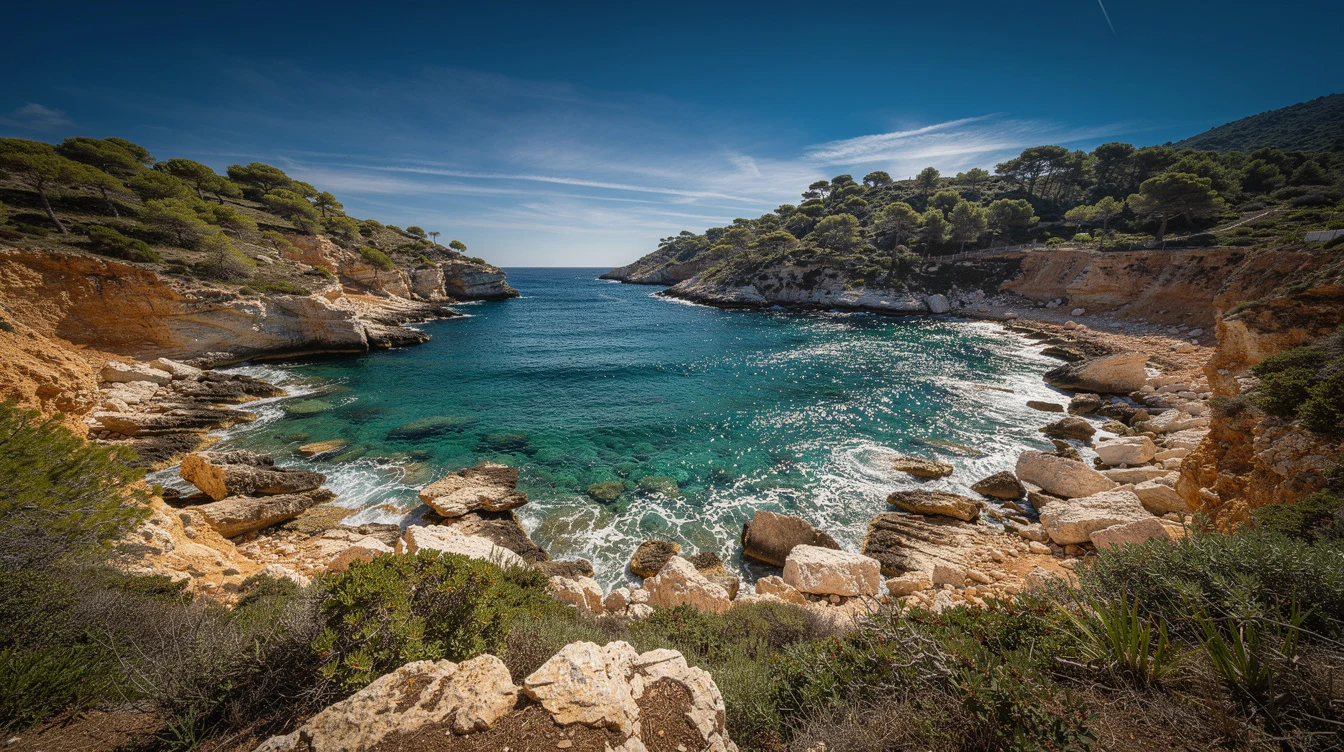
Most Americans hear Ibiza and think of one thing. But the island is 221 square miles, and the clubs occupy only a sliver of that. The rest is pine forest, salt flats, and coves where the water stays warm enough to swim from May through November. That is the Ibiza worth knowing.
30.4 °C in August, but the breeze keeps it honest
The average high in August is 30.4 °C, which sounds brutal. But the sea is right there, and the humidity breaks in the evenings. The record hit 41 °C on 13 August 2022, and that day was genuinely punishing. Most of the time, though, the heat is the kind you can swim through.
The island gets 2,700-2,800 hours of sunshine per year. That is more than the Algarve, and the water is warmer too. The average sea temperature is 19.7 °C, and in late summer it feels like bathwater. The annual average air temperature is 18.3 °C, so winters are mild and the island stays green from November to April.
And here is the contrast that matters. Mykonos is smaller, windier, and packed shoulder to shoulder in July. Ibiza is over five times larger, with room to spread out. The Algarve has Atlantic chill even in August. Ibiza has Mediterranean warmth without the crush.
How do you get there without a car?
You fly into Ibiza Airport, which handled nearly 6 million passengers in 2012 and has only grown since. Or you take the ferry from Valencia, 150 km across the water. The ferry is slower but calmer, and you can bring a bike.
From the airport, buses run to Ibiza Town, Sant Antoni, and Santa Eulària. Taxis are plentiful but expensive in peak season. The island has a decent bus network, and in summer it runs late. But a car or scooter helps if you want the coves on the north coast, where buses do not reach.
The ferry from Dénia or Valencia docks at Ibiza Town. From there, everything spreads south and west. The club strip is concentrated in one zone. The rest of the island is quiet by comparison, and that is by design.
What does UNESCO see that clubbers miss?
Ibiza is a UNESCO World Heritage Site. Not for the nightlife. The designation covers the Renaissance walls of Ibiza Town, the Phoenician ruins at Sa Caleta, and the posidonia oceanica seagrass meadows that keep the water clear. The same clubs that draw the crowds sit beside some of the oldest preserved settlement in the Mediterranean.
The Phoenicians founded a port here in 654 BC. The Carthaginians came after, then the Romans, then the Moors. The island produced salt, dye, and the fish sauce called garum. You can still smell the salt flats working on the south coast, and that smell is ancient.
The highest point is Sa Talaiassa at 1,558 ft. The climb is not technical, but there is little shade for the first stretch. Start early, because the heat builds fast after 10 a.m. The view from the top takes in Formentera on clear days, and the pine cover looks almost black against the sea.
Is the island too crowded now?
The population was 88,076 in 2001 and hit 159,180 in 2023. That is rapid growth, driven partly by an amnesty that registered previously uncounted foreign workers. About 55 percent of residents were born on the island. Another 35 percent came from mainland Spain, mostly Andalusia and Valencia. The rest are foreign, with Germans, British, and French leading the numbers.
The government imposed a Sustainable Tourism Tax in 2016, and there is a moratorium on building in some areas. The island has almost 100,000 legal tourist beds and infrastructure that strains in August. Water shortages happen. The roads clog between Ibiza Town and Sant Antoni.
But the crowds are seasonal and concentrated. June through September is club calendar time. May and October are different islands entirely. The beaches empty out by late afternoon, and the north coast never feels packed. That said, if you want silence, avoid August. The heat is real, and the people are everywhere.
Where to base yourself
Ibiza Town (Vila d’Eivissa) is the capital and the transport hub. The old quarter, Dalt Vila, sits inside those UNESCO walls. It is touristy, but the height of the walls means views over the harbor that justify the climb. The marina has improved dramatically in recent years, with restaurants that cater to the luxury market as much as the club crowd.
Santa Eulària des Riu is calmer, more family-oriented, with a longer beach and less nightlife. Sant Antoni de Portmany is where the club strip lives, and the sunset bars line the west coast. That stretch is lively, but never charming after dark. Choose based on what you are willing to walk home through at 3 a.m.
Formentera is a short ferry south. The Pityusic Islands, or Pine Islands, share the same root. The Greeks called them Pityoûssai, and the pine cover is still the dominant smell inland. Salt and pine, heat and resin. That is the sensory signature.
The real trade-off
Ibiza delivers the warmth and the light, but it asks for timing. The clubs run June through September, and that is when the island is least itself. The beach season stretches seven months, from May to November, and the best months are the edges. October swimming is still possible, and the water holds its heat longer than the air.
The language is Catalan, specifically the Eivissenc dialect, though Spanish is everywhere and English is standard in tourist zones. The food is mainland Spanish with island variations, and the salt from the flats shows up in everything. Prices are high in season, moderate in spring and late autumn.
By the time the last ferry pulls out for Formentera, the harbor is quiet again. The walls of Dalt Vila glow under lights, and the pine scent drifts down from Sa Talaiassa. That is when the island feels most like the place the Phoenicians found, not the one the flyers promise.