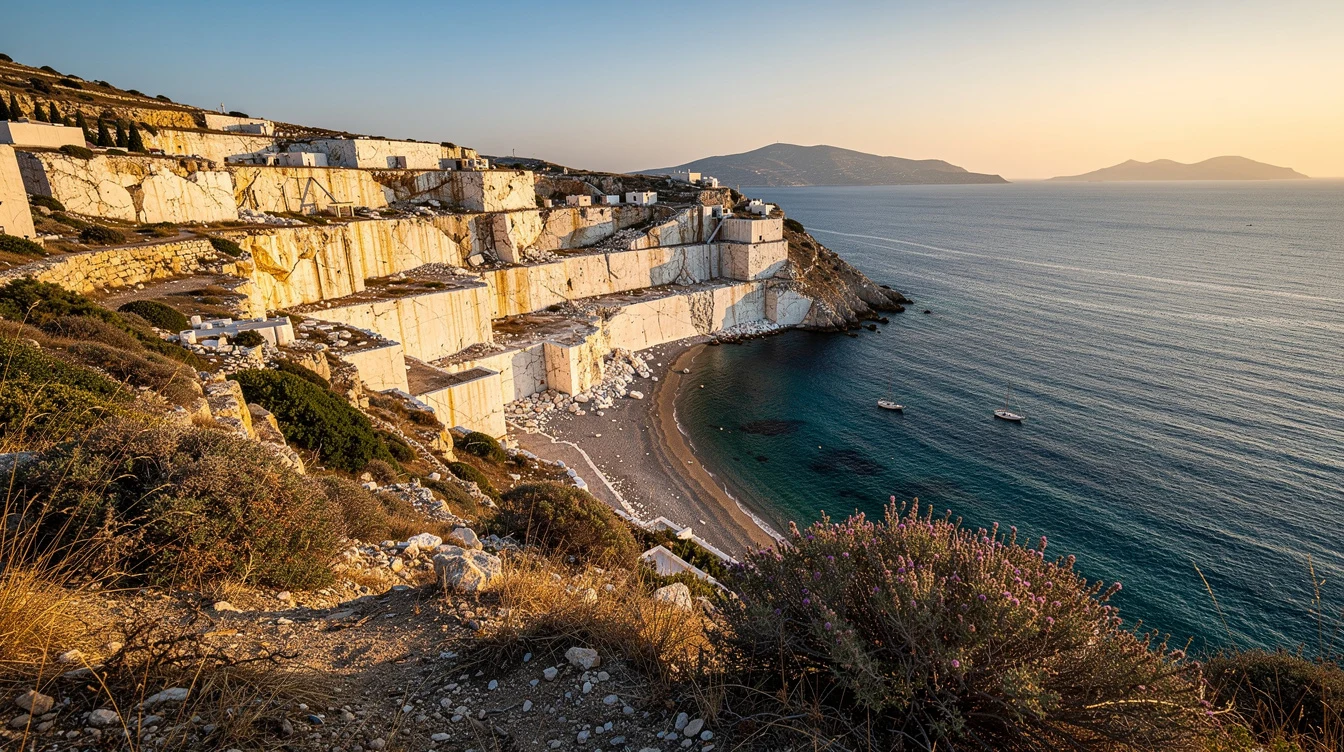
Paros sits only 8 km west of Naxos, close enough that the ferry ride feels like crossing a neighborhood rather than an island chain. But the marble beneath your feet is the same stone that carved the Venus de Milo. And the quarries still cut it today.
The marble that built ancient fame, and the boats that run on time
The island measures 165 km², shaped like a plump pear sloping down from a single mountain at 724 m. From northeast to southwest it stretches 21 km, and 16 km at its widest. That round profile gave it the ancient name Strongyle, meaning round.
The stone here is not just white. It is fine-grained, translucent, capable of holding detail that coarser marble loses. Ancient sculptors knew this. So did the quarry workers who still operate on Paros today, though tourism now dominates the economy.
Getting here is straightforward. Ferries run several times daily from Piraeus, the port of Athens, across 150 km of Aegean water. The crossing takes 3-5 hours depending on the vessel. High-speed catamarans shave time off, but the slower boats let you watch the Cyclades appear one by one on the horizon.
Parikia: where the ferries land and the marble fragments linger
The capital Parikia occupies the site of the ancient capital. Its harbor handles the bulk of Aegean traffic, with daily sailings to Piraeus, Heraklion, Naxos, Ios, Mykonos, and Santorini. The waterfront road is functional, busy, lined with tavernas that know their audience arrives hungry off the boat.
But walk back from the port. About 400 m left of the main square stands the Panagia Ekatontapiliani, the church of a hundred doors. Its oldest features predate Christianity as Rome’s state religion. And local tradition holds that Saint Helen, mother of Constantine, founded it during her pilgrimage to the Holy Land.
The Archaeological Museum of Paros sits in town too. It is small. The best pieces live in Athens now. But the museum holds a fragment of the Parian Chronicle, a marble timeline of ancient Greece from 1500 BC down to 264 BC. The stone itself is the medium and the message.
Can you see the ancient quarries?
Working quarries and abandoned ones both exist on the island. They are not staged as tourist sites. You will need local guidance or a rental car and a willingness to ask directions. The marble is still extracted, still shipped, still used. That continuity matters more than any reconstructed ancient workshop.
Naoussa and the eastern shore: wind, water, and the strait that shapes both
On the north side, Naoussa Bay forms a natural harbor spacious enough to have been closed by a chain in ancient times. Today it fills with yachts and fishing boats and the seasonal swell of visitors. The development is real. The bay still works as a harbor.
The strait between Paros and Naxos runs narrow and windy. That same channel, barely 8 km wide, creates conditions that draw windsurfers from June through September. The air moves consistently, accelerated by the gap between islands. And the water stays rough enough to challenge, flat enough to learn.
Golden Beach near Drios on the east coast, Pounda, Logaras, Piso Livadi, and Agia Irini fill out the beach roster. Each has its own wind exposure, its own crowd density, its own ratio of sand to pebble. None are secrets in July. In June, you might still find morning space.
Antiparos across 2 km of channel: the shuttle runs all day
To the southwest, the smaller island of Antiparos sits close. At the narrowest point, the channel between them shrinks to under 2 km. A car-carrying shuttle ferry operates continuously from Pounda, 5 km south of Parikia. The crossing is brief enough that locals commute, shop, visit without thinking of it as travel.
That proximity changes the character of both islands. Paros has the ferries, the airport access, the volume. Antiparos has the quieter scale. And the shuttle lets you choose your day, your pace, your level of remove.
History that does not stay buried: 1537, 1944, 2000
The Ottoman conquest of 1537 killed old men, enslaved young men as galley rowers, conscripted boys as janissaries, and forced women to dance on the shore for selection. Around 6,000 inhabitants were enslaved. The numbers are documented. The trauma shaped the island’s memory for centuries.
In 1944, Nazi occupation forced the construction of an airfield near Marpissa with over 400 Greek workers. Resistance sabotaged the project. A 23-year-old partisan named Nikolas Stellas was captured, refused to inform, and was hanged publicly. The German commander later spared 125 condemned Parians after an abbot’s appeal. The airfield was bombed by the British. Nothing remains of it now.
On 26 September 2000, the ferry MS Express Samina struck the Portes islets off Parikia bay. 82 people died. The islets are still there, unmarked by memorial, visible from passing boats.
When to go, and what the wind decides for you
June through September is the main season. That is when the beaches operate, the windsurf schools open, the tavernas stay full past midnight. The meltemi wind builds through July and August, strongest in the afternoon. Morning is for swimming. Afternoon is for sailing, or for finding shade.
The altitude of the central mountain keeps the interior cooler than the coast. But there is no real escape from August heat. You adapt your hours, your pace, your expectations of midday activity.
In 2023, locals protested beach businesses for exceeding permitted umbrella counts. The government responded with inspections and fines. The tension between tourism volume and island capacity continues. It is not unique to Paros. It is perhaps more visible here because the island is large enough to attract crowds, small enough to feel the pressure.
By the time the last ferry pulls out of Parikia harbor, the marble dust settles in the quarries, and the town folds into a quieter rhythm. That is when the Cycladic architecture, the flat roofs, the blue doorframes, the orange and pomegranate gardens, feel most like they belong to the people who stay year-round.