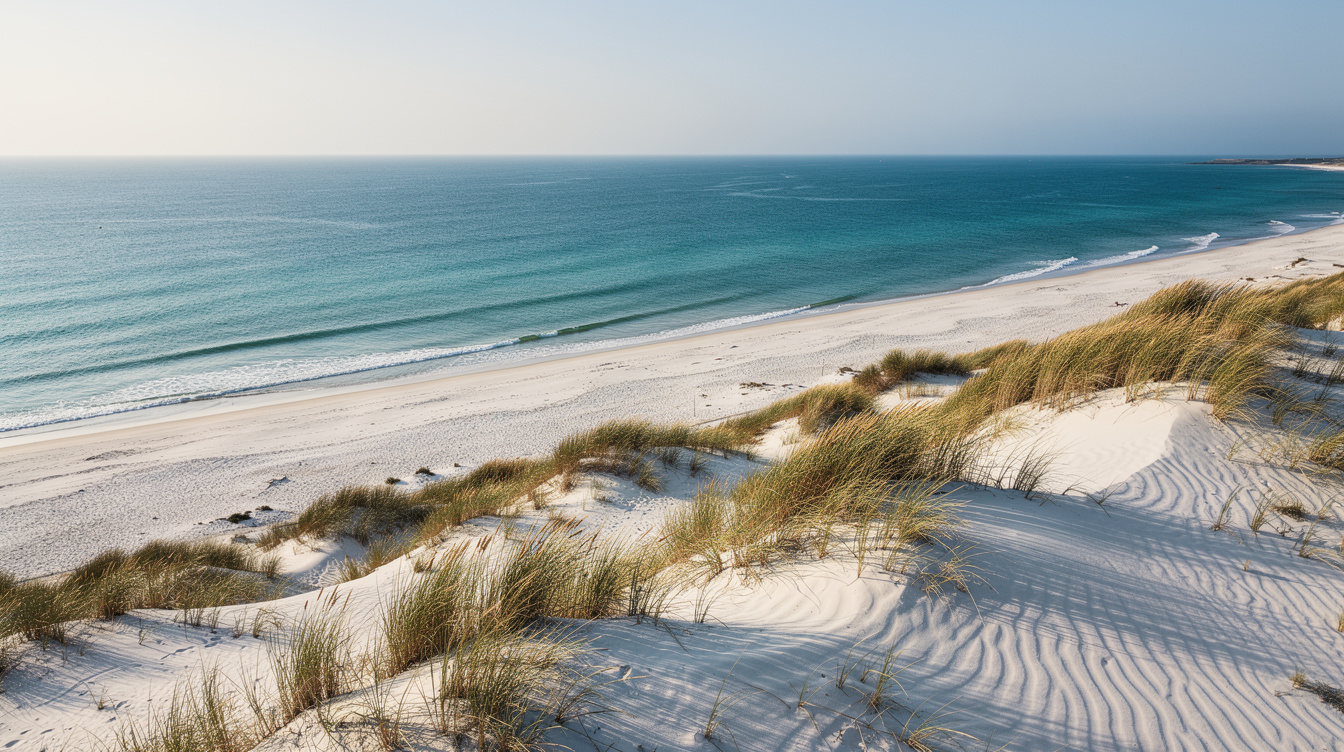
The parking lot at Plage de L’Espiguette is roughly 1.4 miles from the water. That’s not a navigation error. You pay at the barrier, drive to the end of the road, and then cross a dune field that the Rhône River has been building for centuries. By the time sand appears under your feet, you’re already further from a beach umbrella rental than anywhere else on the French Mediterranean coast.
What’s in front of you is close to 9 miles of pale, wind-shaped beach that most visitors to southern France never locate on a map. It looks nothing like the Riviera. That’s the point.
Why this beach looks nothing like the rest of the French Mediterranean
The Riviera runs on limestone: white cliffs, small coves, water that stays calm because the coast curves inward. L’Espiguette runs on Rhône sediment, material carried down from the Alps for millennia and deposited along this low, flat spit at the western edge of the Camargue. Because the coastline faces nearly due south with no headlands to break the fetch, Mediterranean swells hit with actual force.
The Tramontane wind funnels down the Rhône valley and shapes the sand into dune ridges that reach several meters at their tallest. In June, the color is close to white. By late afternoon, the wind makes the surface shimmer and sting slightly against bare legs. There’s no promenade. The dunes are the architecture. And physical forces like these define the whole beach experience, not just the scenery.
But this is genuinely counterintuitive for American travelers who expect “French Mediterranean” to mean Cannes umbrellas and rosé service at $30 a glass.
What the Conservatoire du Littoral protects here
France’s Conservatoire du Littoral began acquiring the Espiguette peninsula from 1981 onward, folding it into the protected coastal zone at the edge of the Camargue regional nature park. The practical consequence is total: no hotel construction, no permanent restaurant infrastructure, no rows of rented beach chairs. The same logic that kept a Majorca beach free of hotels applies here, except the French mechanism is acquisition, not prohibition.
What that looks like on the ground is a seasonal snack facility near the parking area and nothing else for the miles that follow. The dune vegetation, primarily marram grass stabilizing the ridges in pale gold waves, is included in Natura 2000 ecological listings. Local naturalist guides who work the Camargue zone describe the dune system as one of the last functioning examples on the Languedoc coast.
When to go and where to walk
L’Espiguette works best in June and early September. Water temperature in June runs around 68°F, cooler than the enclosed bays further east because this coast has enough exposure for real circulation. July and August bring crowds to the section near the parking lot, and the Tramontane, which blows hardest in summer, kicks up enough sand near the dune base to make sitting uncomfortable by early afternoon.
The section within easy walking distance of the lot carries a real density of towels in peak season. Walk 20 minutes east along the tideline and the density drops sharply. Walk 40 minutes and you’re essentially alone. And unlike wilder beaches that punish you with access, L’Espiguette punishes only the visitors who arrive late and stop close to the car.
The surf is real by Mediterranean standards. Not Atlantic real, but genuine shore break when the wind has been running for a day. The bottom shelves gradually, which makes entry easy. Strong swimmers find it fine. Children need watching near the break line.
What this place is not
There’s no village at L’Espiguette. Le Grau-du-Roi, the nearest town, sits about 4 miles back up the D62, a working fishing port with harbor restaurants and a morning market. The practical structure for a full day: arrive at the beach by 9am, return to town by midday, come back in the late afternoon when the lot has thinned and the light on the dunes shifts from white to pale amber. Other protected French Mediterranean beaches require more effort to reach. This one just requires timing.
Your questions about Plage de L’Espiguette answered
How do you get there from Montpellier or Nîmes?
From Montpellier, the drive runs roughly 45 miles southwest via the A9 toward Nîmes, then south on the D979 through Aigues-Mortes and Le Grau-du-Roi, then out the D62 to the parking barrier. Expect 50 to 60 minutes depending on summer traffic near Le Grau-du-Roi. No public transit reaches the parking area. A car is required.
What months are best for visiting?
June and the first two weeks of September offer the most reliable combination: warm water, manageable crowds, and Tramontane conditions that stay below the level where sand becomes a problem. April and May are quiet but the water stays cold, around 59-62°F. But July and August are hot, windy, and busy near the access point.
Is there a fee, and what should you budget?
Parking in season runs approximately $6 to $9 per day (roughly €5 to €8), managed by the commune. The beach itself is free. The seasonal snack facility near the lot covers drinks and basic food. Budget accordingly: there’s nothing else to spend money on for 9 miles in either direction.
At 6pm in June, the Tramontane drops to something closer to a breath. The dune shadows go long and the sand shifts from white to the pale amber that the low Mediterranean sun produces in the last hour before it touches the Camargue horizon. The parking lot is half empty by then.