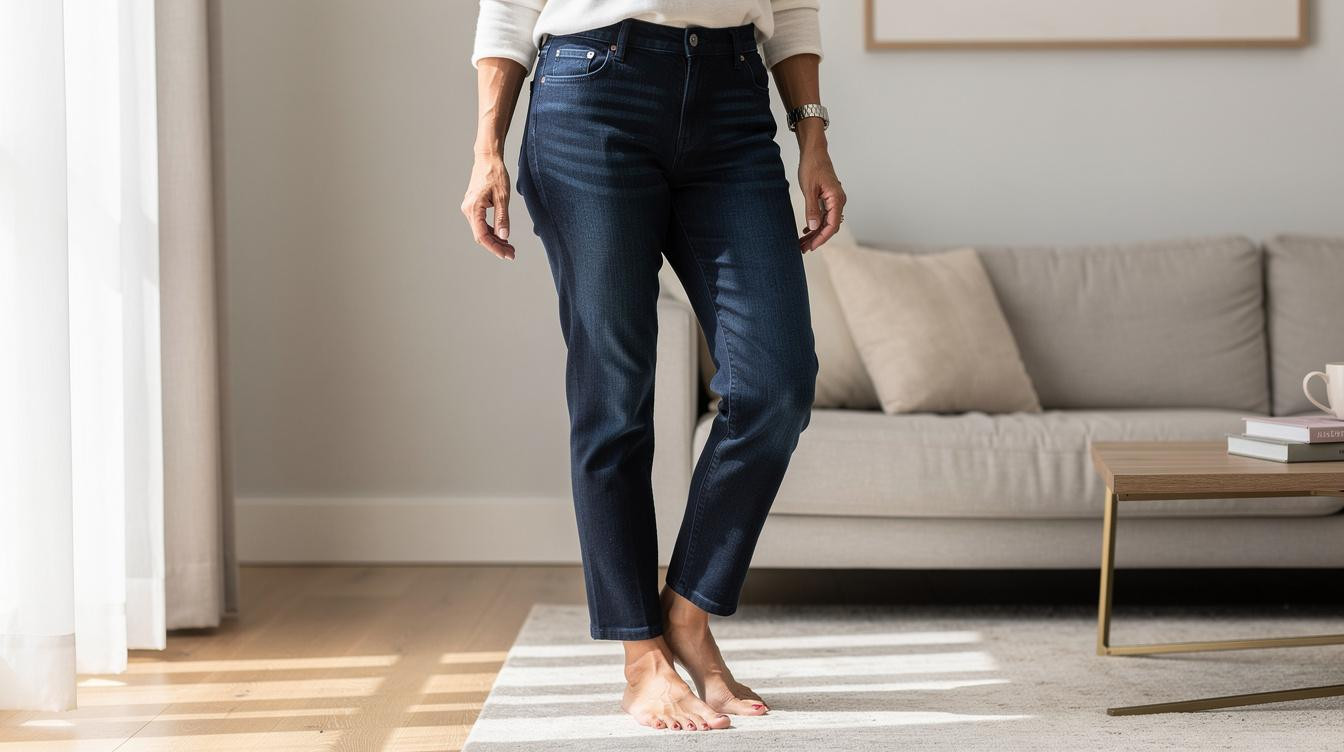
The jeans felt fine at 8am. Dark indigo, straight leg, clean hem sitting right above the ankle. By 2pm the seat had gone soft. By 4pm you were pulling the waistband up without thinking about it. This is not a sizing problem or a body problem. It is a construction problem, and the answer is printed on the inner waistband label in a number most shoppers walk right past.
Why stretch jeans stop stretching back
Cotton does not want to move. Elastane is what makes it move. But elastane has a memory, and that memory degrades based on how much of it is in the weave. Jeans with 4% or 5% spandex feel extraordinary in the fitting room, giving in every direction, skimming instead of gripping.
Then you sit at a desk for three hours, bend to load the dishwasher, and walk a parking lot. The fibers stretch past the point where they can fully contract. The seat bags. The knee pouches. The waistband relaxes forward. And the fabric that felt like a second skin at 9am is a different garment entirely by lunch.
The recovery sweet spot is 1-2% elastane woven into a structured cotton base. That ratio gives the fabric enough elasticity to move with you and enough cotton weight to pull itself back. When you press a thumbnail against the thigh of a structured-stretch jean, the fabric resists. That resistance at 7am is what you want still present at 5pm. For more on stretch jeans that hold their shape all day, there are specific pairs worth knowing about.
What the label is actually telling you
Every pair of jeans has a fabric composition label sewn into the inner waistband or side seam. Most women check the size and wash instructions. The composition line is the one that matters. A label reading 98% cotton / 2% elastane is the range you want.
The cotton does the structural work. The elastane gives the weave enough give to move without losing shape across a full day. At this percentage, the denim feels slightly firm when you first pull it on, which is correct. The give earns itself over the first twenty minutes of wear. Comfortable, but not soft.
But label language is where things get slippery. Any label describing more than 3% spandex combined with words like “super stretch,” “ultra flex,” or “comfort fit” is worth testing carefully. These constructions were engineered for the fitting room, not the afternoon. “Recovery denim” or “shape retention” paired with 1-2% elastane is the combination that actually delivers. Stylists who dress women over 50 consistently flag high-spandex denim as the single most common reason clients end up with fashion mistakes that quietly age an outfit.
Why rise and weave structure complete the picture
Getting the elastane percentage right solves the bagging problem in the body of the leg. But a mid-rise jean with 2% elastane will still gap at the back waistband if the rise sits below the natural waist. The fabric has nothing rigid to anchor to, so it floats and slides.
A high-rise cut, meaning the waistband sits at or above the navel, uses your natural waist as a structural anchor point. The cotton-dominant weave holds against that point rather than drifting. The higher rise also smooths the middle, so the whole silhouette reads longer and cleaner from hip to hem. Style directors at major US publications have noted that this is why high-rise straight-leg denim consistently elongates the leg more than a lower-rise version of the same cut. For a deeper look at how rise changes the leg line in straight ankle jeans, the mechanics are worth understanding before you buy.
Where to find jeans built this way
NYDJ’s Lift Tuck collection uses a cotton-dominant weave with a compression panel, running approximately $99-$139 depending on retailer. Wit and Wisdom Ab-Solution straight leg runs $69-$89 at Nordstrom and uses a reinforced waistband with a 1-2% elastane construction. Eileen Fisher’s straight-leg denim sits at $178-$198 and uses heavier-weight cotton with minimal elastane, so it feels close to rigid denim while still allowing movement. Democracy’s Ab-solution jeans run $59-$79 and include a waistband stay that prevents rollover. For each of these, the fabric percentage is verifiable on the label before purchase. Once you know which jeans hold their shape, outfit formulas that work at 50 give you the styling direction to finish the look.
Your questions about jeans that stretch but never sag
Can I tell from the fitting room whether jeans will sag later?
Yes, but not by how they feel when you first pull them on. Sit in them for five minutes in the fitting room. Stand back up and look at the seat in a mirror. And if the fabric has not returned to its original shape after you stand, it will not return at 4pm either.
Are darker washes more likely to hold their shape?
Darker washes use a denser dye process that slightly stiffens the cotton weave, which is part of why dark indigo jeans tend to hold their shape longer than heavily faded versions of the same style. But fabric weight and elastane percentage still matter more than wash depth. A lightweight, high-spandex jean in dark indigo will still bag out by midday.
What if the jeans fit perfectly in the waist but bag at the knee?
Knee bagging happens when the elastane percentage is too high relative to the weight of the cotton. The fabric stretches at the point of repeated flex and cannot fully contract. And if the waist fits correctly but the knee bags by afternoon, the answer is lower elastane percentage, not a different size.
Dark indigo straight-leg jeans, worn in, waistband sitting flat above the hip. It is 5:47pm. The seat is smooth. The leg is straight. The hem is exactly where it was at 7am. The label says 98% cotton, 2% elastane. That is the whole story.