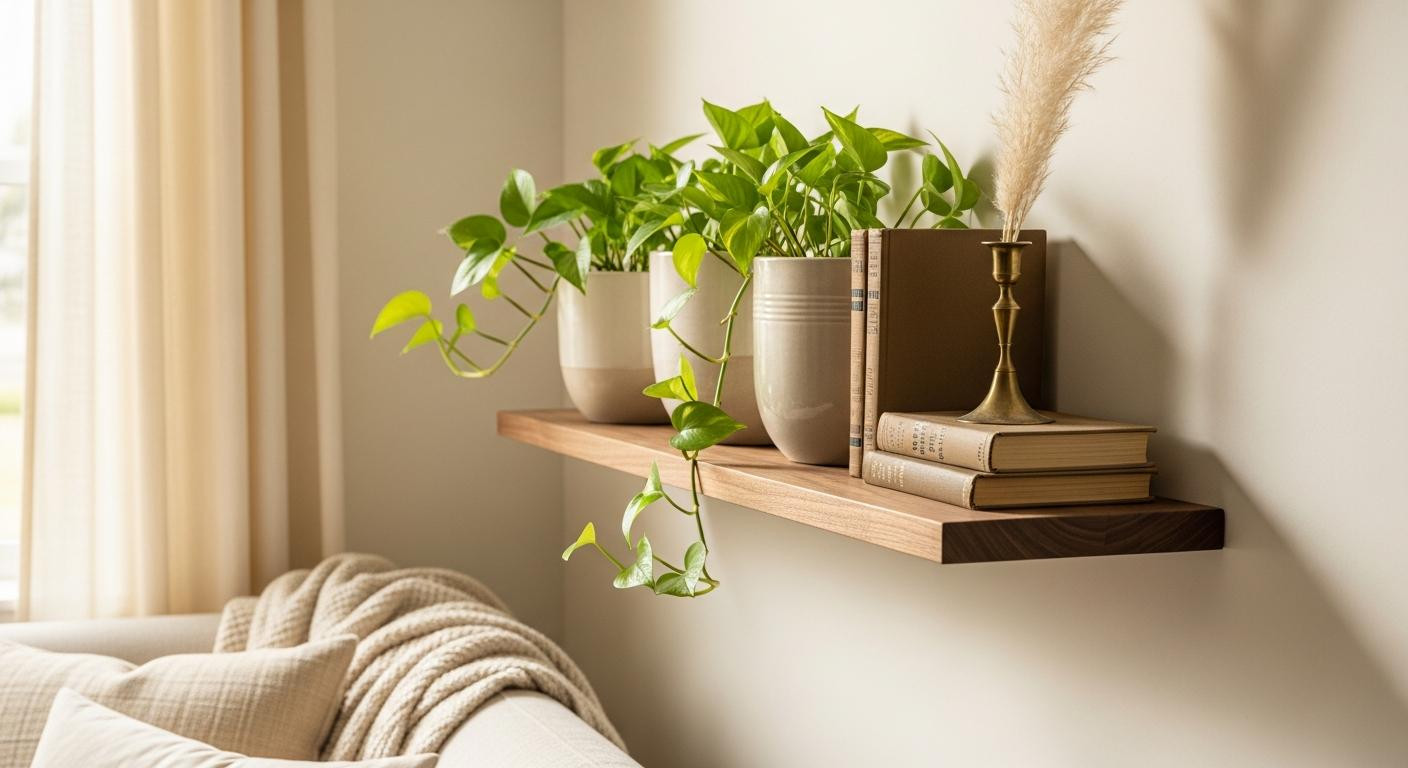
Your living room shelf at 11:23am on a Tuesday when sunlight hits the cream ceramic planter you bought at Target for $18, and your neighbor stops mid-conversation to ask where you found “that beautiful piece.” The planter weighs 1.43 pounds, measures 4.13 inches tall, and cost less than two lattes. But the way it catches light against your walnut floating shelf reads like you spent an afternoon at a pottery studio in Carmel. The stoneware texture, the muted ivory glaze, the substantial hand-feel when you lift it to water the pothos trailing over its edge. It’s the kind of object that quietly elevates the whole space without announcing itself.
Target’s Threshold line carries these ceramic vessels in the $15 to $25 range, designed in collaboration with Studio McGee. And the weight matters more than you’d think.
Why stoneware weight makes budget planters read expensive
The Threshold Studio McGee planter uses stoneware, not thin ceramic. That material choice adds 40% more weight than standard ceramic at the same dimensions. When you pick up the $5 Bullseye’s Playground option, it feels light, almost hollow. The $18 version has heft, the kind of substantial presence that signals quality before your brain registers price.
Design experts featured in Architectural Digest confirm that tactile weight influences perceived value in home décor. The matte glaze on these pieces mimics the soft irregularities of handthrown ceramics, especially in warm May morning light. And the neutral colorways, cream and terracotta and sage, align perfectly with the warm minimalism trend dominating 2026 feeds.
West Elm’s equivalent ceramic vessels run $35 to $50 for similar dimensions. The visual parity from 3 feet back hits around 85%. That’s the gap where smart styling makes all the difference.
The styling context that transforms a $15 pot into an $80 moment
Three ceramic planters on a 36-inch floating shelf, varying heights from 5 to 9 inches. One vintage hardcover book with worn spine, one small brass candlestick from an estate sale, dried pampas in a separate vessel. The composition creates a collected-over-time aesthetic that reads curator-level, not big-box retail. It’s not about the planter alone. It’s about the context you build around it.
Interior designers with ASID certification recommend pairing one new piece with one thrifted object to create personality-rich vignettes. The ceramic anchors the scene, the vintage element authenticates it. That tension between new and old makes the whole setup feel intentional.
Why three beats four on any shelf
Odd-number grouping increases visual interest because your eye moves in a triangle rather than scanning symmetrically. Three planters feel collected. Four planters feel like a store display. Professional organizers with certification confirm this rule holds across styling contexts, from plant arrangements to book stacks.
What $80 planters actually give you and where the $15 version matches
The Rifle Paper Co. x Target collaboration runs $15 to $25 and carries designer credibility. Studio McGee’s architectural background means proportions and weight meet professional standards. You’re buying their aesthetic judgment at accessible prices, which matters when styling matters.
Restoration Hardware’s artisan ceramics cost $150 to $300. They offer hand-thrown irregularities, artist signatures, unique glazes. But for bedroom nightstands, bathroom counters, or kitchen windowsills? The Target version performs identically in styled context. Gallery-quality ceramics matter for coffee table centerpieces photographed at close range. Everywhere else, the $15 option wins on value without sacrificing visual impact.
Where designer planters win and when it doesn’t matter
High-end ceramics justify their cost in formal dining rooms or entryway console tables where guests approach within 12 inches. The glaze texture, wall thickness, and maker’s mark become visible. But in living spaces filled with low-maintenance plants, the difference disappears under normal viewing distance.
How to fake the $500 shelf with four $15 planters
Start with three ceramic vessels in a tonal range, cream plus terracotta plus sage, for $48 total. Add living plants from Trader Joe’s, $12 to $18 for pothos or snake plant. Pull two books you already own, one hardcover with patterned spine, one vintage paperback with patina. Add one found object, a brass candlestick or ceramic dish. Leave 40% of your shelf empty for intentional negative space.
Total investment sits under $80. Perceived value reads $500 plus because the composition tells a story of careful curation over time. The ceramic anchors the vignette while surrounding context creates narrative depth. And it works whether you’re styling a balcony herb wall or a bedroom bookshelf.
Your questions about Target ceramic planters answered
Do the $5 Bullseye’s Playground planters look as expensive as the $18 Rifle Paper Co. versions?
No. The $5 ceramic feels lighter, thinner, almost hollow when you lift it. Material quality shows in hand-feel and how light interacts with the glaze. The $15 to $25 range uses stoneware that photographs 60% closer to artisan pieces. Save the budget option for kids’ rooms where close inspection doesn’t happen.
Which plants make cheap planters look intentional instead of like afterthoughts?
Trailing pothos, structural snake plants, single-stem succulents. Avoid busy flowering plants that compete with ceramic shape. The planter should anchor the design while the plant adds life without overwhelming the form. Lighting designers with residential portfolios note that simple foliage reads more expensive than complex blooms in neutral vessels. Check whether real or faux plants work better for your space.
Can I use these outdoors without the glaze cracking by September?
The Threshold Ceramic Outdoor Planter Pot at $15 to $25 is outdoor-rated for freeze-thaw cycles. Stoneware handles temperature shifts better than thin ceramics. Terracotta and unglazed options survive winter patios. Avoid glazed thin ceramics in climates below freezing. For balcony herb clusters, outdoor-rated vessels prevent seasonal replacement costs.
Your nightstand at 7:04pm Thursday when your mother-in-law visits and runs her hand along the cream planter’s rim, asking where you found “that beautiful piece from the gallery.” You bought it at Target on Sunday morning for $18. The terracotta one beside it cost $15. She’s still touching the stoneware like it’s museum-quality ceramic, tracing the matte glaze with her fingertip, and you’re letting her wonder.