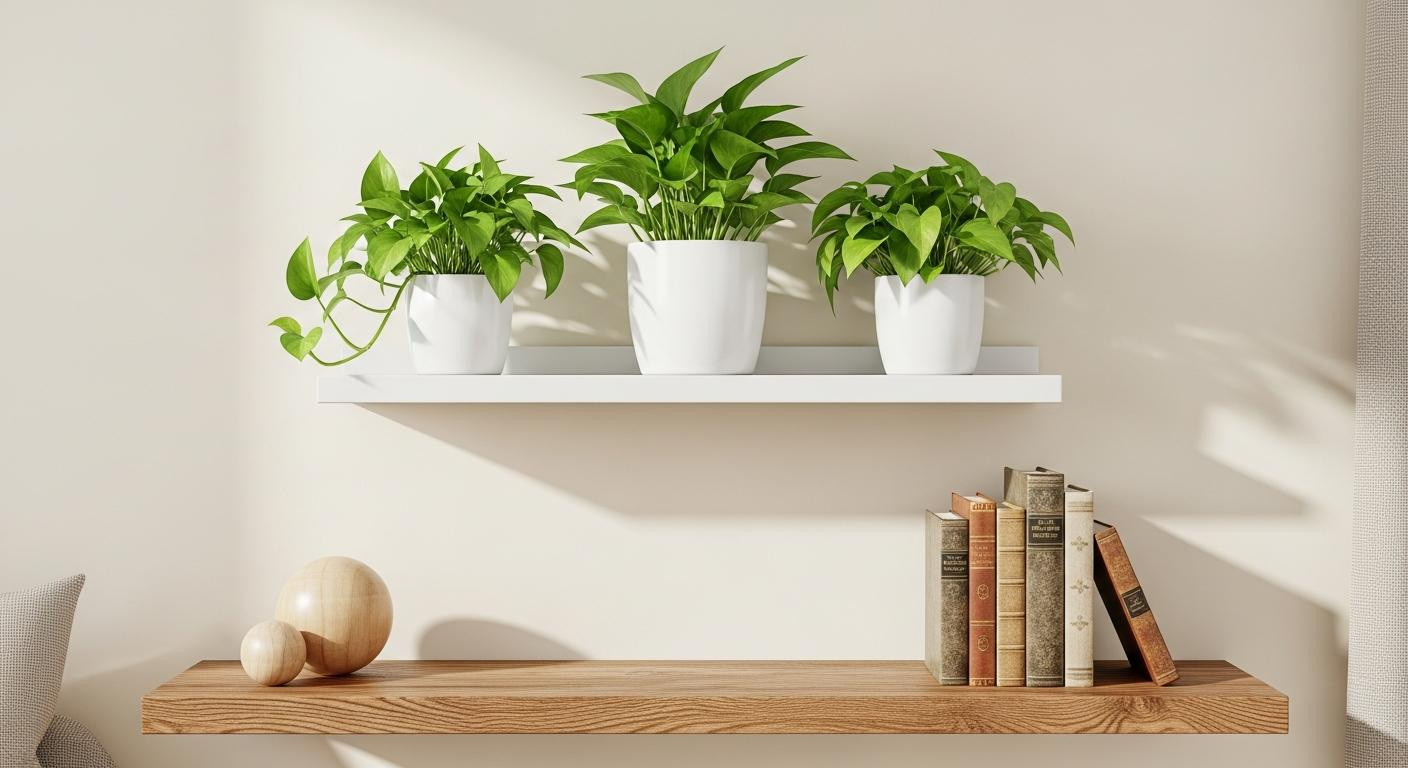
Your living room shelves hold four Pothos in matching white ceramic pots, spaced evenly across 36 inches of wood. They’re healthy. They’re watered. And when your friend visits Tuesday afternoon, she glances at the corner and asks if you just moved in. The plants cost $52 total. The shelf was $79 from IKEA. But the arrangement reads temporary, like you set them down and forgot to finish styling. That’s because your brain processed those four plants as two identical pairs within 2.3 seconds, creating a formal, symmetrical aesthetic that feels staged rather than curated.
The fix isn’t more plants or better pots. It’s understanding that odd numbers force your eye to move differently across a space, creating what interior designers call naturalistic flow instead of static order.
Your brain divides even-numbered groups into symmetrical halves within 2.3 seconds
Two plants read as bookends. Four plants divide into matching pairs. Six plants create three identical sets. According to ASID-certified interior designers, the mind automatically imposes this splitting behavior on even quantities, reinforcing what landscape architects describe as a man-made, orderly aesthetic. The brain looks for pairs, finds them immediately, and stops scanning.
Three plants can’t divide equally. Your eye moves across them searching for that pair, never settling, creating the movement that makes a corner feel intentional. And that searching behavior is exactly what transforms a shelf from storage solution into designed moment.
Professional plant stylists featured in Architectural Digest confirm that odd groupings (3, 5, 7) register as unified clusters rather than individual specimens lined up for inspection. The warmth of natural wood against white pots amplifies this effect, especially when paired with the glossy texture of Pothos leaves catching morning light through west-facing windows.
The triangle placement that makes three plants read like one expensive moment
Stagger depth by 4 to 8 inches to create dimensional flow
Three plants lined horizontally flatten into parade formation. Pull the center plant 6 inches forward on a 14-inch-deep shelf. Place the left plant 2.5 inches from the front edge, the right plant 4 inches back. That triangular offset creates spatial depth your eye reads as composition, not coincidence.
Design experts with residential portfolios note you shouldn’t measure obsessively. But maintain enough separation that the eye catches similarity without plants merging into undifferentiated mass. On shelves holding multiple groupings, this breathing room prevents visual clutter while maintaining that curated gallery feeling.
Mixed heights on tiered shelves multiply the odd-number effect
Stack three plants at different vertical levels and the arrangement compounds its impact. Large Monstera on the back-top tier, medium Philodendron center-middle, trailing Pothos front-lower. The 3D movement forces your eye through vertical space, not just horizontal scanning.
A 3-tier wooden stand from Target’s Threshold line (currently $148) with tiers measuring 18, 24, and 30 inches wide creates this graduated effect naturally. And the walnut finish adds warmth that keeps the white ceramic from feeling too clinical, especially in rooms with abundant natural light.
Five-plant groupings work until your shelf measures under 36 inches wide
The 36-inch minimum that prevents odd-number clusters from reading as clutter
Five plants need breathing room to register as intentional grouping rather than overcrowded collection. Professional organizers with certification confirm that on a 28-inch shelf, five 4-inch pots compress into visual chaos. On a 48-inch shelf with tiered depth, those same five plants create rhythm through repetition.
The math works like this: five 4-inch planters equal 20 inches of pot width. Add 12 to 16 inches of negative space between plants. That’s a 36-inch functional minimum for five-plant odd grouping that doesn’t tip into cluttered. But honestly, it’s easier to feel than measure—if you can’t see wall or shelf between pots, you’ve crossed the threshold.
Seven works in corners but nine needs 60+ square feet of floor space
Seven plants grouped in an L-shaped corner formation maximizes the odd-number rule in tight rental spaces. Design experts note this approach works because vertical walls provide natural boundaries that contain the grouping without additional furniture. Corner placement also amplifies natural light reflection, making plants appear more vibrant than they would against flat walls.
Nine plants require at least 60 square feet of floor space to avoid merging into one undifferentiated mass. According to lighting designers with residential portfolios, that’s roughly an 8×8-foot area where floor groupings can breathe. Beyond 12 to 13 plants, arrangement detail becomes less visually critical because the mass itself dominates as the design element.
The $170 corner setup that proves the rule without renovation
Small apartment corner transformation: $79 for IKEA’s SATSUMAS 3-tier stand (tiers at 16, 20, and 24 inches wide), $39.99 for Target’s Threshold ribbed ceramic 3-pack in sage, $38.97 for three 6-inch Pothos from Home Depot (currently $12.99 each), plus $12 for felt pads to protect rental floors. Total: $169.96.
Arrange them in triangle formation across the three tiers. Front-left Pothos 3 inches from the edge, back-center 10 inches deep, front-right 4.5 inches offset. The setup takes under 30 minutes, requires zero tools, and creates the kind of curated moment that makes guests assume you hired someone.
Your questions about plant styling odd-number grouping answered
Does the rule work with identical plants or do I need variety?
Both approaches work but serve different aesthetics. Three identical Pothos in matching cream pots creates rhythm through repetition—modern minimalist cohesion. Three different plants (Philodendron, Snake Plant, Pothos) in coordinating pots creates texture contrast—collected eclectic. The odd number drives the naturalistic effect regardless of whether you repeat or vary.
Can I use even numbers if I’m going for formal symmetry?
Yes, according to horticulturists featured in design publications. Four plants flanking a fireplace in matched pairs reads intentionally formal, not accidentally cluttered. The key is conscious choice: even numbers signal deliberate symmetry, odd numbers signal naturalistic flow. Most casual living spaces benefit from odd groupings because formal symmetry requires architectural anchors like mantels or built-ins to feel purposeful.
What if my shelf fits exactly four plants and I can’t remove one?
Add an inexpensive fifth element that isn’t a plant. Small ceramic sculpture, wooden sphere, stack of two vintage books. Breaks the even-numbered pairing reflex without requiring new planters. Target’s decorative objects currently run $12 to $30, and the mixed-media approach reads more collected than a matched-plant quartet ever could.
Tuesday afternoon in May when the Philodendron sits 6 inches forward and the Snake Plant anchors the right corner at 4.5 inches back, creating that triangle your eye can’t quite divide into pairs. The glossy leaves catch the light differently now. Your sister notices this time.