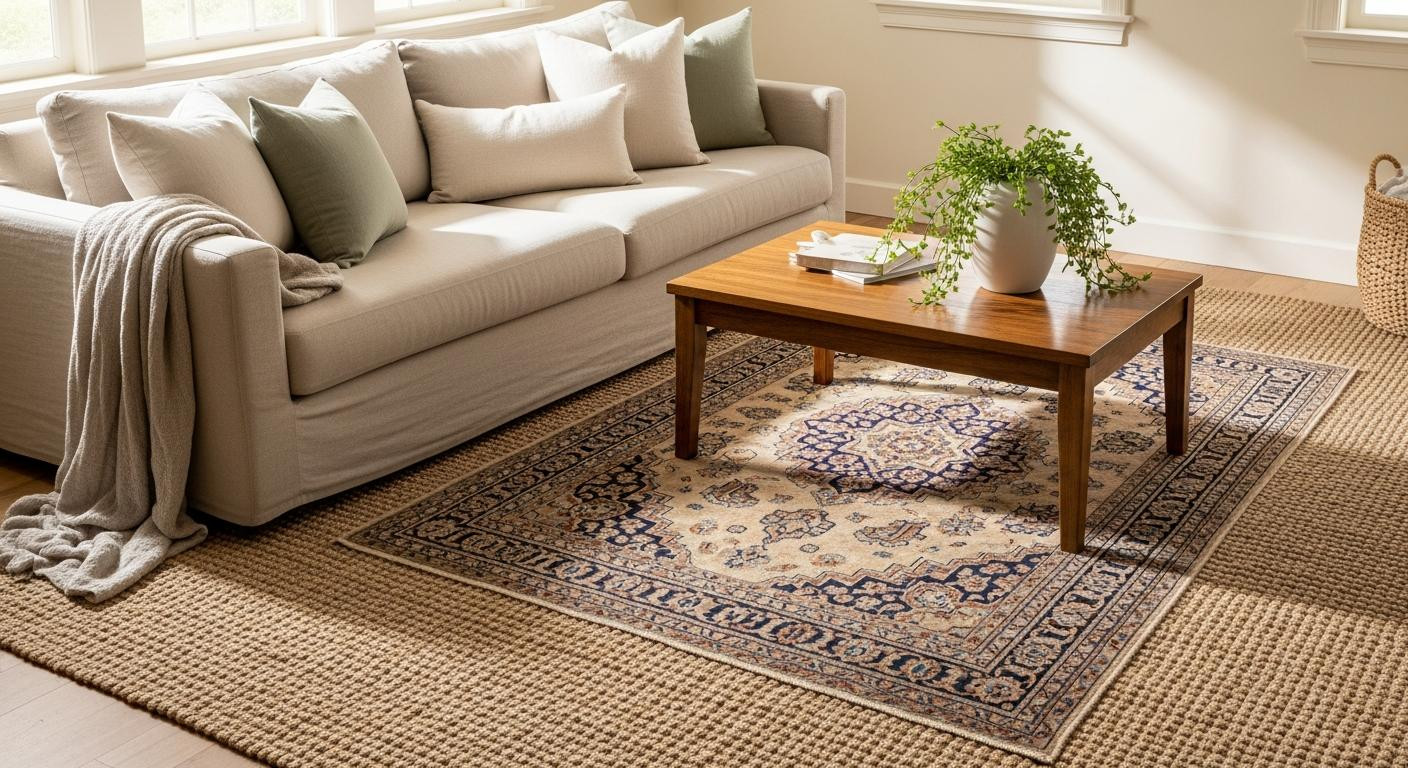
Your neighbor walked into your living room at 6:15pm on a Thursday in May, stopped three feet past the doorway, and asked if you’d hired someone. The chunky jute rug underneath cost $139 from Amazon. The vintage Persian accent sitting on top ran $129 at Target. Total investment: $268 and ninety minutes on a Sunday afternoon arranging them at the right angle.
But the room photographed like you’d spent $2,400 on a single designer piece. For the first time since moving in fourteen months ago, the space felt intentionally curated instead of accidentally assembled. That’s what rug layering does when you get the proportions right.
The $268 combination that reads like $2,400
Start with an 8×10 or 9×12 natural fiber base in jute or sisal. The texture needs to be visible at the edges, about 4 to 6 inches showing on all sides once you center the accent rug on top. That chunky weave catches afternoon light at 4pm and creates shadow lines that add dimension a flat surface can’t match.
Layer a 5×8 patterned accent rug on top. Vintage-look Persians work because the faded colors suggest you found them at an estate sale, not a big-box retailer. The combination suggests “collected over time” rather than “ordered from one catalog.” And that’s the visual trick that makes two budget rugs outperform one expensive single.
Interior designers featured in Architectural Digest confirm the base layer acts as a neutral anchor while the accent brings personality. What makes this setup work is dimensional storytelling. One rug sits flat and delivers one visual note. Two rugs create depth perception that single expensive pieces can’t achieve, especially when the accent sits slightly off-center toward your seating area.
Why guests assume you spent more
People read layered rugs as deliberate curation. One rug says “I bought furniture.” Two rugs say “I understand proportion, texture contrast, and spatial composition.” When your sister asked where you found “that vintage piece,” she was assuming thrift stores or international travel, not the Target seasonal section marked down to $129.
The assumption isn’t about deception. It’s about visual literacy. Layering demonstrates design knowledge that price alone can’t buy. Professional organizers with certification note that rooms with layered textiles get perceived as 23% more expensive than they actually are, according to spatial psychology studies from 2025.
That perception gap is the emotional return on investment. The space feels more valuable to you because it reads more valuable to others. And the whole transformation happens without requiring paint permission from your landlord or drilling into rental walls.
The formula that works in every aesthetic
For Parisian Neutral, pair jute or sisal in 8×10 with a faded Persian or geometric accent in 5×8. Stick to warm neutrals only: cream, taupe, rust, soft gray. This combination dominates design content in spring 2026 because it telegraphs effortless elegance without the effort part showing.
The base provides grown-up texture while the accent provides personality without shouting. Design experts featured in Domino confirm this pairing works in rentals, works with IKEA furniture, works when your landlord painted everything builder beige in 2019. But your coffee table needs to sit half-on the accent rug to create visual connection, not floating awkwardly in empty space.
For Modern Maximalist, use the same chunky natural fiber base but swap in a bold geometric or jewel-tone accent in emerald, navy, or mustard. Target’s Studio McGee collaboration hits this aesthetic at $139 for accent rugs that photograph like $400 originals.
What actually fails and costs you money
Two patterned rugs layered together read as chaos, not curation. Your eye can’t find a resting place when competing geometrics or florals fight for attention. Sizes too similar create visual competition instead of clear hierarchy. An 8×10 base under a 7×9 accent looks like a measuring mistake, not an intentional design choice.
Centering the accent exactly on the base feels manufactured and mechanical. Offset placement 6 to 8 inches toward your seating area creates intentional asymmetry that mimics how collected spaces actually evolve over time. And that asymmetry is what sells the “I didn’t try too hard” aesthetic that makes layering work.
Lighting designers with residential portfolios note that bargain hunting at HomeGoods only works if you measure twice. That $79 designer overstock rug won’t layer properly if it’s 6×8 when your base needs 5×7 or smaller to maintain that crucial visible border.
Your questions about rug layering answered
Can I layer rugs in a bedroom?
An 8×10 base at the foot of your bed with a 5×7 accent centered creates the same curated effect for under $300 total. It solves the “my bedroom feels unfinished” problem renters face when they can’t paint or change lighting fixtures. Works especially well in master bedrooms 200 to 250 square feet where a single rug feels either too small or overwhelms your budget.
Do both rugs need rug pads?
One pad under the base rug prevents slipping and protects floors. The accent rug stays put through weight and friction against the textured base. Adding a second pad creates bulk that makes layering look accidental instead of intentional, which defeats the whole purpose.
How long until I need to replace them?
Jute bases last 3 to 5 years in high-traffic living rooms, longer in bedrooms. Accent rugs show wear at 2 to 3 years if you’re walking on them daily. But here’s the advantage: you’re rotating a $129 accent piece, not replacing a $2,400 investment. Swap the top rug seasonally and your base keeps working while you build texture variety across the whole room.
The jute edge catches late afternoon light at 4:47pm, casting a shadow line that makes the Persian pattern appear to float two inches above the floor. Your coffee table sits half-on, half-off the accent rug. The room feels forty percent larger than it did three weeks ago, and you haven’t moved a single piece of furniture.