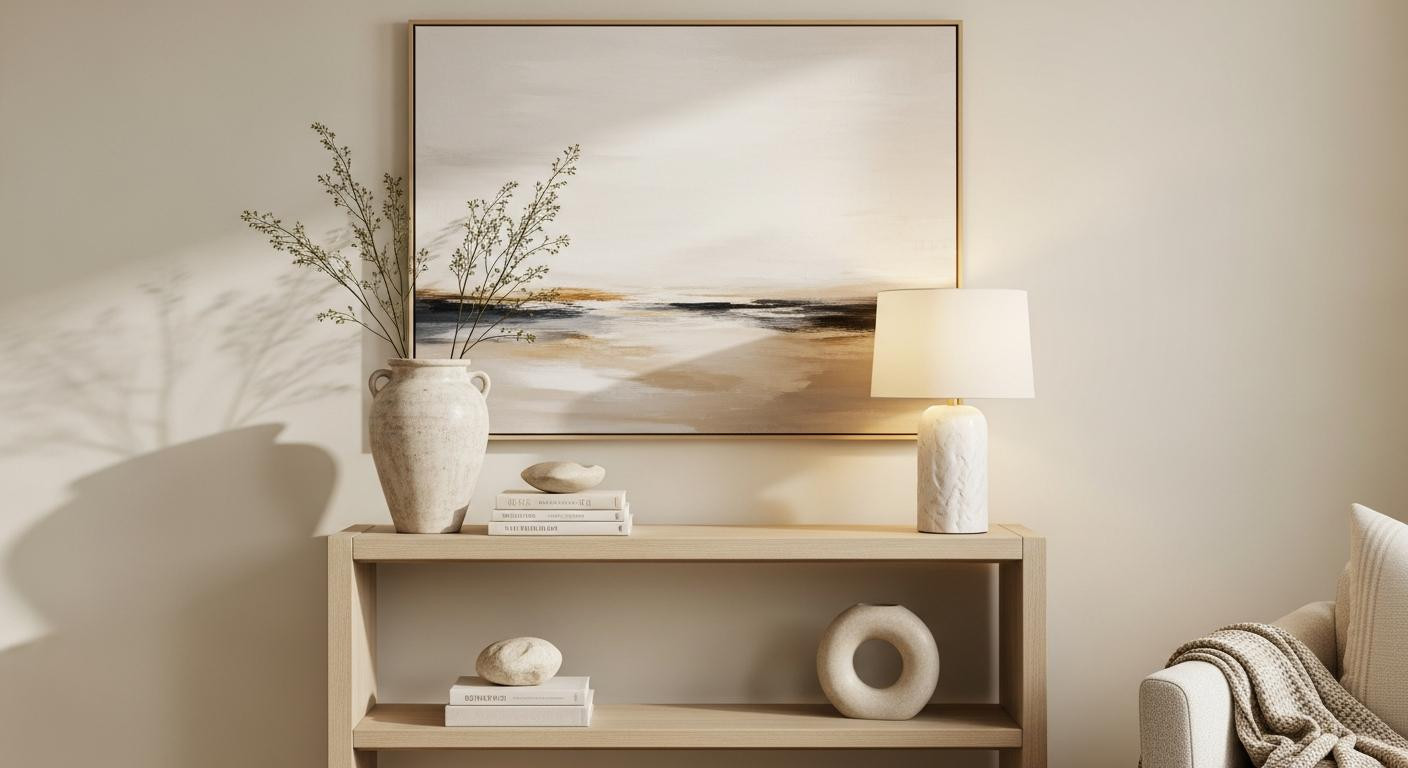
Your Tuesday call went like every other Tuesday until 2:14pm, when the client paused mid-sentence and asked if you’d redecorated. The 70-inch console table you’d positioned Sunday afternoon, styled with a ceramic urn and three stacked books, was doing work you hadn’t anticipated. The background shift didn’t just look better. It changed how people responded to your presence on screen.
The compliments started Tuesday. By Thursday, two colleagues had asked where you bought the art.
The gap between styled rooms and styled Zoom frames
Rooms that look finished in person read as incomplete through webcam lenses. Objects appear 25-35% smaller on standard webcams like the Logitech C920, and single focal points vanish into digital compression. White walls that feel clean in real space translate to institutional coldness on video.
Design experts featured in Architectural Digest confirm that art needs to measure at least 24×36 inches to register as intentional on 1080p feeds. Smaller prints compress to less than 10% of screen real estate, leaving setups feeling sparse even when they’re technically styled. The result is a background that photographs like indifference, not intention.
The three-object formula that photographs like intention
The spatial formula works because it creates depth layers webcams can actually capture. Position a tall botanical element on one side—an urn with stems reaching 24 inches works—then stack books horizontally in the center with a sculptural object on top. Add a warm-lit lamp on the opposite side.
The vertical stem pulls the eye up, preventing the background from feeling squat. And the lamp adds warmth that compensates for overhead office lighting’s harshness, which flattens skin tones and makes even expensive styling read as generic.
The oversizing requirement nobody mentions
Art should hang so its center sits at eye level when you’re seated, not standing-height gallery placement. This creates proper framing when the camera captures your torso. But the size matters more than the height.
Prints smaller than 30×40 inches disappear into the compressed background on video calls, leaving the wall feeling empty even when it’s technically decorated. Professional organizers with certification note that webcam distortion makes objects appear a third smaller than they measure in person, so what feels oversized in your office photographs as appropriately scaled on Zoom.
Budget tiers that all read expensive on camera
The $380 IKEA path
The budget formula works because digital compression doesn’t distinguish between IKEA and West Elm. Start with the VITTSJÖ console at $249, add a Target Project 62 frame with an Etsy abstract print for $70 combined, then fill a HomeGoods urn for $28 with Hobby Lobby faux stems using their 40% coupon at $18. The Target Threshold lamp adds $45, and thrifted books cost less than $10.
Metal-and-glass aesthetics don’t read cheap through 1080p compression. And faux botanicals from craft stores look real when positioned 18 inches from the camera, especially when paired with the desk positioning that finally stopped the constant door-checking.
The $1,200 long-term investment
The premium alternative uses a West Elm console at $699, a CB2 ceramic urn for $79, and a Schoolhouse lamp at $289. Real wood grain photographs with depth that particleboard can’t match. Weighted ceramic bases prevent tipping during desk bumps, and quality lamp hardware produces flicker-free light that flatters skin tones on video.
Commissioned abstracts from local artists run $300-500, but the investment reads as collected sophistication rather than purchased decoration.
The lighting detail that makes $90 setups look boutique
The single highest-impact variable sits inside the lamp, not around it. Warm bulbs at 2700K add a golden undertone that signals residential comfort, the visual shorthand for intentional curation. Cool white bulbs at 4000K create the same harsh institutional lighting your office ceiling fixture produces.
Video compression amplifies color temperature differences, so viewers register warm lighting as intentional design even when they can’t articulate why the background feels polished. Lighting designers with residential portfolios confirm that 2700K-3000K reads as warm professional on video calls without tipping into residential coziness. But Edison bulbs at 2200K render 15-20% too amber on webcams, making setups feel staged rather than lived-in.
The cause-effect chain matters more than the bulb cost. That $25 plug-in dimmer that made Tuesday dinners feel intentional uses the same psychology—adjustable lighting transforms perception.
Your questions about Zoom background setups answered
Does this work in apartments with textured walls?
Textured walls actually help by adding depth that photographs well on compressed video. The console should sit 12-18 inches from the wall to create shadow separation that reads as dimensional on camera, not pushed flush. Command strips support frames up to 16 pounds without damaging rental walls.
What if my desk isn’t centered on the background?
Style the console so visual weight sits where your torso appears in frame, not centered on the furniture itself. If you sit left-of-center, cluster the lamp and books on the left third of the console. Asymmetry reads as editorial on Zoom, especially when combined with the three-zone sideboard rule that made dining rooms look curated.
Can I use wallpaper instead of a console?
Wallpaper with gallery walls costs $400-800 and works for homeowners committed to the space. Console setups cost less, move with you, and provide storage. Pattern saturation can compete with your face on video, while consoles create depth layers that frame you. The principle mirrors pulling balcony furniture away from edges—intentional spacing creates zones.
The lamp clicks off at 6:47pm after your last call, and the urn casts a shadow across the stack of blue books. The art hangs in late-spring light, warmer now than it looked Sunday morning. Your background sits still, but it did work today.