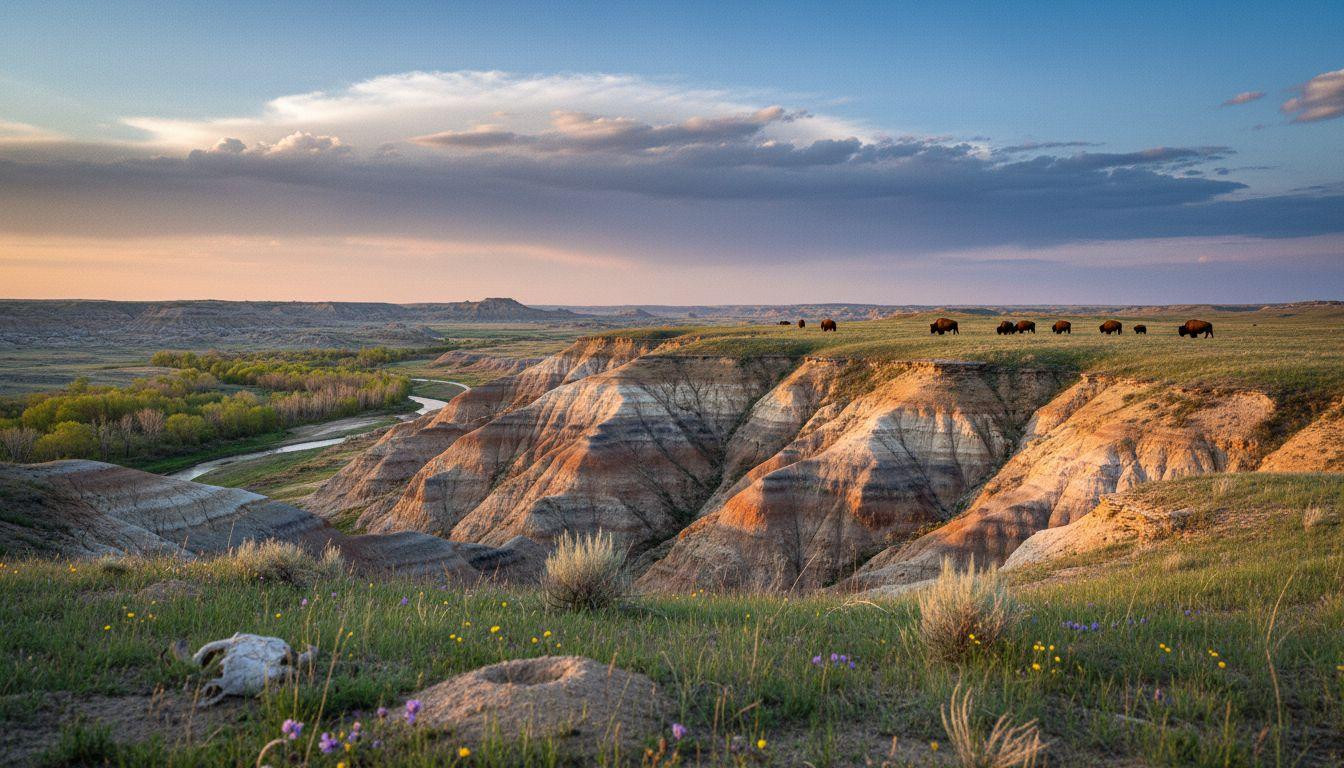
# Better than Badlands where 1M tourists cost $250 and Big Plateau keeps bison herds quiet for $110
Badlands National Park pulls over a million visitors each summer to its famous Notch Trail. The 1.3-mile scramble up a wooden ladder delivers layered fossil formations and bighorn sheep sightings. It also delivers crowds, $200-250 per night lodging in Wall, and boardwalk traffic jams by 10am. Drive 140 miles north to Theodore Roosevelt National Park’s South Unit and the Big Plateau Loop tells a different story. This 5.2-mile backcountry circuit crosses the Little Missouri River at dawn, climbs 565 feet to a plateau where bison graze in silence, and returns you to Medora by lunch for $80-120 a night.
The comparison isn’t subtle. Badlands concentrates its drama into short, accessible overlooks. Door Trail, Window Trail, Pinnacles Overlook. Most visitors never leave pavement. Theodore Roosevelt spreads its badlands across remote valleys where you ford a river to earn the view.
Why Badlands National Park feels overrun
Badlands draws over a million annual visitors to South Dakota’s layered buttes and fossil beds. The park’s accessibility is its curse. Notch Trail’s 1.3-mile route includes a ladder scramble that Instagram loves. By mid-morning in summer, the trailhead parking lot overflows. Door Trail’s half-mile boardwalk puts you face-to-face with jagged pinnacles, but also face-to-face with tour groups.
Wall Drug, the tourist trap 8 miles north, sets the tone. Gateway lodging in Wall and Interior runs $150-250 per night in peak season. The park entry fee is $30, same as Theodore Roosevelt. But the experience costs more in patience. Summer temperatures hit 80-95°F with little shade. Bighorn sheep appear as distant dots on cliffs. The fossil formations are dramatic, the crowds more so.
The cost of the famous view
Badlands delivers spectacle efficiently. Most trails run under 2 miles. Saddle Pass Loop, the longest popular option, covers 4.8 miles with 311 feet of elevation gain. The park’s off-trail policy lets you wander freely in designated areas. But freedom means little when parking lots fill by 9am and overlooks become photo queues.
Meet Big Plateau Loop in Theodore Roosevelt National Park
The Ekblom Trail trailhead sits in the South Unit’s northwest corner, 10 miles from Medora via the scenic loop drive. Population 100. The town rebuilt itself around Theodore Roosevelt’s 1880s ranching legacy. Lodging runs $80-120 per night off-season, $150-250 in summer. Still cheaper than Badlands’ gateway towns.
The loop starts with a river crossing. The Little Missouri runs shallow in spring, ankle to knee-deep depending on snowmelt. No bridge. Wade across and the trail forks. Go clockwise for a gradual 1.5-mile ascent to the plateau. The climb gains 565 feet through colorful badlands, golden-brown layers striped with gray volcanic ash.
The landscape
The plateau top opens to 360-degree views. Grasslands roll to the horizon. Badlands erode in slow motion beneath your feet. Prairie dog towns sprawl across the flat sections, hundreds of them barking warnings as you pass. Wild horses graze the valleys. Bison herds move through like they own the place, which they do.
April 2026 brings late spring conditions. Temperatures range 45-65°F. Snow lingers on north-facing slopes. The grasslands green up while the badlands hold their ancient gold. Wind sweeps the plateau uninterrupted. You’ll have it mostly to yourself.
Price comparison
Theodore Roosevelt sees 600,000 annual visitors total. Big Plateau Loop sees a fraction of that. The park entry fee is $30 per vehicle. Backcountry camping requires a free self-registration permit at the trailhead. Medora dining runs $15-25 per meal. Bison burgers, chokecherry dishes, pitchfork fondue for $20-35. No Wall Drug markup.
The experience Badlands can’t match
Bison on open plateau
Bison probability runs high on Big Plateau. Herds roam the South Unit freely. You’ll see them from the plateau rim, grazing the river bottom, crossing your path on the descent. Keep 25 yards minimum distance. They look slow until they’re not. Fall brings the rut and aggressive behavior. Spring keeps them calm.
Badlands offers bighorn sheep as its signature wildlife. They cling to distant cliffs, impressive but remote. Theodore Roosevelt puts you in bison country. The difference is intimacy. You’re in their landscape, not observing it from a boardwalk.
April snow solitude
Late April 2026 catches the shoulder season sweet spot. Snow patches the plateau edges. The river runs cold but crossable. Sunrise hits the badlands at 6:30am, painting the layers amber and rose. You’ll likely have the plateau to yourself until mid-morning. Compare that to Badlands’ tour bus arrivals at first light.
The quiet matters. Wind through grass. Prairie dogs chirping. Bison grunting in the valley. No engine noise. No crowd chatter. Just the sounds that shaped Roosevelt’s conservation vision when he ranched here in the 1880s.
Trail immersion
The 5.2-mile loop demands commitment. River crossing, steep climbs, exposed plateau. This isn’t a boardwalk stroll. The trail connects to the 144-mile Maah Daah Hey Trail, North Dakota’s epic thru-hike route. You’re in backcountry, not a scenic drive pullout.
Petrified forests line remote sections. Ancient trees turned to stone 65 million years ago. The geology rivals Badlands’ fossil beds but without the interpretive signs and crowds. You navigate by landmarks and instinct. The clockwise route keeps the steep descent for last, when your legs are tired but the river crossing is gentle.
Practical considerations
Getting there
Medora sits along Interstate 94 in western North Dakota. Bismarck airport is 140 miles east, a 2.5-hour drive. Dickinson airport is closer at 35 miles, 45 minutes, but with fewer flights. Chicago is 450 miles, 7 hours by car. The trailhead requires a short drive on East River Road off the scenic loop. No shuttle service. You’re driving.
When to visit
Spring and fall deliver the best conditions. May through October offers 50-75°F temperatures and active wildlife. April catches late snow and greening grasslands. Summer brings 80-95°F heat and thunderstorms. Winter drops to 5-25°F with potential for snowshoeing. The park stays open year-round. Big Plateau sees very low traffic in all seasons.
What Badlands does better
Badlands wins on accessibility. Paved boardwalks reach the best formations. ADA-compliant trails deliver close-up views. Fossil beds are more dramatic and better explained. If you can’t ford a river or handle steep terrain, Badlands serves you better. The infrastructure is built for comfort. Theodore Roosevelt is built for solitude.
Your questions about Big Plateau Loop answered
How difficult is the river crossing?
The Little Missouri runs shallow in spring and early summer, typically ankle to knee-deep. Late summer lowers the water further. Wear waterproof boots or plan to get wet. The current is gentle. Trekking poles help with balance on the rocky bottom. Ice is possible in early April. Check conditions at the visitor center before starting.
Why did Roosevelt choose this landscape?
Theodore Roosevelt arrived in 1883 to hunt bison. He stayed to ranch after personal tragedies. The badlands’ harsh beauty shaped his conservation philosophy. He called it “a land of vast silent spaces.” That silence still exists on Big Plateau. The park preserves the landscape that influenced his presidency and the creation of the National Park Service.
How does this compare to more famous western parks?
Theodore Roosevelt sees 600,000 annual visitors versus Yellowstone’s 4 million or Grand Teton’s 3 million. The experience is less polished, more raw. Fewer amenities mean fewer crowds. Badlands’ million visitors concentrate on short trails. Big Plateau spreads its few hikers across 5.2 miles of backcountry. Choose based on what you value: infrastructure or isolation.
The plateau holds its views until you descend. Bison graze the valley as you cross back through the river. Medora waits 10 miles away with hot coffee and bison burgers. The badlands stay quiet behind you, layered and patient under the spring sky.