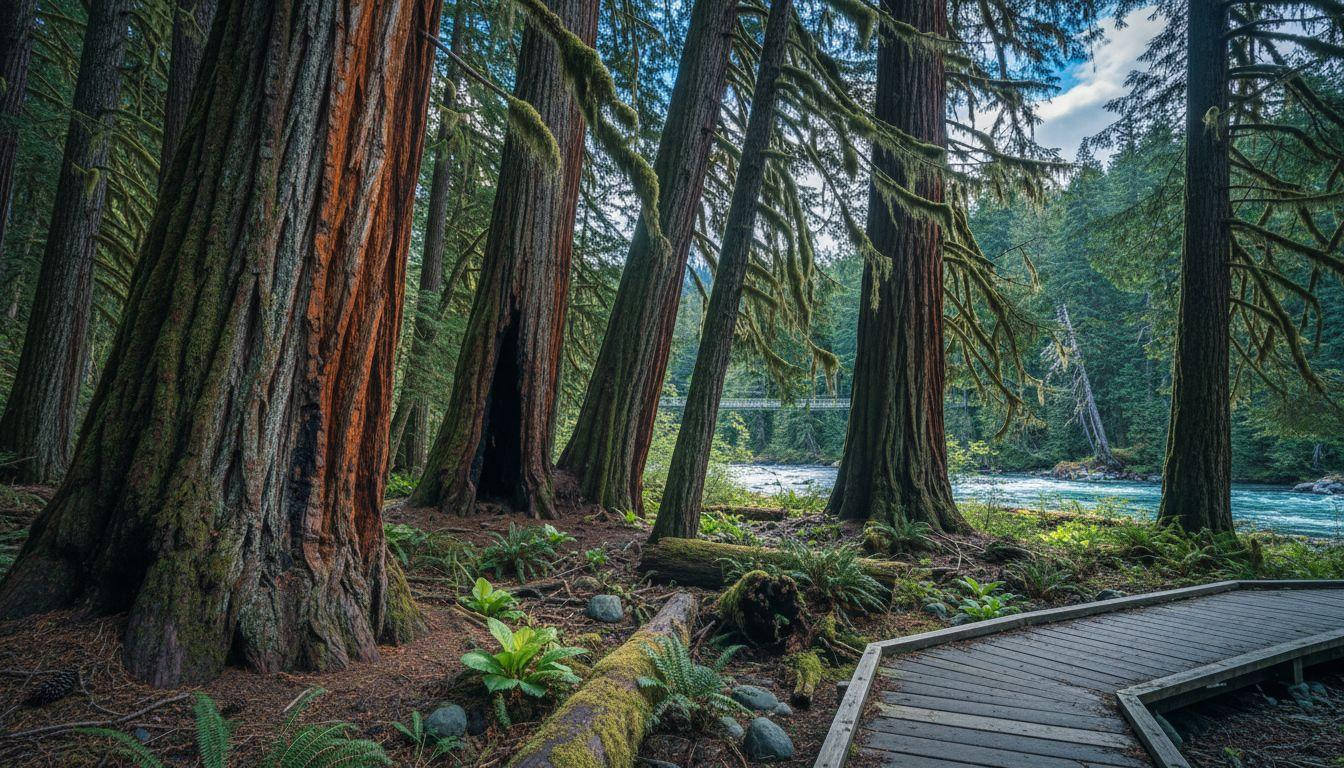
The suspension bridge sways slightly as you cross the Skagit River at dawn. Mist rises from turquoise water 40 feet below. On the far bank, western red cedars rise 200 feet into fog that hasn’t burned off yet. This is Newhalem in late April, when Highway 20 stays open year-round but the high country remains locked in snow. The Trail of the Cedars loop waits 600 feet south of the parking lot, accessible every day of the year.
Most visitors to North Cascades National Park arrive in July or August. They drive past Newhalem without stopping, heading for Cascade Pass or Diablo Lake overlooks. In April those destinations sit under 15 feet of snow. Newhalem operates independently of seasonal closures, a company town built by Seattle City Light in the 1920s to house hydroelectric workers. The trails here never close.
The forest that never closes
Newhalem sits at milepost 120 on State Route 20, exactly 120 miles northeast of Seattle. The elevation stays low enough that snow rarely accumulates. While Thunder Creek trailhead 8 miles east requires snowshoes until July, the Trail of the Cedars remains walkable in sneakers twelve months a year. No permits. No fees. No reservations.
The main loop runs 0.3 miles through old-growth forest. Gravel path, gentle grades, benches every few hundred feet. Interpretive signs explain the 2015 wildfire that burned through here and the forest regeneration happening now. Douglas-fir and paper birch grow between the ancient cedars. Moss covers everything the fire didn’t touch.
A longer option connects via the Rock Shelter Trail and Linking Trail for a 1.8-mile loop. Hard-packed dirt, wheelchair accessible with assistance on the main sections. The trails wind along Newhalem Creek to the old Gorge Powerhouse, the oldest operating building in the Skagit hydroelectric system. The powerhouse still generates electricity. You can hear the turbines from the trail.
Giants in the understory
What 800 years looks like
The cedars near Rock Shelter reach 1,400 years old according to local historians. Most trees on the Trail of the Cedars run 500 to 800 years. Trunks wrapped in stringy red bark. Moss hangs in curtains from branches 80 feet up. The forest floor stays dark even at noon. Light filters green through the canopy.
Touch the bark and it pulls away in strips. The smell hits you immediately, sharp and clean. Western red cedar oil, the same scent native peoples used for centuries. At Rock Shelter, a boulder overhang marks a hunting camp used for over a millennium. The Upper Skagit peoples knew these trees when they were saplings.
Gorge powerhouse history
The suspension bridge you crossed to reach the trailhead was built in the 1920s during Skagit Project construction. Workers lived in Newhalem while building three dams upstream. The town still houses Seattle City Light employees and their families. Population fluctuates around 100 residents year-round.
Interpretive signs along the trail explain the engineering. How they diverted the river. Where they quarried stone. The Gorge Powerhouse at trail’s end shows the original turbine installation. Self-guided tours available when the ranger station opens in May. In April you walk past in silence, just the sound of water moving through concrete channels.
Walking the spring transition
The half-mile cathedral
The Trail of the Cedars gains 50 feet over its 0.3-mile loop. Boardwalk sections cross wet areas where skunk cabbage pushes through mud. Native plants emerge in April but wildflowers wait until May. The forest stays quiet. Bird calls echo differently under the canopy. A Steller’s jay screams once and goes silent.
Extend the walk to Rock Shelter and you add another 1,000 feet of trail. The glade there holds the oldest cedars, trunks massive enough that three people can’t wrap arms around them. Benches face the creek. Morning light slants through at angles that change by the week as spring progresses. By 9am the fog burns off completely.
River confluence routes
The River Loop Trail connects all the short walks into one 1.8-mile circuit. It follows Newhalem Creek to its confluence with the Skagit River, then loops back through old-growth forest similar to Oregon’s ancient cedar groves. Mix of gravel and dirt surface. Stroller-compatible on the main sections if you don’t mind bumps.
Cultural heritage sites mark the route. Interpretive signs explain traditional plant uses. How cedar bark was harvested without killing trees. Where salmon runs once reached before the dams. The history sits quiet in the forest, present but not loud about it.
What April brings here
Late April temperatures in Newhalem run 45 to 55 degrees Fahrenheit. Rain likely but not constant. The Skagit River runs high with snowmelt from peaks you can’t see in the fog. Water temperature stays around 42 degrees, too cold for anything but looking. Turquoise color comes from glacial flour, fine rock particles suspended in the current.
Crowds stay minimal. The parking lot holds dozens of vehicles but rarely fills. Weekdays you might walk the entire Trail of the Cedars without seeing another person. Weekends bring families with small children, the trail gentle enough for a three-year-old to manage. Everyone speaks in low voices. The forest makes you quiet.
By evening the fog returns. It settles in the canyon around 6pm, turning the cedars into silhouettes. Light fades green to gray to black. The suspension bridge creaks in wind you can’t feel on the ground. This is when locals walk the trails, after the few tourists leave. When you understand why Seattle City Light employees choose to live here year-round despite the isolation.
Your questions about Newhalem cedar trails answered
Do I need permits or reservations?
No permits required for day hiking any Newhalem trail. No entrance fees to North Cascades National Park. Parking is free at the Trail of the Cedars lot north of Highway 20. Newhalem Creek Campground operates May through September with 107 sites, reservations required during that window. In April the campground stays closed but trails remain open. Nearest overnight options are Marblemount 20 miles west or primitive camping areas that require backcountry permits.
How does this compare to summer North Cascades access?
Highway 20 through North Cascades typically closes November through May at milepost 134, about 14 miles east of Newhalem. The closure affects access to popular destinations like Cascade Pass and alpine lakes. Newhalem sits west of the closure point at lower elevation. Thunder Creek, Cascade Pass, and most backcountry routes require snow travel skills until July. The cedar trails at Newhalem give you old-growth forest access when nothing else in the park is reachable without winter gear.
What services exist in Newhalem?
Skagit General Store operates in town with limited supplies and no fuel. Nearest gas stations are Marblemount to the west or Winthrop to the east, both over 20 miles away. No restaurants or lodging in Newhalem itself. The North Cascades Visitor Center opens year-round with restrooms and information but no food service. Bring everything you need. Cell service is nonexistent. The ranger station at milepost 120 keeps irregular hours in April, regular schedules starting May when seasonal tourism picks up across Washington State.
The cedars look different in April light than they will in July. Bark darker from rain. Moss heavier. The forest floor stays wet enough that your boots leave prints in mud between boardwalk sections. By summer those prints will be gone, the trail packed hard by thousands of feet. Right now they’re just yours, filling slowly with water as you walk back toward the suspension bridge and the sound of the river below.