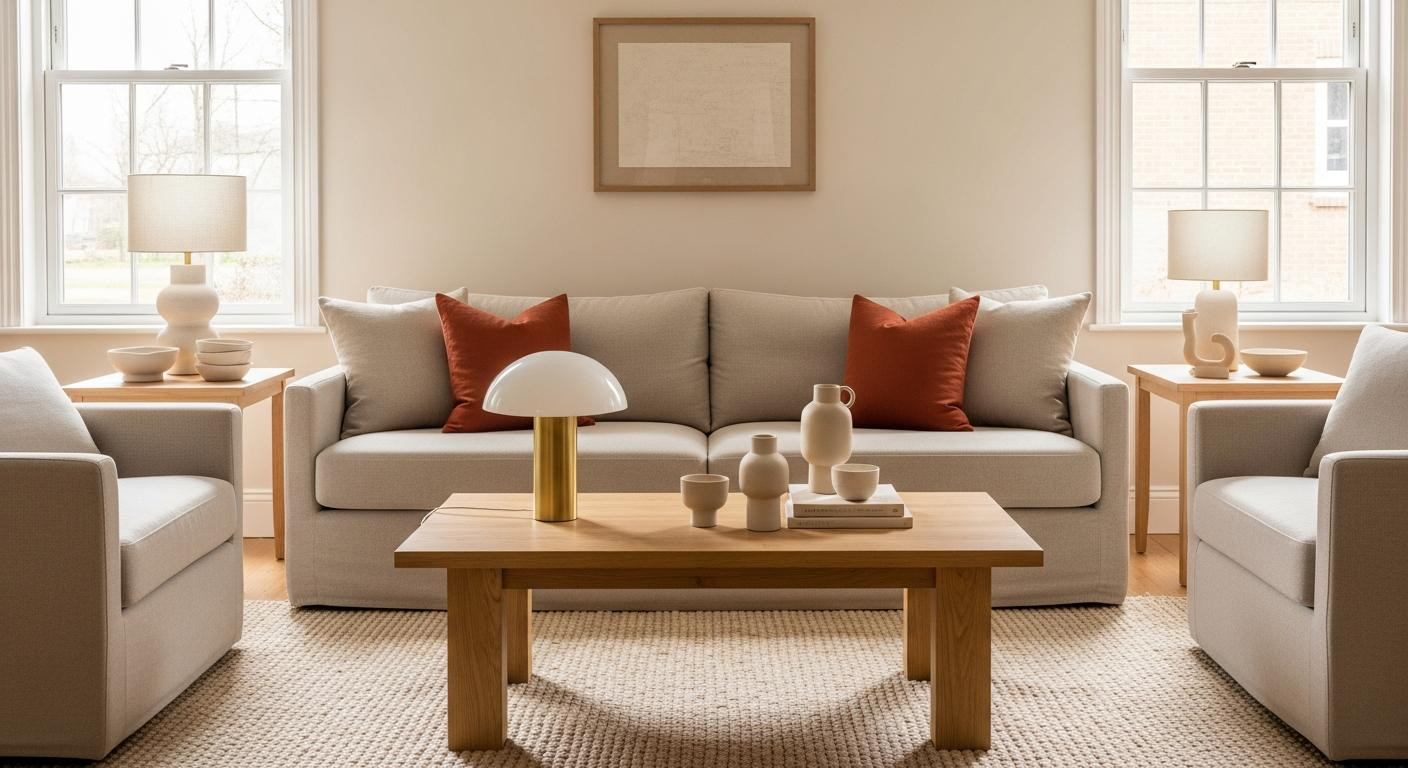
Your living room holds $1,140 worth of decor purchased across four Target runs between February and April. The beige sofa sits against the wall, flanked by terracotta pillows that cost $89, a jute rug showing every coffee stain, and three fiddle leaf figs dying in corners where light never reaches. By 6pm Tuesday the space feels chaotic, not cropped. Every surface holds something, but nothing creates calm. The 80-20 budget rule flips this by putting 80% of money into neutral foundations (that $499 sofa, that $199 rug) and 20% into accent pops that make the neutrals feel intentional instead of boring.
Design experts featured in Architectural Digest confirm creamy beige bases with $35 terracotta throw sets produce expensive-looking rooms for $500 total. The math protects you from trend whiplash and visual fatigue.
Why your $800 room still feels like a stressful mess
You spent $340 at HomeGoods on accent pieces (ceramic bowls, patterned throws, decorative trays) because Pinterest said “layer personality.” The budget split backward: 60% accents, 40% foundations. Your sofa came from Facebook Marketplace for $200, already sagging.
The result reads chaotic because accents fight for attention on unstable neutral ground. Every object screams, nothing anchors. When you spend without strategy, regret purchases pile up fast.
The 80-20 rule inverts this. Limewash ceiling projects and burgundy reading nooks work because plush neutral textures (80%) hold moody accent hues (20%) without visual wrestling. And renters posting transformation TikToks prove $400 oak bases with $60 vintage quilt accents create storied, soulful calm. The foundation determines whether accents lift or clutter.
The room-by-room breakdown that turns $500 into designer calm
Living rooms need 80% texture, 20% color
Your 240-square-foot living room transformation: IKEA jute rug $199 (base texture), Target Threshold sofa $499 (neutral anchor), Amazon terracotta pillow set $35 (20% pop). Total $733. The jute hides clutter, beige sofa disappears against walls, terracotta creates focal warmth without chaos.
But this only works if your ceilings are at least 8 feet. Lower ceilings make beige feel heavy. Spring trends prove this split works because your eye rests on cream, then discovers rust. From there, the space invites you to sit instead of stressing you out.
Bedrooms trade color pops for material contrast
A burgundy velvet chair costs $250 (20% of a $1,250 bedroom budget). The remaining 80% ($1,000) goes to cream linen duvet, limewashed walls, natural oak nightstand. The velvet reads luxe against matte linen, not loud.
Warm minimal approaches show clutter-free bedrooms where one plush element (velvet, bouclé) makes beige feel curated, not lazy. And that texture contrast is what you feel when you sink into the chair after 9pm on a Wednesday.
What fails when you flip the ratio
20% neutrals create visual fatigue by Tuesday
Your friend spent $600 on living room decor: $120 beige rug (20%), $480 on patterned pillows, throws, wall art, ceramics (80%). By Thursday, the room photographs like a flea market. Every pattern competes, your eye never settles.
Renters describe this as ugly, unfinished because accents need neutral scaffolding. Without that $400 sofa grounding the space, $60 terracotta pillows just add noise. The room feels like it’s shouting at you from every corner.
High-accent budgets trap you in trend cycles
Citron green surges spring 2026 as a fresh accent color. If 80% of your $500 budget bought citron (pillows $200, art $150, vase $50), summer’s shift to moody burgundy makes your room feel dated fast. The 80-20 rule protects against this.
A beige sofa survives trends, $35 pillow swaps adapt seasonally. West Elm dupes at Target ($15 citron pillows vs $60) make 20% accent refreshes affordable every quarter. That’s the financial cushion that keeps rooms feeling current without bleeding your budget dry.
The $340 mistake I returned after living with 80-20
I bought a patterned rug for $340 in March (70% of my $487 living room budget). It photographed Pinterest-perfect but made my vintage wood coffee table and velvet chair fight for attention. Everything clashed, nothing breathed.
I returned it, bought IKEA’s $199 jute, spent the remaining $141 on terracotta throws and a brass lamp. The neutral rug let my existing furniture breathe. Similar to small changes that make 6pm feel survivable, one swap shifted the whole mood.
The room went from chaotic to calm in one afternoon. Natural wood with earthy rust works because 80% provides silence and 20% provides punch. The mistake taught me accents need quiet backgrounds to pop.
Your questions about the 80-20 budget rule for decorating every room in your house answered
Does this work in dark apartments with no natural light?
Yes, but shift your 80% to reflective neutrals (cream, light oak) instead of matte beiges that absorb light. Your $400 should buy a light-colored sofa and pale jute rug. The 20% ($100) goes to warm brass lamps and terracotta that add glow without darkening further.
Interior designers with residential portfolios confirm clean 80% neutrals with 20% warm metal accents create soothing escapes even in dim rentals. And the brass catches whatever light exists, bouncing it back into the room in a way that feels intentional.
Can I use this rule for small spaces under 200 square feet?
Especially effective there. Small rooms amplify visual chaos. An 80% neutral palette (beige sofa $499, cream rug $199) makes 150 square feet feel double by removing color competition. Your 20% ($100) buys one statement velvet pillow or vintage art.
Less accent variety expands perceived space. Not in an obvious way, but you notice rooms feel larger when they’re not screaming five different colors at you. Just like pulling furniture from walls creates breathing room, limiting accent colors does the same visually.
What if I already own colorful furniture?
Reverse-engineer: treat existing color pieces as your 20%, buy neutrals to surround them. If you have a $600 emerald velvet sofa, spend $400 on cream rug and beige linen curtains (your new 80%). The green reads intentional instead of random.
One bold piece needs four neutral supports. Kitchen applications follow the same logic. When renters install budget backsplashes, they surround that $200 focal point with neutral counters and cabinets. The pattern holds across every room type.
Your living room at 7pm Thursday holds morning light differently now. The beige sofa sits 18 inches from the wall, jute rug hiding February’s coffee rings, two terracotta pillows catching lamp glow where brass meets linen. The fiddle leaf died but the corner doesn’t feel empty. It feels quiet.