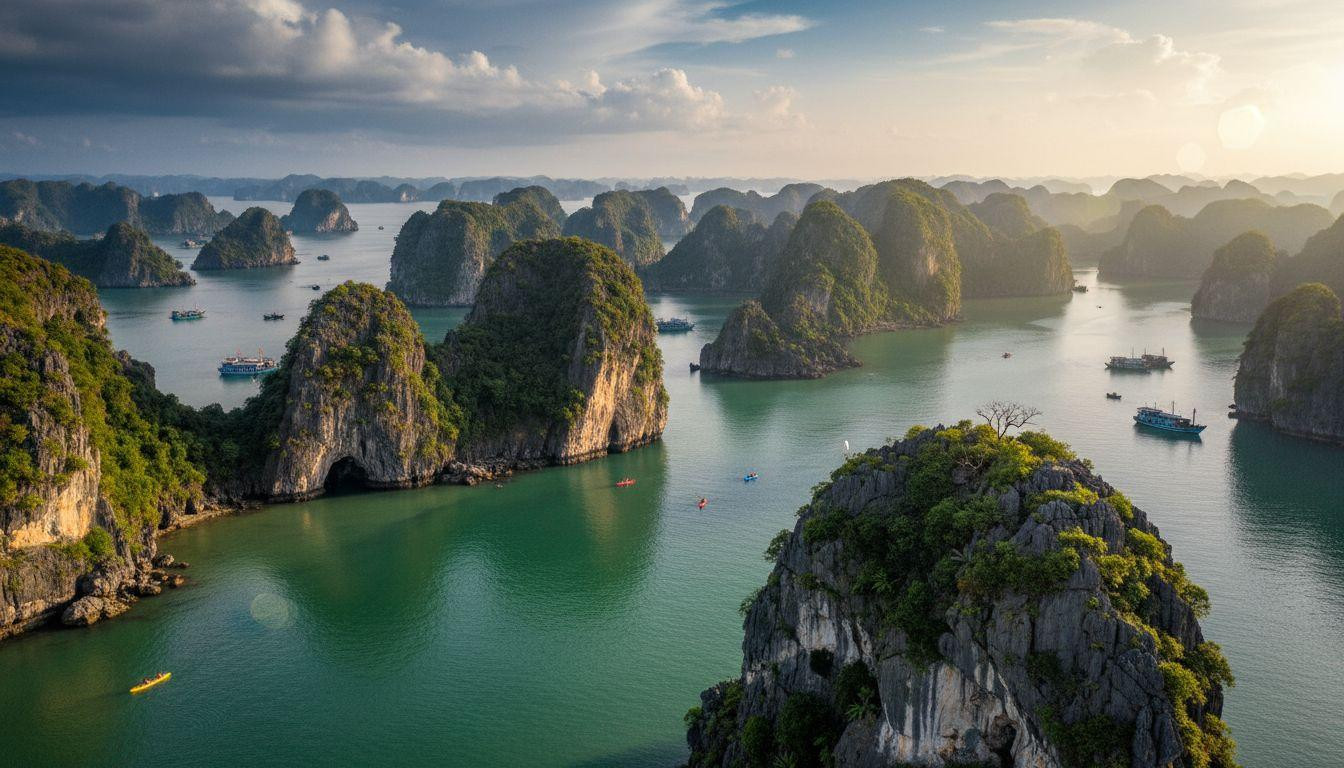
The limestone towers rise from emerald water at dawn, 1,969 of them stacked so close together that kayak paddles scrape cave walls. Ha Long Bay sits 100 miles east of Hanoi, a 3-hour shuttle ride that delivers you to Tuan Chau harbor by 8am. Most visitors board cruise ships. The real bay hides in passages too narrow for anything larger than a kayak.
UNESCO listed this place twice: 1994 for geology, 2000 for biodiversity. The numbers explain why. Across 600 square miles of shallow sea, karst pillars carved from 500-million-year-old limestone create a maze of channels, arches, and hidden lagoons. Water depth rarely exceeds 30 feet. Sunlight filters through suspended limestone particles, turning the shallows that specific shade of green that cameras never quite capture.
Where 500 million years created vertical islands
The karst began as Ordovician marine sediments, compressed into limestone over geological epochs. Tectonic uplift 40 million years ago exposed the rock to tropical monsoons. Twenty million years of rain carved the current towers, some reaching 400 feet above water. Then came the post-ice-age floods 10,000 years back, drowning valleys and isolating peaks into islands.
The result: vertical towers rising from water too shallow for large vessels. Most formations measure 150 to 650 feet tall, packed at a density of 1.3 islands per square mile. Compare that to Phang Nga Bay’s 42 islands across 150 square miles, or Guilin’s river-focused karsts. Ha Long’s geology created something specific: a navigable labyrinth accessible only to small craft.
The bay only kayakers see
Luon Cave’s enclosed lagoon
The tunnel measures 200 feet long with a 13-foot ceiling at high tide. You paddle through in near-darkness for maybe 15 minutes, limestone walls close enough to touch. The passage opens into a circular lagoon ringed by 300-foot cliffs. Orchids and ferns cling to vertical walls. Langurs watch from clifftops, occasionally climbing down to investigate kayakers.
Cruise ships can’t enter. The arch-shaped tunnel restricts access to kayaks and small boats. Most day cruises include Luon in their $50-80 packages. Independent kayak rental costs $2 per person if you book directly at the harbor. Early morning departures at 7am beat the tour groups by two hours.
Dark-Bright Cave in Lan Ha Bay
Thirty minutes south of the main bay, Lan Ha receives 60% fewer visitors. The Dark-Bright Cave system features a 300-foot waterway connecting two lagoons. The first chamber stays dark even at midday. Paddle through and the second lagoon opens to full sunlight, creating that dramatic contrast the name describes. Local eco-cruises launched here in 2024, focusing on kayak-only zones that larger operators can’t access. Similar to the Bahamas chain that shifts 365 sandbars daily, these protected areas maintain their pristine character through careful access management.
Practical realities beyond the photos
Cruises versus chaos
Six to seven million people visited in 2024. Day cruises run $36-80 with lunch and kayak access included. Two-day luxury options range $180-300, though shoulder season discounts in April drop prices 20-30%. October through April brings dry weather and calm seas, with temperatures between 59°F and 81°F. Avoid June through August when typhoons shut down departures.
Tuan Chau Marina serves as the main departure point, 100 miles from Hanoi’s Noi Bai Airport. Van Don Airport sits 10 miles from the bay but flights cost $40-80 versus $15-30 for the shuttle bus. Most visitors choose the bus. The drive takes 3 hours through flat coastal plains that reveal nothing of what’s coming. Much like the Marietas beaches you swim to through volcanic tunnels, the journey itself becomes part of the experience.
What costs don’t tell you
Bay entrance fees run $12.50 per person. Onboard seafood meals add $8-12 for steamed crab, $5-10 for grilled squid. Titop Island offers a 400-step climb to panoramic views, free with cruise admission. Pearl farm tours appear on most itineraries but function mainly as sales pitches. Skip them if time matters. The money goes to kayak time instead.
Cua Van and Vung Vieng floating villages remain active fishing communities, accessible on longer cruises. Families still net fish using traditional methods, though tourism has shifted some income sources. Homestays exist but require three-day cruise bookings. For a different perspective on coastal villages, this Okinawa village keeps centenarians farming citrus groves at similar price points.
The moment that stays
Sunrise from the cruise deck happens around 6am in April. Mist rarely forms this late in the dry season, but when it does, the effect lasts maybe ten minutes. Limestone silhouettes emerge in soft pink light, water absolutely still. No engine noise yet. Just the sound of water against hulls and distant bird calls from the islands.
The alternative: post-kayak stillness in Luon Cave’s lagoon. You float in emerald water surrounded by vertical walls, sunlight filtering through ferns 300 feet above. Monkeys call from somewhere in the canopy. This is the Ha Long that exists between the tour group departures, the version that requires getting up before dawn or staying after everyone else leaves. Similar to the Italian canyon that stacks 9,000-year cave homes, the real discovery happens in the quiet moments.
Your questions about Ha Long Bay answered
Is Ha Long Bay worth the crowds?
Yes, with timing. October through November and March through April offer dry weather with fewer holiday crowds than December through February. Early morning departures at 7am beat tour bus arrivals by two hours. Lan Ha Bay extension delivers identical geology with 60% fewer boats. The kayak-accessible caves alone justify the visit, provided you book cruises that prioritize paddle time over gift shop stops.
How does it compare to similar destinations?
Ha Long’s 1,969 islands exceed Guilin’s estimated 1,000 karst peaks and Phang Nga’s 42 islands. Access proves easier: 3 hours from Hanoi versus flights required for competitors. Costs run similar to Guilin at $60-250 for comparable cruises but higher than Phang Nga’s $30-150 range. Authenticity remains stronger here. Fishing villages still operate, unlike commercialized Yangshuo or relocated Thai communities.
What’s the single best experience?
Kayaking Luon Cave at 7am before cruise ships arrive. The tunnel passage, enclosed lagoon, and cliff-surrounded stillness condense Ha Long’s geological drama into one 45-minute paddle. Book overnight cruises that include early kayak access. Day trips rarely reach the cave before 9am when congestion peaks. The difference between 7am and 9am is the difference between discovery and tourism.
The ferry back to Tuan Chau leaves at 4:30pm. Most visitors make it with time to spare. The ones who almost miss it are usually the ones who found a quiet cave and lost track of time. That’s the version of Ha Long worth finding.