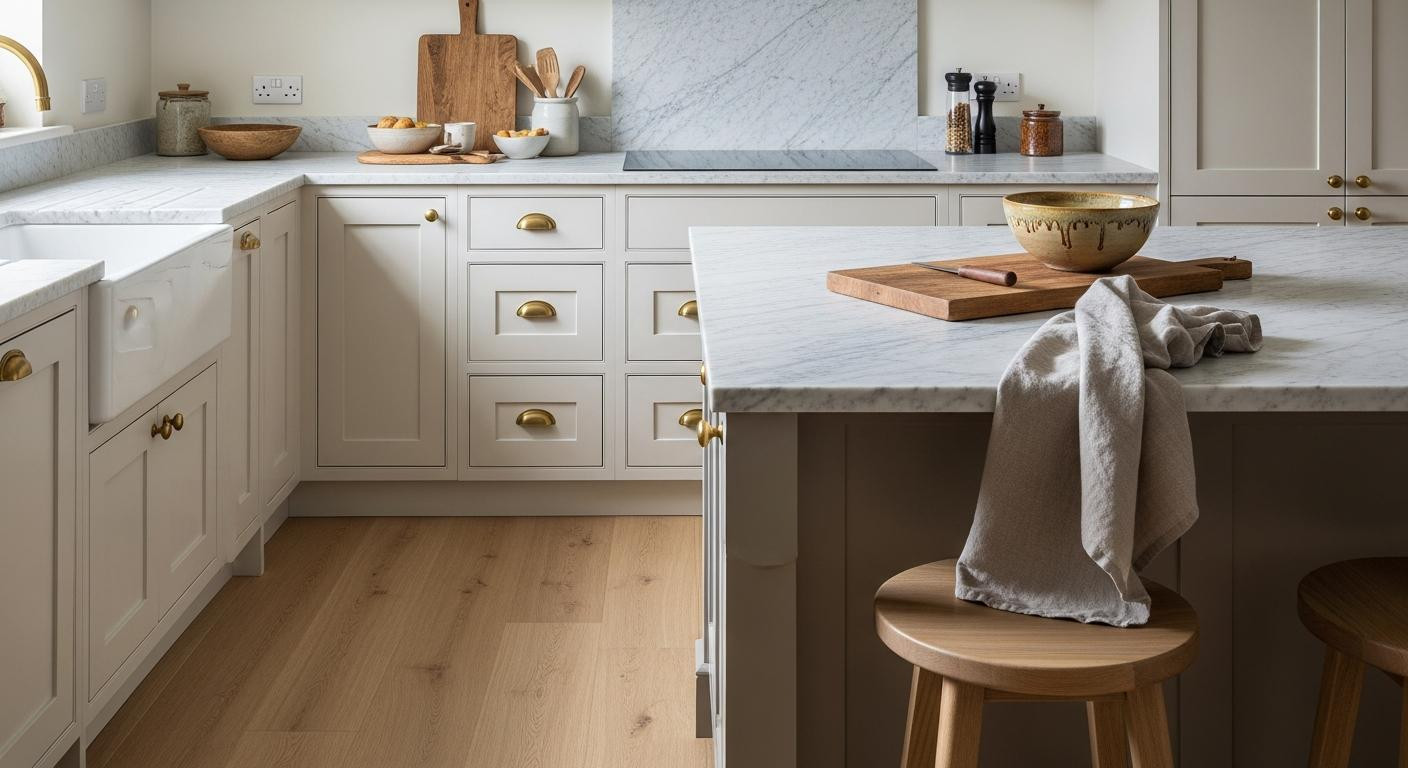
Walk through a kitchen installed in 1998 that still photographs beautifully in March 2026. Shaker cabinets in warm white, honed Carrara on the island, unlacquered brass pulls developing honey-toned patina near the stove. Nothing screams its era. Run your palm across the stone. It’s cool, slightly textured, absorbing afternoon light instead of reflecting it back. The room feels 72°F but reads warmer. This kitchen made five specific choices that resist both trends and sterility. Not expensive choices. Restraint choices.
They choose materials that age visibly, not invisibly
Timeless kitchens select stone, wood, and metal that develop character through use. Honed marble etches from lemon juice within 30 seconds, creating dull spots that add texture rather than damage. Unlacquered brass tarnishes near the stove in 1 to 6 months, showing warmth and contrast as touched surfaces darken while brighter edges remain. Solid oak cabinets dent at the corners after years of grocery bags and school backpacks.
These aren’t flaws. They’re proof the kitchen is lived in, not staged. Polished quartz that chips reveals white substrate underneath. Glossy laminate that scratches looks damaged, not loved. Chrome that dulls reads cheap. The difference: materials with visible aging tell a story about how you actually cook, while materials trying to stay perfect just fail slowly.
And the cost isn’t prohibitive. According to ASID-certified interior designers working with residential kitchens, honed Carrara runs the same price as polished, typically $65 to $85 per square foot installed. The etching starts week three. You stop noticing by month two. The warmth lasts decades.
They limit their palette to three base colors
Walk into a kitchen with white cabinets, gray island, navy backsplash, and walnut floors. Your eye jumps between zones, never settling on one element long enough to feel grounded. Timeless kitchens choose one cabinet color, one counter material, one floor tone. Variation comes through texture like matte paint, honed stone, unsealed wood, not through hue.
This doesn’t mean boring. It means cohesive in a way that feels intentional. A kitchen with cream cabinets, limestone counters, and oak floors reads as one material story even though it contains three distinct elements. The eye tracks a consistent warmth level instead of bouncing between cool and warm zones.
Design experts featured in Architectural Digest recommend the 60-30-10 allocation for visual weight, not literal surface area. 60% goes to cabinetry color, 30% to countertop and backsplash material, 10% to hardware and fixtures. But here’s the nuance: if your brass pulls occupy 2% of surface area but catch light like jewelry, they read as that full 10%. That’s where restraint prevents the room from tipping into busy.
They design for the 3pm light test
Your kitchen looks best at 8:15am when sun hits the east window. By 3pm, shadows pool near the stove, the west wall goes dim, and overhead LEDs can’t compensate for the flatness. Timeless kitchens plan for worst light, not best light. That means lighter cabinet colors on north walls, matte finishes that don’t create glare, and under-cabinet lighting that functions at 3pm, not decorates at 8am.
If your kitchen requires perfect morning light to feel warm, it’s designed for photographs, not life. Green cabinets that absorb light instead of bouncing it back work across all daylight conditions because they hold warmth regardless of sun angle.
Professional lighting designers with residential portfolios note one reflection rule that separates timeless from cold: glossy backsplash behind the range reflects overhead lights in ways that make evening cooking feel institutional. Matte stone, textured tile, or honed surfaces absorb light instead of scattering it. This single swap makes kitchens feel 8 to 10 degrees warmer according to environmental psychology studies, not in actual temperature but in perceived emotional warmth. The eye reads soft surfaces as cozy, hard surfaces as clinical.
They leave 18 inches of empty counter
Timeless kitchens resist filling every surface with appliances. The coffee maker lives in a cabinet. The knife block sits in a drawer. The fruit bowl moves to the dining table when you’re not actively using it. This isn’t minimalism for Instagram. It’s spatial breathing room that prevents the kitchen from reading cluttered no matter how much you’re cooking.
The specific number matters: 18 inches of continuous empty counter flanking the sink and range. Enough space to set down a cutting board, grocery bag, or hot pan without rearranging three appliances first. Professional organizers with certification confirm this measurement creates workflow ease that doesn’t date, while kitchens with under 12 inches of clear counter read cramped within five years regardless of total square footage.
Empty counter is a luxury that never goes out of style. And it costs nothing, which makes it the easiest timeless choice to implement. Cabinet details that separate expensive kitchens from cheap-looking ones often come down to this kind of restraint, not the cabinet doors themselves.
Your questions about timeless kitchen design answered
Does timeless mean I can’t use color?
Timeless means choosing colors with 15-year emotional staying power, not avoiding color altogether. Sage green, warm gray, soft cream work in winter and summer, morning and evening. Navy dates faster because it only works in certain lights, feeling heavy by late afternoon. The warmth problem all-white kitchens create proves that colorless doesn’t equal timeless. Test: does this color make you feel warmer, or does it just photograph well?
What if my kitchen is too small for restraint?
Restraint works better in small kitchens, not worse. Three colors instead of five makes 80 square feet feel larger by removing visual noise. Empty counters create breathing room that expands the perception of space. Countertop trends that looked expensive but now read unnatural actually shrink small kitchens by demanding attention. Timeless principles expand small spaces, while trends compress them.
How much does timeless cost versus trendy?
Often less, not more. Shaker cabinets cost $180 to $240 per linear foot versus $290 to $340 for slab doors with integrated pulls. Honed marble costs the same as polished. Unlacquered brass costs less than lacquered because it skips the finishing process. Timeless usually means simpler, which translates directly to cheaper in kitchen terms.
Stand in that 1998 kitchen at 4:47pm on a Tuesday in March 2026. Late afternoon light catches the honed marble, warm and soft against your wrist. Your hand rests on the oak cabinet door, cool wood grain textured under your palm. The brass pull has darkened to honey near your thumb, bright at the edges. The room feels exactly as warm as it did at 8am.