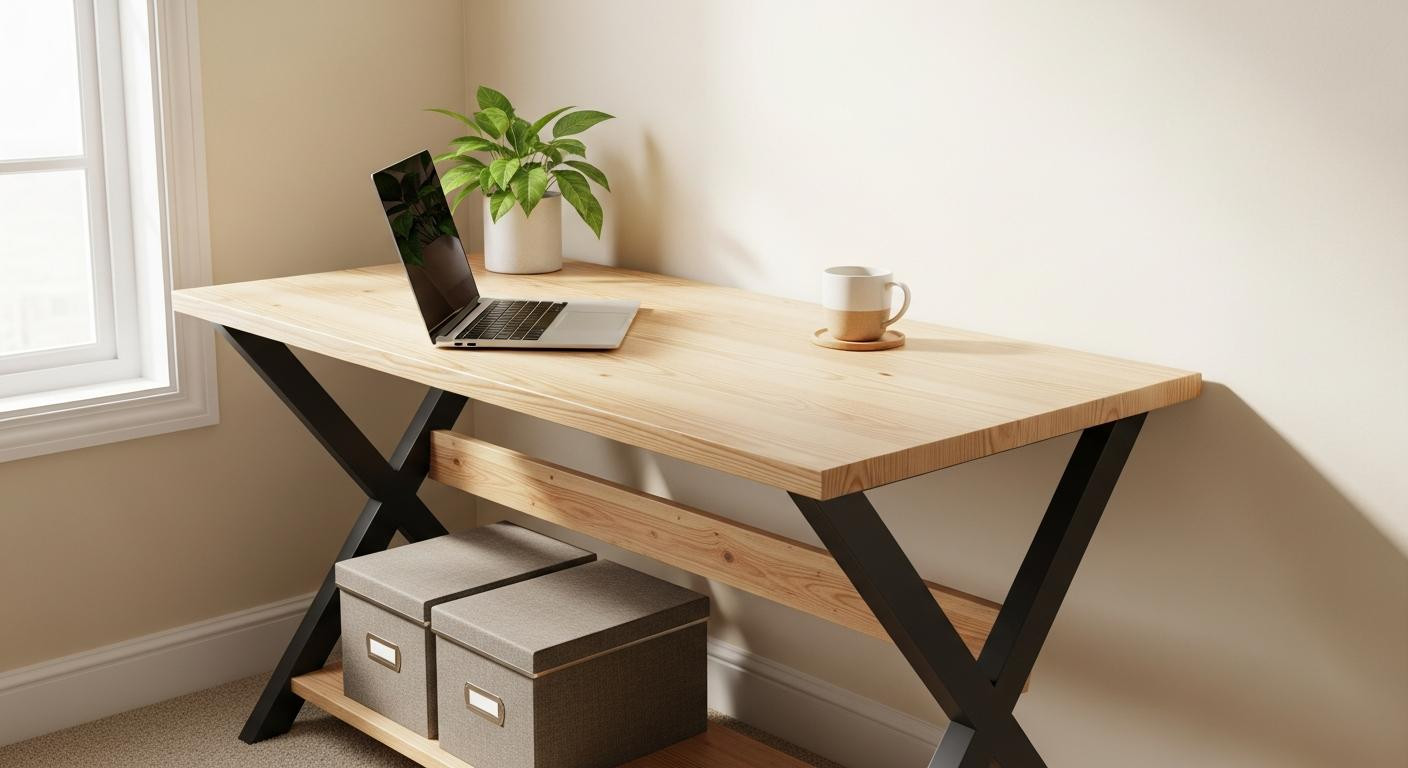
My third particle board desk collapsed during a Tuesday video call. The top sagged where my laptop sat, camera shaking as my client’s face froze mid-sentence. I’d been cycling through $89 to $120 IKEA desks every 18 months since 2021, convinced that was the rental furniture tax. Then I scrolled past a home office photo showing a blond wood desk glowing in afternoon light, assumed it cost $700 from West Elm. The caption tagged IKEA’s BOLLPOJKE at $150. I clicked, skeptical that solid pine and IKEA and that price could coexist. Three weeks later, this desk feels like the first permanent thing in my temporary apartment.
The grain runs uninterrupted and that changes everything
I ran my palm across the desktop after assembly, expecting veneer seams or that plasticky-smooth laminate finish. The pine grain texture caught my fingertips, each ring visible, wood slightly porous in a way that feels organic. No seams interrupt the 35-inch length because it’s actual solid wood boards edge-glued together, not particle board wrapped in printed paper.
The blond color shows natural pine variation without stain, some sections honeyed, others pale. Morning light at 8:15am hits the surface and creates shadows in the grain valleys that laminate can’t replicate. This visual depth is what you’d expect from high-end retailers, not a budget-friendly piece that costs less than most office chairs.
Interior designers featured in Apartment Therapy confirm solid wood furniture on a budget is rare, calling the BOLLPOJKE “a total anomaly” at this price point. The lack of a middle-market markup is what makes IKEA’s solid pine furniture lasting decades financially accessible for renters who’ve accepted temporary-looking furniture as their fate.
My laptop doesn’t wobble anymore and here’s why
The powder-coated steel X-frame creates triangulated support that makes wobble nearly impossible. I pressed down with full body weight on the desk corner during assembly and got zero flex. The physics work because pressure distributes across more connection vectors than my previous four-leg MICKE desk, which shook during typing because force concentrated at attachment points.
And the corners where pine meets steel use traditional joinery secured with bolts, not the cheaper bracket systems that loosen over time. I’ve been typing for three weeks straight, sometimes aggressively during deadline sprints, and the surface stays rock-solid. The 110-pound max load capacity exceeds what most home workers need, even with a monitor, laptop, and stack of books.
Solid pine’s density resists compression better than particle board’s lighter construction. That’s the engineering reason this desk will outlast the flimsy options I cycled through before, where sagging started around month 14 and full collapse hit by month 20.
It fits rental constraints I didn’t know were solvable
I unpacked the box at 2:47pm on a Saturday and tightened the last bolt at 3:15pm. 28 minutes total for assembly with just an Allen wrench. No wall anchoring required because the X-frame base provides inherent stability, unlike shelving units that need anti-tip straps drilled into landlord-owned drywall.
The desk tilted through my 30-inch apartment doorway diagonally without disassembly. I moved it solo between rooms to test portability, and at roughly 30 pounds assembled, it’s manageable for one person. That mobility matters when you’re renting and don’t know if next year’s lease means a different layout.
But the real spatial win is the 23-inch depth that saved exactly the clearance I needed. My bedroom is 9 feet wide with a door swing requiring 26 inches. Standard desks run 28 to 30 inches deep, which would’ve blocked the door. The BOLLPOJKE’s shallower profile left breathing room while the open shelf below holds file boxes, reclaiming 3 square feet I would’ve lost to separate storage furniture.
Design experts with residential portfolios note that warm neutrals over sterile white create intentional spaces in rentals. This desk’s blond pine finish solves the beige wall problem the same way, adding warmth without permanent paint.
My rental office looks intentional for the first time
My partner walked in Thursday evening, stopped, and said, “This looks like you’re staying.” The blond pine glows against landlord beige walls in ways my previous white laminate desk never did. A coworker commented during a video call that my background looked designed, not dorm room. The X-frame’s matte black finish reads Scandinavian minimal instead of college apartment makeshift.
For $150, the desk made a 100-square-foot corner feel like a chosen workspace instead of a temporary setup. Solid wood’s visual weight signals permanence even when the lease says otherwise. That’s not an aesthetic trick or styling hack. It’s what happens when material quality matches the emotional investment you’ve put into remote work over the past five years.
Professional organizers with certification confirm that small apartment storage solutions under $200 deliver similar value shifts when furniture actually solves spatial constraints instead of creating new ones.
Your questions about IKEA’s solid wood desk answered
Will the pine top dent or scratch easily?
Solid pine is softer than oak, so keys dropped from height will leave marks. I’ve got two small dings after three weeks of normal use, one from setting a coffee mug down hard, another from dragging my laptop corner across the surface. Each mark adds character rather than looking damaged because grain patterns camouflage imperfections in ways laminate can’t.
Laminate shows scratches as white lines against printed wood patterns. Real wood dents blend into natural variation. The trade-off is patina versus pristine, and in a rental where nothing else ages gracefully, I’ll take the lived-in warmth.
How does the cable cutout actually work?
The rear corner cutout measures roughly 4 inches in diameter and fits my laptop charger, phone cable, and desk lamp cord bundled together. I zip-tied cables underneath the desktop and routed them through the hole. No grommet included, just a hole cut in wood with sanded edges, but it keeps cords hidden from video call backgrounds.
This only works if your desk sits against a wall because the cutout location assumes that placement. If you float the desk in the center of a room, cables will show. For most renters working in bedrooms or alcoves, it solves the tangle problem without requiring budget fixes that look expensive through elaborate cable management systems.
Can this desk support a monitor arm clamp?
The pine top accommodates most C-clamp monitor arms that require a grip range between 0.4 and 2.4 inches. I haven’t tested this personally, but solid wood handles clamp pressure better than particle board, which compresses and cracks under tension. Clamping to the rear edge near the X-frame attachment provides the strongest hold point because that’s where the desktop connects to the steel structure.
The 110-pound total load capacity exceeds what a typical monitor arm setup weighs, so structural failure isn’t a concern. The question is whether your specific arm’s clamp mechanism fits the desktop thickness, which sits around three-quarters of an inch based on visual assessment during assembly.
It’s 4:17pm on a Wednesday three weeks after assembly. Afternoon light slants across the desk, catching the grain in ways that make the pine look amber instead of blond. The surface feels cool and slightly textured under my forearm. The X-frame’s shadow stretches across the floor, making even the geometry feel warm.