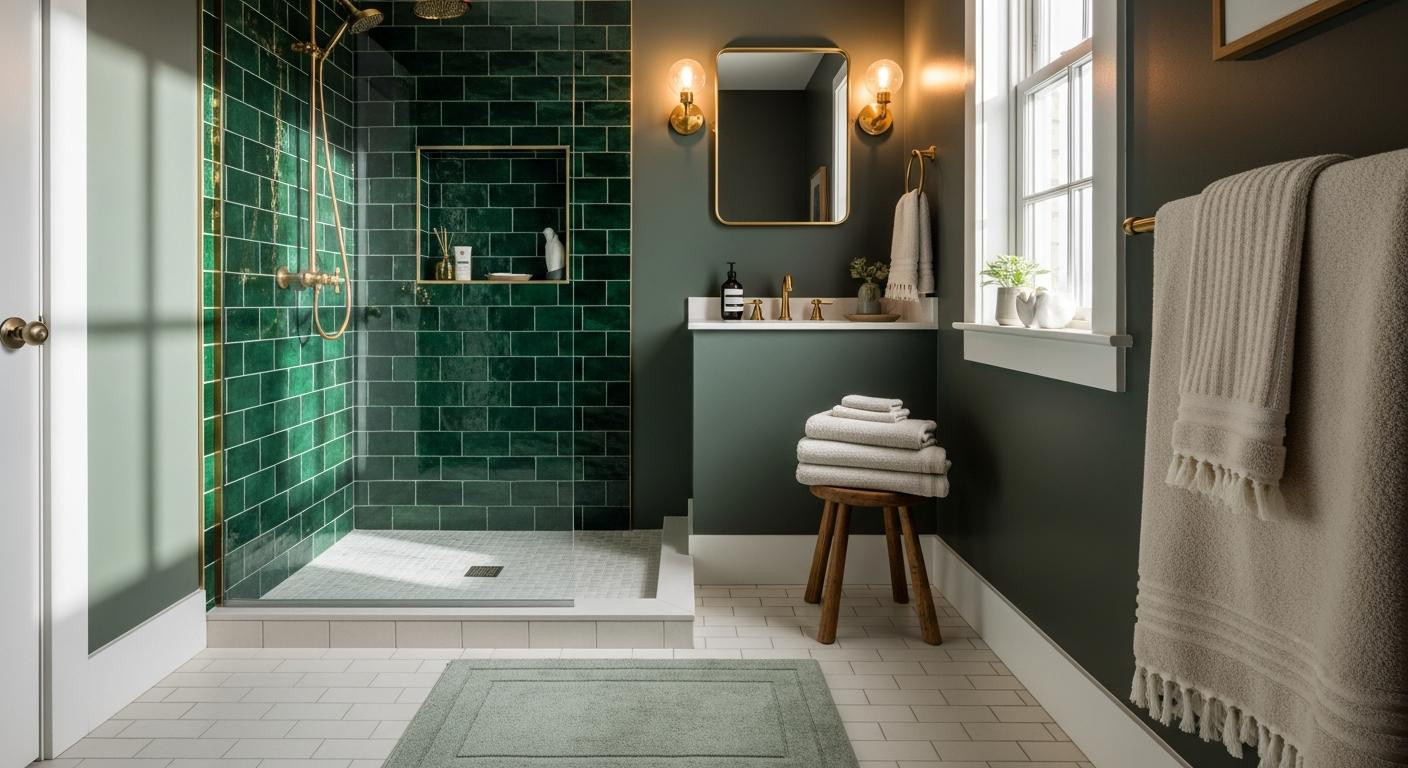
The bathroom measured 65 square feet with one north-facing window. Landlord beige walls absorbed what little morning light reached the mirror by 7:30am. The previous tenant’s white subway tile stretched floor to ceiling in that flat, institutional way that made brushing your teeth feel clinical. For eleven months, mornings started in a space that triggered nothing, cost $1,850 a month, and photographed like a hotel you’d skip. Then Sherwin Williams Dried Thyme went on the walls. Glossy emerald zellige covered the shower niche. Brass sconces replaced builder-grade chrome. The room became somewhere you wanted to sit with coffee at 6am, door closed, volume lowered.
The before-state problems moody green actually solves
Dim lighting makes mornings stressful in ways you don’t notice until they stop. Flat beige under fluorescent bulbs creates decision fatigue when you’re trying to get ready. The psychological response is measurable, that low-grade dread of walking into a room that feels ignored and ugly.
Plain walls kill personality in 50 to 70 square foot bathrooms where there’s nowhere else to add it. No molding, no architectural detail, just builder-grade tile and basic fixtures that scream temporary. According to design experts featured in Bathroom and Kitchen Update, requests for dark green feature walls surged in 2026 precisely because people got tired of spaces with no soul.
Clutter overwhelms small bathrooms partly because there’s nothing else to look at. When the walls don’t hold your attention, every toothbrush and hair product becomes visual noise. Deep green changes where your eye lands, in the same way warm kitchen cabinets redirect focus from countertop chaos.
What deep green does to light and space perception
Deep green absorbs rather than reflects light, which sounds counterintuitive until you see it work. The color has an LRV of 21, meaning it reflects only 21 percent of visible light. That absorption creates visual depth that makes 65-square-foot spaces feel cocooning rather than cramped.
White tile glare was the actual problem in the before bathroom. Morning sun at 7:47am bounced off every surface, creating harsh contrast that made the small space feel smaller. The matte green walls soften incoming light, turning it warm and amber instead of cold and clinical.
But absorption only works if you have enough light sources to begin with. This bathroom has one window plus two new brass sconces at 800 lumens each, which lighting designers confirm is the minimum for LRV under 25. Without that baseline, dark green reads black and you’ve built a cave.
Why brass fixtures amplify the warmth
Deep green’s blue undertones read cold when paired with chrome or nickel. The color needs warm metals to counter its natural coolness. Brass reflects amber light back into the room, creating a glow that balances the forest tone without fighting it.
Hardware experts specializing in residential bathrooms recommend brushed brass over polished for humid spaces. The matte finish hides water spots better and develops a softer patina over time. Total fixture cost here was $460, two sconces at $130 each, one 24-inch towel bar at $120, toilet paper holder at $60, installation hardware at $20.
The actual transformation sequence that worked
Sherwin Williams Dried Thyme went on three walls in two coats over one weekend. The paint cost $90 per gallon for Emerald Interior Acrylic Latex in satin, which has mildew resistance rated for high-humidity bathrooms. One gallon covered the entire 200 square foot wall surface with paint left over.
Primer was required over the builder beige. Skipping it would’ve meant four coats instead of two. The Sherwin Williams Multi-Purpose Waterbased Primer cost $40 for a half gallon, dry time between coats was three hours at 70 degrees.
And here’s what nobody mentions about dark green paint until you’re living with it. The color shifts completely depending on time of day. Morning light at 7:30am makes it look almost olive. Afternoon sun at 4:15pm pulls out hidden blue undertones. Evening artificial light from the brass sconces turns it warm and grounding, the kind of green that makes you exhale.
Glossy emerald zellige in the shower niche
The shower niche measured 24 inches by 36 inches, six square feet total. Glossy ceramic tiles in emerald green cost $10 per square foot from Amazon, total material cost $60. The gloss finish catches LED light and creates a wet-looking shimmer even when dry, adding a luxury signal without marble expense.
Installation took four hours DIY with a manual snap cutter for straight edges. Mapei Kerabond thinset mastic at $25 for a 10-pound bag, Mapei Keracolor grout in Ivy Green at $18. Matching grout instead of white hides soap scum better and makes the tile look intentional rather than decorative.
What this costs versus what it signals
Total material cost was $600. Paint and primer $130, tile and grout $78, brass sconces $260, towel bar and toilet paper holder $180, sage bath mat from Pottery Barn $40, miscellaneous supplies $30. Compare that to the perceived luxury, guests assume a $4,000 renovation based on the gloss tile and warm metal alone.
Houzz data from March 2026 shows green bathrooms boost home value by 5 to 7 percent compared to builder neutrals. That’s partly because dark colors signal risk, someone willing to commit to a bold choice. And partly because moody green photographs well, making listings stand out in scroll-heavy markets.
But rental-friendly? Admittedly, permanent paint commits you. California Civil Code requires tenants to repaint to original color at move-out, typical cost $300 to $600 for a 65-square-foot bathroom. The trade-off is escaping builder beige that makes mornings feel dreadful, which is worth more than deposit risk if you’re staying longer than a year.
Your questions about this once-dim bathroom transformation answered
Does deep green work in bathrooms under 50 square feet?
Yes, if you have at least one light source, window or good overhead. The absorption effect works better in tiny spaces than in large ones, it creates an intimate cocoon rather than a warehouse void. Won’t work in windowless basement bathrooms with a single 60-watt bulb, you’ll need task lighting first.
What if my bathroom has no natural light at all?
Add lighting before painting. Interior design specialists certified by professional organizations confirm that pairing dark greens with 3000K LED strips prevents the cave effect. Budget $80 to $150 for under-cabinet or mirror-mount fixtures, install them first, live with them for a week, then decide if the room can handle dark walls.
Can renters do this without losing deposits?
Legally risky but practically doable if you document the original paint color with photos and repaint on move-out. Cost is $120 in materials and one weekend of labor. Some landlords appreciate upgrades that make units more rentable, ask first with a written proposal showing before-and-after inspiration photos.
The shower tile catches afternoon light at 4:15pm, throwing green ripples onto the ceiling. Your hand rests on the cool brass towel bar, the forest-toned walls making the white fixtures glow warmer than they did Tuesday. The room holds you differently now. Mornings start quieter.