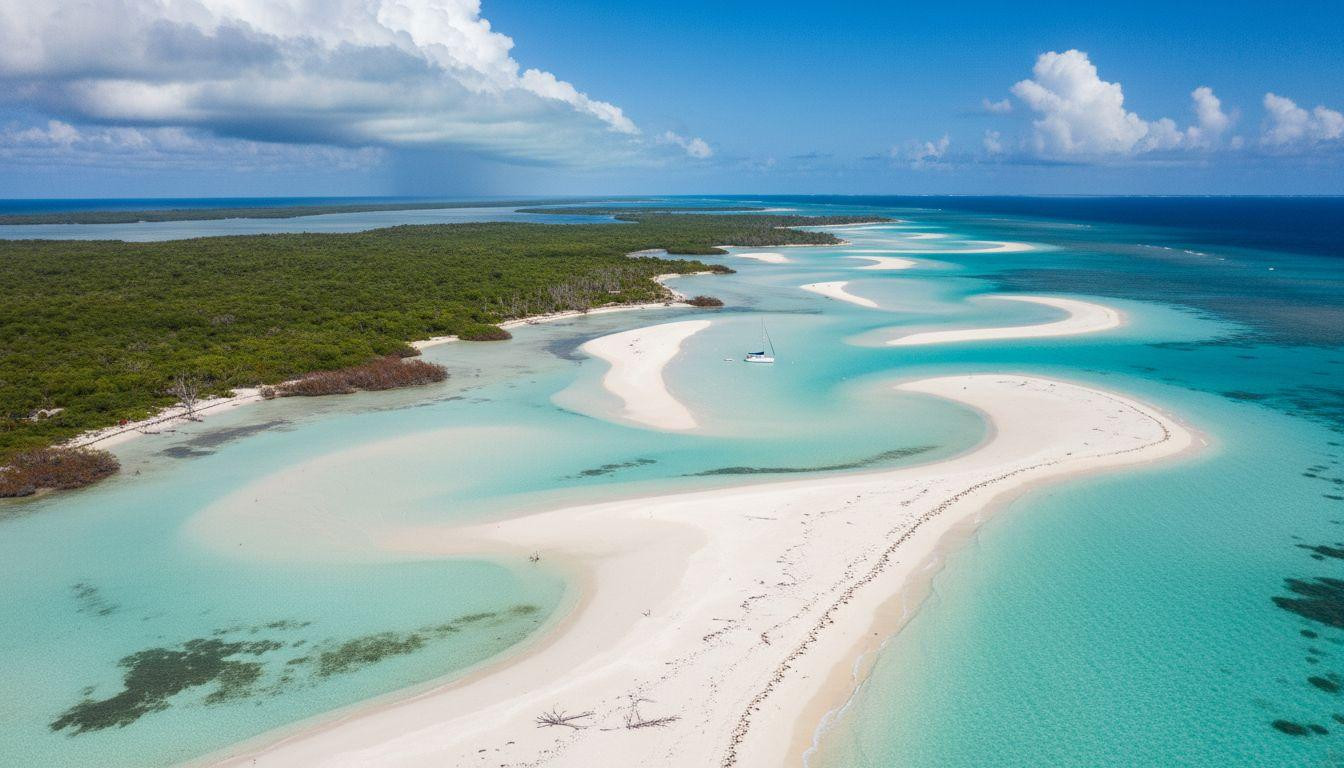
The Exuma Cays stretch across 100 miles of turquoise water between Great Exuma and the open Atlantic. Sandbars appear and vanish with the tides. Swimming pigs wade into shallows at Big Major Cay. Nurse sharks circle docks at Compass Cay. This 176-square-mile marine park protects what most Caribbean resorts paved over decades ago.
George Town sits on Great Exuma’s western shore, population 1,437. Flights from Miami take one hour and cost $300-500. The harbor fills with sailboats in March when water temperatures hit 75°F and winds drop to 10 knots. Conch vendors at The Fish Fry serve fritters for $12 while fishermen unload catches at 3pm.
The sandbars that shift daily
Big Farmer’s Cay Sand Bar stretches one mile at low tide. The powdery white strip emerges around midday and disappears by evening. Tidal ranges measure 2-4 feet across the Exumas, creating new paths through turquoise shallows twice daily. No two visits look identical.
The Exuma Cays Land and Sea Park established no-take rules in 1959. Fishing, anchoring on reefs, and resource extraction remain prohibited across 167 square miles of marine habitat. Seagrass beds stay intact. Patch reefs on the Great Bahama Bank shelter juvenile fish. Offshore reefs in Exuma Sound drop to depths beyond recreational diving.
Sandbars you can walk
Pipe Creek, Sandy Cay, and Exuma Sand Bar become accessible at low tide throughout March and April. Boat captains time departures for slack water when currents pause. Knee-deep channels turn electric blue in afternoon light. Baby lemon sharks glide past ankles in water clear enough to count their spots.
Protection that works
Visitor surveys from 2025 show 47% of snorkelers perceive higher fish abundance inside park boundaries compared to unprotected areas. Live coral coverage measures 26.9% on large Montastraea colonies. The park spans more territory than Bonaire’s 6.7-square-mile marine reserve and enforces stricter anchoring rules than most Caribbean protected zones.
Where wild meets turquoise
Forty pigs swim at Big Major Cay. Local residents feed them vegetables and monitor health. The animals wade into shallows when boats approach, snorting and paddling toward visitors. Tour operators limit feeding to prevent dependency. Daily visitor counts reach 100-200 during high season and drop to 20-50 in summer months.
Half-day tours from George Town cost $200-300 per person. Full-day excursions including Thunderball Grotto run $400-600. Boat captains depart at 8am and return by 4pm. The 25-nautical-mile run to Compass Cay takes 90 minutes at 20 knots.
Compass Cay’s nurse sharks
Groups of 10-20 nurse sharks gather under the marina dock. The harmless species circles in shallow water, allowing swimmers to wade among them. No entry fees apply as of March 2026. Marina staff supervise hand-feeding of fish scraps. Zero safety incidents have been recorded since the attraction began.
Thunderball Grotto’s caverns
The 30-foot-diameter chamber sits half-submerged at high tide. Multiple openings create air pockets inside. James Bond filmed underwater scenes here in 1965’s Thunderball. Snorkelers enter at slack high tide when currents pause and visibility reaches 60-100 feet. Schools of yellowtail snapper, rays, and occasional turtles navigate the gin-clear passages. The grotto sits half a nautical mile from Staniel Cay, a five-minute boat ride.
The quiet season advantage
March 2026 brings air temperatures of 75-82°F and water at 74-78°F. Rainfall averages two inches for the month. Calm seas occur 80% of days compared to 70% in April. Sunrise arrives at 6:45am and sunset at 7:15pm. Hurricane season runs June through November with peaks in August and October.
George Town sees 500-1,000 daily tourists in late March as high season transitions to shoulder months. Staniel Cay Yacht Club runs 80-100% occupancy December through March. Nassau cruise terminals process 10,000 arrivals daily while Exuma remains under-the-radar. For a more secluded Caribbean experience, this Caribbean lagoon sits between 5 uninhabited cays you reach in 15 minutes.
Chat’N’Chill on Stocking Island operates a one-mile beach accessible by hourly ferry from George Town for $15 round-trip. Daily crowds range 50-100 visitors. Stingrays gather in shallows for hand-feeding. The bar serves grilled fish and rum punch while reggae plays from weathered speakers.
Your questions about the Exuma Cays answered
How do I get there and what does it cost?
Exuma International Airport (GGT) receives flights from Miami in one hour ($300-500 round-trip) and Nassau in 35 minutes ($200-350). Ferry service from Nassau takes four hours and costs $100-150. Car rentals at GGT run $60-80 daily for compact models and $100-150 for SUVs. Budget hotels in George Town charge $150-250 per night while mid-range resorts cost $300-500. Private island properties like Fowl Cay exceed $2,000 nightly.
What makes this different from other Caribbean destinations?
The 176-square-mile no-take marine park preserves wild animal interactions that resort areas commercialize. Swimming pigs, nurse sharks, and pristine reefs exist without manufactured experiences. George Town’s Fish Fry maintains 60/40 local-to-tourist ratios with conch fritters at $10-15. Exuma receives 1,000 daily visitors compared to Nassau’s 10,000 cruise arrivals. If you’re considering alternatives, this Fiji lagoon keeps coral visible in waist-deep water you reach by boat offers similar marine diversity.
How does this compare to the Maldives or Turks and Caicos?
Five-day Exuma trips including tours and lodging average $2,500 per person. Equivalent Maldives overwater experiences exceed $4,000 due to 20-hour flights and resort premiums. Turks and Caicos runs $3,000-plus for similar sandbar and marine park access. Exuma sits one hour from Miami versus the Maldives’ full-day journey. For a closer Caribbean option, this Long Island beach hides turquoise coves where 15 minutes feels like 1960 provides similar seclusion.
Staniel Cay boat tours depart George Town at 8am. The route passes uninhabited cays where frigatebirds nest on mangrove branches. Sandbars emerge as tides recede. Pigs wade into shallows. Sharks circle under docks. The grotto’s caverns echo with wave action. By 4pm the boat returns to George Town where fishermen tie up at the same docks their families have used for generations. For another protected marine experience, Sandy Cay keeps low-tide sandbars for $200 with fewer crowds.