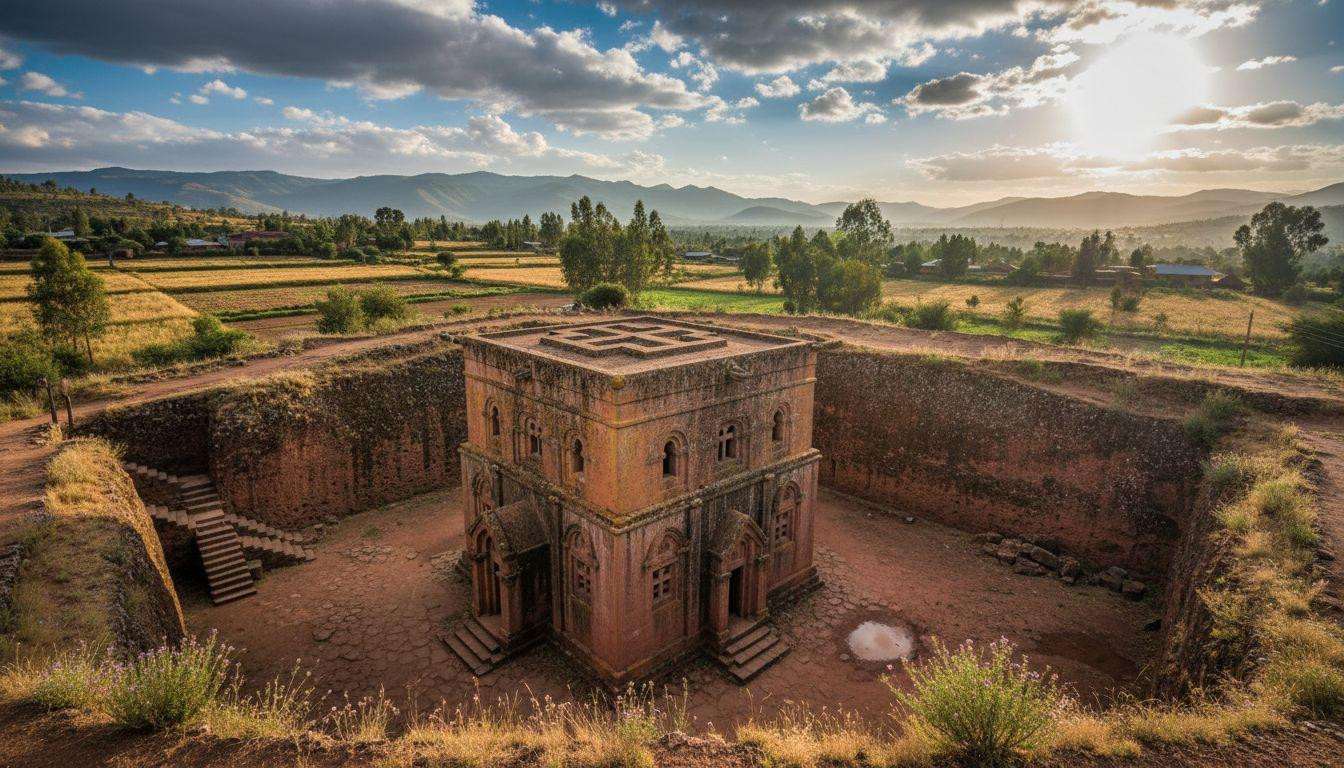
The priest’s chant echoes through a trench carved 40 feet into red volcanic rock. Dawn light hasn’t reached the bottom yet. You’re standing in a church that was never built, only subtracted from the earth, its walls and columns and arches all part of one continuous piece of basalt. Lalibela’s 11 monolithic churches sit in northern Ethiopia’s highlands at 8,629 feet, where medieval faith carved downward instead of upward, and Orthodox pilgrims still arrive before sunrise to pray in the same stone crypts their ancestors hollowed out 800 years ago.
The engineering that shouldn’t exist
King Lalibela’s 13th-century masons didn’t stack stones. They dug vertical trenches around massive basalt blocks, isolating each church from the surrounding bedrock, then carved downward and inward to form roofs, windows, columns, and interiors without mortar or seams. Bete Medhane Alem, the largest, measures 108 feet long and 33 feet high, all from one piece of rock. The smallest, Bete Maryam, fits inside a trench barely 60 feet across but holds centuries of blackened incense on its carved crosses.
No one knows where the excavated rock went. The volume removed would fill dozens of modern dump trucks, yet the highland plateau shows no piles, no debris fields. Some churches connect to neighbors through thin rock bridges left deliberately to prevent collapse. Bete Giyorgis stands alone in its cross-shaped trench, 12 meters deep, carved as a freestanding structure after the other ten were finished. The king supposedly ordered it built after Saint George appeared in a vision, angry at being left out.
Underground Jerusalem in the highlands
The tunnel network priests still use
Trenches and tunnels connect the churches in a symbolic journey to the Holy Land, carved when Crusades blocked actual pilgrimage routes. Walk through the pitch-black passages and you need a guide or a flashlight. The stone stays cool at 59-64°F even when highland sun hits 77°F outside. Crypts hold mummified remains visible through iron gates. Priests move through these tunnels daily for services, their white robes bright against the rough basalt walls worn smooth by centuries of hands.
Living faith in carved stone
Orthodox liturgy hasn’t changed since 1200 AD. Morning chants in Ge’ez start around 6am, lasting two to three hours, with bell peals echoing through trenches in triple rhythms. Incense blends myrrh and frankincense, blackening ceilings that were carved clean eight centuries ago. Saturday and Sunday draw the most local pilgrims in white cotton wraps, bare feet on stone paths. Genna on January 7 brings 10,000 to 20,000 for Christmas bonfires. Timkat on January 19 draws 30,000 for Epiphany processions with replica Arks of the Covenant.
Walking through medieval morning
Bete Giyorgis at 6am
The most photographed church reveals its cross shape only from the trench rim above. Golden hour light hits the red scoria between 6am and 7am, when pilgrims arrive for early prayers and tour groups haven’t started their 9am circuits. The Eastern cluster of four churches sits about half a mile away, a 45-minute walk through Bete Medhane Alem, Bete Maryam, Bete Meskel, and Bete Golgotha. The Western cluster adds five more in a 90-minute circuit. Most visitors spend four to six hours covering all eleven, with 20 to 40 minutes per church.
The craft markets after prayer
Woven baskets in tight highland grass patterns sell for $5 to $15 outside the church gates. Hand-painted icons on wood go for $10 to $30. Coffee ceremonies in clay pots cost $2 to $5 per person, the beans roasted over charcoal while incense burns. Injera with shiro wat, the lentil stew that’s a fasting staple, runs $3 to $7. Tej honey wine, 8% to 12% alcohol, costs $2 per glass or $10 per bottle. The town of 15,000 keeps prices 20% to 30% below Ethiopia’s national averages.
The silence after tourists leave
October through February brings the dry season and the clearest skies. March into May sees shoulder season crowds drop 40% to 60% from peak. Tour groups leave by 4pm, and priests reclaim the churches for evening prayers around 5pm. The feeling shifts from performance to witness. You’re watching faith that doesn’t need an audience, rituals that continued through wars and famines and the arrival of protective fences in the 2000s that some visitors complain block photos but locals see as necessary against erosion.
Your questions about Lalibela answered
How do you visit respectfully?
Remove shoes before entering any church. Cover shoulders and knees. Early morning visits between 6am and 8am put you alongside Orthodox pilgrims instead of tour groups. Hire guides born in Lalibela who explain the tunnel symbolism: Bete Golgotha’s trench represents the Via Dolorosa, the crypts mirror the Holy Sepulchre. The 5-day site pass costs around $50 USD or 5,500 Ethiopian birr. Guided tours run $30 to $50 for one day, $80 to $150 for two days covering all clusters.
Why does this feel different from Petra?
Petra’s facades were carved into sandstone cliffs but the structures behind them crumbled. Lalibela’s churches are free-standing monoliths carved entirely from living rock, still used daily for Orthodox worship. Petra draws over 1 million visitors annually. Lalibela sees 50,000 to 100,000, mostly during festival peaks. The difference shows in the morning quiet, the absence of souvenir hawkers inside the trenches, the way priests ignore cameras during liturgy. This isn’t an archaeological site. It’s a working pilgrimage destination that happens to be 800 years old.
Is the altitude a problem?
At 8,629 feet, Lalibela causes less altitude sickness than Cusco at 11,152 feet or La Paz at 11,942 feet. Under 10% of visitors report headaches or nausea compared to 30% to 50% at higher elevations. Arrive a day early to acclimate. Walk 20% to 30% slower through the church circuits. Local belief says highland coffee helps adjustment, which lacks medical evidence but keeps you hydrated. Flights from Addis Ababa to Lalibela take 50 to 60 minutes and cost $200 to $350 round-trip. The airport sits 5.5 miles from town, a $10 to $15 taxi ride.
The last light leaves Bete Giyorgis around 6pm. The trench walls turn dark red, then black. Somewhere below, a priest lights candles for evening prayers. The chanting starts again, faint and steady, the same words in the same stone that’s been carved into worship for eight centuries.