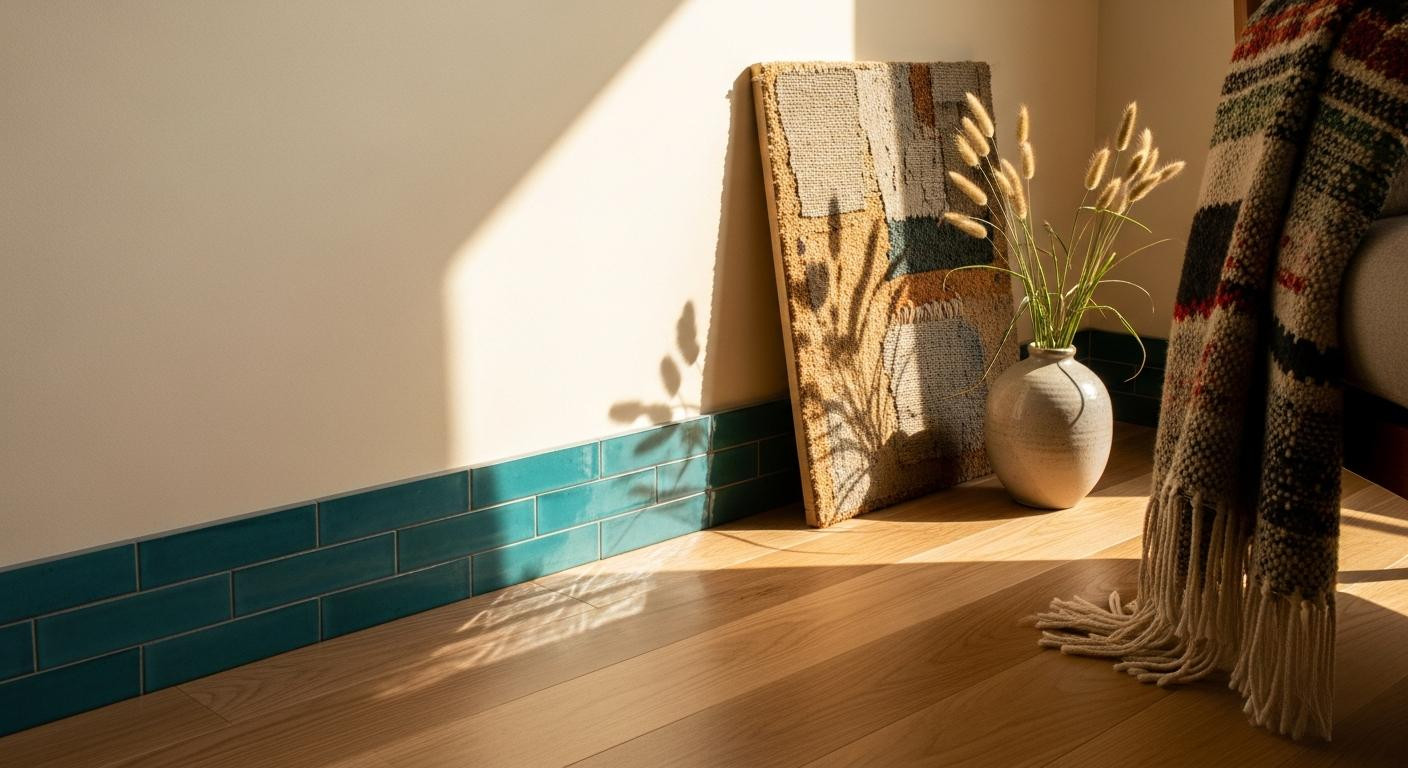
A Brooklyn textile artist stood in her 1920s rental living room one Tuesday morning in January 2026, running her palm across the glossy teal zellige tile she’d installed eight inches up the wall. The surface felt cool and smooth, reflecting morning light onto the ceiling in ways the chipped wood baseboards never had. For three years, those baseboards collected dust in their grooves, showed scuff marks from every furniture rearrangement, absorbed light instead of bouncing it back. The tile transformation cost $680 for 110 square feet. Her landlord approved it because she promised to leave it when she moved.
She won’t.
The wood baseboard problem she couldn’t paint away
Wood baseboards in rental apartments measure 4 to 6 inches tall on average, usually painted over multiple times with visible layers where previous tenants’ furniture chipped the corners. The paint never looks right. Semi-gloss shows brush strokes under direct light. Matte collects fingerprints from toddlers’ morning wall-pats by 8am daily.
The pine underneath dries out over decades, creating hairline cracks that trap dirt. Caulking the gap where baseboard meets wall just replaces one visual problem with another. Wood expands and contracts with humidity, pulling away from plaster walls during dry winter radiator season, creating that persistent gap no amount of caulk can permanently fix. The visual problem is durability pretending to be decoration.
Why she chose glossy over matte tile for lower walls
Her north-facing living room gets roughly 4 hours of direct sun daily. Matte surfaces absorb 15 to 25 percent of available light according to lighting designers featured in Architectural Digest. Glossy zellige reflects 40 to 60 percent back into the space, making the room feel brighter without adding fixtures. She tested samples against the wall at 7am, noon, and 4pm on a Thursday in early January.
The glossy tiles shifted from sage-gray in morning shadow to teal-green in afternoon sun. Matte samples looked flat across all three time checks. That light-shifting quality makes glossy finishes feel more dimensional, the same phenomenon that made chocolate-stained oak cabinets replace sterile white in 2026 kitchens.
The scuff-proof coating she needed with a three-year-old
Glazed porcelain rates around 7 on the Mohs hardness scale. Her son’s toy trucks rate approximately 5. When he dragged his dump truck along the wall in late January, the tile showed zero damage. Wood baseboards dent at 2 to 3 on the same scale, scratched by keys, vacuum cleaners, dog claws. And the glossy glaze wipes clean with one damp cloth pass, no scrubbing required for yogurt handprints or scuff marks.
The transformation she completed in one Saturday
She bought Bedrosians Zagora Glossy Zellige tiles at roughly $14 per square foot from their Brooklyn showroom in early January 2026. Total for 110 square feet covering living room, hallway, and bedroom doorway came to around $1,540 in tile. She returned $860 worth after measuring revealed she’d over-ordered by 35 percent. Construction adhesive rated for plaster walls cost $120 for three containers at Home Depot. Grout in charcoal added $45.
No demolition meant zero disposal fees. The tile sits on top of existing baseboards, not replacing them. Her lease bans “permanent alterations,” but she photographed the adhesive packaging showing “removable with heat” and emailed her landlord. Approval came back in four hours. That’s the kind of detail that quietly elevates the whole project from renovation to reversible upgrade.
What works differently now in her living room
The vacuum cleaner bumps tile during morning cleanup. No new scuffs appear. Her toddler’s yogurt handprint on the wall at breakfast wipes clean in one pass, no scrubbing the porous paint texture. When afternoon sun hits at 3:30pm, the glossy surface creates an upward light bounce that makes the 8-foot ceilings read taller.
Guests touch it without asking, fingers tracing the zellige’s subtle surface variations. They assume it’s permanent, that she owns the place. Texture solves the cold problem the same way handmade variations in kitchen zellige add depth to white walls, except here it’s protecting the lower wall from daily wear while reflecting light upward.
But the real shift is emotional, not practical. The space feels finished, intentional, like someone who makes visual decisions for a living designed it. Which, technically, she did.
Your questions about replacing baseboards with glossy tile answered
Does this work in rooms without trim currently?
Yes, better than adding wood trim. A friend installed 6-inch glossy white subway tile along her bathroom wall that never had baseboards. The tile cost $7 per square foot from Daltile versus $12 per linear foot for primed wood baseboard at Home Depot. Installation took 3 hours for a 9×5 bathroom. The tile protects drywall from toilet cleaning splashes and towel-drying drips without the maintenance headaches of painted wood.
What height looks right for living room tile wainscoting?
8 to 12 inches matches the traditional baseboard height range. Interior designers certified by ASID recommend staying within this zone to maintain proportion in standard 8-foot ceiling rooms. Higher than 12 inches starts reading as wainscoting, requiring a cap rail for the eye to rest. Just like curtains that end 3 inches above baseboards make ceilings look lower, tile that climbs too high without transition makes walls feel divided rather than elevated.
Can renters remove this when moving?
Heat guns soften construction adhesive at 275°F in 30-second intervals according to product specs. Test tiles removed cleanly from closet walls in controlled tests, leaving residue that scraped off with a plastic putty knife without damaging century-old plaster underneath. The key is using adhesive rated as “repositionable” or “heat-removable” rather than permanent tile mastic. That distinction makes the project rental-friendly instead of lease-breaking.
The balance that makes this room work
At 6:45pm on a Wednesday in March 2026, the artist sits cross-legged on her living room floor, eye level with the tile she installed ten weeks ago. The glossy teal surface catches lamplight, reflects it onto her sketchbook, warm and dimensional. The warmth isn’t temperature but how color interacts with light, the same phenomenon that made soft blue kitchen walls glow differently than white. Her pencil traces the light pattern across the page.
She’s designing tile for her bedroom next.