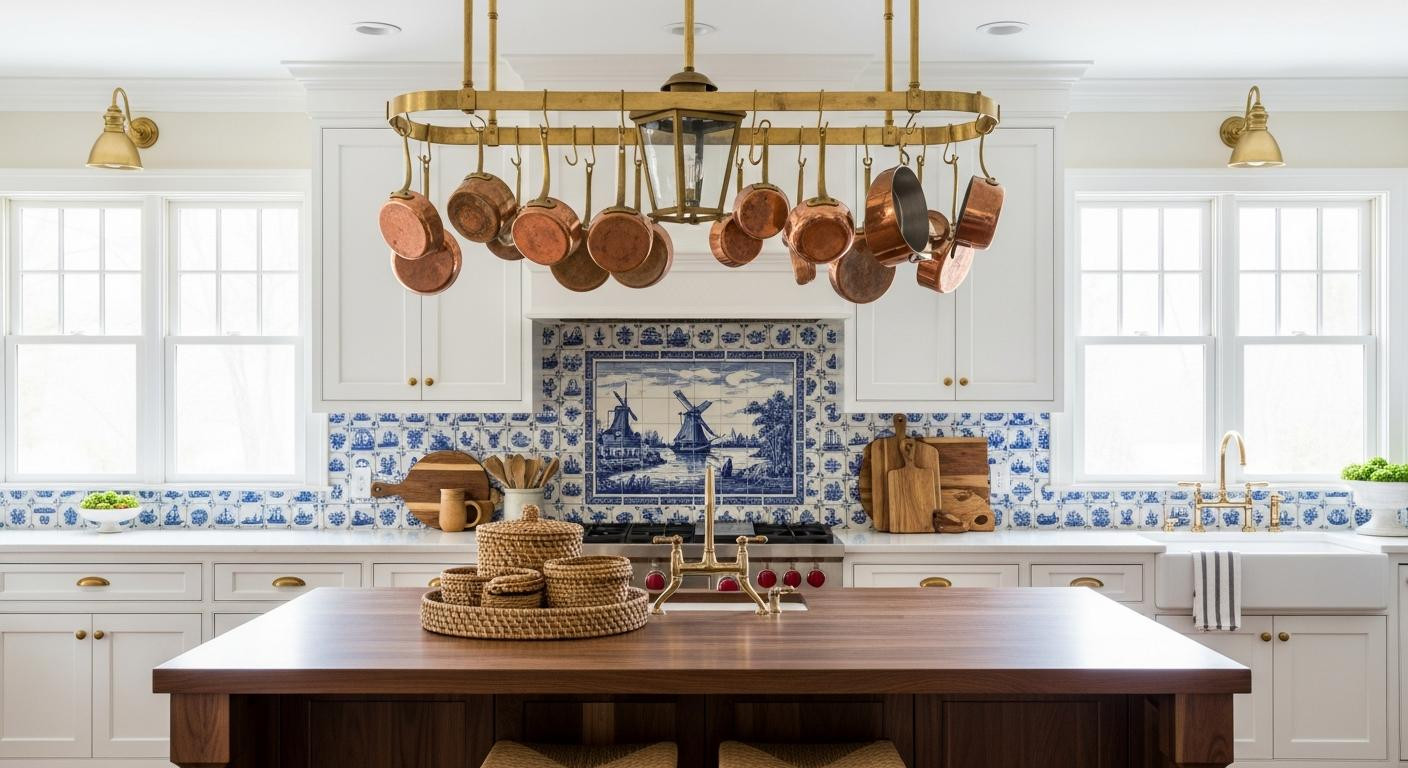
Your all-white kitchen looked pristine in 2020. By March 2026, every handprint shows. The recessed lighting casts flat shadows across quartz counters that echo when you set down your coffee mug. You wipe the same smudge near the sink for the third time this week while scrolling past warm, textured kitchens on Instagram that somehow feel expensive without looking new. The gap isn’t budget or square footage. Five traditional details are transforming sterile spaces into rooms that actually feel like home, and none require tearing out cabinets.
Why white kitchens photograph like hospital wards in 2026 light
People describe modern kitchens as “zero personality, everything echoes,” and the problem isn’t imagined. White reflects all wavelengths equally, creating visual monotony without texture to absorb or scatter light differently. Morning sun exposes the flatness in a way that makes cooking feel stressful instead of grounding.
Posts under #CozyTraditionalKitchen racked up 12 million impressions by February 2026, showing layered, collected spaces that feel intentionally designed rather than contractor-white. The complaint isn’t about cleanliness. It’s about rooms with no soul, no light play, nowhere for your eye to rest. And the fix isn’t a gut job.
The comeback details that layer history into rental kitchens
Delft tile backsplashes turn blank walls into collected stories
Run your fingers over hand-painted blue tiles, and you’ll feel the slight texture variation that catches afternoon sun differently than subway tile. According to ASID-certified interior designers, antique-inspired Delft backsplashes add soul and narrative through history and a collected quality that flat surfaces can’t deliver.
The price reality: $20 to $45 per square foot, with a 15 square foot backsplash running $300 to $675 total. Installation takes 2 to 3 days if you’re tiling over existing subway tile with white thinset mortar applied in quarter-inch ridges. Budget options start at $8 per square foot for IKEA Vardagen-style tiles, while reclaimed Delft from specialty importers hits $35 per square foot.
But here’s what makes this work in 100 to 150 square foot kitchens where people complain about clutter overload: pattern breaks up visual monotony without adding physical bulk. The blue whispers instead of shouts.
Ceiling pot racks solve storage without sacrificing the warm minimal aesthetic
The before scene: pots stacked in dark cabinets, daily excavation to find the right pan, clanging metal every time you dig for the Dutch oven. Then the after: brass rods suspended 7 feet up, copper catching morning light, 18 inches of freed cabinet space below where you can actually see what you’re storing.
Entry-level options start at $99 for a 3-foot span, while aged brass versions for 4-foot islands run $650. YouTube videos on old-world charm kitchen upgrades hit 500,000 views in January 2026, with commenters noting the immediate shift from “lab” to “lived-in.” Installation takes 1 day if you’re mounting to ceiling studs, or $120 for professional hanging if you’d rather skip the drill.
Admittedly, this only works if your ceilings are at least 8 feet tall. Lower than that, and the rack turns into a head hazard instead of a storage solution that frees up cabinet real estate.
How freestanding pieces craft Parisian apartment ease for under $400
Pantries as furniture, not built-ins
Built-in pantry renovations cost $5,000 to $8,000 with a 2-week timeline and permanent commitment. A freestanding wood hutch costs $1,800 at mid-range furniture retailers and moves with you next year. Instagram posts tagged #ParisianKitchenVibes pulled 1.5 million likes in March 2026, styling these pieces as collected objects with history rather than sterile storage boxes.
And the renter-friendly entry point sits at $350 for Target Threshold wood units that deliver the same visual weight without the custom price tag. The psychological shift matters more than the price: it’s a piece with character, not contractor-grade cabinets that echo when you close them.
Stained wood islands when white perimeters need grounding
The two-tone trend layers painted perimeter cabinets in white, sage, or soft blue with rift-cut walnut or oak islands that add weight and warmth. Interior designers featured in Architectural Digest recommend mixing stained wood with painted finishes to avoid the all-or-nothing trap of monochrome kitchens.
A $2,500 wood island from mid-range retailers anchors the room, while $150 walnut stain kits on budget base cabinets deliver similar warmth for half the cost. TikTok engagement on “warm minimal” kitchen posts jumped 60% from 2025 to Q1 2026, driven by that caramel-toned glow against white walls. But this only works if your kitchen has room for an island, meaning at least 4×8 feet with 36-inch clearance on all sides.
The lighting shift from recessed to lantern that changes everything
Light from a lantern pendant feels different than a recessed can because it’s warmer in color temperature, 2700K versus 3000K, and diffused through glass instead of beamed directly down. Lighting designers with residential portfolios note that classic lantern-style fixtures transform kitchens into beautifully lived-in spaces through pools of light instead of flat wash.
Options range from $450 at West Elm down to $80 for plug-in versions that work if you have overhead hooks. Hardwired installation requires an electrician at $150 to $250, but renters can skip the cost with the kind of detail that quietly elevates the whole space without permanent changes.
User comments from March 2026 describe the effect as “feels like a warm hug, not a lab,” and that emotional payoff comes from how the light pools and glows rather than exposing every surface equally.
Your questions about traditional kitchen comebacks answered
Do Delft tiles work in a kitchen with stainless appliances?
Yes, if you add brass or aged bronze hardware to bridge the cool metal with warm tile. The contrast needs a mediating finish, or the stainless reads cold against the handpainted blue. Layer in wood cutting boards or woven baskets to soften the metal further.
Can you mix lantern lighting with recessed cans?
Layer them instead of replacing. Keep recessed for task lighting over counters where you need focused beams for chopping and cooking. Add lanterns over islands or dining areas for ambiance that makes the room feel collected rather than clinical. Don’t try to do all your lighting with one source.
What’s the minimum budget to add traditional warmth?
$180 gets you a budget pot rack and a lantern dupe from home goods retailers. $500 adds a freestanding storage piece that gains prep space without renovations. Full transformation with tiles and stained wood that knocks white off its pedestal runs $2,000 to $4,000 depending on square footage and material quality.
At 6:30pm on a Tuesday, you lean against your new wood island, lantern light pooling warm across Delft tiles while steam rises from pasta water. Your hand rests on caramel-stained oak that glows like it’s been here for decades. The room finally feels like yours.