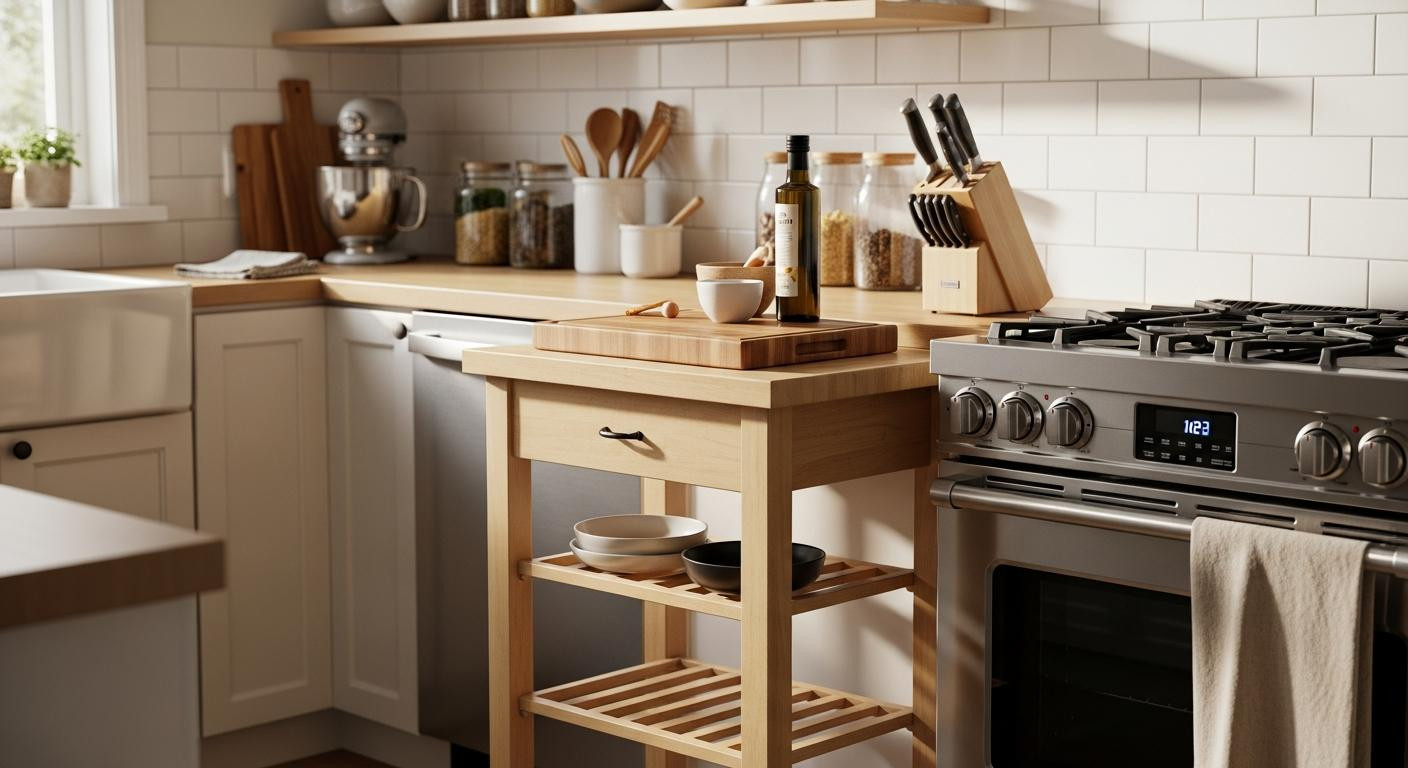
Your kitchen measures 72 square feet. Counter space disappears under the coffee maker, dish rack, and knife block by 7am every morning. Standard kitchen islands start at 36 inches wide, blocking your refrigerator door in a galley that’s barely 8 feet across. For six months, IKEA’s FÖRHÖJA cart sat in your bedroom holding books because you couldn’t figure out where it fit. Then you measured the gap between your counter and stove, discovered 34 inches of wasted passage space, and realized those birch slats could become a permanent island if you stopped thinking about wheels.
The 34-inch gap standard islands can’t solve
Most kitchen islands measure 36 to 48 inches wide, designed for open-plan kitchens exceeding 120 square feet. Your galley creates a 34-inch corridor between counter and appliances. Anything wider blocks cabinet doors. The FÖRHÖJA measures 16.875 inches wide, fitting the gap with 8.5 inches clearance on each side. That margin means your oven door swings fully open while the cart stays positioned.
You tested this Sunday morning, opening every drawer and appliance with the cart in place. The birch frame and solid oiled worktop feel substantial under your palm, not wobbly like cheaper carts. IKEA lists the overall dimensions at 39.375 inches long by 35.375 inches tall, enough vertical space for three open shelves that each hold nine bottles according to the manual.
Removing wheels turned rolling storage into fixed prep surface
The FÖRHÖJA’s height creates a problem. At 35.375 inches with wheels, it sits nearly counter-height but not quite, making it useless as overflow workspace. Your counters measure 36 inches. Unlike the RÅSKOG cart that thrives on mobility, this cart needed commitment. You removed the caster wheels Tuesday evening using a Phillips screwdriver, discovering they unscrew in about 45 seconds each.
Dropping the cart directly onto the floor reduced height to roughly 32 inches. You added a 1.5-inch thick acacia cutting board across the top shelf, creating a 33.5-inch work surface, just below counter level but accessible while standing. The warm honey tone of acacia against pale birch adds texture without clashing. And suddenly, your knife block, olive oil bottle, and bamboo cutting board that colonized 18 inches of counter space found a permanent home 16 inches from the stove.
Why mobility became a liability in 72 square feet
You initially valued the idea of rolling the cart around for different tasks. Reality proved otherwise. The cart moved once in six months. Kitchen designers certified by the National Kitchen and Bath Association note that movable islands in spaces under 80 square feet rarely migrate because owners optimize placement within days, then never adjust. Removing wheels and fixing the position eliminated the illusion of flexibility in favor of functional permanence.
Dead corner space became vertical storage worth 11 inches
Your kitchen corner creates an L-shape where perpendicular counters meet. This junction trapped 11 inches of depth no standard cabinet could reach. The void held air for three years. Positioning the FÖRHÖJA’s 16.875-inch width diagonally into this corner reclaimed the space. The cart’s three shelves now hold mixing bowls on top, spices mid-level, and baking sheets on bottom.
Everything sits within arm’s reach while cooking. But the corner placement does more than add storage. It creates a visual boundary between cooking zone and passage, making the kitchen feel designed rather than arranged. The birch tone warms the space without introducing heavy furniture bulk that makes small kitchens feel cramped.
Three problems one $180 modification solved
The hack cost $179.99 for the FÖRHÖJA cart in March 2026, plus roughly $40 for a quality cutting board large enough to span the top shelf. Your kitchen gained approximately 1.5 square feet of prep surface, reclaimed 11 inches of corner depth, and established spatial definition between zones. The change registers every morning at 7:30am when you prep breakfast without playing Tetris with appliances.
Admittedly, removing casters means you can’t easily move the island for floor cleaning. You solved that by adding pull-out storage underneath counters, making deep-cleaning less frequent. Professional organizers with residential certification confirm that in kitchens measuring under 80 square feet, fixed islands outperform mobile ones because every placement decision carries spatial weight.
Your questions about hacking IKEA’s kitchen cart for small spaces answered
Can the FÖRHÖJA support countertop use without wheels?
Yes. The solid birch worktop comes pre-oiled and supports cutting boards, small appliances, and daily prep tasks. Removing casters distributes weight across four corner posts rather than wheels, increasing stability. The frame measures 50 pounds 2 ounces according to package weight, substantial enough to stay planted. Place furniture pads underneath to protect flooring and add subtle height back.
Does this work in rentals without violating lease terms?
The modification requires zero permanent installation. You’re not drilling into walls or cabinets. The cutting board rests on the existing top shelf, removable in seconds. When you move, the cart remains standard furniture. Total disassembly time measures under 10 minutes. Like quality IKEA pieces, the FÖRHÖJA maintains resale value if kept intact.
What if my kitchen gap is narrower than 34 inches?
The FÖRHÖJA at 16.875 inches fits passages as narrow as 28 inches while maintaining door clearance on both sides. For tighter spaces under 30 inches, measure appliance door swings first. Interior designers working with studio apartments recommend leaving at least 6 inches clearance per side to prevent bottlenecks during cooking.
Your hand rests on warm acacia at 6:45pm, chopping garlic while pasta water boils 16 inches away. The knife block sits within reach. Olive oil catches evening light through the window. The corner that held nothing for three years now holds everything you need without wheels to remind you it could be somewhere else.