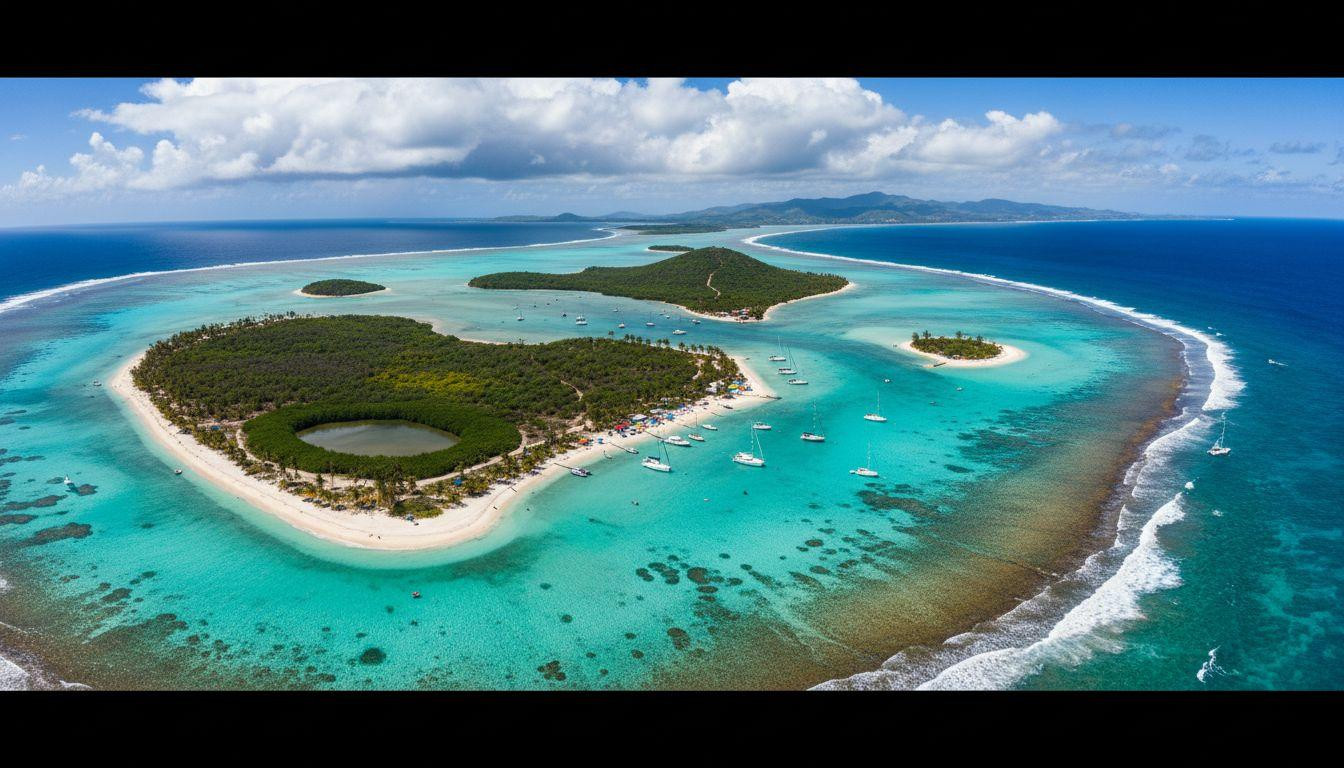
The boat leaves Union Island at 8am. Fifteen minutes later you see it: five uninhabited cays floating in water so turquoise it looks like someone adjusted the saturation. Petit Rameau sits in the center, no buildings, no docks, just white sand and a patch of red mangroves that shouldn’t exist this far south in the Grenadines.
This is Tobago Cays Marine Park, 1,400 acres of protected lagoon where development stopped in 1998. The government owns all five islands. Nobody lives here. Nobody builds here. You come by boat or you don’t come at all.
A lagoon the color of myth
Horseshoe Reef wraps around the cays in a 2.5-mile arc. Inside that barrier, the water stays calm enough to see turtles grazing 15 feet down. The reef structure creates depth variations: pale turquoise over sand, deeper blue over coral, emerald green where seagrass grows.
Petit Rameau holds the only red mangrove stand in St. Vincent and the Grenadines. The trees grow in a small lagoon on the island’s east side, roots tangled in water that stays still even when wind hits the outer reef. Birdlife concentrates here: herons, egrets, species that need the shelter mangroves provide.
The marine park charges $5.55 per person for 24 hours. Rangers collect fees from boats, cash only. That money funds mooring maintenance and reef monitoring. No anchoring allowed on coral or seagrass. The rules work: visibility runs 60-80 feet on calm days, and turtle populations stay stable year over year.
Where iguanas own the trails
Petit Bateau sits 500 yards from Petit Rameau across a shallow channel. The island has thick scrub vegetation and a trail to the summit that takes under five minutes. Iguanas live in the undergrowth, large ones, the kind that freeze when you approach then bolt into the bushes.
The view that justifies the boat ride
From Petit Bateau’s highest point you see all five cays: Petit Rameau to the west, Baradal and Jamesby to the north, Petit Tabac to the south. The turquoise channels between them look shallow enough to wade, though currents run stronger than they appear. Sailboats anchor in clusters near Petit Bateau’s north beach, white hulls against blue water.
Beach barbecue on the only inhabited spot
Petit Bateau’s north beach allows vendors under park regulations. Boat operators grill fresh fish and lobster on portable barbecues, $50 per person for lunch. The fish comes from morning catches: snapper, grouper, whatever ran into nets that day. Lobster season runs September through April, so March 2026 timing works. Rice cooked with local spices, fried plantains, cold beer from coolers.
Getting there without resort prices
Union Island Airport (UNI) connects to Miami via regional carriers, roughly $400-600 round-trip including the hop through St. Vincent’s main airport. From Union Island’s dock, shared boat trips run $50-80 per person with snorkel gear included. Private water taxis charge around $260 for groups, plus $10 per passenger park fee.
Union Island guesthouses start at $64 per night for budget options. Four-star places run $475. March sits in peak dry season: 2-4 inches of rain for the month, temperatures 77-86°F, calm seas for the boat crossing. Water temperature holds around 79°F. Turtle sightings peak because visibility stays high and currents stay gentle.
Why this beats the Maldives comparison
The Maldives requires 16-plus hours of flights from the US East Coast. Tobago Cays: three hours Miami to St. Vincent, 30 minutes to Union Island, 15 minutes by boat. Similar turquoise atolls, similar coral shallows, one-fifth the travel time, one-fifth the cost. No resort minimums. No overwater bungalows charging $800 per night. Just protected marine park and day boats.
What March 2026 timing delivers
Dry season runs December through April. March hits the sweet spot: past Christmas crowds, before Easter rush, steady northeast trade winds at 10-15 knots keeping temperatures comfortable. Sunrise around 6am, sunset around 6:10pm. Turtle activity stays high because seagrass grows thick in calm water. The park sees maybe 150 visitors on busy days, spread across five islands.
What you won’t find here
No accommodations on Petit Rameau. No restaurants, no beach bars, no wifi, no electricity. The marine park designation prevents all development. This isn’t manufactured exclusivity like private islands charging $2,000 per night. This is legal protection: the government decided in 1998 that some places stay empty.
Day boats from Union Island return by 4pm. You spend six hours in the cays, then you leave. Nobody camps. Nobody stays overnight unless they’re on a liveaboard sailboat with proper mooring permits at $22 per 24 hours. The emptiness resets every evening when the last boat motors back to Union Island.
Your questions about Tobago Cays answered
Can you stay overnight on Petit Rameau?
No accommodations exist on any of the five cays. Marine park rules prohibit overnight stays on land. Base yourself on Union Island or Mayreau, take day boats. Liveaboard sailboats can anchor using designated moorings, but land access follows day-use rules. This protects the islands from development pressure and keeps wildlife undisturbed at night.
What makes the water that specific color?
Horseshoe Reef creates a shallow lagoon over white sand and coral. Depth variations produce color gradients: 10 feet of water over sand looks pale turquoise, 30 feet over coral looks deeper blue. Minimal river runoff keeps sediment low. The reef barrier blocks ocean swells, so water stays clear instead of churning up sand. Similar physics to Maldives atolls, Bora Bora lagoons, anywhere coral and sand meet in protected shallows.
How does this compare to the British Virgin Islands?
BVIs see higher development and higher costs. A three-day BVI trip runs $200-plus per day for mid-range accommodations and activities. Tobago Cays: $70-120 per day including guesthouse, meals, boat trip, park fee. BVIs get cruise ship crowds at popular anchorages. Tobago Cays stay boat-access only, no cruise ships allowed in the marine park. Similar turquoise quality, similar snorkeling, fraction of the visitor density.
The boat back to Union Island cuts through the channel between Petit Rameau and Petit Bateau. Water depth drops from 15 feet to 60 feet in seconds, color shifting from turquoise to navy. Behind you, the five cays sit empty again, waiting for tomorrow’s boats.