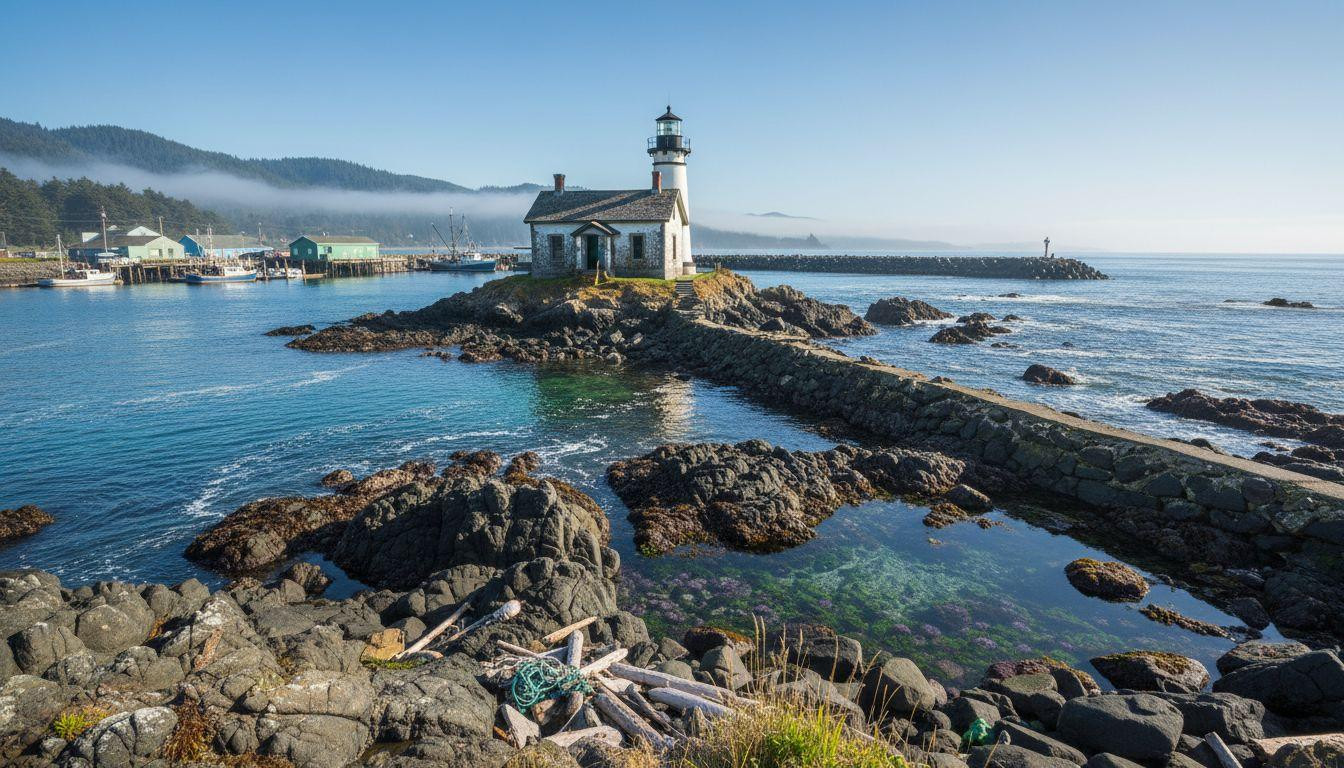
The fog lifts around 9am on most March mornings in Crescent City. For maybe twenty minutes the whole harbor turns silver-gold. Then Battery Point Lighthouse appears on its rocky islet, connected to shore by a causeway that vanishes twice daily under Pacific waves.
This northern California town of 6,700 sits where Highway 101 meets the redwood belt. The lighthouse has stood here since 1856. You can walk to it only at low tide.
The causeway that appears twice daily
Battery Point Lighthouse sits 100 yards offshore on a tidal island. At high tide, waves cover the basalt causeway completely. At low tide, the rocks emerge wet and dark, forming a path you cross on foot.
Check the tide tables before you go. Safe crossing happens when water drops below 2.5 feet. In March 2026, that window opens around midday, lasting roughly two hours. The crossing takes five minutes if you move carefully over slick stones.
Tours run October through March, 10am to 4pm, tide permitting. Volunteer keepers rotate monthly, living in the 1856 keeper’s house. The $5 admission includes the museum, Victorian quarters, and tower climb. Groups max out at ten people.
Fog meets redwood on rocky shores
Crescent City occupies a rare coastal zone where Pacific fog funnels directly into old-growth redwood groves. Drive five miles inland and you’re in Jedediah Smith Redwoods State Park, where 300-foot trees filter mist into cathedral light.
The scent shifts as you move between zones. Salt spray and kelp at the harbor. Damp earth and pine resin under the canopy. The fog doesn’t lift so much as transform, turning green-gold through redwood needles.
Howland Hill Road at first light
This unpaved scenic route cuts through old-growth forest north of town. Morning fog sits thick here until 8am. The gravel surface runs narrow between massive trunks, their bark grooved deep enough to hide your fist.
No cell service. No other cars at dawn. Just diffused light and the sound of your tires on wet stones. The road connects to coastal trails that rival Norway’s fjord paths for dramatic isolation.
Why the Norway comparison holds
Brovig-style mist clings to these rocky headlands the same way it does in Scandinavia. Basalt cliffs, fog-wrapped conifers, cold Pacific swells. The visual similarity is uncanny. But Crescent City sits six hours from San Francisco by car, not eleven hours across the Atlantic by plane.
Rocky Pacific drama without the crowds
Pebble Beach stretches south of the lighthouse, a mile of wave-smoothed stones and tide pools. Park near the trailhead. Walk down to exposed rocks at low tide. Sea stars cling to crevices. Anemones pulse in shallow water.
Brother Jonathan Point rises 100 feet at the harbor’s north edge. The 1865 shipwreck that gives it a name still draws treasure hunters. Four million dollars in gold supposedly rests offshore. Divers search for it every summer.
Best times for wave watching
March brings storm swells. Waves hit the cliffs hard enough to send spray 50 feet up. Photographers camp at the bluffs for golden hour, when low sun turns the mist orange. Summer calms the water but thickens the fog. July and August offer the clearest days, though mornings stay gray until 10am.
Local rhythms and Dungeness crab
Fishing boats leave before dawn. They return by 2pm with fresh Dungeness crab, in season November through June. Restaurants near the harbor serve it for $25 a plate. The meat comes out sweet and cold, cracked at your table.
The Northcoast Marine Mammal Center rehabilitates seals and sea lions year-round. Their rescue videos go viral on TikTok under #CrescentCitySeals. You can visit the facility, though the animals stay in recovery pools, not display tanks. Admission is free.
The unhurried north coast
Crescent City doesn’t rush. Locals wave from truck windows. The general store sells bait and coffee from the same counter. Victorian buildings line the harbor, painted in faded blues and greens, salt-weathered but standing.
Compare this to Oregon’s busier coastal towns 80 miles north, where summer crowds triple the population. Or Big Sur, 350 miles south, where lodging runs $450 a night in peak season. Crescent City motels average $130.
Your questions about Crescent City answered
When can I walk to Battery Point Lighthouse?
Check NOAA tide tables for Crescent City. Safe crossing requires tides below 2.5 feet. March low tides typically occur around midday. Tours operate 10am to 4pm, October through March, but only when the causeway is passable. Summer tides shift to early morning and evening windows.
What makes this different from Big Sur?
Half the lodging cost. One-tenth the crowds. Redwood proximity. Big Sur draws visitors for dramatic cliffs and luxury resorts. Crescent City offers working-town authenticity, fog-wrapped forests, and tide-dependent lighthouse access that feels more Norwegian than Californian.
Is March a good time to visit?
Pros include dramatic storm watching, lowest prices (motels drop to $80), and 18 rainy days that create moody atmosphere. Cons include frequent fog that obscures views and cold highs around 55°F. Best for photographers and solitude seekers. For clear skies, visit July or August.
The ferry back to shore leaves when the tide turns. Most visitors make it with time to spare. I almost missed it once, distracted by a seal surfacing near the causeway rocks. The keeper rang the bell twice. I ran.