“`html
The morning ferry crosses the Arade River in five minutes. Portimão’s skyline fades behind you. Ahead, whitewashed houses climb toward an ochre fortress splitting two beaches. Population 2,000. Six quiet zones where fishing rhythms survive tourism’s arrival elsewhere in the Algarve.
Ferragudo sits on the east bank of the Arade estuary, 40 miles west of Faro Airport. The village faces Portimão across turquoise water but costs 30-50% less for rooms and meals. March 2026 brings shoulder-season calm: under 50 daily visitors at Praia Grande versus thousands in summer. Water temperature hits 59°F, air reaches 64°F, wildflowers bloom on cliff trails.
Dawn harbor routines at Praça Rainha Dona Leonor
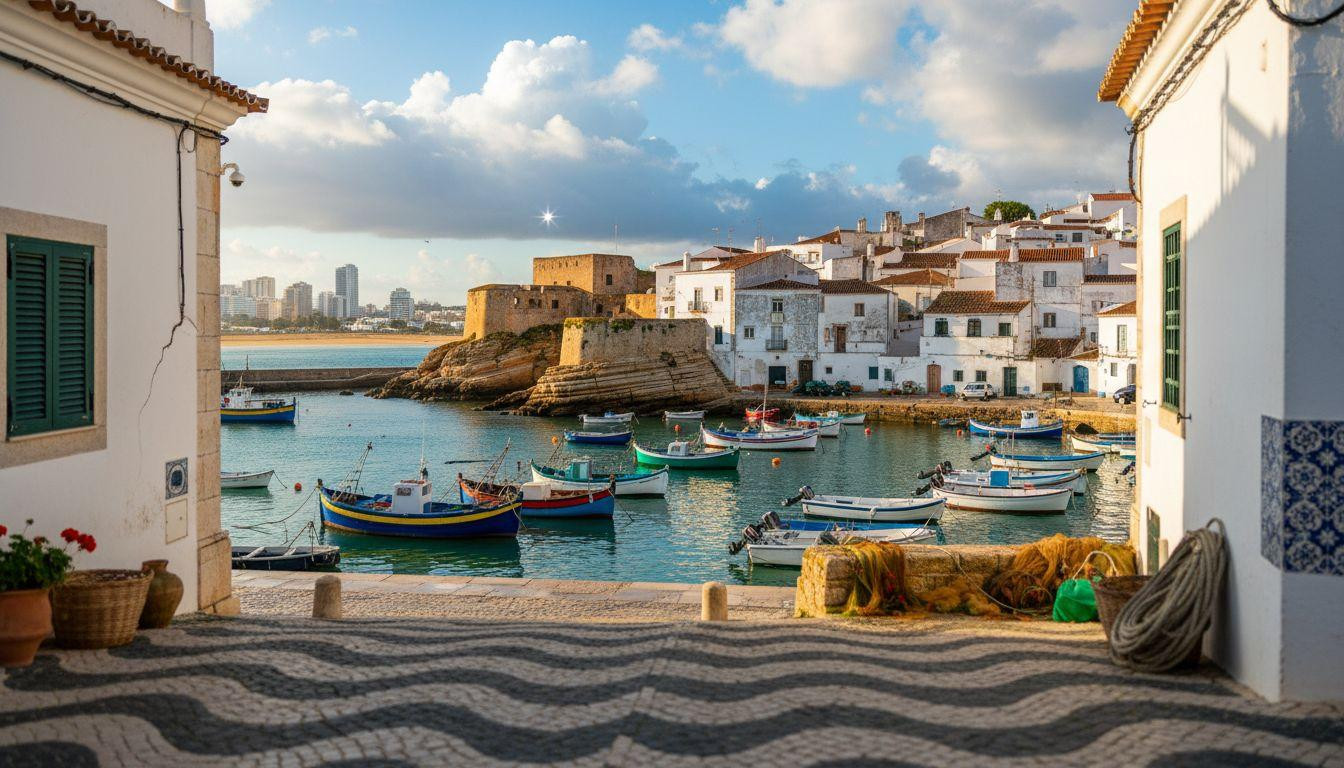
Fishermen return between 5am and 6am. Colorful boats bob in the small harbor, nets drying on stone walls. By 7:30am, the daily fish auction starts at the quay. Locals bid on sardines, sea bass, octopus. Prices begin around $5-10 per kilogram. Tourists rarely witness this.
Café O Porto sits steps from the auction. Coffee and pastel de nata cost $5-8. Fishermen gather here after unloading their catch. The fleet numbers 20-30 boats. Fishing dominates the economy at 60%, tourism at 40%. This balance keeps the village authentic.
Walk two minutes from the village center to reach the harbor. March mornings belong to locals. Nets dry in pale light. The auction ends by 8am. Restaurants source their daily catch here, explaining why menus change with the tide. For a similar coastal rhythm in a different setting, this Costa Rica reef stays calm enough to see rays from shore.
Fortress peninsula between two beaches
Praia Grande stretches 1.2 miles of golden sand. The beach divides at Castelo de São João do Arade, a 17th-century fortress on a rocky peninsula. Eastern coves shelter families from Atlantic swells. Western sections face open ocean. Water shifts from turquoise estuary tones to deeper Atlantic blue-green.
The fortress trail and pirate history
A 1.5-mile trail connects Praia Grande to the fortress in 20-25 minutes. Walls rise 16 feet, perimeter stretches 1,640 feet. The castle is privately owned but publicly accessible. Pirate raids in the 16th and 17th centuries prompted its construction. Sunrise from western cliffs shows the color shift clearly.
Village center to Praia Grande takes 15 minutes on foot. Free parking holds 100 cars. The fortress sits at 65 feet elevation. March brings fewer than 20 visitors daily. Walk the peninsula at dawn for solitude. The castle’s ochre walls glow against morning water.
Beach geography and family calm
Praia Grande’s eastern cove stays calm at high tide. Beach width narrows to 165 feet when water rises. Sand is fine-grained and golden. Western sections see stronger waves, attracting bodyboarders. The fortress divides these zones naturally.
Portimão’s skyline appears across the estuary. The contrast is visible: high-rise hotels there, low whitewashed houses here. Ferragudo resisted heavy development. This preserved the village feel that draws visitors seeking quieter Algarve alternatives. Much like Tellaro keeps harbor gold for $95, Ferragudo offers authenticity at lower cost.
Six micro-experiences in walking distance
Cliff trail to Praia dos Caneiros and lighthouse
Praia dos Caneiros lies 25 minutes uphill from the village center. A wooden staircase descends 100 steps to the beach. The beach measures 985 feet long, 260 feet wide, backed by 100-foot cliffs. Parking holds 50 cars. Arrive before 10am in March to secure a spot.
Restaurant O Litoral serves grilled fish for $15-25 per person. The family-owned spot sources daily harbor catches. An 800-yard trail continues to Ponta do Altar Lighthouse, built in 1893. The path is moderate, rocky in sections. March sees under 20 daily visitors. Sunrise happens at 7am, sunset at 6:30pm mid-March.
Hilltop church and seven-color estuary view
Nossa Senhora da Conceição sits atop the village. Cobblestone lanes climb steeply for 10 minutes from the center. The 18th-century Baroque church features azulejo tiles inside. The terrace stays open daily, offering 360-degree views. Locals gather here for quiet moments.
From this 165-foot elevation, the estuary shows seven color gradients. Turquoise near shore deepens to sapphire where Arade meets Atlantic. Portimão’s skyline glows at dusk across the water. Terracotta rooftops cascade below. Population holds steady at 2,000 residents. March brings under 10 daily visitors to this viewpoint.
Five-minute ferry to Portimão contrast
The ferry departs every 30 minutes in winter. Fare runs $2-3 one-way. Boats seat 50 passengers, accept bikes and wheelchairs. Crossing time: 5-7 minutes. The dock sits 10 minutes’ walk from Portimão’s municipal market. Water temperature in the estuary reaches 55-57°F, slightly warmer than the Atlantic’s 54-55°F.
Portimão offers urban Algarve: markets, tile shops, higher prices. Ferragudo provides the return to village calm. The ferry ride itself delivers scenic value. Seven-color water gradients appear from mid-river. Morning crossings stay calmer than afternoon winds. This geographic proximity without urban density mirrors Scopello keeps tonnara coves for $88 near busier Sicilian towns.
Your questions about Ferragudo answered
When should I visit for the best weather and fewest crowds?
March through May delivers ideal conditions. Temperatures range from 59°F to 72°F. Wildflowers bloom on cliff trails. Visitor numbers stay 70% below summer peaks. March 2026 sees under 50 daily beachgoers at Praia Grande versus thousands in July-August. Eight rainy days occur monthly on average. Shoulder season ends late May when peak tourism begins.
How does Ferragudo compare to other Algarve villages?
Ferragudo costs 30-50% less than Lagos or Albufeira for hotels and meals. Average hotel rates run $92-127 per night versus $150+ elsewhere. Meals cost $21-40 per person including tax and tip, compared to $35+ in resort towns. Fishing culture remains dominant here at 60% of the economy. Lagos and Albufeira shifted to tourism-first economies. Carvoeiro sits nearby but Ferragudo maintains quieter rhythms and lower prices.
What are the essential costs for a March 2026 visit?
Faro Airport taxi costs $50-70 for the 45-minute drive. Bus route 56 via Portimão runs $8-12 hourly. Hotel Casabela charges $177-271 per night in low season. Guesthouses average $92-127. O Barril restaurant serves cataplana for $25-30 per person, grilled sardines for $21-40. Ferry to Portimão costs $2-3. Kayak rentals run $40-60 for half-day tours. Free activities include beaches, harbor walks, church viewpoint, and village wandering.
Morning light hits the fortress. Fishing nets dry in the harbor. Portimão’s skyline stays visible but distant across turquoise estuary. Six zones deliver beaches, fortress history, estuary geography, and fishing culture within walking distance. March 2026 shoulder season brings warmth without crowds, prices 15% below Algarve averages. When you cross back on the evening ferry, Portimão’s lights reflect in water you just left behind.
“`