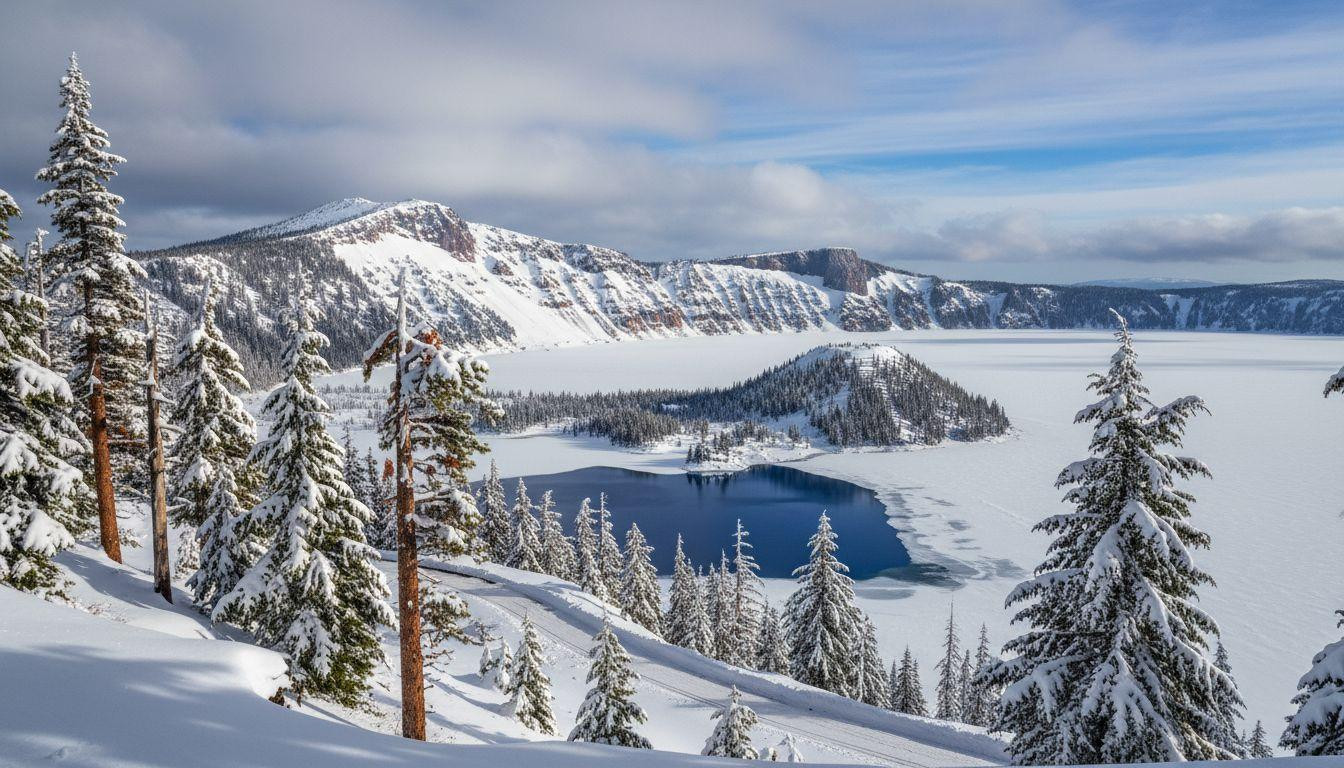
Summer at Crater Lake means parking lots full by 8am and shuttle waits stretching past 30 minutes at Rim Village. Winter flips the script. The north sector of Rim Drive closes to cars in November and stays snow-packed until July. Cross-country skiers get the entire 12-mile loop to themselves. No vehicles. No crowds. Just volcanic silence and frozen turquoise glimpses through winter clouds.
The contrast is stark. Crater Lake drew 670,822 visitors in 2025, a 21% jump from the year before. Nearly all of them arrived between May and September, concentrating at the south and west rim overlooks accessible year-round via Highway 62. The north sector sees maybe 10 skiers on a busy winter day. Most days, you break trail alone.
Why south rim crowds miss the point
Rim Village sits at the park’s south edge, open 365 days a year. It’s the default destination. Summer brings trolley tours running 9am to 3pm, viewpoint jostling, and the hum of idling engines. The experience becomes transactional. Pull up, snap a photo, move on. The caldera’s depth gets lost in the logistics.
Highway 62 stays plowed all winter to park headquarters and Rim Village, three miles in. That year-round access funnels everyone to the same overlooks. The south rim became the park’s front door by necessity. But it’s the north sector that holds the quiet.
Parking restrictions don’t exist yet, but summer volume creates its own gridlock. Forget Grinnell where 1,600 hikers cost $280 and Elizabeth Lake keeps glacial blue for $7 captures a similar dynamic. Popular doesn’t always mean better.
The north sector difference
The North Entrance Road closes November 1 every year. Snow buries the 33-mile Rim Drive loop under feet of powder. What was a scenic byway becomes a backcountry ski route. The transformation is complete by Thanksgiving.
What you see from the north rim
Cloudcap Overlook sits at the north sector’s high point, over 8,000 feet. On clear mornings, the frozen lake spreads below in shades of blue-gray. Phantom Ship island rises like a basalt ghost. The caldera walls drop 2,000 feet, their volcanic layers visible through scattered snow. Winter storms hide the lake most days. When clouds part, the view feels earned.
The road itself curves through mountain hemlock and Shasta red fir, their branches bent under snow weight. Ski tracks from previous days fade under fresh powder. The silence is absolute except for wind through the trees.
Why winter works better
Summer’s 670,000 visitors vanish in winter. The park doesn’t track exact numbers, but winter visitation stays under 5% of the annual total. Most winter visitors stick to the plowed road between headquarters and Rim Village. The north sector requires skis or snowshoes and the willingness to break trail.
No permits are needed. No reservations. No shuttles. You park at headquarters, clip into your skis, and go. The only requirement is chains or traction tires for the drive in. Highway 62 gets plowed daily from the south and west, but it’s still a Snow Zone.
Skiing the frozen rim
The typical north sector loop runs 10 to 15 miles, depending on how far you push toward the North Entrance. Most skiers start at park headquarters and head clockwise. The road gains elevation gradually, engineered in the 1930s for cars but perfect for Nordic skiing now.
What the experience feels like
Dawn at 7am in March means alpenglow on the caldera rim. The lake stays hidden under clouds, but the volcanic walls glow pink for maybe 10 minutes. By 8am, the light turns flat and gray. You ski through that quiet until mid-morning, when the sun breaks through or doesn’t.
Breaking trail through fresh snow takes time. A 12-mile loop can stretch to six hours with stops. Most skiers turn back at Cloudcap, making it a 10-mile day. The road surface stays smooth under the snow, easier than backcountry terrain. This Utah ski resort costs $70 where Park City charges $209 daily offers similar winter value.
What makes it special
The 1930s scenic byway engineering holds up. Curves bank gently. Grades stay manageable. The road was built for this landscape, and skiing it feels like using infrastructure the way it was meant to be used before cars took over.
Weather drama defines winter here. Clouds roll in from the Pacific and dump an average 41 feet of snow annually. As of March 14, 2026, the snowpack measured 36 inches. Storms can close Highway 62 for days. When they clear, the lake appears in shades of frozen blue that summer visitors never see.
Getting there in winter
Highway 62 from the south and west stays open year-round. Klamath Falls sits 60 miles away, a one-hour drive. Medford is 80 miles, about 90 minutes. Both towns offer ski rentals around $30 per day, though specific 2026 rates weren’t available. Lodging runs $80 to $120 per night in winter, well below summer peaks.
The park entrance fee applies year-round at $30 per vehicle, good for seven days. All in-park lodging closes November through April. Crater Lake Lodge and Mazama Village won’t reopen until late May 2026. That forces you to stay in nearby towns, but it also keeps winter crowds minimal.
Fill your gas tank before entering. No fuel is available in the park from October through May. Cell service is unreliable. The park’s 24-hour emergency line operates from headquarters, but you’re mostly on your own out there. Salt spray hits basalt cliffs where Yachats keeps Oregon’s coast wild captures a similar remote Oregon experience.
Your questions about Crater Lake’s north rim winter skiing answered
When does the north sector actually close and reopen?
The North Entrance Road and Rim Drive close November 1 annually, sometimes earlier if heavy snow arrives. They reopen mid to late June, occasionally stretching into July depending on snowpack. March 2026 sits in the heart of winter access, with 36 inches of snow still on the ground as of March 14.
Do you need backcountry permits or avalanche gear?
No permits are required for day skiing on the closed Rim Drive. Backcountry camping needs a permit, but most skiers stick to day trips. Avalanche risk on the road itself is low compared to off-trail terrain. Standard winter gear includes chains or traction tires, layers for sub-freezing temps, and navigation tools since cell service is spotty.
How does this compare to summer south rim access?
Summer concentrates 90% of annual visitors at south and west rim overlooks. Parking fills early. Trolley tours run all day. Winter north sector skiing means near-zero competition. You trade guaranteed lake views for solitude and weather drama. 5 Maine coastal trails where ocean ice clings to pink granite all winter offers a similar winter-over-summer trade.
The ski tracks fade behind you as fresh snow falls. By afternoon, the clouds drop lower and the lake disappears completely. You turn back toward headquarters, alone on a road that will stay closed to cars for three more months. Summer will bring the crowds back. Winter keeps this for the few who know.