
Every year on March 14, something unusual happens across the United States. Bakeries sell out by noon. Schools erupt into spontaneous renditions of Happy Birthday. Runners lace up their shoes for a race that measures exactly 3.14 miles. And somewhere in San Francisco, a brass band leads a parade of enthusiastic strangers through a museum, circling a brass shrine a very specific number of times.
Welcome to Pi Day, arguably the only holiday in the world born directly from a number.
The date itself is the whole joke. In the American date format, March 14 is written as 3/14, which perfectly mirrors the first three digits of π, the mathematical constant that represents the ratio of a circle’s circumference to its diameter.
Pi is infinite, irrational, and has been fascinating mathematicians for thousands of years. It also, apparently, makes for an excellent excuse to eat pie.
Pi Day was officially born in 1988 at the San Francisco Exploratorium, under the creative direction of physicist Larry Shaw. The first celebration was charmingly low-key: museum staff walked in a circle and shared fruit pies.
Nobody could have predicted that this small, nerdy ritual would eventually become a nationally recognized holiday celebrated by millions of Americans every single year.
From a Californian joke to a National Holiday
The growth of Pi Day from local quirk to mainstream celebration is a uniquely American story. Word spread slowly at first, math teachers adopted it, science museums picked it up, and the internet eventually turbo-charged the whole thing.
By the mid-2000s, Pi Day events were popping up in schools across the country, with students competing to memorize decimal digits and cafeterias serving circular foods in honor of the occasion.
The tipping point came in 2009, when the US House of Representatives officially designated March 14 as National Pi Day, recognizing it as an opportunity to encourage math learning and promote science education nationwide. The resolution passed without opposition, which is perhaps the most bipartisan thing Congress has ever done.
Since then, Pi Day has evolved into something that genuinely transcends the classroom. It now brings together professional mathematicians, curious teenagers, casual pie enthusiasts, and everyone in between.
The shared joke, that a number can have its own holiday, turns out to be a surprisingly powerful hook for getting people interested in science. And in 2026, with the date falling on a Saturday for the first time in years, the celebrations are expected to be bigger than ever.
The historic epicenter gears up for an epic Saturday
The Exploratorium in San Francisco remains the spiritual home of Pi Day, and the museum takes that responsibility seriously. For the 2026 edition, the Exploratorium is preparing a free, full-day event packed with immersive math activities, hands-on exhibits, and expert presentations designed to make geometry feel genuinely exciting for all ages.
First-timers and returning regulars alike can expect the full experience, and yes, there will be complimentary pie.
But the undisputed highlight of the day is the Pi Procession, a tradition that has become as sacred to Pi Day as fireworks are to the Fourth of July.
The parade begins at exactly 1:59 PM, representing the continuation of the sequence 3.14159, and winds through the museum’s galleries accompanied by a lively brass band.
Participants hold up signs displaying the infinite digits of Pi before performing the ritual that started it all: circling a commemorative brass shrine exactly 3.14 times.
Einstein’s birthday and a chorus you won’t forget
If Pi Day already felt cosmically designed, consider this: March 14 is also the birthday of Albert Einstein. The man who reshaped our understanding of space, time, and gravity was born on the same date that the world celebrates its favorite mathematical constant. Whether you believe in coincidence or not, the overlap is almost impossibly perfect.
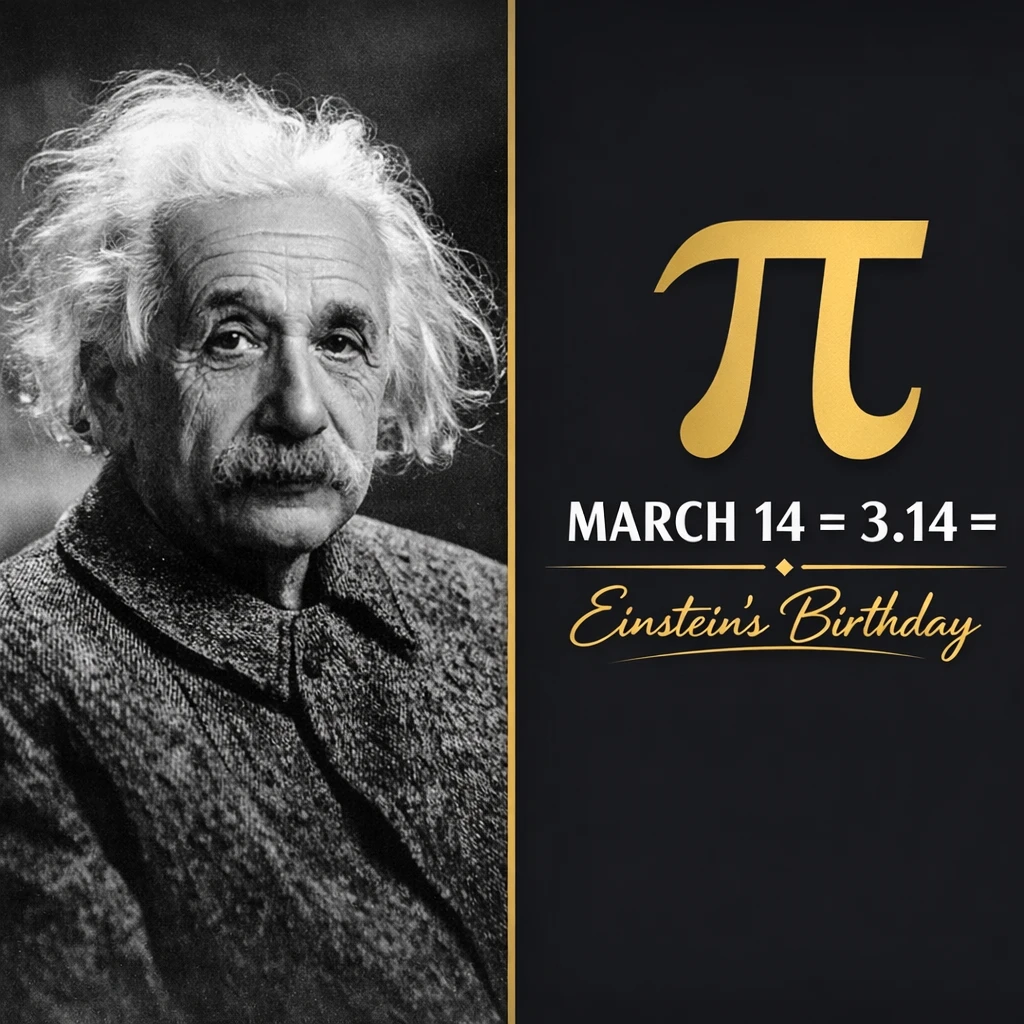
Schools across the country have leaned fully into this connection. Many Pi Day celebrations include a mass rendition of Happy Birthday in Einstein’s honor, turning a geometry lesson into a tribute to one of the greatest scientific minds in human history. It gives the day an extra layer of meaning — a reminder that behind every abstract formula is a real person who dedicated their life to understanding the universe.
For younger students especially, the Einstein connection is often the emotional hook that makes Pi Day stick. The idea that the smartest person who ever lived shares his birthday with the most famous number in mathematics feels like something out of a movie.
It makes math feel like it belongs to the same world as legends and stories, not just textbooks and tests.
Running 3.14 miles for a slice of pie
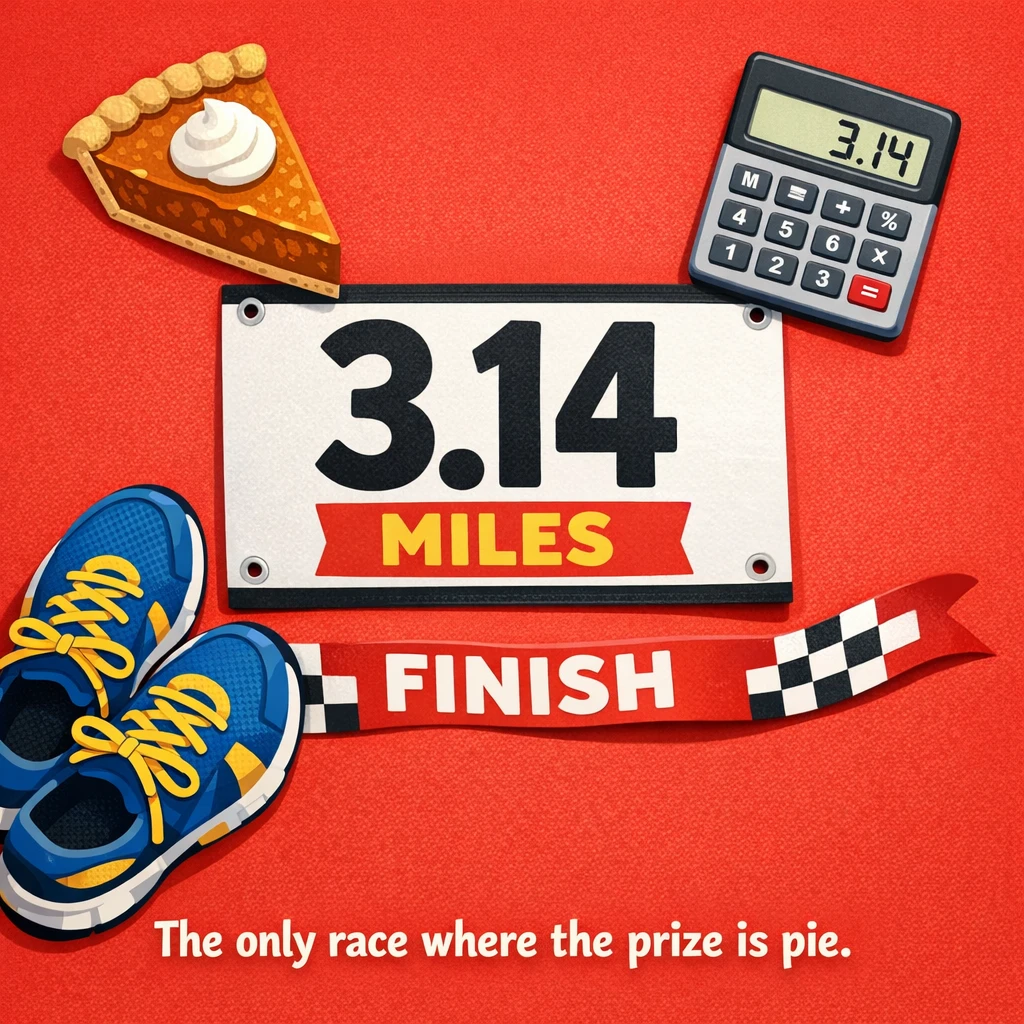
Pi Day has quietly developed a serious athletic following over the years, and the format could not be more on-brand. Cities across the country organize official Pi Runs, races measuring exactly 3.14 miles, which works out to just over five kilometers. These events blend physical exercise with full-on geek culture in the most good-natured way imaginable, welcoming participants of all ages, speeds, and mathematical abilities.
The finish line reward is not a traditional medal. It is a slice of pie, handed to sweaty, grinning runners who have just completed one of the more eccentric distances in recreational athletics. The combination of running, math humor, and baked goods turns out to be a remarkably effective formula — Pi Runs consistently sell out weeks in advance in major cities.
Because the 2026 edition falls on a Saturday, race organizers nationwide are expecting record registration numbers. Families who might skip a weekday event are clearing their schedules, and several cities are expanding their courses and participant caps to meet the demand. If you have been looking for a reason to start running, a 3.14-mile pie-themed race on a Saturday morning is honestly a pretty good one.
Workshops, competitions, and the art of memorizing the infinite
Beyond the parades and the runs, Pi Day generates a remarkable amount of grassroots educational activity. Interactive children’s museums, public libraries, and community centers use the occasion to run hands-on STEAM workshops for kids who might otherwise never think twice about geometry.
The youngest participants discover the concept of circumference by measuring round everyday objects with string, a simple activity that consistently produces genuine moments of discovery.
At the high school and university level, the energy is more competitive. Pi recitation contests have become a Pi Day staple, with students competing to memorize and correctly recite as many decimal digits of π as possible. Some extraordinary competitors manage to recite several thousand consecutive digits without a single mistake , a feat of memory and concentration that draws real crowds and regularly goes viral on social media. The current world record stands at over 70,000 digits, a number so staggering it is almost impossible to conceptualize.
These competitions matter beyond the spectacle. They bring genuine prestige to mathematical achievement in an environment where academic accomplishment can sometimes feel invisible next to athletic or artistic success.