“`html
Rhode Island Sound meets stone walls built in 1682, where fog softens rocky shores into grayscale mornings 9 miles from Newport’s tourist crowds. Little Compton sits at the state’s southeastern corner, population 3,500, maintaining agricultural silence while its neighbor commercialized. The harbor still works. Lobster boats leave before dawn. No boutique hotels yet.
Where Plymouth Colony left its mark
Little Compton incorporated in 1682 as a Plymouth Colony settlement, joining Rhode Island in 1747. It remains the state’s only town with this Pilgrim heritage. The town common is Rhode Island’s sole official one, listed on the National Register of Historic Places since the 1970s.
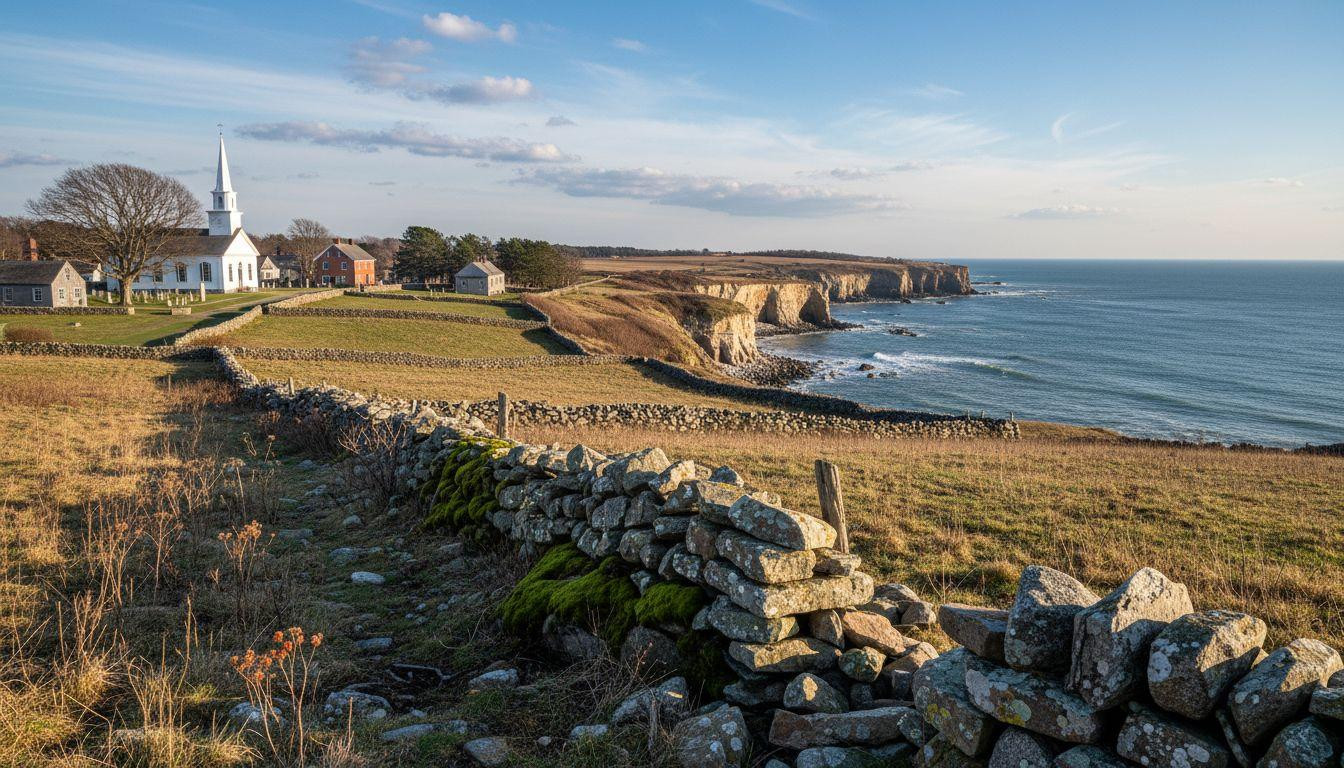
Stone walls divide every meadow. Over 20,000 miles of them, built by colonists clearing fields in the 1600s and 1700s. Fieldstone and granite, moss-covered now, creating walking paths through fog that rolls in from the Atlantic most mornings. The walls look timeless. They are.
The fog, the walls, the quiet
Morning light through coastal mist
Sakonnet Point lighthouse area sits 4 miles from town center, a 10-minute drive. Rocky Atlantic shores meet Rhode Island Sound here, cliffs rising 20-50 feet above the water. Fog arrives around 6am in late February, turning the coast gray-blue until mid-morning. Temperature hovers 35-45°F, chilly but calm.
Goosewing Beach Preserve added accessible boardwalks in fall 2025 for year-round wildlife viewing. The beach stretches a mile, rocky rather than sandy, with tide pools sheltering blue mussels and green crabs. A fisherman on the pier for 30 years says the fog makes everything quieter. Sound carries differently in the mist.
Stone walls as time capsules
The Rhode Island Red Monument stands near the town common, commemorating the chicken breed developed here in the 1850s. It became the state bird. Locals joke it’s the real town mascot, more authentic than Newport’s mansions. The monument made the National Register in 1973.
Gray’s Store opened in the 1860s, still operating as a general store with penny candy and local gossip. White clapboard buildings line the common, unchanged since the 1700s. No chain stores. No parking meters. The pharmacy doubles as the post office.
What you actually do here
Coastal trails and farm stands
Goosewing Beach offers free access, no parking fees. The preserve trails total 5 miles of rocky shoreline and woodland paths. Dundery Brook Trail features a raised boardwalk through wet woodland, opening to a field and pond. A resident who moved here from Brooklyn in 2019 says she walks it three times a week, never sees crowds.
Sakonnet Vineyard expanded its winter tasting room in November 2025. Tastings run $20-30, compared to $40-75 in Napa. The vineyard sits 3 miles from Goosewing Beach, an 8-minute drive through stone-walled meadows. Young Family Farm operates a seasonal stand, though hours vary in winter. Similar coastal fog and colonial quiet appears in Delaware’s forgotten seaports.
The unhurried culture
Farm-to-table dining means fresh clams and oysters from Rhode Island Sound, delivered daily to the few restaurants open year-round. Average meal costs $15-25, half what Newport charges. A visitor review from 2025 notes the area is “very quiet, bring drinks and extra food because shopping is limited.” That’s not a complaint. That’s the point.
Winter emptiness suits the place. February sees minimal visitors, maybe a few dozen on weekends. Parking is always available. The bakery owner whose family opened in 1953 has time to chat. Michigan’s fishing villages maintain similar unhurried traditions.
Why February feels right
Chilly fog enhances the atmospheric beauty rather than diminishing it. The mist creates moody coastal scenes, turning rocky shores into something timeless. Water temperature drops to 42°F, discouraging swimmers but perfect for contemplative walks. Sunrise at Sakonnet Point happens around 6:45am in late February, sunset at 5:25pm.
Accommodation rates run 20-30% below Rhode Island averages. Harmony Home Farm B&B charges from $164 nightly in February 2026. The Edith Pearl Historic Bed and Breakfast offers similar rates with breakfast included. Little Compton cottages start at $170. Compare that to Newport’s $208-280 for mid-range hotels the same week. Empty beaches in low season reward those who visit off-peak.
Your questions about Little Compton answered
How do I get there without a car?
Amtrak runs to Providence, 35 miles north (50-minute drive). T.F. Green Airport in Providence offers the closest flights, with car rentals $50-80 daily. Boston Logan Airport sits 70 miles away, a 1.5-hour drive. No direct train or bus service exists to Little Compton. A car is necessary.
Is it really that different from Newport?
Newport draws millions annually for Gilded Age mansions and commercial beaches. Little Compton sees roughly 50,000 visitors, mostly day-trippers. Costs run 25% lower. No resort hotels, no tour buses, no mansion tours. Stone walls and working farms instead of opulent estates. The town maintains agricultural heritage that Newport traded for tourism decades ago. Quieter alternatives to famous destinations often preserve authenticity better.
What’s with the chicken monument?
The Rhode Island Red breed developed here in the 1850s, becoming the state bird in 1954. The monument honors agricultural heritage that shaped the town’s identity. Locals protect this farming legacy while Newport embraced Vanderbilt-era opulence. The monument stands as a quiet assertion: this place values substance over spectacle.
The ferry back to Newport leaves at 4:30pm. Most visitors make it with time to spare. I almost missed it once, because someone at the farm stand started talking about stone walls. The conversation lasted an hour. That’s Little Compton.
“`