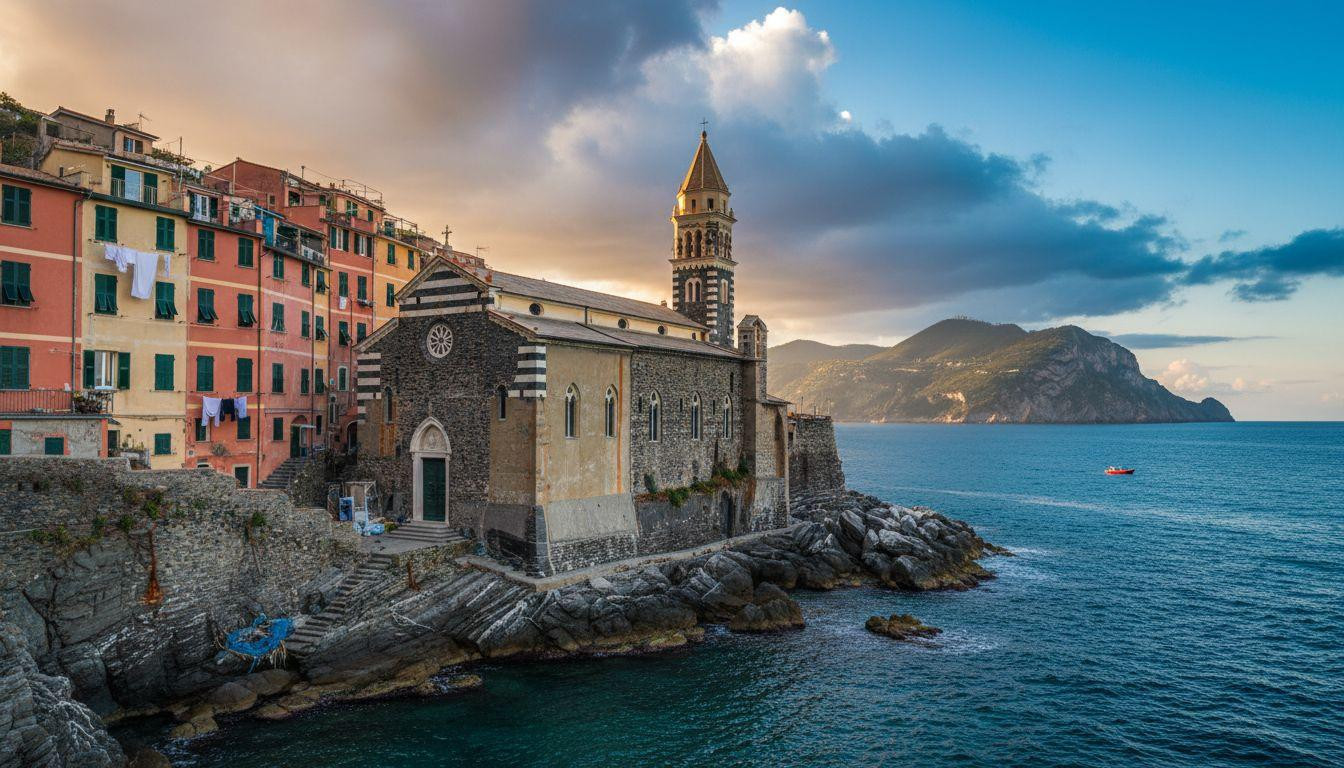
The ferry from La Spezia pulls into Portovenere harbor at 10am. Pastel houses stack up the cliff in pinks and yellows. At the promontory’s edge, the Church of San Pietro sits in black-and-white Gothic stripes. This is the sixth village of Cinque Terre that tourists miss because no train stops here.
Portovenere holds 3,600 residents on a rocky peninsula 7.5 miles west of La Spezia. The Gulf of Poets spreads turquoise below medieval walls. Lord Byron swam these waters in 1822 to visit Shelley. The bay still carries his name in local memory.
The setting that filters crowds
No railway station exists in Portovenere. This single fact keeps visitor numbers at 500,000 annually while Cinque Terre absorbs 2.5 million. Access requires a 30-minute ferry ride at $11-16 or a bus climbing coastal switchbacks for $2-5. Cars squeeze through the SP530 road to limited parking at $2-3 per hour.
The approach by water reveals the town’s vertical architecture. Six-story Genoese houses wedge into cliffs. Narrow caruggi alleys thread between stone walls. The 1458 Doria Castle crowns the ridge. UNESCO designated this coastline a World Heritage Site in 1997 alongside the Alpine villages where balconies overflow with geraniums.
February temperatures hover at 48-54°F in town. The promontory runs 4-7 degrees cooler with steady wind off the Ligurian Sea. Water temperature sits at 57-64°F. Winter brings the lowest crowds and clearest coastal views.
The church at land’s end
Gothic stripes on a pagan foundation
The Church of San Pietro occupies the promontory tip at coordinates 44.0489°N, 9.8349°E. Romans built a Venus temple here first. A 5th-century Syrian-style church replaced it. The current Gothic structure dates to 1198 with its striped facade completed between 1256-1277.
Local black stone alternates with white Carrara marble in horizontal bands. The pattern marks Genoese architecture across Liguria. Sunset hits the western face at 5:45pm in February, 8:30pm in May, 8:45pm in August. Golden hour lasts 30-45 minutes when the stone glows amber against blue water.
The Byron legend and sea access
A sea cave below the church carries Byron’s name. The poet supposedly swam from this spot across the bay. No historical record confirms the exact location. The grotto sits 330-660 feet from the cliff base. Access requires calm seas and strong swimming ability. Most visitors view it from boats or the church terrace above.
The promontory walk from harbor to church covers half a mile. Stone steps climb past fishing nets and moored boats. After 7pm in any season, daytrippers leave. The church stands empty except for wind and wave sounds. This quiet matches what locals protect about Portovenere.
What you do here
Walking the medieval core
The Porta del Borgo gate marks the entrance to centro storico. Caruggi alleys run 6-10 feet wide between houses. Laundry lines cross overhead. Cats sun on doorsteps. The Doria Castle sits 0.3 miles uphill with $3-5 entry. Rampart views span the archipelago of Palmaria, Tino, and Tinetto islands.
Palmaria Island ferries depart hourly in season at $15-20 round trip. Rocky beaches line the western shore. Military restrictions close Tino and Tinetto to visitors. Their silhouettes remain visible from San Pietro’s terrace. Boat tours to Cinque Terre run $18-25 for 30 minutes to Riomaggiore, similar to the ferry connections between Aeolian Islands.
Muscoli and Vermentino
Trattorias cluster along the harbor waterfront. Muscoli alla Portovenere appears on every menu at $15-25. Local mussels steam in white wine broth with garlic and parsley. Pesto genovese costs $12-18 per pasta dish. Focaccia sells for $3-5 at bakeries in the caruggi.
Vermentino wine comes from terraced vineyards above town. A glass runs $5-8. Full bottles cost $20-35. Limoncino liqueur and olive oil fill shop windows as take-home products. The fishing fleet still works these waters. Fresh catch arrives at harbor restaurants by mid-afternoon.
The evening transformation
Harbor lights switch on around 6pm in February. Reflections ripple across black water. Outdoor tables fill with locals and overnight guests. The atmosphere shifts from tourist destination to residential village. This change happens every evening after the last ferry departs at 5:30pm.
Morning brings different light. Sea mist rises from the bay between 7-9am. Coffee costs $1-2 at harbor cafes. The stone walls hold overnight coolness until noon. By 10am, the first ferry arrives and the cycle repeats. But those who stay past sunset understand why Portovenere remains quieter than its famous neighbors, much like the hilltop villages of Provence that preserve medieval silence.
Your questions about Portovenere answered
How crowded is Portovenere compared to Cinque Terre?
Portovenere receives 500,000 visitors annually versus Cinque Terre’s 2.5 million. The absence of train service naturally limits day-tripper volume. Weekends from May through October see the highest concentration. November through April maintains low season quiet. Overnight stays reveal the town’s authentic character after 7pm when ferries stop running.
What makes the San Pietro sunset worth the visit?
The church’s cliff position catches unobstructed western light. The striped Gothic facade glows gold during the 30-45 minute golden hour window. Byron’s romantic legend adds historical resonance. The promontory remains accessible after daytrippers leave. February sunset at 5:45pm offers cooler temperatures and minimal crowds compared to summer’s 8:45pm timing.
How do costs compare to other Italian coastal towns?
Meals in Portovenere average $20-35 versus Cinque Terre’s $30-45 range. Hotel rates run 20-30% lower at $150 median compared to Positano’s $300-plus properties. The lack of train access and limited parking keep prices below Amalfi Coast levels. Winter rates drop further with availability increasing November through March, similar to the pricing patterns in Greek island alternatives like Hydra.
The last ferry back to La Spezia leaves at 5:30pm in winter. Most visitors make it with time to spare. The church stands empty at dusk. Wind carries only wave sounds across the promontory. This is when Portovenere shows why 3,600 residents chose to stay.