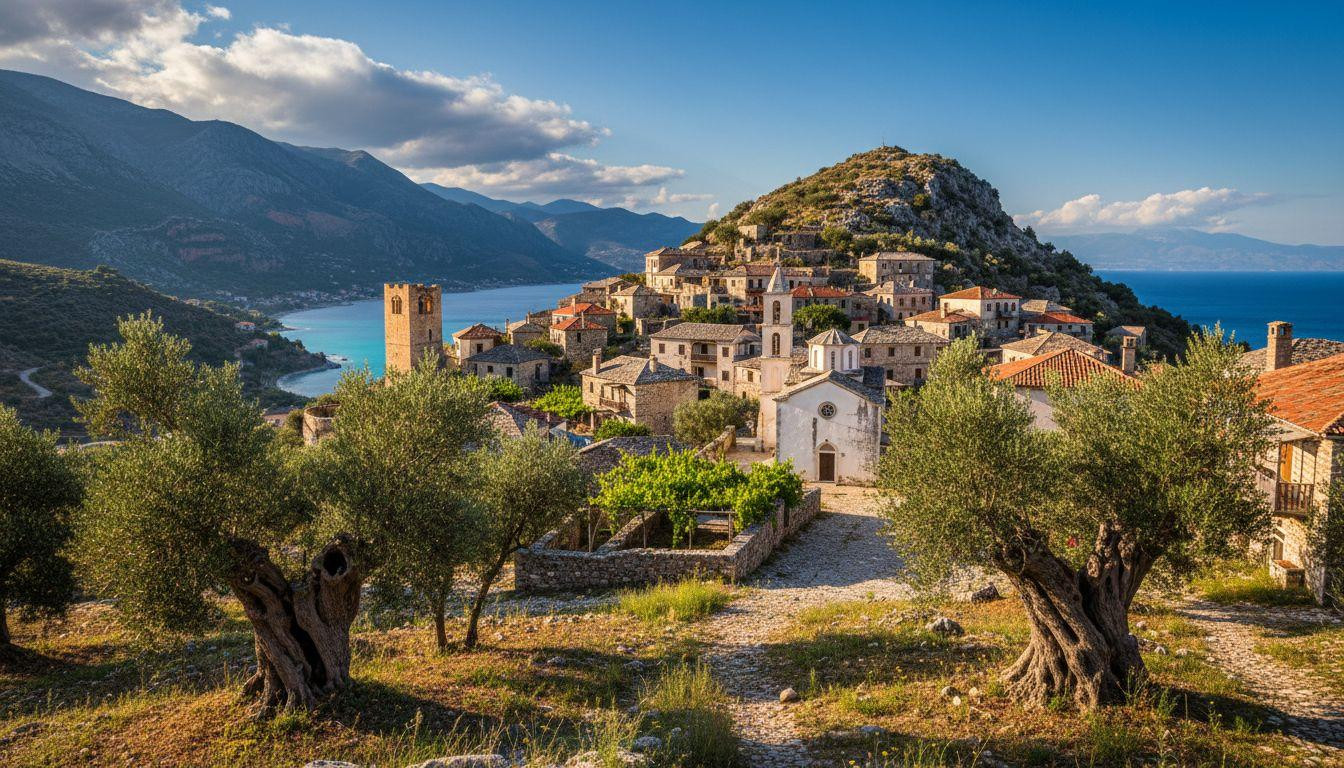
Sarandë’s beachfront fills by 9am in summer. Hotel lobbies buzz with tour groups. Restaurant waitlists stretch to two hours. Forty kilometers north, Upper Qeparo sits at 1,500 feet above the same Ionian water with stone lanes empty enough to hear wind through olive trees. The village costs half what Sarandë charges and delivers the Albanian Riviera experience the beach town abandoned when tourism arrived.
Why Sarandë lost what Upper Qeparo kept
Sarandë’s port processed 740,000 passengers in the first ten months of 2025. September alone brought 140,600 visitors, a 29% jump from 2024. The town that once lived on fishing now runs on resort hotels and beachfront cafes charging tourist prices. Three-star hotels fill fast. Four-star properties cost more than comparable rooms in Greece.
The infrastructure strains under the weight. Beaches pack tight from June through August. Parking disappears by mid-morning. The promenade that once felt Mediterranean now feels like any other overtouristed coast. Residents surveyed in 2024 acknowledged economic benefits but noted trade-offs in quality of life and environmental pressure.
Upper Qeparo avoided this trajectory by accident. The late 1950s coastal road bypassed the hilltop village entirely, pulling residents down to Lower Qeparo where beach access and modern services waited. Albania’s 1997 economic collapse accelerated the exodus. By 2020, the upper village stood mostly empty, preserved by neglect rather than planning.
The village geography tells its story
Upper Qeparo occupies a haystack-shaped hill surrounded by steep mountains covered in scree. The approach climbs through olive groves on a winding road that requires attention but not specialized vehicles. Standard cars manage fine. The village appears suddenly around the final curve, stone houses stacked against the hillside with the Ionian stretching blue and endless below.
Stone architecture that tourism hasn’t touched
Traditional Albanian houses line cobblestone streets too narrow for cars. Grey and white stone walls soften at the edges where time and weather work together. Vines climb through abandoned courtyards. Some homes still hold traditional furniture and century-old olive presses, material culture frozen when families left for work in Greece and Italy.
The Church of Saint Mary sits above the village center, its frescoes intact and its terrace offering views from Porto Palermo to Borsh. Ali Pasha’s Tower, an 18th-century fortress, dissolves into the landscape in afternoon light. The village cemetery occupies the highest point, where morning fog lifts last and evening shadows arrive first.
The panorama Sarandë can’t match
Elevation creates perspective. From Upper Qeparo’s viewpoint, the entire southern Albanian coast unfolds in both directions. Porto Palermo’s castle sits on its peninsula five miles south. Borsh Beach stretches seven miles to the north. On clear days, Corfu’s mountains rise across the strait. Sarandë’s beaches offer water access but no vertical drama, no sense of the coast as a continuous ribbon of geography.
What you actually do in Upper Qeparo
The village works as a base for coastal exploration rather than a beach destination itself. Porto Palermo Beach sits ten minutes south by car, its clear water sheltered by the castle headland. Qeparo Beach in the lower village offers free parking and fewer crowds than anything near Sarandë. Borsh Beach, Albania’s longest at seven miles, runs 15 minutes north.
Morning walks and afternoon light
Sunrise arrives around 6:45am in February. The first light touches the Ionian before reaching the village, creating a graduated illumination that photographers favor. Cobblestone lanes connect the scattered houses, each turn revealing another courtyard or viewpoint. By 8am, the village is fully awake but still quiet.
Afternoon light between 4pm and 5:45pm sunset turns everything gold. The ochre earth, white stone, and green olive trees shift through warm tones. This is when the village looks most like the Mediterranean postcards promised, except without the crowds those postcards attract. Similar to the Italian island with twin volcanic peaks, Upper Qeparo preserves small-population authenticity through geographic isolation.
Local food and olive culture
Two restaurants operate in the village, both family-run and serving traditional Albanian dishes. Expect fresh seafood, grilled meats, and vegetables prepared simply. Homemade raki appears at the end of meals. Olive oil tastings happen informally when residents invite visitors to see their presses and groves.
The olive trees here are centuries old, gnarled trunks and silver-green leaves that rustle constantly in the sea breeze. Some families still harvest by hand in October and November. The oil tastes different from Greek or Italian varieties, more peppery and less fruity. For travelers seeking alternatives to overtouristed Greek islands, this represents authentic Mediterranean agriculture without the tourist infrastructure.
The practical reality of visiting now
Upper Qeparo sits at an inflection point. Former residents are returning after years working abroad, reinvesting in properties and opening guesthouses. Tourism is increasing but remains minimal compared to coastal hotspots. February 2026 represents an optimal window before potential mass discovery.
The drive from Sarandë takes 20-30 minutes via the SH76 coastal highway. Roads are mostly paved with some gravel sections in the village itself. Gradients are steep with 10-15 hairpin turns, but standard cars handle the route with careful driving. GPS coordinates place the village center at approximately 40.069°N, 19.873°E.
Accommodation options remain limited, which naturally controls visitor numbers. Guesthouses charge roughly 30-50 euros per night in off-season, significantly less than Sarandë’s hotels. Book ahead, as capacity is small. The village has no ATMs, so bring cash. English proficiency is limited outside hospitality contexts. Learning basic Albanian phrases helps.
Your questions about Upper Qeparo answered
When is the best time to visit Upper Qeparo?
February through May and September through October offer mild weather without summer crowds. February highs reach 57-61°F with lows around 45-48°F, similar to coastal California winters. Expect 8-10 rain days per month and 5-6 hours of daily sunshine. Summer brings heat and more visitors to nearby beaches, though the village itself stays quieter than Sarandë. Winter provides solitude and lower prices but cooler temperatures for beach activities.
How does Upper Qeparo compare to other Albanian Riviera villages?
Upper Qeparo ranks among Albania’s most undiscovered hilltop villages alongside Lukovë, Piqeras, and Kudhës. It offers better coastal views than inland villages while maintaining authentic character that beach towns like Himara and Dhermi have traded for tourism infrastructure. The partial abandonment creates a time-capsule quality similar to hilltop villages in southern France, but with Mediterranean light and Ionian proximity.
What makes Upper Qeparo worth the extra effort compared to staying in Sarandë?
The village delivers three advantages Sarandë cannot match. First, near-zero crowds year-round versus thousands of daily visitors in peak season. Second, accommodation costs 40-60% less than comparable Sarandë hotels. Third, authentic local interaction rather than tourist-focused service. The trade-off is limited amenities and steeper access, but for travelers seeking the Albanian Riviera before mass tourism transformed it, Upper Qeparo offers that experience. For those planning broader European village exploration, medieval stone villages in southern France provide similar architecture with different cultural contexts.
The ferry back to Sarandë leaves at 4:30pm for those combining both destinations. Most visitors make it with time to spare. The stone lanes and olive groves stay exactly where they are. The silence might not.