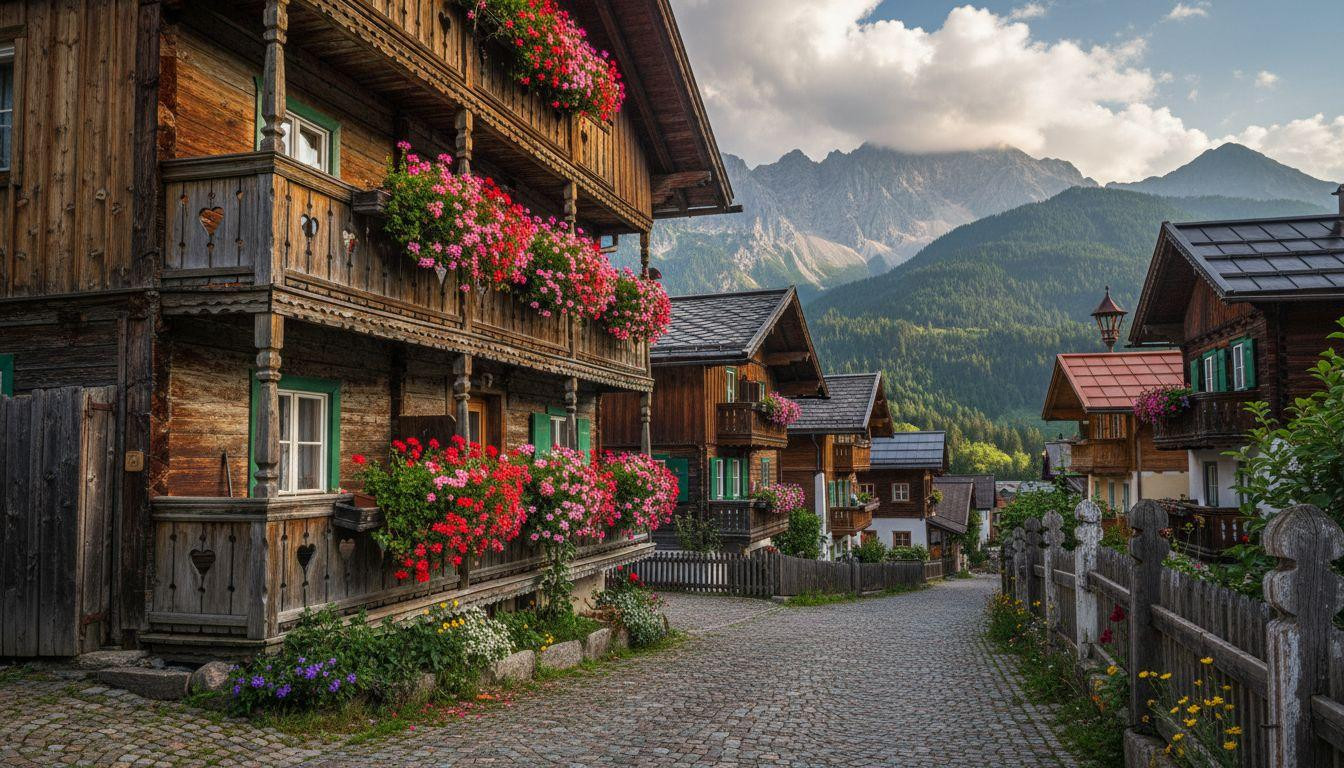
Red geraniums cascade from carved wooden balconies in nine European villages where medieval timber framing meets Alpine tradition. Hallstatt draws a million visitors yearly. These alternatives keep flower-draped authenticity with 60-85% fewer crowds. Spring 2026 blooms peak May through July when petals overflow against mountain backdrops and canal reflections.
February 2026 offers the planning window. Book now for shoulder-season rates dropping 20-30% below summer peaks. These villages preserve balcony flower contests dating to the 1600s. Geraniums honor alpine spirits in traditions passed grandmother to granddaughter.
Hallstatt, Austria: lakeside pastels where swans glide past window boxes
Population 800 sits on Lake Hallstatt beneath Dachstein peaks. Pastel houses mirror water at dawn. Red geraniums frame every balcony from May through September in displays judged annually each June.
The UNESCO salt mine operates since 7000 BCE. Prehistoric tunnels run beneath flower-draped streets. One million visitors arrive yearly but new 2025 rules cap daily entries at 3,000 with a parking limit of 500 spots.
Carved balconies and heart-shaped railings
Deep eaves shelter wooden overhangs carved with heart motifs. Geraniums cascade 3 feet down in reds and pinks. Petunias and lobelia add white accents. Local contests reward the most abundant displays with prizes announced at summer festivals.
What to do beyond the crowds
The Skywalk viewpoint opens at 8am ($15 entry). Salt mine tours run hourly ($18 adults). Rent boats before 9am ($20 per hour) when day-trippers fill the lakefront. Stay in Obertraun 10 minutes away where rooms cost $90 versus $200 in-village.
Alpbach, Tyrol: chalet balconies against green peaks
This village of 2,500 residents earned Austria’s most beautiful designation. Fifteenth-century wooden chalets line car-free lanes. Wildflower balconies bloom June through August in displays that follow flower trail traditions mapped since the 1800s.
Scrollwork railings feature intricate Tyrolean carvings. Balconies extend 6 feet with geraniums in vibrant reds and oranges mixed with trailing ivy. The village sits at 3,280 feet elevation where alpine air stays crisp through summer.
Hiking from village center
Trails depart directly from the main square. The Wiedersbergerhorn cable car ($25 round-trip) reaches 6,560 feet in 12 minutes. Cheese-making demonstrations happen Thursdays at local dairies. The Käslauf festival on June 6, 2026 features villagers skiing with cheese wheels in a tradition dating to medieval harvest celebrations.
Practical planning details
Innsbruck Airport sits 31 miles away. Buses run twice daily in summer ($20 one-way). A car proves essential for mountain trails. Family-run pensions charge $90-120 per night with balcony views adding $20-30 to rates. Visit in late May when crowds stay 80% below Hallstatt levels.
Colmar, Alsace: canal-framed half-timber and Petite Venise flowers
Population 70,000 with a compact medieval core. Renaissance half-timbered houses line canals in the Petite Venise quarter. Flower competitions drive balcony displays from April through June when multicolored geraniums and petunias overflow from ornate wooden brackets.
The Unterlinden Museum ($8 entry) houses Grünewald altarpieces in a 13th-century convent. Canal boat rides ($12 for 30 minutes) glide past shuttered windows draped in blooms. The town sits on the Alsace wine route where medieval arcades frame markets in nearby villages.
When crowds thin out
Day-trippers from Strasbourg leave by 6pm. Evening strolls through empty lanes reveal locals at sidewalk cafés. The TGV from Paris takes 2.5 hours ($60-110 depending on booking time). Stay outside the pedestrian zone where hotels charge $110 versus $165 in-village.
Spring wine fair timing
The Colmar Wine Fair runs April 25-27, 2026 with tastings from 200 regional producers. Choucroute (sauerkraut with sausages) costs $18 at traditional winstubs. Flammkuchen (Alsatian flatbread) runs $16. Visit in May for peak blooms without August heat that reaches 84°F.
Český Krumlov, Czech Republic: riverside castle and Baroque balconies
The 13th-century UNESCO castle overlooks 5,000 residents along Vltava River bends. Renaissance and Baroque buildings mix with flower-draped balconies displaying geraniums and lobelia from May through July. Local gardening guilds maintain traditions in pastel displays similar to Austrian villages.
Castle tours cost $12 with hourly English departures. River rafting companies charge $25 for 2-hour trips through town. Evening walks after 6pm reveal empty cobblestones when buses depart. The town draws 1.2 million visitors yearly but most concentrate in July and August.
Staying overnight matters
Dawn streets at 7am stay empty for photography. Guesthouses inside walls charge $75-115 per night. The 3-hour bus from Prague costs $18 with departures every 2 hours. Book accommodations with balcony views for $15-25 extra per night.
Eguisheim, Alsace: circular lanes without cars
This village of 2,000 residents follows a 13th-century circular layout. Car-free cobbled lanes wind through medieval arches dripping with geraniums from May through August. The birthplace of Pope Leo IX preserves half-timbered authenticity with 85% fewer visitors than Hallstatt.
Grapevine motifs carved into wooden balconies reflect wine village heritage. Deep overhangs shelter cascading displays in bright pinks and reds. Wine village flower awards announced each June drive competitive plantings. The circular walking route takes 30 minutes at a leisurely pace.
Wine tastings and hidden viewpoints
Family wineries offer tastings for $8-15 per flight. Tuesday morning markets sell local produce and flowers. The tucked vineyard loop behind the church reveals quiet paths locals use. Stay in chambres d’hôtes (family guesthouses) for $85-125 per night.
Getting there without trains
Eguisheim sits 6 miles from Colmar with no direct rail service. Rent bikes in Colmar ($20 per day) for the scenic cycle path. Basel Airport lies 28 miles away with car rentals from $50 daily. Visit on weekday mornings when tour buses stay in Colmar.
Rothenburg ob der Tauber, Bavaria: walled medieval gables
Twelfth-century walls encircle 11,000 residents in timber-framed gables with flower boxes blooming June through September. The Medieval Crime Museum ($10 entry) displays quirky torture devices. Night Watchman tours ($8) depart at 8pm in English telling stories from the Thirty Years’ War.
Geraniums mix with begonias on gingerbread-style carved balconies. Historic flower markets dating to the 1400s continue each Saturday. The town draws 2 million visitors yearly but most leave by 5pm when buses depart for Munich and Nuremberg.
Walking the wall circuit
The complete rampart walk takes 2.5 hours covering 2 miles. Plönlein corner stays quietest at dawn for photography. Schneeballen pastries (fried dough balls) cost $4 at bakeries opening at 6am. Guesthouses inside walls charge $90-135 per night.
Gruyères, Switzerland: alpine balconies and cheese traditions
This car-free medieval hilltop houses 2,100 residents. The 13th-century castle ($14 entry) overlooks balconies overflowing with red geraniums facing Alps. Steep chalet overhangs extend 5 feet with blooms peaking July through August at 2,690 feet elevation.
The cheese factory offers free tours showing traditional Gruyères production. Fondue at terrace restaurants costs $25 per person. The HR Giger Museum ($12 entry) displays biomechanical art in contrast to village charm. Similar to hilltop villages that preserve medieval character in France.
Train access from lake regions
Montreux sits 1 hour away by train ($18 one-way). Park at the base lot ($12 per day) and walk 15 minutes uphill. Hotels charge $140-190 per night with balcony rooms adding $30-45. Visit in June when flower displays emerge and crowds stay 70% below peak August levels.
Murten/Morat, Switzerland: lake walls and bilingual flower boxes
Medieval ramparts overlook Lake Murten in this bilingual town of 8,000 residents. German-French signage marks flower-draped arcades where geraniums and lobelia bloom May through July. Frescoed wooden balconies feature arcaded rails in displays judged at medieval flower festivals.
Walk the complete ramparts in 45 minutes for lake views. Swimming areas open June through August when water reaches 72°F. Boats to Neuchâtel depart hourly ($15 round-trip). Saturday markets sell local perch and produce.
Bern proximity advantage
The capital sits 19 miles away with trains every 30 minutes ($28 round-trip). Hotels charge $95-140 per night compared to $165 in Gruyères. Church bells ring hourly in both languages. Visit Thursday mornings for bilingual markets and quieter lanes.
Mittenwald, Bavaria: Lüftlmalerei frescoes and violin-making
Painted frescoes (Lüftlmalerei) cover timber houses in this village of 7,500 residents. Violin-making heritage dates to 1684 when Matthias Klotz established workshops. Balconies against Karwendel Alps overflow with geraniums and petunias from June through August.
Fiddle-scroll carvings on 5-foot overhangs reflect lute-making craft traditions. The Violin Museum ($7 entry) displays 200 instruments. Cable cars reach Karwendel peaks ($25 round-trip) in 10 minutes. Hiking trails depart from town center. Evening beer gardens serve Obatzda (cheese spread) for $13.
Munich day trip alternative
The city lies 56 miles north with trains every 2 hours ($25 one-way). Pensions charge $85-130 per night. Avoid ski-season crowds by visiting May through September when flowers peak and temperatures stay 59-72°F. Locals gather at Gasthof Stern after hikes for traditional Bavarian meals.
Your questions about European fairytale villages with wooden balconies overflowing with flowers answered
When do flower displays peak and how do I avoid crowds?
Geraniums bloom strongest from late May through July across all nine villages. Visit in late April or early May when displays emerge but summer crowds stay home. Arrive before 8am or after 6pm when day-trippers leave. Book accommodations for overnight stays to experience empty dawn streets. Avoid July and August when visitor numbers triple compared to shoulder seasons.
Which villages work best without a car?
Colmar, Rothenburg, and Murten offer the easiest access via train networks. Hallstatt and Český Krumlov require buses from airports but remain walkable once arrived. Alpbach and Mittenwald need cars for mountain trails. Eguisheim works with bike rentals from nearby Colmar. Gruyères requires parking at the base with a 15-minute uphill walk.
How do costs compare to more famous destinations?
These villages run 15-25% cheaper than Hallstatt for accommodations and meals. Alpbach and Mittenwald offer the best value at $85-130 per night for mid-range stays. Swiss villages (Gruyères, Murten) cost 10% more but remain below major resort prices. Czech Krumlov provides the lowest costs at $75-115 per night. Alsace villages (Colmar, Eguisheim) balance moderate prices with excellent wine route access. Budget $25-40 per person for dinners across all locations.
These nine villages preserve wooden balcony traditions where geraniums cascade against mountains, rivers, and medieval walls. February 2026 marks the planning window for spring visits when flowers emerge and crowds stay minimal. The Alpine-Alsace-Bavarian corridor delivers storybook visuals without Hallstatt’s million annual visitors. Pack wide-angle lenses and arrive at dawn when morning light touches carved overhangs and empty cobblestones reveal centuries of flower-draped heritage.