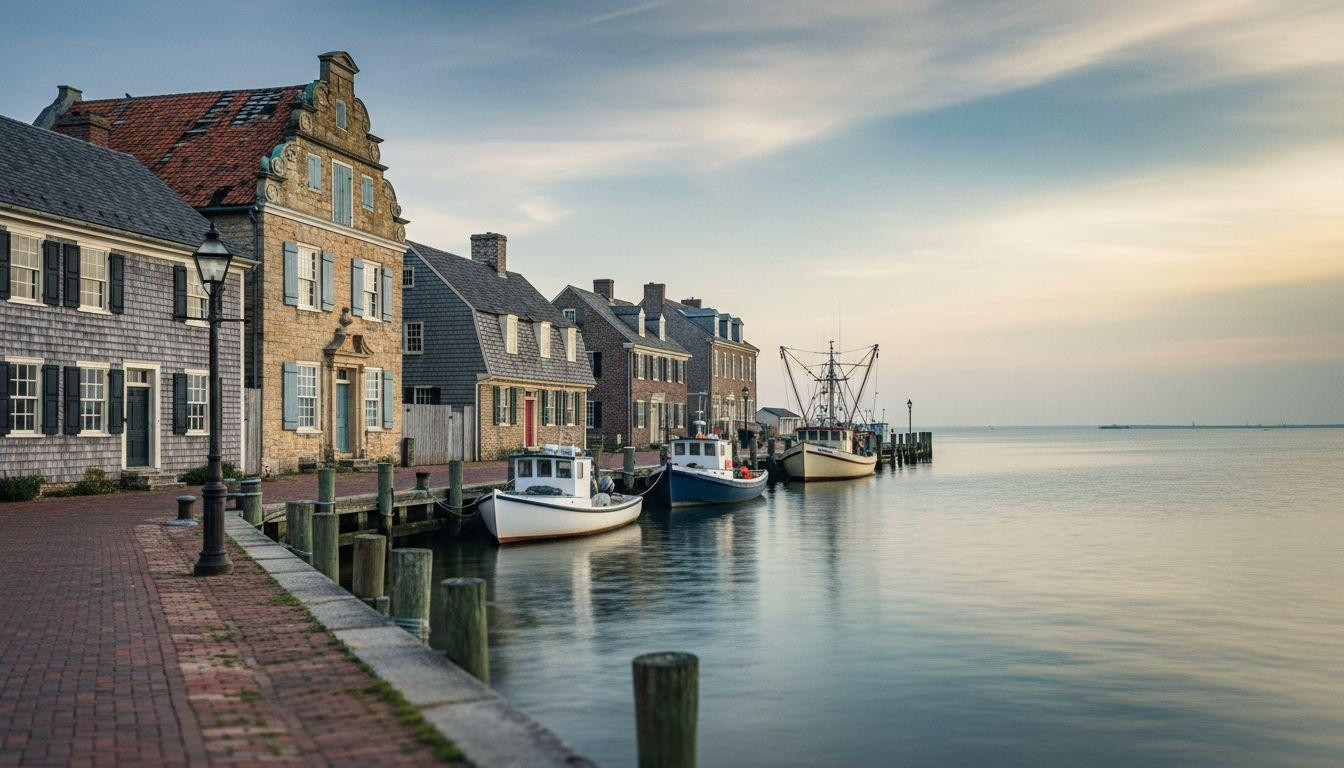
Fog settles over Delaware Bay at 6:30am, turning the colonial shingles of Lewes into soft gray shapes against blue water. Four miles east, Rehoboth Beach wakes to boardwalk crowds and $250 hotel rooms. Here, population 3,400, the harbor still works. Fishing boats leave before dawn. The town that called itself home in 1631 keeps a pace Rehoboth forgot decades ago.
This is the seaport where European settlement in Delaware began, where British cannonballs from 1813 still lodge in house foundations, where you walk streets laid out before William Penn arrived. No beach clubs. No surf shops every 50 feet. Just the oldest town in the First State, quiet on a Tuesday morning in February 2026.
Where the bay meets colonial silence
Lewes sits at the mouth of Delaware Bay where it opens to the Atlantic through Cape Henlopen and Roosevelt Inlet. The geography creates an estuary calm that ocean beaches 4 miles away never know. Water temperature in February hovers at 39°F. Wind comes steady off the bay. Most visitors stay in Rehoboth.
From Washington DC, the drive takes 2.5 hours via US-1 and DE-1. Philadelphia sits 3.5 hours north. Baltimore 2.5 hours west. The nearest airport, Salisbury-Ocean City, connects in 45 minutes. Or take the ferry from Cape May, New Jersey. Fifteen minutes across the bay, $40 to $60 per car. The approach by water shows you what Dutch whalers saw in 1631.
Cape Henlopen State Park frames the eastern edge with 6 miles of dunes meeting estuary water. The Lewes-Rehoboth Canal cuts 4 miles through marshland. In winter, parking lots at the state park sit mostly empty. No reservations needed at Beach Plum Island or most access points. Fee season starts March 1, but February mornings belong to locals and the occasional seal sighting near the fishing pier.
The town that time preserved
Dutch beginnings and British cannonballs
On June 3, 1631, Dutch whalers established Zwaanendael, Swan Valley, as Delaware’s first European settlement. A year later, Lenape warriors destroyed it after a dispute over a stolen coat of arms. Permanent settlement resumed in 1659. William Penn renamed the town Lewes in 1682 after his mother-in-law’s English hometown.
The British Navy bombarded Lewes on April 5 and 6, 1813, during the War of 1812. One cannonball embedded itself in the foundation of what locals now call the Cannonball House. It stayed there. Walk Second Street today and you see the same Federal-style buildings that stood when that cannonball hit. The town earned its designation as First Town in the First State not through marketing but through survival.
Colonial architecture that lives
The Ryves Holt House dates to around 1665, making it the oldest structure in Delaware still on its original foundation. Weathered shingles in soft grays and whites. Gambrel roofs. Federal-style facades in beige and cream against maritime blue. The Zwaanendael Museum, built in 1931, mimics Dutch Renaissance architecture with stepped gables honoring the lost 1631 settlement.
These buildings function as homes, shops, museums. Not preserved behind velvet ropes but integrated into daily life. The Plank House from around 1700 sits near the canal. Historic Lewes, a preservation society established in 1962, maintains 13 properties across town. Each structure tells part of the story without needing to announce itself. You notice the age in the way light hits old glass, in door frames that settled decades before the Revolution.
The experience Rehoboth forgot
Morning on the canal
The Lewes-Rehoboth Canal at dawn stays still enough to reflect clouds. Kayak rentals run $40 to $60 for a few hours. Launch near the Lewes end and paddle east through marsh grass and quiet water. Seals appear sometimes, curious about the movement. No jet skis. No party boats. Just the sound of your paddle and occasional bird calls.
By 8am, fog usually lifts. The water turns from gray to blue-green. You see why locals protect this. Similar coastal towns in the Bahamas or along the Great Lakes share this unhurried maritime rhythm. Places where the water still works for a living.
Maritime rhythms
Fisherman’s Wharf serves blue crab and oysters pulled from Delaware Bay that morning. Meals run $15 to $25. She-crab soup, clam bakes, rockfish specials. The wharf added heated patios in November 2025 for off-season dining. You sit outside in February with a bowl of chowder and watch fishing boats return.
Cape Henlopen State Park charges $5 per vehicle starting March 1. Before that, access stays free most days. The lighthouse, Fort Miles from World War II, walking trails through dunes. Historic Lewes offers walking tours for $20 that cover the 1813 bombardment, Underground Railroad safe houses marked by single candles in upper windows, the evolution from whaling port to quiet residential town. The same stories preserved villages in France tell about surviving without surrendering character.
When winter brings it back
February 2026 brings temperatures between 30°F and 45°F. Wind off the bay cuts through light jackets. This is fog season, when morning light diffuses through moisture and turns the whole town soft-edged. Hotel occupancy drops to 20% or 30%. Rooms that cost $250 to $500 in Rehoboth during summer go for $120 to $180 here in winter.
The town feels most like itself when tourists stay away. Locals walk dogs on empty beaches. The general store sells coffee and newspapers without a line. You understand why 3,400 people choose to live here year-round instead of treating it as a summer escape. Places like Port St. Joe on the Gulf Coast maintain the same balance between welcoming visitors and keeping their own pace.
Your questions about Lewes answered
How do I get there from major cities?
From Washington DC or Baltimore, take US-1 south to DE-1 east, about 2.5 hours. From Philadelphia, follow I-95 to DE-1, roughly 3.5 hours. The Salisbury-Ocean City airport sits 45 minutes away with connections to major hubs. Or drive to Cape May, New Jersey, and take the ferry across Delaware Bay. The ferry runs year-round, takes 85 to 90 minutes, costs $40 to $60 per vehicle. Arriving by water gives you the full estuary experience.
What makes Lewes different from Rehoboth Beach?
Lewes draws roughly 500,000 visitors annually compared to Rehoboth’s 3 million. That difference shows in everything from parking availability to restaurant wait times. Lewes preserves colonial and Federal architecture from the 1600s and 1700s. Rehoboth built a commercial boardwalk. Hotel rates in Lewes run 20% lower on average. The focus here stays on maritime heritage, quiet streets, and estuary access rather than beach clubs and nightlife.
When should I visit to see the real Lewes?
Late fall through early spring, November to March, brings fog, empty streets, and the unhurried pace locals know. February offers the coldest bay water at 39°F but also the most atmospheric mornings. Summer attracts overflow from Rehoboth, though Lewes still maintains more authentic character. Spring and fall provide mild weather, 45°F to 70°F, with fewer crowds than summer. Winter reveals what the town becomes when it stops performing for visitors.
The ferry horn sounds across the bay at 4:30pm. Most day visitors make it back to Cape May with time to spare. The ones who stay watch fog roll in again around sunset, turning the colonial shingles back to gray shapes against darkening water. Tomorrow the fishing boats leave at dawn. The rhythm continues.