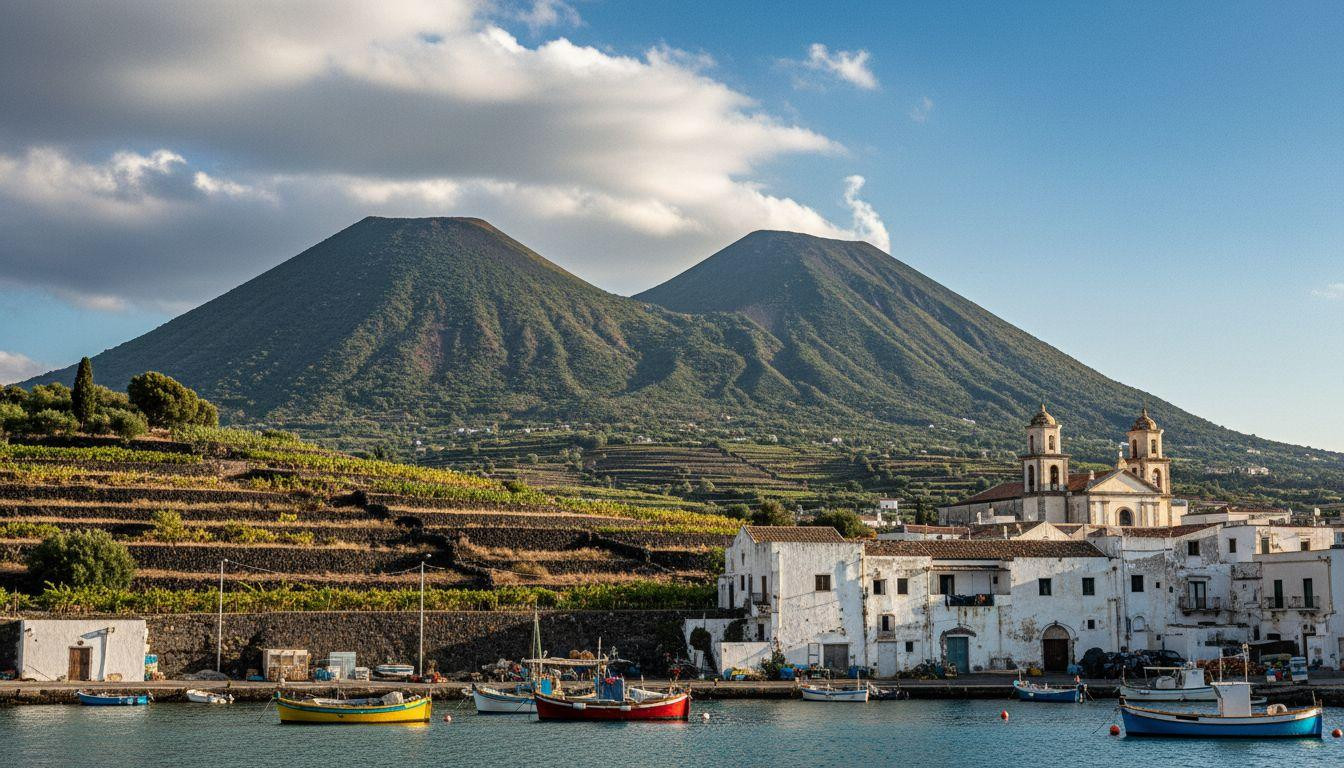
The ferry from Milazzo cuts through morning fog. Then the outline appears: two volcanic peaks rising from the Tyrrhenian Sea, their doubled silhouette unlike any other island in the Aeolian chain. Monte Fossa delle Felci reaches 3,156 feet. Monte Porri stands at 2,822 feet. Between them, terraced vineyards climb black volcanic slopes in neat green rows. This is Salina, population 2,300, where three villages share 10 square miles of the greenest island in the archipelago.
The twin peaks define every view. From Santa Marina’s harbor, they frame the morning light. From Pollara’s beach, they anchor the horizon. From any vineyard trail, they create a doubled rhythm that feels deliberate, almost architectural. These are extinct volcanoes, dormant for 13,000 years, now protected as a nature reserve since 1984.
The twin peaks that define every view
Monte Fossa delle Felci formed between 160,000 and 120,000 years ago. Its crater depression holds a chestnut grove at the summit. The trail from Valdichiesa climbs 2,220 feet over 5.2 miles, taking about 2 hours through ferns, holm oaks, and Mediterranean scrub found nowhere else in the Aeolians.
Monte Porri rises slightly lower but creates the same visual drama. The two peaks connect through a valley called Valdichiesa, where hiking trails branch toward both summits. From the top, the entire archipelago spreads out: Lipari to the east, Stromboli’s smoke plume to the north, Sicily’s coast to the south.
The geology matters because it shaped everything else. Volcanic soil holds water better than the pumice-covered islands nearby. Freshwater springs bubble up where they don’t exist on Vulcano or Stromboli. This abundance created the nickname locals use: perla verde, the green pearl.
Where green replaces arid
The vegetation that earned its nickname
Salina is the only Aeolian island with natural freshwater springs. This single fact explains the eucalyptus groves, the alders along streams, the cypresses that line village roads. While neighboring islands turn brown by July, Salina stays green through summer. The nature reserve protects rare ferns that grow only on these slopes.
The contrast hits immediately. Sicily’s volcanic Aeolian Islands typically show black rock and sparse vegetation. Salina breaks that pattern. Myrtle and heather cover the lower slopes. Strawberry trees produce fruit in autumn. Mountain maples cluster near the peaks.
Malvasia vineyards climbing volcanic slopes
The terraced vineyards produce Malvasia delle Lipari, a sweet amber wine protected by IGP designation. The vines grow in volcanic soil enriched by centuries of ash. Harvest happens in August and September, when grapes reach peak sugar content. Wine trekking tours cost around $77 and include tastings at family-run vineyards.
The visual impact of these terraces matters as much as the wine. They create horizontal lines across vertical slopes, a human geometry imposed on volcanic chaos. From any beach, from any piazza, the pattern repeats: black rock, green vines, blue sky.
Three villages, one unhurried rhythm
Santa Marina’s working harbor
The main port serves 1,200 residents. Fishing boats leave before dawn, return by mid-afternoon with the day’s catch. The morning market sets up near the Chiesa di Santa Maria, a church with twin bell towers that echo the island’s double-peaked profile. Hotel Ravesi offers boutique rooms from $165 per night in February 2026.
The harbor stays functional, not decorative. Nets dry on concrete piers. Locals buy fish directly from boats. The Tyrrhenian coast hides fishing villages tourism forgot, and Santa Marina maintains that authenticity despite ferry arrivals.
Pollara’s sunken crater
The village sits inside a collapsed volcanic crater, its western wall eroded by the sea. This created a natural amphitheater bay where Massimo Troisi filmed Il Postino in 1994. The sea stack at the bay’s edge turns gold at sunset, a moment that draws photographers year-round.
The pebble beach below the village stays quiet even in summer. Access requires a steep path down the crater wall. Most visitors stop at the viewpoint above, leaving the shore to locals and those willing to make the descent.
Lingua’s granita ritual
This fishing hamlet of 700 residents preserves the afternoon granita tradition. Il Gambero serves almond and lemon versions for around $4. The ritual matters: locals gather after the midday heat, sitting at outdoor tables facing the harbor. Salt pans line the shore, remnants of an industry that once defined the village economy.
Colored fishing boats rest in shallow water. The light in late afternoon turns everything soft. This is where the island’s pace becomes most apparent. No one rushes. Conversations extend. The granita melts slowly.
The experience Lipari can’t match
Salina maintains three independent municipalities where Lipari consolidated into one. This administrative detail creates practical differences. Each village keeps its own character, its own rhythm, its own relationship with visitors. Santa Marina handles ferry traffic. Malfa focuses on wine production. Leni stays agricultural.
The caper harvest in August offers participatory experiences. Locals pick the tiny flower buds at dawn, before heat opens them. Visitors can join harvest tours, learning the hand technique required to preserve the buds’ tight form. These capers, protected by IGP status, are considered the archipelago’s finest.
February 2026 brings mild temperatures (50-59°F), fewer ferries, and empty trails. Islands where wine terraces meet volcanic soil offer year-round appeal, but winter on Salina provides something rare: solitude without desolation, quiet without closure.
Your questions about Salina answered
How do you reach Salina?
Fly into Catania Fontanarossa Airport (9 hours from New York) or Palermo (similar distance). From either, reach Milazzo port on Sicily’s north coast. Liberty Lines operates hydrofoils to Santa Marina (1 to 1.5 hours, $11-16 one-way). February schedules run less frequently than summer, so check current timetables before booking. Island-hopping ferries connect to Lipari in 20-30 minutes.
What makes it different from other Aeolian islands?
Freshwater abundance creates the key difference. While Stromboli and Vulcano import water, Salina’s springs support agriculture and dense vegetation. The three independent municipalities maintain local governance that larger Lipari lost through consolidation. This creates village-specific character rather than island-wide uniformity. Mediterranean escapes where February brings warmth without crowds often sacrifice authenticity for tourism infrastructure. Salina balances both.
When should you visit?
May and September-October offer optimal conditions: warm seas (72-77°F), moderate crowds, and harvest season atmosphere. February works for solitude seekers willing to accept cooler water and limited ferry schedules. Avoid August unless you enjoy peak crowds. The caper harvest runs August through September for those interested in agricultural tourism. April through November provides the best hiking weather, with summer months too hot for the twin-peak trails.
The ferry back to Milazzo leaves at 4:30pm. Most visitors make it with time to spare. The twin peaks stay visible until the boat rounds Lipari’s northern cape, their doubled outline the last thing you see before they disappear into afternoon haze.