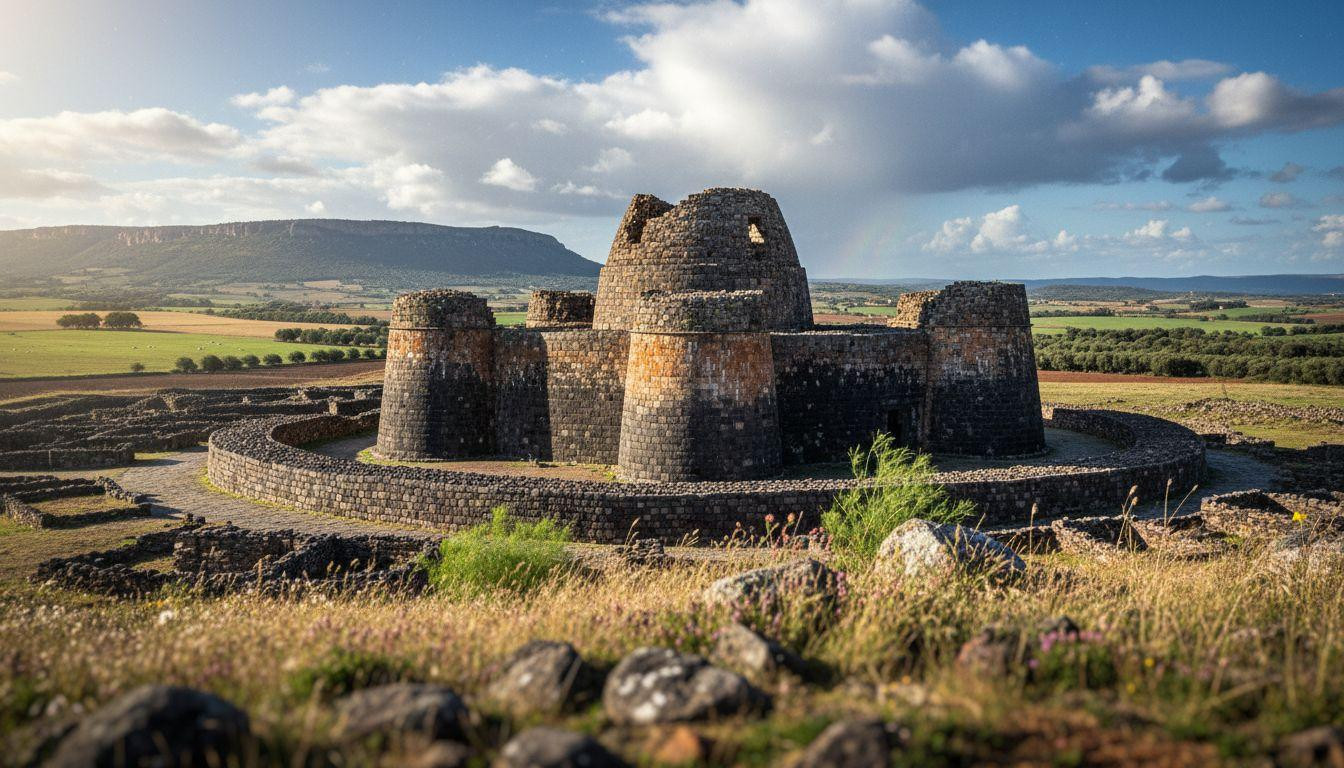
The drive from Cagliari cuts through central Sardinia’s Marmilla region for 45 minutes. Then the towers appear. Dark basalt cones rise from a small plateau, precision-fitted stones creating beehive shapes that have stood 3,500 years. This is Su Nuraxi di Barumini, Sardinia’s only UNESCO World Heritage site and the most complete Bronze Age nuraghe fortress in the Mediterranean. The entrance sits 7 meters high. Inside, scholars still debate what these 7,000 megalithic structures across Sardinia actually were.
Carbon-14 dating places the central tower’s construction at 1478 BC. No one knows why.
Rising from the Marmilla plateau
Su Nuraxi sits at 230 meters elevation, 50 miles south of Cagliari. The central tower dominates, originally 65 feet high, built from basalt quarried from nearby Giara highlands. Dark volcanic rock creates charcoal-gray facades that shift from brown to near-black depending on Mediterranean light angles. Four lateral towers at cardinal points surround the mastio, connected by massive polygonal walls. Seven outer defensive towers create a hexagonal perimeter.
The village of Barumini (population 1,400) sits modest and quiet nearby. No boutique hotels. The general store sells produce and coffee from the same counter. Free parking at the archaeological site means you walk 500 meters through unchanged pastoral landscape before the fortress appears.
The mystery that remains unsolved
Architecture that defies easy answers
The central tower features three overlapping tholos chambers. Corbelled vaults created by progressively stacking stones inward form false domes without binding material. Walls measure 7 meters thick in the oldest sections. The entrance at 23 feet high made the fortress virtually impenetrable to Bronze Age warfare, yet some nuraghe show no defensive advantages. Of 7,000 remaining nuraghe across Sardinia, no two are identical.
A well 26 feet deep still functions after 3,000 years. Water flows from underground sources unchanged since Bronze Age inhabitants drew daily supplies.
Theories from fortresses to sacred spaces
Archaeologists remain genuinely divided. Defensive stronghold evidence includes thick walls, elevated entrance, strategic plateau position. Religious temple evidence includes well structures suggesting ritual use, artifact deposits indicating ceremonial activity. Status marker evidence includes massive resource investment, prominent visibility, continuous occupation through cultural transitions spanning 2,300 years. The mystery persists because all three theories hold weight.
Recent visitor surveys from 2025 reveal travelers appreciate this uncertainty. The site draws 50,000-100,000 visitors annually, far below Mycenae’s 1 million or Knossos’s 1.5 million.
Walking through Bronze Age passages
Inside the fortress complex
Entry costs $15, includes mandatory guided tours departing every 30 minutes. Tours last 1 hour. Modern walkways guide visitors through narrow passages carved into basalt walls, some barely 3 feet wide. Transparent flooring sections reveal excavated settlement layers below. The courtyard well draws your attention because it works. Interior chambers maintain cool temperatures even in summer heat, showcasing passive climate control that Bronze Age engineers understood intuitively.
The labyrinthine village ruins extend around the fortress. Stone lanes, domestic structures, communal spaces create a preserved snapshot of Nuragic daily life. Similar to ancient Greek settlements preserved underwater, Barumini offers intimate access to 3,500-year-old spaces.
The Giara landscape context
Su Nuraxi sits at the foot of Giara plateau, 3 miles away. Pastoral vistas remain largely unchanged from Nuragic times. Rolling grasslands, wild horses (100-200 currently), endemic Mediterranean flora. Walking from the archaeological site through contemporary Barumini village transports you from 1478 BC to present day without commercial tourism infrastructure intervening. Local trattorias serve malloreddus pasta and pecorino cheese for $20-30 per meal.
Quiet presence in modern Sardinia
Despite UNESCO recognition since 1997, Barumini attracts modest visitor numbers compared to coastal destinations. February brings fewer than 5,000 monthly visitors versus summer peaks exceeding 20,000. Fondazione Barumini Sistema Cultura manages the site with protective infrastructure balancing preservation and access. Spring (April-May) and fall (September-October) offer ideal conditions: temperatures 54-72°F, wildflowers, minimal crowds. Winter brings rain but contemplative solitude.
The contemporary village maintains authentic rural Sardinian rhythms. Morning markets, family trattorias, residents continuing pastoral traditions with continuous lineage to Bronze Age herding economies. Unlike commercialized Italian coastal towns, Barumini preserves working agricultural life unchanged by tourism.
Your questions about Barumini answered
How do I visit Su Nuraxi?
Drive from Cagliari airport (45 minutes, 50 miles via SS131 highway). Car rental costs $100-150 for 3 days in February 2026. Limited rail service reaches central Sardinia. Site entry $15 includes mandatory guided tour. Allow 2-3 hours for fortress complex and attached museum. Parking free. Site open 9am-5pm daily, last entry 4pm.
What makes this different from other ancient sites?
Exceptional preservation across multiple construction phases spanning 1,000 years. Continuous habitation through Bronze Age, Phoenician influence, and Roman period creates unique cultural timeline ending 7th century AD. The fundamental mystery distinguishes nuraghe from better-understood Mediterranean civilizations. Similar to overlooked Croatian heritage sites, Barumini offers depth without crowds.
When should I visit?
April-May or September-October for optimal weather (54-72°F) without summer crowds. February requires layers but offers solitude, temperatures 46-59°F with occasional rain. Site accessible year-round. Busiest hours 10am-2pm when guided tours fill. Morning arrivals before 9:30am guarantee immediate tour departure. Like preserved New England villages, Barumini rewards off-season exploration.
Morning light touches the basalt towers around 7:30am in February. The fortress appears almost timeless against Sardinia’s clear sky. Tourists arrive later. The stones keep their secrets.