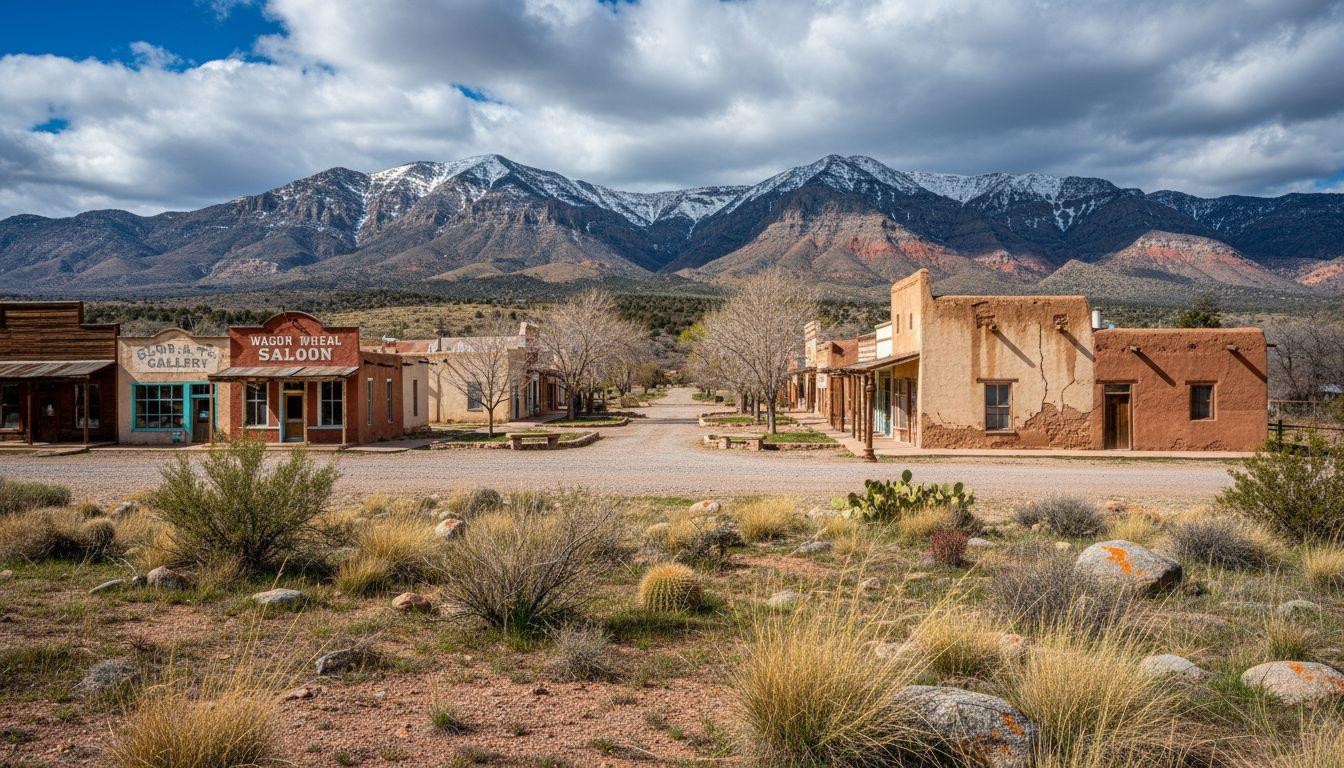
Highway 82 drops through golden Sonoita grasslands and the town appears without warning. Adobe storefronts from the 1850s silver boom line a single street. Population 796. The Patagonia Mountains rise behind town in snow-dusted ridges that hit 10,000 feet. This is southeastern Arizona’s quiet adventure hub where gravel roads spiral into empty canyons and hikers disappear into Coronado National Forest trails you’ll have to yourself.
Tucson sits 60 miles northwest. An hour’s drive trades city sprawl for high-desert solitude at 4,000 feet elevation. The mountains create what locals call sky islands: peaks surrounded by grassland desert that feels more like Tuscany than the Sonoran lowlands. February mornings start at 40°F and climb to 65°F by noon. Perfect for the gravel bike network that loops through creosote-scented valleys.
Where mining boom left frontier architecture
Silver strikes in the 1850s built this town. ASARCO closed the last mine in 1964. What remains: weathered wood facades along the central park, a museum in the old railroad depot, galleries in converted mining offices. The arts community moved in quietly during the 1990s. No gentrification wave. No boutique hotel chains.
The town holds 796 residents who protect the unhurried pace. Global Arts Gallery sells pottery and jewelry in a building that once stored mining equipment. The Wagon Wheel Saloon serves green chili breakfast burritos for $10 at tables where prospectors used to drink. Summer brings Concert Haul performances on a mobile stage. The fall Arts and Crafts Festival fills the park with local work.
Walk the three-block downtown in 15 minutes. Most visitors miss the Telles Family Shrine at mile marker 16 on Highway 82. Vibrant folk art monument locals tend year-round. The kind of detail that reveals itself slowly if you stay past the day-trip rush.
The mountain landscape that defines it
Sky islands rising to 10,000 feet
The Patagonia Mountains form the eastern wall. Mineral-rich peaks that produced 9.2 million ounces of silver historically. Geology creates dramatic compression: valley floor at 4,000 feet, summits at 10,000 feet within 6 miles. February covers the high ridges in snow while the grasslands stay golden and dry.
Coronado National Forest wraps the town. The Arizona Trail Passages 3 and 4 cut through on their way from Mexico to Utah. Trailheads sit empty most mornings. For comparison, Sedona’s red rock trails draw millions annually. Here you’ll count hikers on one hand.
Grassland desert below the peaks
Sonoita Creek flows year-round through cottonwood groves. The Nature Conservancy protects 873 acres as Patagonia-Sonoita Creek Preserve. Entry costs $10 per adult. Trails wind under 130-year-old trees where butterflies cluster in spring. The preserve contributed $23 million to Santa Cruz County’s economy in 2019 through nature-based tourism.
Golden wild grass covers rolling valleys between town and mountains. Creosote bushes dot the landscape. The visual echo of Tuscany’s hills surprises first-time visitors. Different plants, same unhurried beauty. Drought conditions mean the creek runs lower than historical levels but the ecosystem persists.
The gravel road network adventure
Coronado National Forest access
Gravel roads branch from Highway 82 into mountain canyons. No permits required. No entry fees for forest trails. Roadside Rest sits 2 miles north: an unconventional birding hotspot where rare species appear in scrub along the shoulder. Park rangers confirm it yields sightings other locations miss.
The Arizona Trail offers two passages through town. Passage 3 runs north toward the Rincon Mountains. Passage 4 heads south to the border. Both stay quiet compared to popular sections near Flagstaff. Gravel biking events like the Patagonia 50 use these roads but most days you’ll ride alone. Similar solitude to Laramie’s Medicine Bow trails without the Wyoming cold.
Birding without the crowds
The Paton Center for Hummingbirds operates 2 miles from downtown. Free entry, donations accepted. Feeders attract violet-crowned hummingbirds and 10 other species. Peak activity runs 7am to 10am when morning light hits the pavilion. Tucson Audubon expanded facilities in 2025 with better viewing platforms.
Eleven Audubon Important Bird Areas surround town. The preserve’s creek trail delivers butterfly clouds and songbird calls without the tour bus crowds that pack Vermont’s covered bridge villages. Bring binoculars. Locals will point you toward recent sightings if you ask at Gathering Grounds cafe.
Why October through April works
Summer heat hits 95°F in July and August. Monsoon rains arrive unpredictably. October drops temperatures to the 70s. By February you’re looking at 40-65°F days perfect for all-day hikes. April brings wildflowers before heat returns in May.
Low season means cheaper stays. Campgrounds at Patagonia Lake State Park run $25 to $50 per night. B&Bs like Stage Stop Inn and Spirit Tree Inn charge $100 to $180 in winter compared to summer peaks. Circle Z Ranch offers higher-end options around $250. That’s 40% below Sedona’s winter rates for similar mountain access.
Crowds stay minimal year-round. December through February sees slight upticks for birding season. June through August empties out. You’ll find parking at trailheads and tables at restaurants without reservations. The town’s 796 residents outnumber visitors most days.
Your questions about Patagonia answered
How does it compare to Bisbee cost-wise?
Both are former mining towns an hour from Tucson. Bisbee’s bohemian reputation draws more tourists. Hotels there run $100 to $300 per night. Patagonia stays quieter with rates 20-30% lower. Same authentic mining architecture, fewer crowds, better value for multi-day stays.
Is it actually empty or overhyped?
Population 796 creates real small-town scale. Nature-based tourism brings tens of thousands annually but spreads them across trails and preserves. You won’t find Sedona-level congestion. Morning hikes often mean solitude. The under-the-radar status holds because there’s no major resort development pushing visibility.
Can you do it as a Tucson day trip?
The 60-mile drive takes an hour each way. Possible itinerary: morning trails at the preserve, lunch at Velvet Elvis pizza ($15-25), afternoon at Paton Center, sunset from Roadside Rest. But staying overnight lets you catch dawn birding and evening quiet when day-trippers leave. Two nights gives the town time to reveal itself.
Morning fog lifts around 8am in February. The grasslands turn gold under clear light. Hummingbirds work the feeders in silence. This is the moment most visitors miss by arriving late or leaving early.