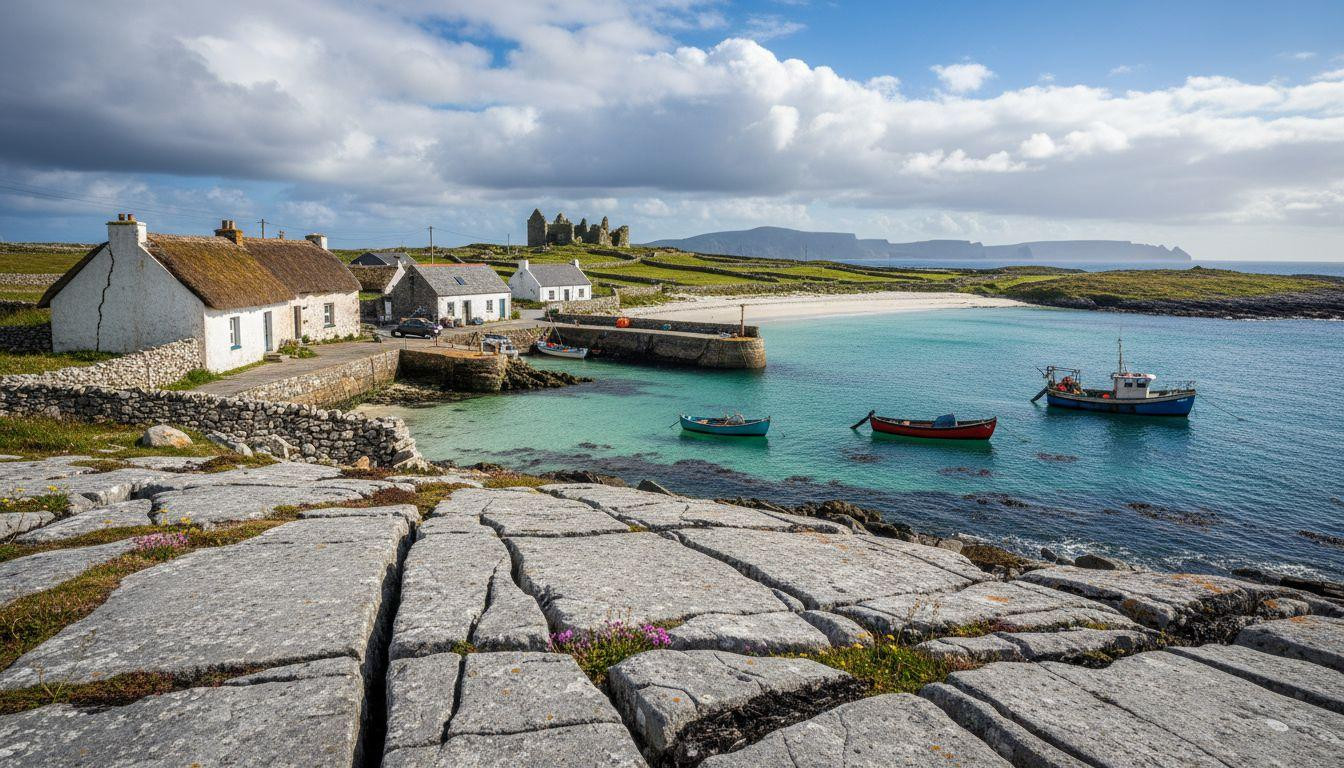
The ferry from Doolin takes 20 minutes. Most passengers head to Inis Mór, the largest Aran Island, where tour buses clog single-track roads and 200,000 annual visitors crowd Dún Aonghasa fort. You step off at Inis Oírr instead. Population 298. The pier is quiet. Three bike rental shops, one café, limestone walls stretching toward O’Brien’s Castle ruins on the hill. This is what the Aran Islands felt like before tourism arrived.
Why Inis Mór feels like work
Inis Mór spans 31 square kilometers. Exploring it requires a full day, pony trap tours costing $55-77, or hours of cycling uphill roads. Dún Aonghasa sees 1,000 daily visitors in summer. Tour buses arrive from Galway ferries every 40 minutes. Rick Steves calls it a “hectic day-tripper scene.” The island delivers spectacular cliff forts and ancient monasteries, but you share them with crowds who arrived on the same schedule you did.
Inis Oírr measures 1.4 square kilometers. You can bike the entire perimeter in two hours. The ferry from Doolin costs $32 round-trip, same as Inis Mór from Galway, but cuts travel time by half. Winter ferries from Doolin cancel 10% less often than Galway departures. February 2026 means one or two crossings daily, weather permitting. The shorter crossing handles Atlantic storms better.
Meet Inis Oírr: bikeable, authentic, empty
Landscape on human scale
Golden limestone walls crisscross emerald fields. The north beach stretches one kilometer of white sand. Turquoise water stays calm in Galway Bay’s shelter. O’Brien’s Castle sits 75 meters above sea level, a 20-minute walk from the pier. The 360-degree view shows the Cliffs of Moher eight kilometers west, the Burren’s gray limestone north, Galway Bay’s islands east. Morning fog burns off by 10am most days. The Plassey shipwreck rusts on rocks near the lighthouse, a 1960 cargo vessel storm-beached intact.
Every path connects. Pier to castle, castle to lighthouse, lighthouse to Sunken Church. An Teampall Chaomháin sits half-buried in sand dunes, an 8th-century monastery the tides expose and hide. Stone walls everywhere, built without mortar from limestone and seaweed. Over 2,000 kilometers of walls on 1.4 square kilometers. Families inherit land here. Nobody sells.
Real Gaelic life, not performance
Irish is the first language for 70-80% of residents. You hear it in shops, at the pier, in pub conversations. Inis Mór speaks more English to accommodate tour groups. Here the language lives in daily use, not signage. Ten to fifteen fishing boats still work from the harbor. Dulse seaweed harvesting continues. Currach boats, traditional canvas-covered frames, sit upturned on beaches.
Tigh Ned pub hosts trad sessions Friday and Saturday nights, 9:30pm start. Local musicians only. No tourist performances. The Inis Oírr Hotel runs sessions other nights. You sit with fishermen and farmers who’ve played these tunes since childhood. Similar authentic island experiences exist across Europe, but few this close to major tourist routes.
Experience without the crowds
The ferry choice nobody tells you
Doolin sits 15 minutes by boat from Inis Oírr. Galway requires 40 minutes to reach Inis Mór. Doolin ferries handle winter weather better due to shorter exposure. February 2026 crossings run daily when conditions allow. The Doolin route costs $32 round-trip. Galway ferries charge $40-45. Doolin also puts you closer to the Cliffs of Moher, combining two destinations in one day.
Most visitors choose Inis Mór because guidebooks emphasize Dún Aonghasa. They spend six hours in crowds, return exhausted. Inis Oírr delivers the same limestone landscape, Gaelic culture, and Atlantic drama in three unhurried hours. You have time to talk with locals, sit on the beach, watch sunset from O’Brien’s Castle without tour groups blocking views.
Where your day actually goes
Morning arrives with golden light on the north beach. Empty from 8-10am. Water temperature hits 59°F in February, cold but swimmable for hardy types. Locals walk dogs here. Gulls and cormorants call from rocks. The beach curves into protected coves where families gather in summer. February keeps it quiet.
Midday brings the walk to An Teampall Chaomháin and the lighthouse. Two kilometers of stone-walled paths. The church sits in shifting dunes, half-exposed. Tides and wind reveal more or less of the structure each visit. The 19th-century lighthouse offers views back toward the Cliffs of Moher. Atlantic lighthouses share this dramatic positioning between land and open ocean.
Afternoon means O’Brien’s Castle. The climb takes 20 minutes from the village. Stone ruins of a 14th-16th century O’Brien fortress. Panoramic views of Galway Bay, the Burren, the Atlantic. Fewer than 20 visitors on winter days. Summer brings maybe 100, still 90% less than Dún Aonghasa. Sunset aligns southwest over the ocean in February, the Cliffs of Moher silhouetted black against orange sky.
Evening returns you to the village. Three restaurants operate year-round. Tigh Ned serves fresh crab for $28-33, caught that morning. The café behind the church charges half the waterfront prices. Someone’s living room opens as a restaurant on Fridays, locals only. Small coastal communities across Europe maintain this intimate scale.
Practical realities
Accommodation runs $88-110 per night in February 2026. Óstán Inis Oírr, the main hotel, charges $110-132. Tigh Ned offers rooms for $99-121. South Aran House stays around $88-110. Book ahead for May-September when ferries run more frequently. Winter means calling to confirm openings. Many places close November-March.
Bike rental costs $17-22 per day at the pier. Three shops compete, keeping prices reasonable. The island’s compact size means even casual cyclists complete the loop easily. No hills except the castle climb, which you walk. Food costs less than mainland Ireland. Fish and chips run $17-20. Pub lunches cost $13-17. Fresh seafood dinners range $28-44.
Best months are May-September for ferry reliability and weather. February offers solitude and storm-watching drama, but ferries cancel in high winds. Remote Atlantic islands share this seasonal trade-off between crowds and accessibility.
Your questions about Inis Oírr answered
How does Inis Oírr compare to Inis Mór for first-time visitors?
Inis Mór delivers iconic cliff forts and extensive prehistoric sites across 31 square kilometers. It requires a full day, costs $55-77 for pony trap tours, and sees 200,000 annual visitors. Inis Oírr offers the same limestone landscape, Gaelic culture, and Atlantic setting in 1.4 square kilometers. You explore it in 2-3 hours by bike for $17-22. It receives 50,000-100,000 annual visitors, 75% fewer crowds. Choose Inis Mór for archaeological spectacle. Choose Inis Oírr for authentic island life.
Is Irish really spoken daily on Inis Oírr?
Yes. Approximately 70-80% of the 298 residents speak Irish as their first language in daily life. You hear it in shops, at the pier, in pub conversations. This contrasts with Inis Mór, where tourism has shifted more interactions to English. Inis Oírr maintains Gaeltacht status, meaning Irish language and culture receive government protection. The fishing fleet, seaweed harvesting, and traditional music sessions all operate primarily in Irish.
Why take the Doolin ferry instead of the Galway ferry?
The Doolin-Inis Oírr crossing takes 20 minutes versus 40 minutes from Galway to Inis Mór. Doolin ferries cost $32 round-trip, similar to Galway’s $40-45. The shorter crossing cancels 10% less often in winter storms. Doolin also positions you near the Cliffs of Moher, allowing two destinations in one day. Galway ferries serve primarily Inis Mór, the busiest island. Doolin focuses on Inis Oírr and Inis Meáin, the quieter alternatives.
February sunset drops behind the Atlantic at 5:45pm. The castle ruins turn gold, then gray, then black against orange sky. Fishing boats return to harbor. Lights come on in village windows. The pub fills with locals speaking Irish. You realize this is what the Aran Islands were before anyone wrote guidebooks about them.