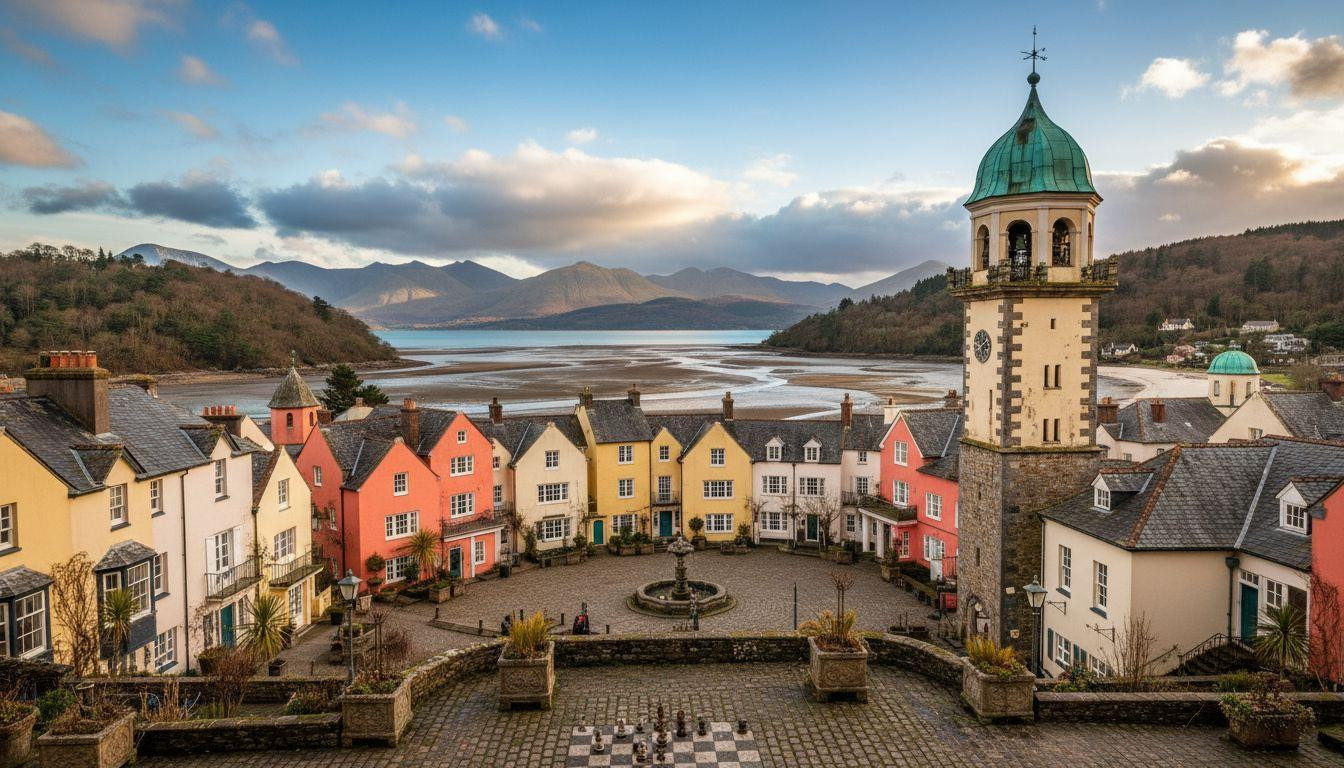
The ferry from Porthmadog cuts through morning mist, and suddenly the peninsula appears. Pastel towers rise against Welsh green. Ochre walls, pink facades, terracotta roofs. This is Portmeirion, where architect Clough Williams-Ellis spent 50 years proving Mediterranean fantasy could root itself in North Wales coastal rock. Population zero. Visitors 200,000 annually. Entry $20 winter 2026.
Eight cinematic moments wait across 70 acres. Italian piazzas meet subtropical woodlands. Gothic salvage frames estuary views. The village that starred as “The Village” in 1967’s The Prisoner still feels like walking onto a film set where the cameras never stopped rolling.
Central piazza where pastel colors defy Welsh gray
The heart holds a cobblestone square ringed by color-washed buildings. Ochre, pink, yellow, terracotta. The Gloriette fountain (salvaged from a demolished Bristol structure in the 1950s) anchors the center. A 20-foot chessboard offers free pieces for public games. Locals call this the soul of Williams-Ellis’s vision.
Morning light hits best between 8-9am before crowds arrive. The mist burns off the Dwyryd Estuary by 9am most February mornings. Golden hour in winter (4-5pm) paints the facades amber. Caffi’r Sgwâr serves Welsh rarebit for $12, gelato for $5, coffee for $4. Average meal runs $20-35.
Audio guides cost $6 and include Williams-Ellis narrating his own creation. His voice explains why he chose each color, why he placed the fountain exactly here. Arrive before 10am for empty piazza photographs. By noon, 200 daily winter visitors fill the square.
Campanile bell tower frames Snowdonia peaks
The 70-foot Venetian-inspired tower dominates the skyline. Its bell came from Venice in 1931. Climb 108 steps for 360-degree views: Snowdon 9 miles northeast, Cnicht 5 miles north, Moel yr Hydd 6 miles east. The estuary spreads turquoise below.
Tower hours run 9:30am-4:30pm, but wind above 30mph closes access. February 2026 sees frequent closures after 4pm. Sunrise climbs (winter sunrise 8am) offer mist-thick estuary views. The chimes ring every hour, audible across the village. Photography works best with wide-angle lenses.
Winter reveals what summer foliage hides. Receding greenery exposes stone details, salvaged corbels, hidden archways. The tower’s Ionic columns came from demolished UK buildings. Williams-Ellis called this “propaganda for good manners through architecture.” Similar coastal drama appears in Maine’s fog-wrapped lighthouses, but Portmeirion adds Mediterranean color.
Battery Square preserves cult TV history
Round House stands at Battery Square’s edge. This was “Number 6’s” home in The Prisoner, filmed 1967-68. Patrick McGoohan walked these cobblestones. The interior now sells memorabilia: mugs $10-30, posters $50, DVDs $25. Free maps at the Welcome Centre mark filming locations.
Self-guided tours take 45 minutes. The square’s pastel buildings haven’t changed since cameras rolled. Fans visit in May for the annual Prisoner Convention. Off-season means no wait for interior access. McGoohan once said this was “a place of beauty and fantasy.” He visited in 1966 before filming began.
The show’s surreal tone matched Williams-Ellis’s vision. Both created worlds that felt simultaneously real and impossible. Battery Square stays quiet most winter mornings. By 11am, tour groups arrive. The upper terrace beyond the square offers solitude even at peak times.
Y Gwyllt woodlands hide Japanese pagodas in Welsh forest
The Wild (Y Gwyllt in Welsh) spreads 70 acres of subtropical forest behind the village. Over 50 exotic species grow here: Japanese cedars, Himalayan rhododendrons, Tasmanian myrtles. A 1.5-mile loop trail passes the Dog Cemetery, where 12 gravestones mark pets from Williams-Ellis’s family. One reads “Beloved Taffy, 1932-1945.”
The 1928 Japanese pagoda hides deep in the woods, gold leaf still visible on its eaves. Lily ponds reflect moss-covered stones. Tangle Wood’s hidden groves feel like stumbling into Kyoto. The 20-mile trail network connects to coastal paths reaching Harlech 9 miles south.
Winter strips the canopy, exposing stone sculptures and hidden benches. Boots help on boggy paths. The Ghost Garden (named for its white flowers) blooms March weeks 2-3. Azaleas and camellias follow. But February’s bare branches reveal architecture summer hides. Similar woodland escapes exist in Vermont’s preserved villages, minus the Mediterranean flourish.
Clifftop grotto meets 15-foot tidal swings
Basalt cliffs rise 205 feet above the Dwyryd Estuary. The stone grotto (built 1960s from local slate) offers cave exploration at low tide. Tidal range hits 15 feet, creating 2-hour windows for safe access. Oystercatchers and herring gulls nest on cliff faces. The Irish Sea meets the estuary here.
Sunrise at 8am February lights the water gold. Mist typically clears by 9am, revealing Snowdonia’s peaks across the bay. The Rotunda viewpoint sits 100 yards from the grotto, perfect for contemplation. Tide tables appear on the Tides Near Me app or at the Welcome Centre toll booth.
High tide blocks grotto access but creates dramatic wave action against the cliffs. Low tide exposes white sand beaches and hidden coves. Shell-hunting yields cockles and whelks. The 50-foot-deep cave requires caution: check tide times before entering. Local tourism boards confirm February sees the quietest clifftop access all year.
Bristol colonnade frames salvaged UK grandeur
Twelve Ionic columns stand in perfect formation, salvaged from Bristol’s demolished Royal Hotel in 1958. The Gothic Pavilion beside them came from an 1830s London mansion demolished in 1962. Williams-Ellis rescued over 20 structures from UK demolition sites, incorporating them into his fantasy village.
The colonnade frames harbor views through its arches. Golden hour (4-5pm winter) creates dramatic shadows through the columns. Photography works best with the estuary as backdrop. Each column bears original weathering from its Bristol life. The Gothic Pavilion’s interior shows Victorian craftsmanship: carved oak, stained glass, plaster moldings.
This salvage philosophy defined Williams-Ellis’s approach. He called it “cherish the past, adorn the present, construct for the future.” Similar preservation efforts shape Ireland’s painted villages, but Portmeirion’s scale exceeds most UK examples. The colonnade stands as proof that demolition need not mean destruction.
Dwyryd beach stretches white sand below colorful towers
A 0.6-mile white sand beach curves along the estuary’s edge. Three unnamed caves punctuate the shoreline. Low tide exposes shell beds: cockles, whelks, razor clams. The beach sits 20 minutes’ walk from the village center via woodland trails. No facilities exist here, so pack water and snacks.
Kayak rentals run May-September through Estuary Adventures: $25 per hour, $100 per day. Winter access means empty sands. The beach faces southeast, catching morning sun. By afternoon, the village’s pastel towers glow above the treeline. Coastal paths connect to Harlech 9 miles south, a moderate 5-hour hike.
The contrast defines Portmeirion’s appeal. Mediterranean architecture meets Welsh coastal wild. Italian fantasy roots in Celtic rock. The beach proves Williams-Ellis understood how civilized design could enhance, not dominate, natural beauty. Similar coastal contrasts appear in Croatia’s painted peninsulas, but Wales offers this without the crowds.
Triumphal arch frames alpine vistas from terraced gardens
The 25-foot arch crowns the upper terrace, framing Snowdon 9 miles north and Cnicht 5 miles northeast. Terraced gardens cascade down toward the estuary. Azaleas and camellias bloom March weeks 2-3, magnolias follow. February shows bare branches but clearer mountain views.
Sunset at 5:15pm (February 2026) paints the arch gold. Locals claim this as their secret spot after day visitors leave. The upper terrace stays quietest all day, perfect for solo reflection. Williams-Ellis designed the arch to echo Roman triumphs, but the view is pure North Wales.
Gardens hold 50+ plant species: rhododendrons, Japanese maples, Himalayan pines. The terrace offers the village’s best panorama: estuary below, mountains beyond, pastel towers between. This is where Williams-Ellis’s vision crystallizes. Fantasy architecture can frame natural grandeur without competing. The arch proves his point daily.
Your questions about Portmeirion answered
When should I visit to avoid crowds?
November through March sees 200 daily visitors versus 5,000 summer peak. February 2026 offers quiet access with winter pricing: $20 entry (online advance sometimes $12-13). The Central Piazza empties before 10am. Upper terrace and Triumphal Arch stay quiet all day. Spring blooms (March weeks 2-3) draw moderate crowds. Fall foliage peaks in October. Summer (June-August) brings maximum visitors but warmest weather.
How does Portmeirion compare to actual Italian villages?
Portofino hotels average $300-500 nightly versus Portmeirion’s $190-320 (Hotel Portmeirion winter rates). Cinque Terre charges $13 trail permits versus Portmeirion’s $20 all-access entry. Italy sees millions of annual visitors. Portmeirion hosts 200,000. The Welsh village delivers Mediterranean aesthetics without transatlantic flights, passport hassles, or Italian summer crowds. Williams-Ellis created fantasy, not reproduction. The architecture evokes Italy but remains distinctly Welsh in its coastal setting.
What practical details matter for planning?
From Caernarfon (25 miles, 45-minute drive via A487), Porthmadog train station (5 miles, $12-19 taxi, 10-15 minutes), or Manchester Airport (3 hours). Entry $20 adult winter, parking free with EV charging. Open 9:30am-5:30pm (last entry 4:30pm). Hotel Portmeirion: $190-250 winter, $380+ summer. Nearby Porthmadog B&Bs: $100-150. Caffi’r Sgwâr meals: $20-35. Audio guide: $6. Combine with Caernarfon Castle (25 miles north) or Snowdonia hikes. Tide tables via Tides Near Me app or Welcome Centre charts.
The ferry back to Porthmadog cuts through 5pm mist, and Portmeirion’s towers blur into watercolor. Eight cinematic moments in 70 acres. Italian piazzas, Welsh woodlands, Victorian salvage, cult TV history. $20 entry, zero passport hassle. Williams-Ellis spent 50 years proving fantasy architecture could anchor itself in real coastal rock and stay timeless. Return in winter for fog-thick quiet, spring for blooming gardens, summer when locals claim the clifftop at sunset. Portmeirion stays strange, stays cinematic, stays itself.