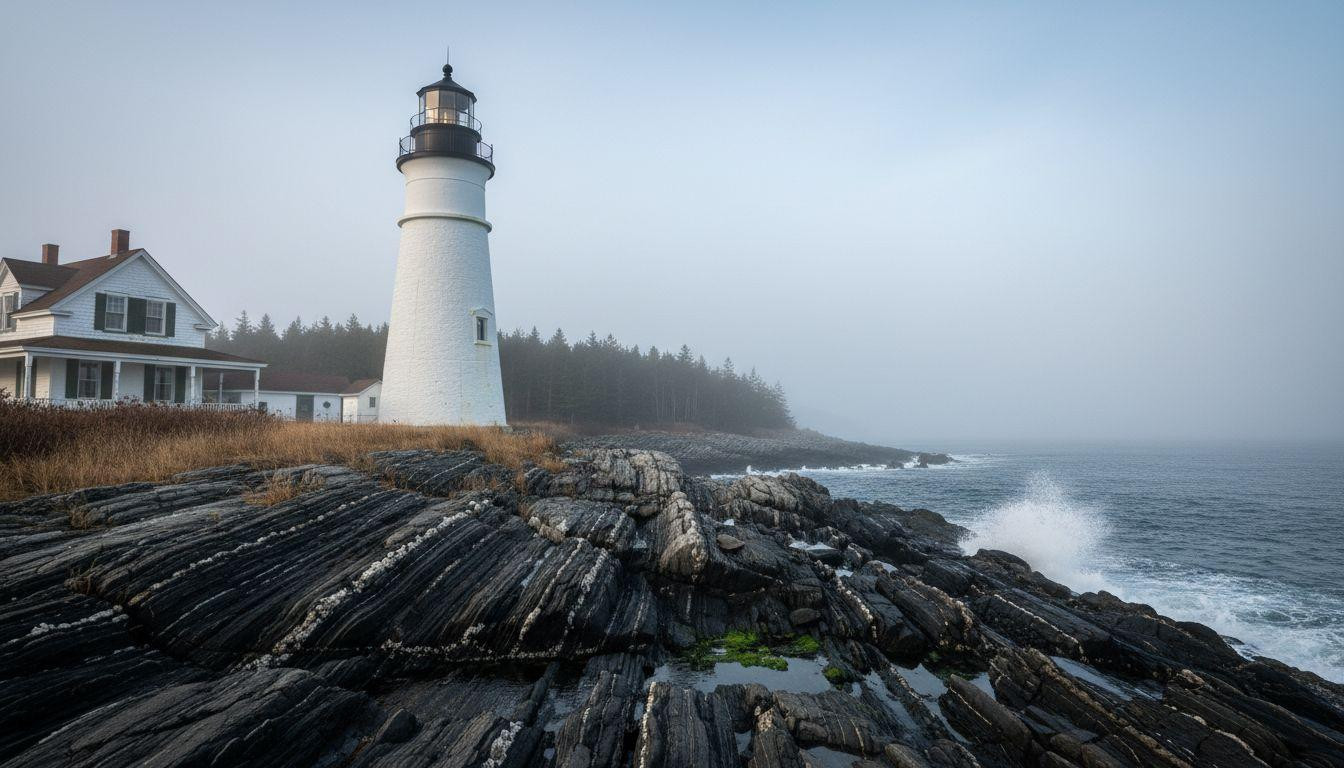
The fog rolls into Pemaquid Harbor at 6am most February mornings. By 7am it hides the white tower on the rocks. By 9am the sun burns through and the lighthouse appears like a ghost becoming solid. This is midcoast Maine in winter: 2,800 residents, six working lighthouses within 30 miles, and almost no tourists. Lodging runs $80 to $120 per night. The rocky Atlantic coast stays quiet. The towers still flash for lobster boats.
6 colonial lighthouses where fog hides granite towers and Atlantic waves crash empty
Pemaquid Point Light sits at the southern tip of Bristol on 400-million-year-old metamorphic rock. The current tower dates to 1835 after the first one crumbled from saltwater mortar. A fourth-order Fresnel lens installed in 1856 still operates. The Coast Guard automated it in 1934. It became the first lighthouse on U.S. currency when Maine voters chose it for the 2003 state quarter.
The keeper’s house holds a Fishermen’s Museum with maritime artifacts. A January 2024 storm destroyed the 19th-century bell house. Local volunteers rebuilt it by September. The town of Bristol bought the property in 1940 for Lighthouse Park. Friends of Pemaquid Point Lighthouse manage it now. The tower opens Memorial Day through Columbus Day for $5 climbs. February means external viewing only.
Marshall Point Light stands 15 miles north in Port Clyde. A 31-foot white tower connects to the keeper’s house via wooden walkway. Tom Hanks ran to the end of that walkway in Forrest Gump. The 1857 station overlooks a working harbor where lobster boats still moor at dawn. The St. George Historical Society runs a museum in the keeper’s house from May to October. Winter visitors walk the breakwater and photograph the tower from multiple angles.
The working harbor context that makes these different from museum sites
Owls Head Light sits 5 miles from Rockland on a 100-foot promontory. The current 30-foot tower dates to 1852. A Coast Guard family still lives in the keeper’s house. This makes it the last inhabited lighthouse station in Maine. The fourth-order Fresnel lens flashes every 15 seconds. Owls Head State Park surrounds the light with trails through spruce forest down to rocky beach. Seals haul out on offshore ledges in winter. Bald eagles hunt the coves.
Rockland Breakwater Light requires a mile-long walk over granite blocks. The breakwater took 18 years to build starting in 1881. The 1902 lighthouse sits at the terminus: white clapboard house with square tower and green lantern room. Friends of Rockland Breakwater Light restored it after the Coast Guard decommissioned it in 1964. The keeper’s house opens for tours Memorial Day through October. February means a 40-minute walk each way over uneven granite with no railings. Ice cleats help. Wave splash can reach 10 feet on stormy days.
The fog timing that creates drama
Curtis Island Light guards Camden Harbor entrance. The 1896 station features unusual green trim instead of the standard white or red. A Coast Guard family uses the keeper’s house seasonally. The 14-acre island sits one mile offshore. No public ferry runs. Kayak rental costs $50 for a half-day in summer. February crossings require cold-water experience. Most visitors view the light from Camden Harbor Park using telephoto lenses. The harbor’s windjammer schooner fleet docks for winter. Three tall ships sit idle while Curtis Island’s fourth-order lens keeps flashing.
Fort Point Light marks where the Penobscot River meets the sea in Stockton Springs. The square bell tower dates to 1836. This makes it unique among Maine’s mostly conical towers. Fort Pownall ruins surround the light: moss-covered stone walls from a 1759 British garrison. Fort Point State Park preserves 157 acres of earthwork fortifications. A one-mile riverbank trail passes mudflats where wading birds feed at low tide. Osprey platforms dot the shoreline. The keeper’s house remains a private residence. The tower stays closed but grounds stay open year-round.
The cost reality vs summer pricing
These six sites form a natural loop. Start at Pemaquid Point heading north. Drive Route 1 through Bristol to Port Clyde for Marshall Point. Continue to Rockland for Owls Head and the breakwater. Camden sits 20 miles north for Curtis Island views. Fort Point requires 40 more miles to Stockton Springs. Total driving: 60 miles over 2 to 3 hours. Add stops and you need a full day. February advantages include zero crowds and peak atmospheric conditions. Storms heighten wave drama. Fog creates mystery. No summer tour buses block parking.
Rockland makes a logical lodging base. Five motels charge under $120 per night in winter. The Farnsworth Art Museum displays maritime paintings and Wyeth family works for $20 admission. Maine Lighthouse Museum holds 65 Fresnel lenses for $8. Camden’s windjammer fleet docks nearby with vessels built in the 1800s. Meals run $15 to $25 at local spots. Lobster rolls cost around $20. Clam chowder goes for $12.
What you actually experience at each lighthouse
Pemaquid Point offers the most dramatic rock formations. Black granite ledges descend in layers to crashing surf. Sneaker waves have killed visitors who stood too close. Warning signs mark dangerous spots. The Pemaquid Art Gallery sits adjacent with nautical woodwork and lighthouse models. Fort William Henry ruins stand half a mile away: colonial stone foundations overgrown with moss. Dawn visits catch fog lifting around 8am. Sunset backlights waves for 10 minutes of gold light.
Marshall Point’s wooden walkway creates a unique composition. Photographers shoot the tower from the shore looking out. The black granite breakwater extends 60 feet into Port Clyde harbor. Lobster boats depart between 6am and 8am. The Port Clyde General Store dates to 1868 with unchanged interior. Monhegan Island ferry docks nearby but suspends service in winter. Oregon’s Heceta Head Light shares similar fog patterns on the Pacific side.
The food and local products worth finding
Owls Head’s quarter-mile trail winds through coastal forest. The wooden staircase up to the light offers harbor views through spruce branches. The rocky beach below holds tide pools and driftwood. Best light comes between 4pm and 5pm in winter when low sun backlights the tower. Seals appear on offshore ledges most days. Eagles perch in protected coves. The site stays quiet enough to hear only waves and wind.
Rockland Breakwater demands physical effort. The granite blocks sit uneven with gaps between. No railings exist. Ice covers sections in February. The walk takes 30 to 40 minutes each way. Mid-breakwater views look back at Rockland’s waterfront. Lobster boats navigate the channel all day. The Samoset Resort sits nearby with a public café charging $18 for entrées. Marie Reed Memorial Park provides free parking and restrooms. Bring a headlamp for sunset walks since no lights illuminate the breakwater.
The emotional pull of empty maritime heritage
Curtis Island requires patience. Harbor views from Camden Harbor Park work best with 200mm or longer lenses. The green trim shows clearly on bright days. Winter fog often obscures the island until mid-morning. Local kayak guides offer summer crossings but February water temperatures drop to 38°F. The town maintains the island as a preserve. Three restaurants line Camden Harbor. The one behind the church costs half what the waterfront place charges. Mount Battie rises 800 feet above town with an aerial view of the harbor and Curtis Island for $3 park entry.
Fort Point combines lighthouse and military history. The fort’s earthwork walls create geometric patterns under snow. Interpretive signs explain the 1759 British garrison that held 400 soldiers. The Penobscot River channel still guides commercial shipping. Mudflats at low tide expose foundation stones. Osprey return in March to nest on platforms. The site sees maybe 50 visitors per month in winter versus 500 in summer. Lubec’s Quoddy Head Light sits 60 miles east with similar isolation.
Your questions about midcoast Maine lighthouses answered
When do these lighthouses offer the best photography conditions?
February provides 22 fog days on average at Pemaquid Point according to National Weather Service data. Fog typically rolls in around 6am and lifts between 8am and 10am. This creates dramatic reveal moments as towers emerge from mist. Winter storms generate higher waves against granite rocks. Low sun angles between 4pm and 5pm backlight towers and create long shadows. Summer offers clear skies but brings crowds to parking areas. Overcast days work better than bright sun for capturing fog texture and moody atmosphere.
How do these compare to Portland Head Light in terms of crowds and access?
Portland Head Light draws approximately 500,000 visitors yearly. These six midcoast stations see combined traffic around 50,000. Pemaquid Point gets the most at roughly 15,000 annual visitors. February reduces those numbers by 90 percent. Portland Head charges $2 parking and sees tour buses daily. These sites offer free parking except where noted. No gift shops exist at most locations. Vermont’s Grafton village maintains similar authentic preservation 4 hours west.
What makes February specifically worth the cold for lighthouse visits?
Winter storms create the wave drama that makes lighthouse photography compelling. Fog frequency peaks in February and March. Empty parking lots mean unobstructed views and no waiting for photo angles. Lodging costs 40 percent less than summer rates. Rockland and Bristol motels charge $80 to $120 versus $150 to $250 in July. Local restaurants serve the same lobster rolls for the same $20 but with immediate seating. The working harbor context becomes clearer when tourist crowds disappear and only fishing boats remain active.
Portland Head Light fills parking by 10am most summer days. Pemaquid Point’s lot holds 30 cars and stays half empty in February. The Rockland Breakwater sees maybe a dozen walkers per day versus hundreds in August. Curtis Island sits in fog-shrouded silence. Fort Point’s trails show only your footprints in snow. The towers keep flashing. The fog keeps rolling. The granite keeps standing against Atlantic waves. This is what 1835 looked like before tourism existed. February preserves that.