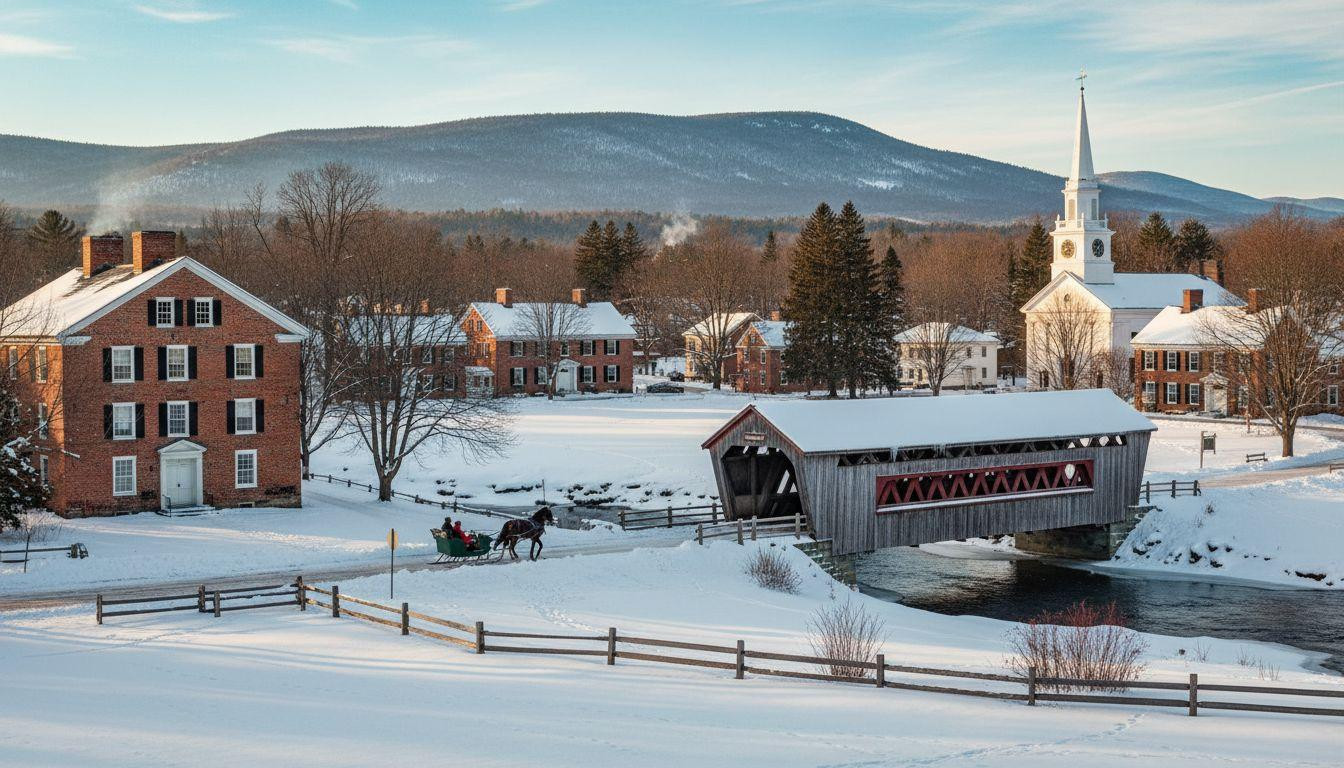
Route 4 curves through eastern Vermont and the village appears without warning. Red brick buildings cluster around an oval green. A white church steeple rises against Mount Tom’s snowy ridge. Population 3,000. Two hours from Burlington. This is Woodstock in February 2026, where Federal-era architecture from the 1790s still frames daily life and preservation ordinances keep chain stores out.
The village feels like stepping into a snow globe someone forgot to shake. Horse-drawn sleighs cross pastures at Billings Farm. Wood smoke drifts from chimneys built in 1807. The Ottauquechee River runs under covered bridges that predate the Civil War.
The architecture that fire couldn’t erase
Woodstock’s red brick dominance has a practical origin. After early wooden structures burned in the late 1700s, builders switched to fireproof materials. The result: 95 contributing buildings in a 275-acre historic district listed on the National Register in 1973. Federal-style homes with symmetrical facades line Elm Street. Greek Revival columns frame the Windsor County Courthouse from 1855.
The village green started as a small triangle donated by Israel Richardson in 1787. It expanded to its current boat shape in 1793, then received transplanted trees in 1830. Today it anchors the town center where locals gather and tourists photograph the First Congregational Church’s white steeple.
Three covered bridges span the area. Middle Bridge crosses the Ottauquechee in town. Taftsville Bridge, Vermont’s second-longest at 165 feet, powers a small hydroelectric dam three miles east. Lincoln Bridge sits north on Route 4. All three remain functional for vehicle traffic.
The national park that started in a dairy barn
Marsh-Billings-Rockefeller National Historical Park occupies 550 acres on Mount Tom’s slopes. It’s Vermont’s only national park. Frederick Billings established a model dairy farm here in 1871 and began reforesting the mountain. His work influenced early American conservation movements. Laurance Rockefeller later donated the property to create the park in 1992.
Winter transforms the forest trails
Twenty miles of carriage roads become Nordic ski and snowshoe routes from December through March. The Mount Tom summit trail climbs 1,310 feet over a 3-mile loop. Morning light filters through bare maples and hemlock. Tracks in fresh snow reveal deer, fox, and occasional moose. The mansion offers tours for $18 per adult, though February schedules vary.
Billings Farm keeps 1890s routines alive
The working dairy farm maintains a herd of Jersey cows that produce milk and cheese. Winter visitors watch morning milking, maple sugaring demonstrations, and sleigh rides across snow-covered fields. Draft horses pull wooden sleighs for $5 plus farm admission. The experience feels unhurried, closer to 1889 than 2026. For more preserved New England heritage, coastal Maine towns offer similar Federal-era architecture.
What winter reveals when foliage crowds leave
October brings peak fall colors and hotel rates above $450 per night. February drops prices 20-30% and empties the streets. You can walk Middle Covered Bridge at dawn without encountering another person. The quiet lets you hear ice cracking on the river and church bells from three blocks away.
Activities that work better in snow
Saskadena Six ski area sits 10 minutes north with small local slopes and lift tickets around $60. The Nordic Center at the Woodstock Inn charges $25-35 for trail access. Snowshoe rentals run $20. Torchlit evening trails operate select weekends through the park. For similar winter mountain experiences, Wyoming’s preserved college towns offer comparable Victorian architecture and trail access.
Local products worth the detour
Simon Pearce operates a glassblowing studio where you can watch artisans shape molten glass into bowls and vases. Farmhouse Pottery sells handmade ceramics. Sugarbush Farm offers tastings of four maple syrup grades and 15 cheddar varieties. The Vermont Institute of Natural Science rehabilitates injured raptors and opens for educational visits. These aren’t tourist traps. They’re working operations that happen to welcome observers.
The feeling that preservation creates
Modern businesses operate inside colonial bones here. A craft brewery occupies a renovated barn. Farm-to-table restaurants serve Jersey cow dairy in buildings from the 1800s. The town rejected a McDonald’s application in the 1980s. Design review ordinances from 1983 still regulate new construction.
This creates an unusual sensation: time layered instead of erased. You’re not visiting a museum or a theme park. You’re watching 250 years of continuous use that somehow didn’t destroy the original canvas. Similar preservation exists in small European villages, but Woodstock offers it two hours from Burlington.
Your questions about Woodstock answered
When should I visit to avoid crowds?
Winter from December through February sees the lightest tourist traffic. Spring runs muddy from March through May. Summer stays pleasant but busier. Fall peaks in October with advance bookings required and rates 40-50% higher than winter. February 2026 offers snow activities without October’s congestion.
How do costs compare to other Vermont destinations?
Accommodations range from $150-250 for budget motels to $300-450 for mid-range inns like the Woodstock Inn. High-end resorts exceed $500. That’s 20-30% above typical small-town Vermont but 25-40% below Stowe’s resort pricing. Meals average $20-35. Activities run $18-70 depending on season. For budget-conscious alternatives, winter national park visits often cost less than summer peaks.
What makes this different from Stowe?
Stowe centers on major ski resorts with year-round crowds and hotel rates from $400-700. Woodstock focuses on heritage preservation with a working village feel. The national park offers trails instead of lift lines. Architecture dates to the 1790s versus Stowe’s resort development. Population stays around 3,000 versus Stowe’s 5,000 plus seasonal influx. Woodstock feels quieter and more authentic.
Afternoon light hits the red brick buildings around 3pm in February. The snow reflects gold onto Federal-era windows. Sleigh bells fade toward Billings Farm. This is the moment photographers wait for and locals take for granted.