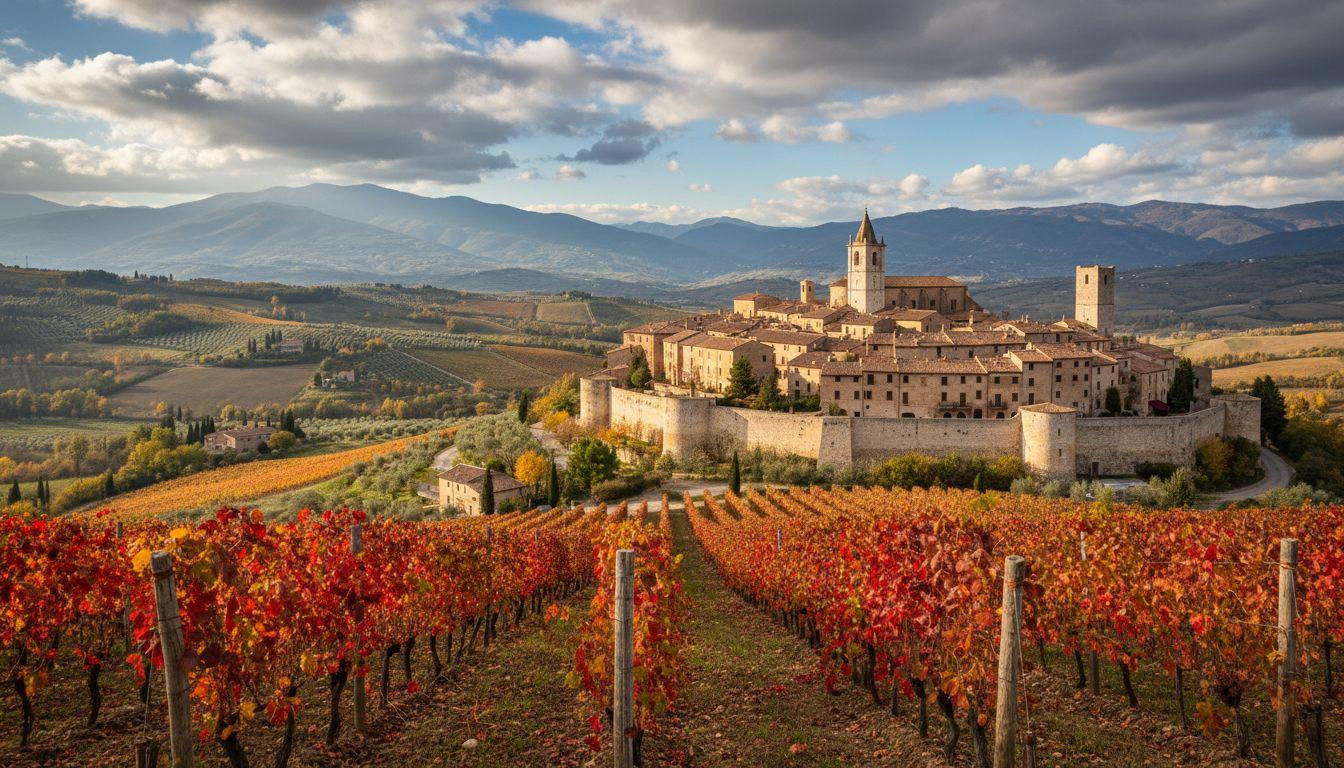
Tuscany’s Chianti hotels charge $275 per night and pour wine you can buy in Nebraska. Forty miles south, Montefalco’s medieval stone balcony above Umbrian vineyards delivers Sagrantino wine that grows nowhere else on Earth, Renaissance frescoes rivaling Florence’s Uffizi, and autumn harvest magic where grape leaves turn blood-red against emerald valleys. All for $150 per night with zero tour-bus crowds.
This hilltop town of 5,800 residents sits at 1,549 feet, earning its nickname “the Balcony of Umbria” through geography rather than marketing. Walk the ancient walls and 360-degree views unfold over vine-carpeted valleys and silver-green olive groves. The stone glows honey-colored in morning light. Cobblestone streets wind upward in medieval circles that haven’t changed layout since 1335.
10 experiences that make Montefalco worth the drive from Perugia
The town sits 28 miles southeast of Perugia San Francesco d’Assisi Airport, a 45-minute drive through rolling countryside. Rome lies 2 hours south, Florence 2.5 hours north. No train reaches Montefalco directly. Rent a car for $45 per day and park in centro storico lots for $1.50 per hour.
The panoramic viewpoint locals protect
Ancient walls circle the town’s perimeter, offering the single most profound visual experience. The whole of Umbria spreads below: Spoleto valley to the south, Assisi hills to the north. Sunset arrives around 6:30pm in October, 5pm in November. Tour buses crowd the viewpoint 11am to 2pm. Visit at dawn or after 6pm for solitude.
Walking the 800-meter circuit
Access the walls through Porta Sant’Agostino. The circuit takes 20 minutes at a slow pace. Morning sun illuminates the eastern valleys first, creating sharp contrasts between light and shadow. Bring a camera. Every angle looks like a postcard because the elevation creates natural composition.
Why the “balcony” name matters
At 1,549 feet above sea level, Montefalco functions as an actual balcony overlooking the Clitunno valley. This isn’t promotional language. The town’s position creates literal viewing function. You see weather approaching from miles away, watch fog lift from vineyards at 8am, observe harvest activity in surrounding fields.
Paolo Bea winery: 500 years of family Sagrantino
The Bea family has produced wine here since 1472. That’s 500 years of continuous operation in the same location, predating most Italian wine regions’ formal recognition. Book private tours 2 months ahead for autumn visits. Groups max at 6 people. Cost runs $45 per person for 90 minutes.
Barrel-filled aging cellars descend to controlled depths where temperature holds steady at 55-61°F year-round. The oldest barrels contain wines aging 20-plus years. During September through November harvest, fermentation aromas drift through the property. Locals describe the smell as earthy and yeast-rich, distinct from the cleaner scents of modern production facilities.
Benozzo Gozzoli’s frescoes without Uffizi crowds
The Church of San Francesco, built 1335-1338, houses a fresco cycle painted by Benozzo Gozzoli between 1450 and 1452. The work covers 200-plus square meters in the apse, depicting the life of St. Francis. Entry costs $6. Average daily visitors number 50-100, compared to the Uffizi’s 10,000-plus.
Natural light hits the frescoes best between 10am and 2pm. The church’s acoustics create unusual quiet. Footsteps echo softly on stone floors. A 45-minute visit feels unhurried. This Tuscan town carves medieval homes from the golden cliff it sits on, but Montefalco’s art collection rivals anything in Tuscany’s better-known museums.
Autumn harvest: when grape leaves turn red
Sagrantino grape leaves transform during weeks 2-4 of October. The color shift creates dramatic contrast: blood-red foliage against green hills. Temperature drops from August’s 77°F to September’s 64-72°F range. Fermentation peaks mid-October with strong aromas drifting from wineries.
Harvest activities you can observe
Vineyard walks become accessible during harvest season. Photography works best during golden hour, 4-6pm, when low-angle light intensifies the red-green contrast. The Sagra del Sagrantino festival runs late September with 70% local attendance. Harvest workers become visible in surrounding fields, moving methodically through vine rows.
Why autumn beats summer
August brings 500 daily visitors. February sees 50. October balances ideal weather with authentic wine production activity and moderate crowds. This Provence plateau blooms purple in mid-July when Valensole fields turn brown, demonstrating how seasonal timing transforms wine country experiences.
Arnaldo Caprai: modern Sagrantino at boutique scale
This 100-plus hectare operation won Gambero Rosso Tre Bicchieri awards in 2023, 2024, and 2025 for Sagrantino quality. The 5-wine tasting with lunch package costs $90 per person, half what comparable Chianti experiences charge. Duration runs 2-3 hours including vineyard views and local menu featuring pasta and meats.
The property maintains boutique character despite size. Tasting rooms overlook ordered vine rows. Staff explain Sagrantino’s geographic exclusivity: the grape grows nowhere else on Earth. This creates genuine rarity rather than marketing scarcity.
Medieval cobblestone maze and wine bars
The town’s circular medieval layout preserves its original 14th-century structure. Honey-stone buildings line narrow alleys that wind upward following the hilltop’s natural contours. Walk the 1.5-kilometer circuit during quietest hours: 8-10am or after 6pm. Shops close 12-3pm for siesta.
Five to seven enotecas occupy corners and alcoves throughout the centro storico. Tables spill onto cobblestones. Doorways show geraniums and bougainvillea in season. One turn reveals artisan ceramics, another textiles. The experience feels like stumbling upon authentic local life without guidance. This Provence village keeps a 900-year hexagonal tower for 550 residents, offering similar medieval atmosphere at comparable scale.
Umbrian farm-to-table without tourist markup
Enoteca L’Alchimista and Locanda del Teatro serve 3-course meals with Sagrantino pairings for $40-50 per person. That’s 30-40% less than Greve in Chianti charges for equivalent quality. Locals outnumber tourists 60-40 at Locanda’s signature strangozzi pasta.
Truffle-infused dishes appear on autumn menus. Ingredients source from surrounding farms. Wine lists run extensive, emphasizing local Sagrantino producers. Kitchen visibility varies by restaurant, but most maintain open sight lines showing preparation.
Agriturismo Camiano Piccolo: half Chianti’s cost
This pool-equipped farm stay charges $160-185 per night for panoramic double rooms in 2026, including $2.10 city tax. Comparable Chianti properties run $250-plus. Garden views extend over vineyards. Free parking eliminates the hassle common in Tuscan hill towns.
The property functions as working farm and accommodation. Breakfast includes local products. The setting provides quiet removed from centro storico activity while maintaining 10-minute driving access.
Spring vineyard bloom: green renewal
March through May brings visual transformation as hills turn green and vineyards begin blooming. Temperature ranges 50-64°F, comfortable for walking without summer heat. Photography captures different aesthetic than autumn: fresh growth rather than harvest drama.
Visitor numbers run 30% lower than summer. Tourism infrastructure operates full services. Early-season tastings preview upcoming vintages. The experience feels less crowded while maintaining complete access to wineries and restaurants.
Sagrantino Wine Route: five-municipality circuit
The formal wine route connects Montefalco with Bevagna (population 4,700, Roman arches), Giano dell’Umbria (population 3,800, hilltop churches), Gualdo Cattaneo, and Castel Ritaldi. Drives between towns take 20-30 minutes on SP421’s scenic segments. Twenty-plus wineries participate. App signage updated in 2025.
Car rental becomes essential for exploring the circuit. The route offers diversity in producer styles and town architecture. Bevagna shows Roman influences, Giano emphasizes medieval churches. 5 Greek islands feel like Santorini but cost $70 a night, demonstrating similar value propositions in Mediterranean destinations.
Your questions about Montefalco answered
When should I book for autumn 2026 harvest?
Reserve Paolo Bea tours 2-3 months ahead for September-November visits. Arnaldo Caprai requires 1-month lead time. Agriturismo Camiano Piccolo fills early for October. February bookings secure best availability for peak autumn season when grape leaves turn red and fermentation aromas intensify.
How does Montefalco compare to Tuscany?
Costs run 40-50% below Tuscany equivalents. Montefalco hotel rooms average $150-185 versus Chianti’s $250-plus. Crowds measure significantly lower: 50 daily visitors in February versus August’s 500, compared to thousands in San Gimignano or Montepulciano. Sagrantino wine exists only here, creating genuine exclusivity.
What’s the ideal stay duration?
Two to three days covers comprehensive experience. Day 1: Paolo Bea and Arnaldo Caprai wineries. Day 2: Centro storico walk, San Francesco frescoes, panoramic viewpoint. Day 3: Sagrantino Wine Route extension to Bevagna and Giano dell’Umbria. Base at agriturismo for easy drives between properties.
The moment you walk the ancient walls at sunset, watching golden light pour over 360 degrees of vineyard-covered hills while fermentation aromas drift from Paolo Bea’s 500-year cellars below, you understand why visitors return every season and daydream about the stone house with shutters on Via Ringhiera Umbra.