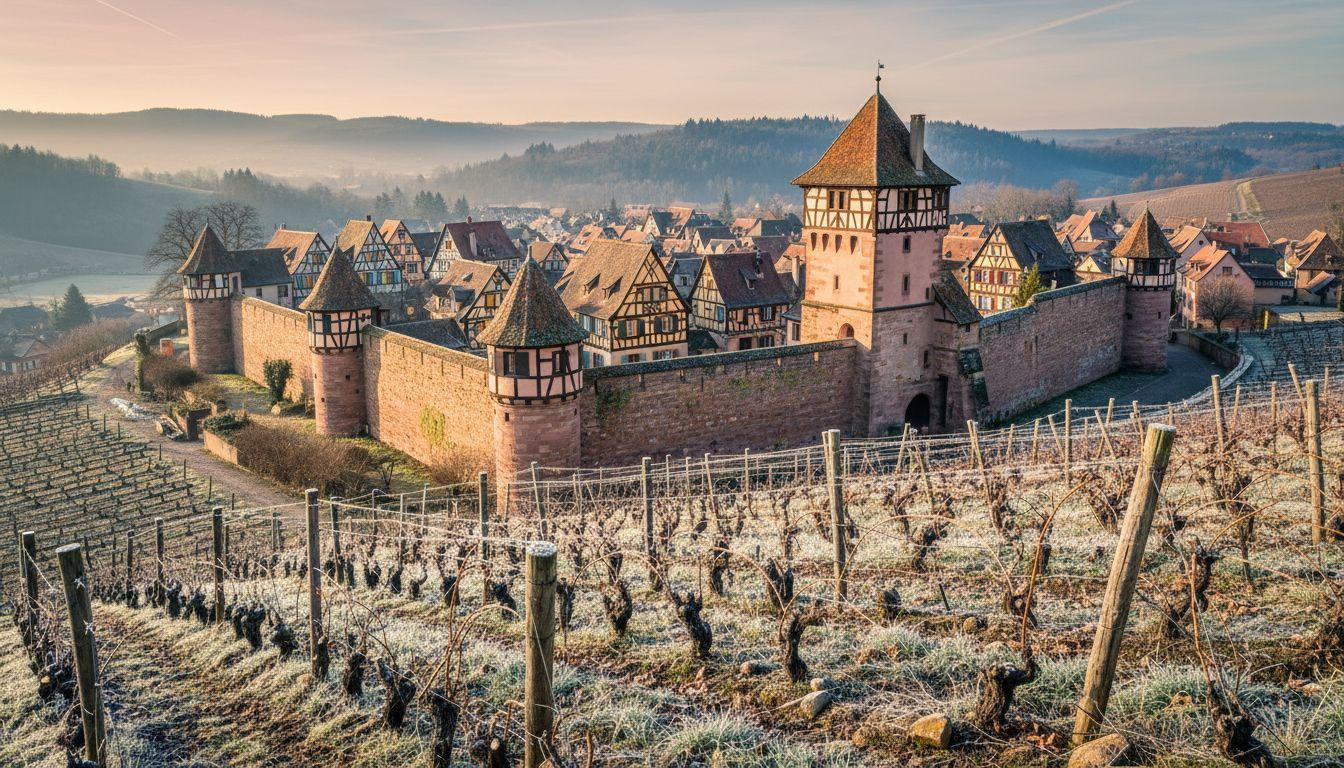
Frost settles on vineyard rows at dawn in February 2026. The Dolder Tower rises 82 feet above pink sandstone ramparts, silhouetted against pale sky. Riquewihr stays quiet until 10am, when day-trippers arrive from Colmar, 7 miles west. Population 1,200. Medieval fortifications built starting 1291. Half-timbered houses stacked inside double walls, their wooden beams and flower balconies unchanged since the 16th century. This is the Alsace wine village that survived the Thirty Years’ War, escaped WWII bombs, and still feels like prosperity frozen in time. Twenty minutes by car from Colmar. A different century of pace.
Ramparts rising from Riesling slopes
Riquewihr’s fortifications wrap a compact core roughly 980 feet by 720 feet. The Dolder Tower guards the western entrance, built 1291 from pink Vosges sandstone. The Thieves’ Tower stands 59 feet tall at the eastern edge, pentagonal shape, former prison with torture chamber now open as museum. These ramparts sit at 920 feet elevation amid Grand Cru vineyard slopes. Golden stone against green vine rows. Vosges foothills backdrop.
February light adds drama. Low winter sun at 7:50am. Frost dusts the vines until mid-morning. Rampart shadows stretch across cobblestones. Walk the outer circuit for angles tour groups miss. Ramparts from below. Half-timbered gables stacked against walls. Vineyard workers pruning in silence. No marked path. Just follow the base of the fortifications. Free. Unhurried.
Half-timbered wealth still standing
16th-century prosperity preserved
Rue Charles de Gaulle runs the length of the village. Half-timbered houses line both sides. Sandstone bases. Wooden beams. Oriel windows jutting over the street. Flower balconies empty in winter but geraniums return in May. Inner courtyards hide wells and fountains. Dominant colors: ochre facades, pink stone, white plaster, red-tiled roofs. This isn’t reconstruction. The Counts of Württemberg ruled 1324-1796, and wine wealth built these homes. The Thirty Years’ War ravaged the region but Riquewihr survived. WWII somehow spared it.
Les Plus Beaux Villages de France designation protects authenticity. Walk side alleys after 4pm when day-trippers leave. Rue des Juifs. Rue du Cerf. Privileged silence. Carved stone lintels from 1580. Winemaker signs above doorways. Courtyard fountains you hear before you see. This Tuscan town carves medieval homes from the golden cliff it sits on, but Riquewihr’s half-timbered charm feels warmer, more lived-in.
Local life beneath tourist veneer
Locals make wine in cellars beneath these half-timbered homes. Boulangeries sell kougelhopf to residents, not just visitors. Population 1,200 means functional village, not theme park. Contrast: Rothenburg stages medieval nights for 1 million annual visitors. Riquewihr just lives. Woodsmoke rises from chimneys on cold mornings. Church bells mark hours. Dogs walk cobblestones with their owners at dusk.
Winter quiet and wine-focused calm
February 2026 timing advantages
High season runs June-August and late November-early January for Christmas markets. February brings daily temperatures 36-43°F. Possible light snow on Vosges peaks. Minimal tourists. Why this works: photograph Dolder Tower unobstructed. Wine cellars open for tastings with unhurried conversations. Frost on ramparts at sunrise. Rooms available for $110-165 versus summer’s $200-plus. Downside: sunset around 5:45pm. Some restaurants closed Monday-Tuesday. Upside: the village becomes yours after 3pm when few visitors linger.
This Provence plateau blooms purple in mid-July when Valensole fields turn brown, but Riquewihr’s winter appeal lies in what’s absent, not what’s blooming. Quiet streets. Empty cafes. Time to notice details.
Riesling trails and cellar tastings
Grand Cru vineyard slopes surround the village. Free self-guided wine trails start from the tourist office. Maps available. Schoenenbourg and Sporen vineyards within walking distance. One to two-hour loops. Dolder Tower views from vine rows. Local producers offer tastings in rampart cellars: Riesling, Gewürztraminer, Pinot Gris. Expect $11-22 per tasting. Harvest season runs September-October with golden foliage, but winter pruning walks offer solitude. You taste where grapes grow, not in urban wine bars.
Quiet evenings inside medieval walls
Day-trippers from Colmar arrive 10am-4pm. Stay overnight to own the village at dawn and dusk. Chambres d’hôtes inside ramparts run $110-200. Morning ritual: walk the perimeter at 7am before Dolder opens at 9am. Woodsmoke rises from chimneys. Vineyard frost glows pink in early light. Evening quiet settles by 5pm. Rue Charles de Gaulle empties. Locals walk dogs. Half-timbered facades glow under streetlamps.
No nightlife exists here. That’s the point. Choucroute at family auberges costs $22-38. Tarte flambée $11-16. Early bed. Morning light on ramparts. Time moves differently inside walls built in 1291. This Provence village keeps a 900-year hexagonal tower for 550 residents, and Riquewihr’s towers serve the same purpose: marking time that refuses to rush.
Your questions about Riquewihr answered
How do I get there without a car?
From Strasbourg Airport (43 miles): TER train to Colmar, 30 minutes, $11-16. Then bus line 109 to Riquewihr, 20 minutes, $2. Buses run 4-6 times daily in winter. From Basel-Mulhouse Airport (37 miles): train to Colmar or rent a car for 20-minute drive via A35. Parking outside ramparts is free at the entrance lot. Cars banned inside walls. Walk only. Five to ten-minute walk from parking to Dolder Tower.
What’s the best time besides winter?
Late fall, September-October, brings harvest colors and wine festivals. Golden vineyards. Fewer crowds than summer. Christmas markets run late November-early January with fairy-tale lights but crowded main street. Avoid June-August: tour buses, $220-plus hotels, heat. Spring, April-May, offers blooming vines but unpredictable rain. February 2026 delivers authentic village pace without performance.
How does it compare to Colmar and Eguisheim?
Colmar (7 miles away): larger town, canals, year-round crowds, $165-275 hotels, urban wine culture. Eguisheim (6 miles): circular village layout, flatter terrain, similar half-timbered charm, more touristy in summer. Riquewihr: ramparts add drama, vineyard setting, quieter off-peak, authentic wine-producer vibe. This Poconos town keeps 1,300 residents and zero chain stores in Victorian snow, and Riquewihr maintains the same unhurried authenticity. Do all three if time allows. Riquewihr for overnight quiet. Colmar for amenities. Eguisheim for circular walk.
The ferry back to reality leaves when you choose. Most visitors make it with time to spare. I almost stayed twice, both times because someone at the wine cellar started talking about terroir and forgot to stop. Frost melts by 9am. The village wakes slowly. You should too.