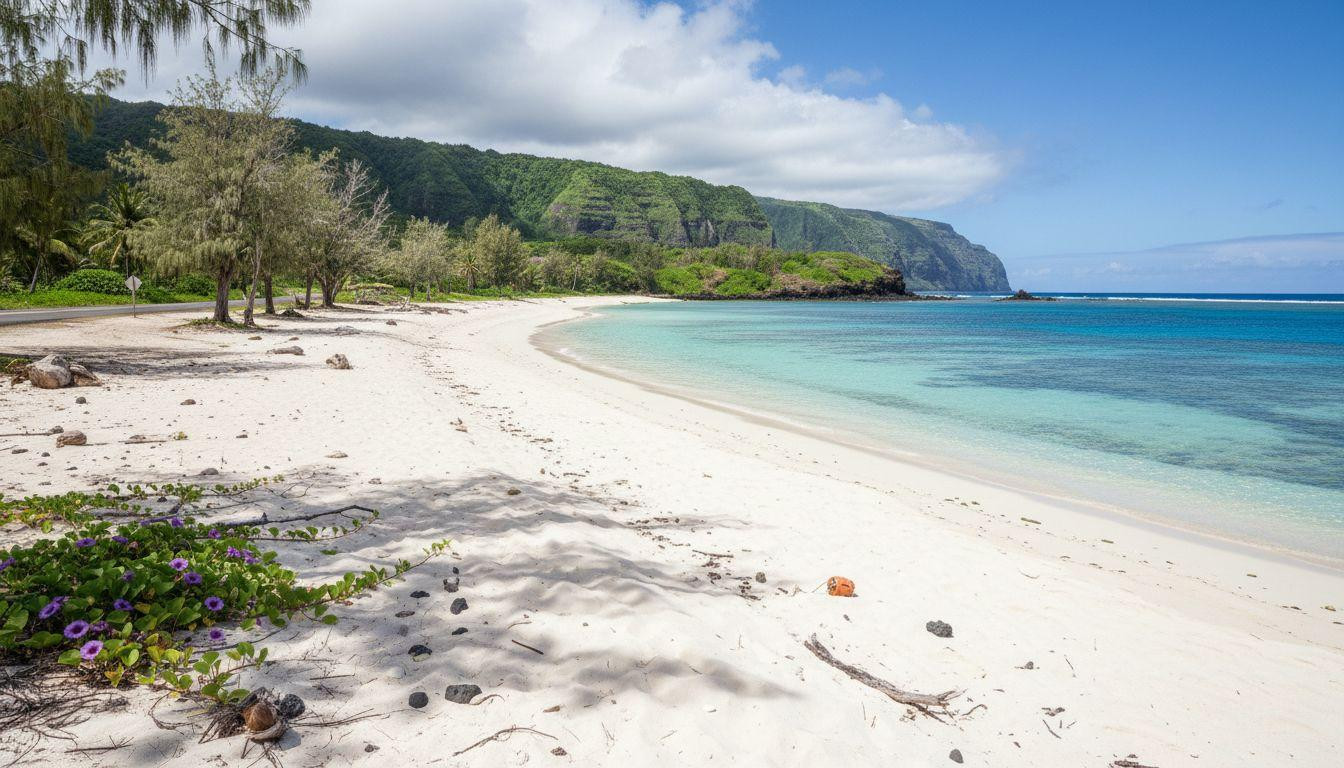
Highway 450 narrows past mile 21 on Molokai’s east end. The road curves along cliffs, then drops to reveal a white sand crescent tucked against turquoise water. No sign marks it. Just a dirt pullout where the pavement meets the beach.
This is Sandy Beach. Population zero. Facilities zero. Summer calm turns the protected bay into glass.
The roadside crescent nobody developed
Sandy Beach sits between mile markers 21 and 22, right before the climb to Halawa Valley. The crescent spans maybe 100 yards, white sand against green cliffs. Park on the shoulder. Walk 20 feet to the water.
Molokai sees roughly 50,000 visitors annually. Maui gets 3 million. The math explains the emptiness. Most tourists fly to Honolulu, drive to Waikiki, pay $30 to park at Kaanapali. Here the beach costs nothing and asks for nothing back.
The offshore reef breaks winter swells before they reach shore. November through April brings dangerous south swells. May through October the bay goes calm. Local tourism boards confirm summer as the safe swimming window.
What summer calm reveals
Reef-protected shallows
The crescent shape creates natural protection. Winter waves crash on the outer reef, sending spray 15 feet high. Summer mornings the water barely moves. Trade winds pick up around noon, ruffling the surface but leaving the shallows calm.
Water temperature holds at 78-82°F from May through October. The rock-free entrance makes wading easy. Visibility reaches 30 feet on clear days. Parrotfish and surgeonfish drift over coral heads in 6 feet of water.
White sand, zero development
The sand stays pure white, no coral fragments mixed in. Ironwood trees grow sparse at the road edge. No palms, no pavilions, no lifeguard towers. Just open sky and the green wall of Halawa Valley rising a mile east.
Molokai resisted resort development that transformed other Hawaiian islands. The east end lacks hotels, restaurants, rental shops. A resident who moved here from Honolulu in 2019 explains the local attitude: preserve what remains by keeping it uncommercialized.
The east end experience
Summer swimming and snorkeling
Bring your own gear. The nearest rental shop sits 20 miles west in Kaunakakai, charging around $20 per day for mask and fins. Morning offers the calmest conditions before afternoon trade winds arrive.
The reef extends 50 yards offshore. Snorkelers find healthy coral and tropical fish in the protected zone. Recent visitor surveys from 2025 show satisfaction ratings above 90% for water clarity and marine life diversity.
No restrooms exist on-site. The nearest facilities sit 2 miles back at Kakahaia Beach Park. Cell reception runs spotty, especially on T-Mobile. AT&T and Verizon provide partial coverage.
Halawa Valley proximity
The road continues 5 miles past Sandy Beach to Halawa Valley, where Polynesian settlers cultivated taro terraces 1,400 years ago. Guided hikes to the valley’s twin waterfalls cost around $120 per person and run 2-3 hours.
The valley represents one of Hawaii’s oldest continuously inhabited settlements. Ancient stone walls still mark taro patches. A local guide whose family has farmed here for generations leads cultural tours explaining traditional irrigation systems.
Most visitors combine Sandy Beach with Halawa in one day. Swim in the morning calm, drive to the valley for an afternoon hike. The 10-minute drive between them makes the pairing natural.
Why this beach stays empty
Molokai’s anti-tourism stance keeps development minimal. No chain hotels exist on the island. The east end maintains its isolation through lack of infrastructure rather than active restriction.
Highway 450 narrows to one lane in sections. The 20-mile drive from Kaunakakai takes 45 minutes. Rental cars cost around $80 per day, and availability stays limited. Flights from Honolulu to Molokai run multiple times daily but seat fewer than 20 passengers per plane.
The island’s fishing culture dominates the east end. Locals respect traditional kapu practices, maintaining quiet reverence for coastal areas. Tourism boards emphasize this cultural preservation as Molokai’s defining characteristic.
Your questions about Sandy Beach answered
When is it safest to swim?
May through October provides the calmest conditions. South swells from November through April create dangerous currents and high surf. Official tourism data from 2025 shows zero swimming incidents during summer months but multiple rescues during winter swells.
How do you get there?
Fly to Molokai Airport from Honolulu (20-30 minutes, $100-200 one-way). Rent a car at the airport. Drive east on Highway 450 for 20 miles past Kaunakakai. Look for the beach between mile markers 21 and 22. Total travel time from Honolulu: 2 hours.
What makes it different from Oahu beaches?
Sandy Beach sees maybe one visitor per day versus 50 people per 100 yards at Waikiki or Lanikai. Parking costs nothing versus $30 daily at resort beaches. The complete absence of facilities creates natural crowd control that Oahu’s developed shores lack.
The trade winds die down around 4pm. The crescent fills with golden light. Water laps the white sand in rhythms unchanged since before anyone thought to name this place.