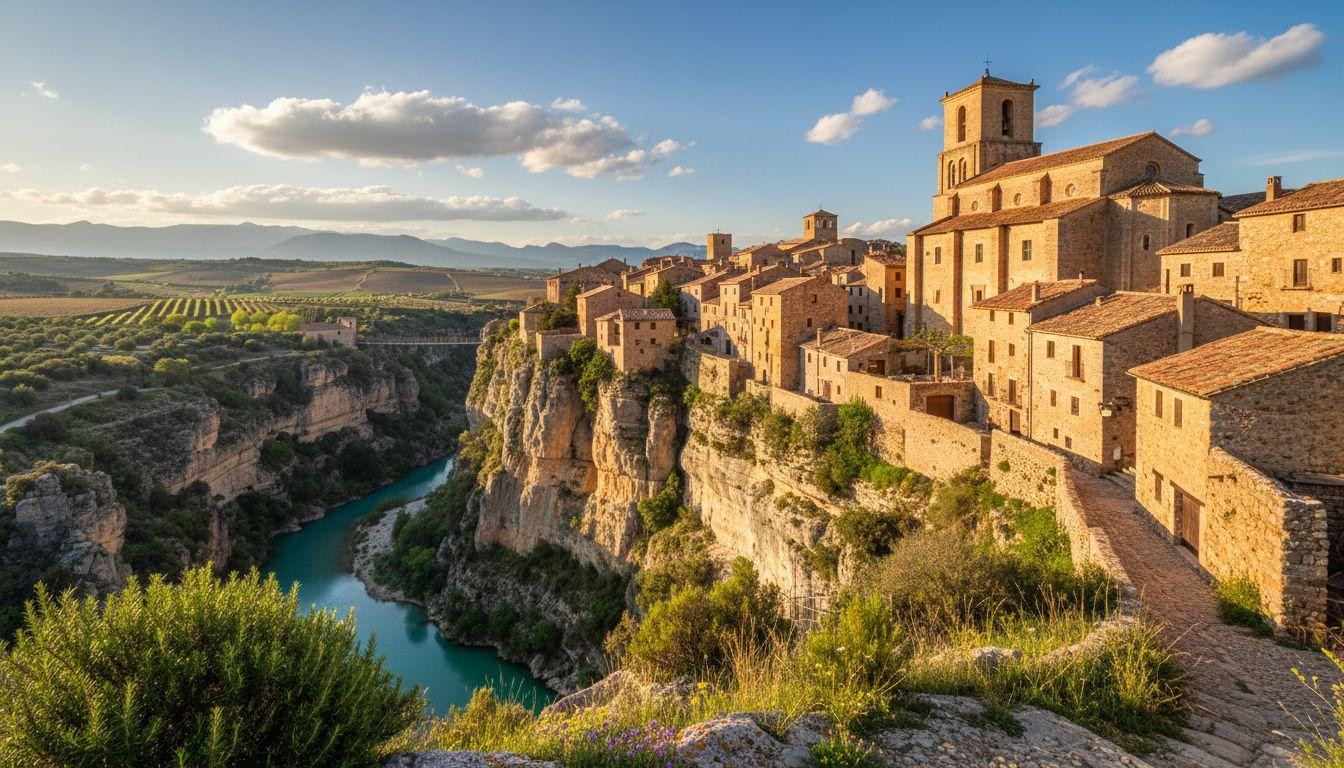
Ronda’s Puente Nuevo bridge draws 500 tourists at once for the same gorge photo. Two hours east, Alquézar’s collegiate church sits above the Vero River canyon where walkers descend alone past 5,000-year-old cave paintings. Same golden stone villages. Same dramatic drops. Half the cost. Zero queues.
Ronda pulls over 450,000 visitors annually. Hotels run $165-330 nightly. The old town feels like a stage set by noon. Alquézar gets maybe 100,000, most passing through Sierra de Guara Natural Park without stopping. The 300 residents still run the bakery, the stone-walled bars, the morning market.
Why Ronda struggles with its own success
The Puente Nuevo bottleneck hits hardest between 11am and 3pm. Tour buses unload at the top. Everyone wants the same cliffside shot. Parking costs $17-27 daily in paid lots a half-mile from the bridge.
Restaurant waits stretch to 45 minutes for lunch. Menu del día prices that used to hover around $15 now push $35-50 in the old quarter. Boutique hotels charge $440+ for rooms with gorge views. The white-washed streets photograph beautifully. They just don’t feel lived-in anymore.
Andalucía saw 13.8 million international arrivals through November 2025, up 7% from 2024. Ronda absorbs a disproportionate share. The town’s infrastructure wasn’t built for this volume. Neither was its charm.
Meet Alquézar where medieval Spain still breathes
The clifftop setting
Alquézar perches at 2,165 feet on a limestone ridge. The Collegiate Church of Santa Maria la Mayor crowns the village, built atop 9th-century Muslim fortress ruins. Golden-red sandstone facades glow at sunrise. The Vero River cuts 985 feet below, turquoise against white rock.
Griffon vultures circle overhead. The canyon walls echo with their calls. No entry fees to walk the village. Parking sits free at the edge of town, a 5-minute walk to the church square.
The price difference that matters
Hostales run $55-88 nightly. Mid-range hotels like Villa de Alquézar charge $110-165 for rooms with canyon views. Boutique options top out around $220. Compare that to Ronda’s $165 baseline.
Meals cost $17-27 at village restaurants. Somontano wine, produced 15 miles north, goes for $5.50 per glass. The collegiate church charges $5.50 adults, $3.30 reduced. Canyoning trips through Gorgas Negras or Peonera run $77-88 with guides. Wine tours in the Somontano region cost $44 half-day.
Total savings hit 40-50% for equivalent experiences. The difference funds an extra day, better meals, or side trips to nearby medieval villages like Colungo.
What you actually do here
Walk canyons instead of viewpoints
The Ruta de las Pasarelas descends 0.6 miles into Vero Canyon via wooden boardwalks. Free access. The trail hugs cliff faces, crosses suspension bridges, ends at river level where turquoise pools collect.
Neolithic cave art sites date to 5000 BC. Accessible via exposed metal ladders bolted to canyon walls. UNESCO tentative list status. The climbs require nerve but not technical skill. February weather stays mild enough, 59-68°F highs.
Canyoning routes like Mascún offer rappels, swims, scrambles through slot gorges. Ronda gives you the Puente Nuevo overlook. Alquézar gives you the canyon itself. The distinction matters when you’re standing in cold water looking up at limestone spires.
Somontano wine country without tourist markup
The Somontano DO region produces reds and whites 12 miles north. Village bars pour local bottles at $5.50 per glass. Casa Pardina serves vermouth on tap, a regional tradition Ronda’s tourist bars abandoned.
Day wine tours visit family bodegas. $44-55 buys tastings, cellar walks, lunch. Ronda area tours charge $88-132 for similar experiences. The Somontano landscape rolls with vineyards and almond groves. It feels like Tuscany’s quieter cousin, minus the crowds.
Medieval village life that still functions
Stone callizos wind between houses. Some passages narrow to 3 feet. The castle’s Death Edge Corridor runs along a sheer drop, no railings. Locals use these streets daily, not just for photos.
Weekly markets sell produce, cheese, pottery from nearby Naval. The rhythm feels unhurried. Compare this to Ronda’s tourist-dependent economy where authentic moments hide behind staged experiences.
Getting there and staying
Alquézar sits 1.5 hours from Zaragoza, 75 miles northeast. Barcelona lies 3.5 hours west. ALSA buses run twice daily from Huesca, 1 hour, $11-17. Self-drive works best. Roads wind through Sierra de Guara foothills.
Hotel Villa de Alquézar offers mid-range comfort at $110-165. Hostales provide clean basics for $55-88. Book February through May for shoulder-season calm. September through November works equally well. Summer heat pushes 86-95°F. Winter rarely drops below freezing.
Access matches Ronda’s ease from major cities. Parking beats it significantly. The village absorbs visitors without strain. Canyon microclimates keep temperatures 10-15 degrees cooler than surrounding plateaus.
Your questions about Alquézar answered
When should I visit to avoid crowds?
February through May offers mild weather and minimal visitors. September through November provides similar conditions. Peak season runs July-August when Spanish families vacation. Even then, crowds stay manageable compared to Ronda’s year-round surge. Weekdays beat weekends consistently.
Is Alquézar suitable for families with young children?
The village itself works well for all ages. Ruta de las Pasarelas handles strollers on paved sections, though canyon descents require carriers. Cave art sites demand ladder climbs, not suitable under age 8. Canyoning trips set minimum ages around 12. Swimming spots along the Vero provide safe alternatives.
How does Alquézar compare culturally to Ronda?
Both preserve medieval architecture and dramatic settings. Ronda leans heavily on bullfighting heritage and romantic tourism. Alquézar maintains working village traditions, outdoor sports culture, and wine production ties. Ronda feels curated for visitors. Alquézar feels like it tolerates them politely while continuing its own routines.
Sunset from the collegiate church terrace paints golden stone over blue canyon. The village empties by 7pm. Locals emerge for evening paseo. This version of medieval Spain costs $55 for a bed, $22 for dinner, nothing for the view. Ronda charges triple and delivers half the quiet.