“`html
Ávila’s medieval walls draw half a million visitors annually who pay $14 to walk ramparts booked weeks ahead. Hotels charge $140-$350 per night. Tour buses from Madrid arrive by 10am, filling cobbled streets until dusk. Ninety-three kilometers east, Marvão sits at 2,820 feet on a granite ridge where 350 residents guard whitewashed lanes that stay empty at dawn. Castle entry costs $3. No reservations required.
Why Ávila fills up and drains wallets
Ávila earned UNESCO World Heritage status in 1985 for its intact 12th-century walls. The designation brought crowds. Spain recorded 97 million international visitors in 2025, with inland regions like Castile and León seeing 60% growth since 2019. October 2024 alone logged 110,000 tourists in the province.
Hotels near Ávila’s walls charge $140-$300 nightly in shoulder season. Restaurants inside the old town run $25-$40 per entrée. Timed entry slots for wall walks sell out by midday in spring and fall. Day-trippers from Madrid (90-minute drive) pack the main plaza by noon, leaving by 6pm.
The crowds create their own problem. You wait for photos. You book ahead for mediocre meals. You share rampart views with 200 others. The medieval atmosphere dissolves in shuttle bus exhaust.
Meet Marvão at the Portuguese border
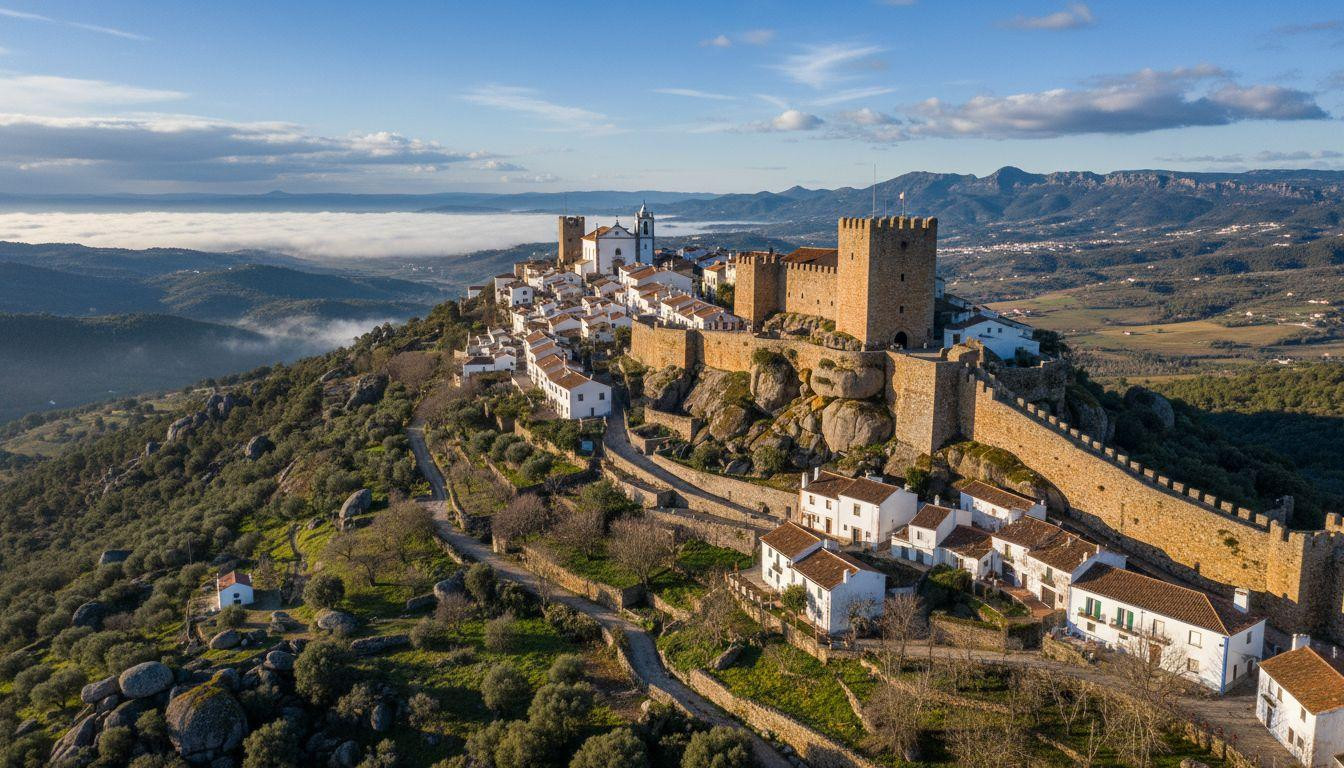
Marvão rises from Serra de São Mamede Nature Park, a 266-square-mile reserve of cork oak and wild olive. The village clings to a ridge visible from Spain, 3 miles east. Granite boulders merge with castle walls built by Moors in 876 AD, reinforced by Portuguese kings through the 18th century.
Whitewashed walls and feldspar glow
Houses stack against fortifications, their lime-washed facades reflecting golden light at sunset when quartz and feldspar in the granite catch the sun. Wrought-iron balconies hold geraniums. Cobbled lanes wind past arched doorways, some dating to the 14th century. The castle keep stands at the highest point, arrow slits facing Spain.
Walk the ramparts at 8am. Fog lifts from valleys below, revealing almond groves and the ruins of Roman Ammaia 6 miles downhill. No crowds. No entry queues. Just wind and the occasional kestrel cry.
Moorish roots and crusader layers
Ibn Marwan, a Moorish rebel, founded the fortress in the 9th century. Christians took it in 1166 under Afonso I. King Dinis I added the keep and outer walls in the late 1200s. The village survived Spanish attacks in 1641, 1648, and 1704 during border wars. Lightning struck the southern barbican in 1997. Repairs continue.
The Municipal Museum displays Paleolithic tools, Roman coins from Ammaia, and medieval pottery. Entry costs $2. Open Tuesday through Sunday, 9am to 5pm. No guided tours required. Plaques explain the layers in Portuguese and English.
What you actually experience in winter 2026
February brings mild days (45-55°F) and cool nights. Rain falls occasionally but clears fast. Sunrise happens around 7:30am. The castle opens at 9am. Most visitors arrive after 11am, if they come at all. Weekdays see maybe 20 people total wandering the village.
Walking ramparts and empty streets
The full castle perimeter takes 30 minutes at a slow pace. Stone steps lead to turrets with 360-degree views. Spain’s hills form a jagged line to the east. The village spreads below, rooftops tight against the walls. You’ll pass maybe three other people.
Cobbled lanes connect small plazas. The Igreja do Espírito Santo sits near the castle entrance, its baroque interior quiet except for the occasional local lighting a candle. A tiny market operates Saturday mornings near the main gate, selling cheese, olives, and cork products. No tour groups. No souvenir shops blasting music.
Porco preto and Alentejo wine
Black pork (porco preto) dominates menus. Try it at family-run taverns like those near the castle, where a plate of grilled pork with migas (fried breadcrumbs) and greens costs $15-$20. Açorda, a bread soup with garlic and cilantro, runs $12. Local Alentejo DOC wines start at $18 per bottle.
The village bakery near the main gate opens at 7am. Pastéis de nata cost $1.50 each. Coffee is $1. Sit outside and watch the valley fog burn off. Similar experiences exist at this Tuscan hilltop, though Marvão stays quieter.
The quiet that makes you stay longer
Most visitors plan one night. Many add a second after arriving. The pace slows you down. Evening light turns the granite walls amber. Locals greet you in Portuguese, switching to careful English if needed. No one rushes.
A resident who moved from Lisbon in 2019 mentioned the silence as the main draw. Nights bring stars visible from the castle courtyard. Morning fog fills valleys, leaving the village floating above clouds. You walk the same streets three times and notice new details each pass.
For similar quiet in European castle towns, Żywiec offers Habsburg architecture with fewer crowds. Marvão’s advantage is proximity to Spain for cross-border trips and lower costs than Portuguese coastal towns like Mediterranean fishing villages.
Your questions about Marvão answered
How do I get there from Lisbon?
Drive 3 hours east on A6 and N359 (rental cars run $50-$100 daily). Or take a train from Lisbon to Portalegre (4-5 hours, $30-$40), then a 30-minute taxi ($25-$35). Buses connect Portalegre to Marvão twice daily. The village has limited parking inside the walls. Arrive before 10am or park below and walk up.
When should I visit for the best experience?
Spring (March-May) brings wildflowers and almond blossoms. Fall (September-October) offers mild weather and the Al Mossassa Islamic festival honoring Ibn Marwan. Winter (November-February) sees the fewest visitors but cooler temps. Avoid July-August heat unless you prefer empty streets in exchange for 85°F days.
How does Marvão compare to other Portuguese hilltowns?
Óbidos draws larger crowds and charges higher prices ($110-$330 nightly). Monsaraz sits lower with similar whitewashed charm but more tour buses. Sortelha matches Marvão’s quiet but lacks the dramatic border views. Marvão’s altitude (2,820 feet) and fortress scale make it unique. Similar atmospheres appear in remote Norwegian villages, though climates differ.
The castle ramparts empty by 5pm. Locals close shutters. The village settles into evening quiet. You stand at the highest point in Portugal, looking east toward Spain, and understand why 350 people stay.
“`