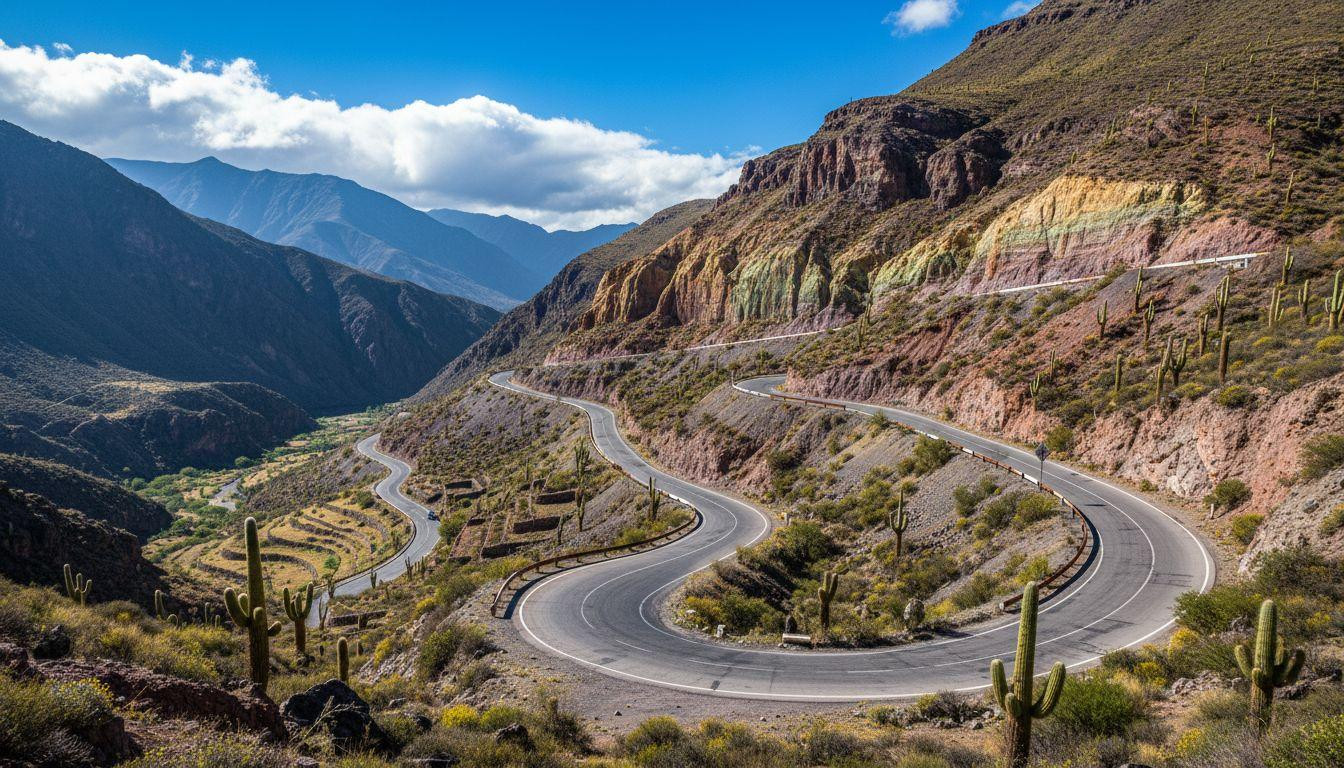
Quebrada de Humahuaca’s fourteen-color mountain pulls 400,000 visitors annually to roads where tour buses queue for photo stops at Purmamarca’s Hill of Seven Colors. Sixty miles south, Quebrada de Escoipe shifts through violets, greens, reds, and golds along Route 33’s zigzag climb to 10,984 feet. You can drive it alone. For free.
The difference isn’t subtle. Humahuaca earned UNESCO status in 2003 and became Argentina’s postcard. Escoipe stayed a working mountain pass between Salta and the Calchaquí Valleys, paved but uncrowded, dramatic but overlooked.
Why Quebrada de Humahuaca became overwhelming
UNESCO recognition transformed a 96-mile valley into a tour bus corridor. Purmamarca, population 2,000, now absorbs hundreds of thousands annually. The Hill of Seven Colors creates bottlenecks on Route 9’s narrow sections where organized tours dominate and independent drivers wait.
Prices followed attention. Meals in Purmamarca run $15-25. Accommodations in Tilcara and Humahuaca start at $100-180 per night. Day tours from Salta cost $150-200, covering 186 miles round-trip to reach viewpoints that fill by mid-morning December through February.
The valley deserves its reputation. Rainbow ridges rise above pre-Columbian ruins and colonial adobe. But the experience now includes navigating crowds at Pucará de Tilcara and timing photo stops around bus schedules.
Meet Quebrada de Escoipe: same views, zero pressure
Route 33 leaves Salta and follows Río Escoipe through green valleys that shift to mineral-streaked ridges. Violets come from manganese. Reds signal iron oxides. Greens mark copper deposits. The geology performs the same color show Humahuaca promises, but the road stays quiet.
Cuesta del Obispo’s 20-plus hairpin turns climb from 3,937 feet at Chicoana to 10,984 feet at Piedra del Molino. Each switchback offers different ridge perspectives. No entrance fees. No permits. No tour requirements. Just paved asphalt and pullouts where you stop when the light hits right.
The color show nobody photographs
Morning sun turns ridges golden. By noon, shadows deepen violets and reds. Afternoon light before 3pm cloud buildup brings out layered yellows and greens. The palette changes hourly, but you won’t wait behind tripods to see it.
El Maray Mirador sits partway up the climb. Andean condors with 10-foot wingspans ride thermals above terraced valleys. The viewpoint costs nothing and sees maybe 20 vehicles on weekdays. Similar dramatic mountain drives in Colorado or Utah charge park fees and fill parking lots by 9am.
Price comparison that matters
Self-drive from Salta to Piedra del Molino runs 35 miles one-way. Gas costs approximately $25 round-trip. Day tours including Cachi village charge $70-120 per person versus $150-200 for Humahuaca equivalents. Salta accommodations at $60-100 per night work for both destinations, but Escoipe requires no premium village stays.
The savings add up. A couple spending three days exploring pays $300-400 less choosing Escoipe over Humahuaca without sacrificing Andean scenery or cultural depth. Budget-conscious mountain destinations elsewhere follow similar patterns.
What you’ll actually experience
Leave Salta by 7am for clearest light. Chicoana, 12 miles out, offers last fuel and supplies. The road narrows past Puente del Mal Paso, an iron bridge from the 1900s spanning Río Escoipe. Locals call it the “bad step” crossing, though the structure holds steady for photo stops.
Hairpin turns start gradually, tightening as elevation climbs. Every switchback reveals new ridge colors. Weekday traffic: 10-20 vehicles total between dawn and 3pm. No infrastructure means bringing water and snacks, but it also means no souvenir stands or timed entry windows.
Best photo spots without GPS
The first major pullout after kilometer marker 20 faces violet-streaked ridges. El Maray Mirador at roughly 8,200 feet offers condor sightings and valley panoramas. Piedra del Molino at the summit provides 360-degree Andes views. No need for coordinates when every hairpin offers compositions.
Afternoon clouds typically build after 3pm above 9,800 feet. Morning drives catch ridges in full sun. High-altitude weather patterns follow similar schedules across mountain passes.
What you won’t find
Tour bus pressure. Entrance fees. Timed access. Souvenir gauntlets. The pass functions as transportation between valleys, not a ticketed attraction. Cachi village, 37 miles beyond Piedra del Molino, adds colonial adobe and artisan markets for those continuing the loop via Route 40.
Planning your drive
March through May and September through November deliver dry weather and minimal crowds. Summer (December-February) brings afternoon storms and peak Argentine holiday traffic. Winter (June-August) sees occasional snow above 9,800 feet but passable conditions most days.
Regular sedans handle paved Route 33 without issue. The climb from 3,937 feet to 10,984 feet happens gradually over 35 miles, reducing altitude sickness risk compared to abrupt ascents. No technical driving skills required, just comfort with mountain switchbacks.
Cell coverage fades past Chicoana. Download offline maps. Carry extra water for altitude. Return the same route or continue to Cachi for a loop back via Route 40 and Route 68, adding roughly 90 miles and three hours to the day.
Your questions about Quebrada de Escoipe answered
When does the pass close for weather?
Route 33 stays open year-round except during rare heavy snowfalls, typically 2-3 days per winter. Check Salta road conditions before departing June through August. March through November offers most reliable access with clearest skies.
Why do locals protect this route from tourism promotion?
Escoipe functions as daily transportation for Cachi residents and agricultural traffic. Heavy tourism would slow commerce and require infrastructure locals don’t want. The pass remains authentic because it serves practical purposes beyond scenery.
How does this compare to other Andean passes?
Paso de Jama on the Chile border sees heavy truck traffic. Ruta 40 through Cachi attracts more visitors but spreads them across 300 miles. Lesser-known alternatives consistently deliver better experiences than famous counterparts. Escoipe offers Humahuaca’s color palette with Jama’s solitude.
The ridges don’t care about UNESCO plaques. They shift through violets and golds whether 400,000 people photograph them or forty. Morning light at Piedra del Molino turns the Andes into layered color fields, empty except for condors riding thermals and the occasional sedan navigating hairpins at its own pace.